PGDM in Business Analytics: How It Is Solving India’s Big Data Crisis
Posted on 06 Jul 2026
By Dr. Vikas Gupta
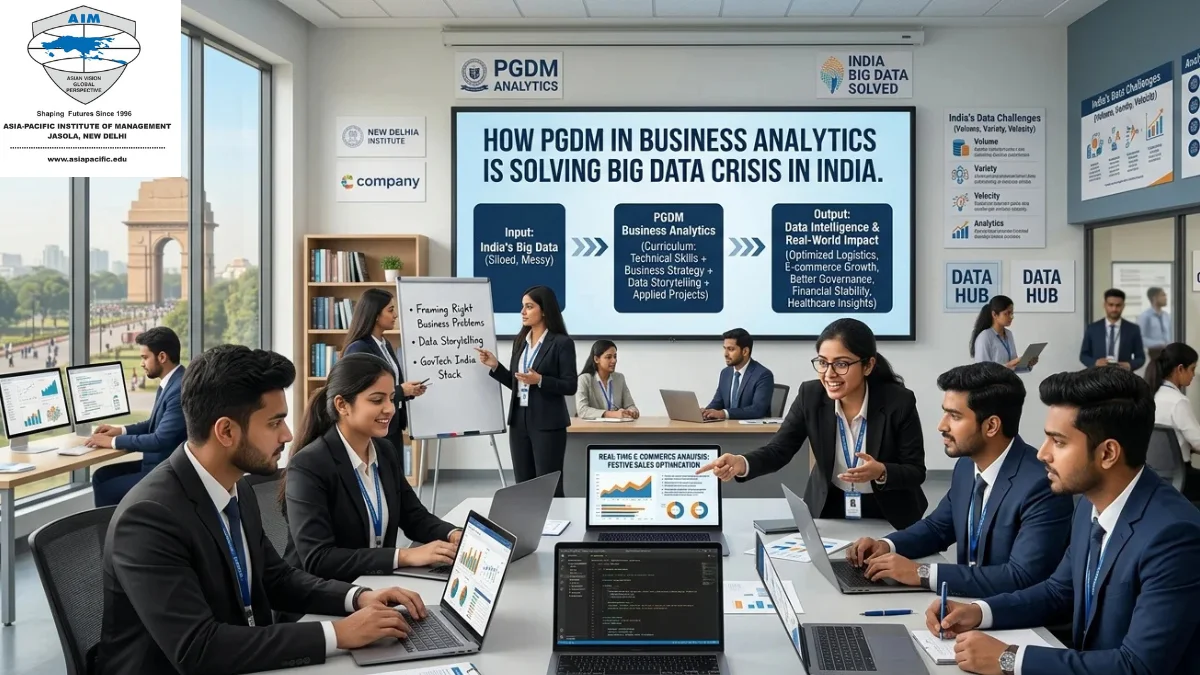
India is producing more digital data than ever before. Every online payment, app order, social media interaction, banking transaction, healthcare record, and e-commerce click creates data. However, many companies still struggle to turn this data into clear business decisions. This is where a PGDM in business analytics becomes important.
For tech graduates, the opportunity is clear. India does not only need coders. It also needs professionals who can connect data, business strategy, technology, and decision-making.
In this blog, PGDM in business analytics is used as a career-focused term. At Asia Pacific Institute of Management, the relevant official program is PGDM in Big Data Analytics, which combines management education with data science, AI, machine learning, cloud computing, and predictive analytics.
What is the Big Data Crisis in India?
The big data crisis in India is not only about having too much data. It is about not having enough skilled professionals who can clean, interpret, analyze, and use data for business decisions.
Companies collect large volumes of data from customers, supply chains, apps, payments, marketing campaigns, and operations. However, raw data has limited value unless someone can convert it into insight.
There are not enough skilled analytics professionals
Decision gap
Many businesses still struggle to convert data into strategy
Tool gap
Teams may use tools without understanding business context
Communication gap
Technical teams and business teams often speak different languages
Therefore, India needs professionals who understand both analytics and management.
PGDM Data Analytics
Solve complex corporate problems using data engineering frameworks. Learn predictive intelligence, data visualization metrics, and strategic model building.
A PGDM in business analytics matters because data is no longer limited to IT departments. Today, marketing, finance, banking, HR, operations, consulting, and supply chain teams all use analytics.
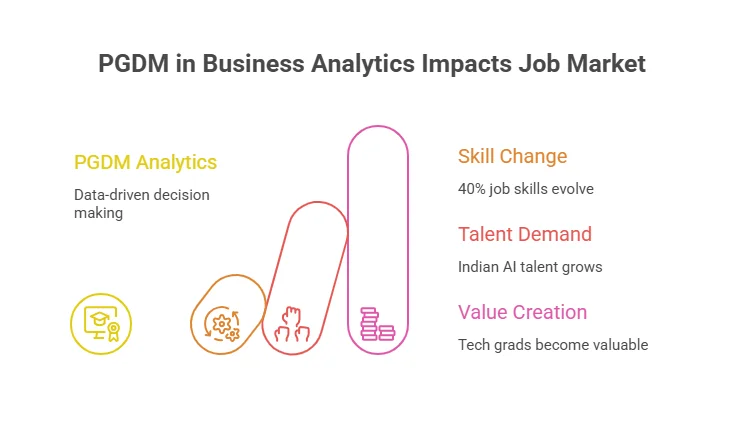
The World Economic Forum’s Future of Jobs Report 2025 states that nearly 40% of job skills are expected to change by 2030. It also identifies AI, big data, and cybersecurity as fast-growing technology skill areas.
Additionally, a Deloitte-NASSCOM report projects Indian AI talent demand to grow from around 600,000–650,000 to more than 1,250,000 during 2022–27. The report also notes that faster AI market growth may create a demand-supply gap, making upskilling important.
This means tech graduates who add management and analytics skills can become valuable in the job market.
How PGDM in Business Analytics Solves the Big Data Crisis
A PGDM course in analytics helps bridge the gap between data collection and business action.
It trains students to ask practical questions such as:
What problem is the business trying to solve?
Which data is useful?
Which data is incomplete or misleading?
What pattern does the data show?
What decision should the company take?
How should the insight be explained to managers?
This is the real value of a post graduate diploma in management with analytics focus. It does not only teach tools. It teaches students how to use data for business decisions.
PGDM in Business Analytics vs Big Data Analytics
Students often search for PGDM in business analytics, PGDM in data analytics, big data analytics courses, BDA courses, big data course, or diploma in data analytics. These terms are closely related, but they are not always the same.
Term
Meaning
Business Analytics
Using data to solve business problems
Data Analytics
Cleaning, studying, and interpreting data
Big Data Analytics
Working with large, complex, fast-moving data sets
AI Analytics
Using artificial intelligence for prediction and automation
Predictive Analytics
Forecasting future outcomes using data
Cloud Analytics
Using cloud platforms to store and analyze data
At Asia Pacific Institute of Management, the PGDM in Big Data Analytics is a two-year, AICTE-approved, full-time program divided into six trimesters. The program blends management learning with AI, machine learning, cloud computing, predictive analytics, coding, and analytics tools.
Why Tech Graduates Should Consider PGDM in Analytics
Tech graduates often have coding, mathematics, statistics, or engineering exposure. However, they may need business knowledge to move into decision-making roles.
A PGDM program helps tech graduates move from “technical execution” to “business impact.”
For example:
Tech Skill
PGDM Analytics Advantage
Coding
Helps automate analysis and work with tools
Mathematics
Supports statistics and modelling
Engineering logic
Improves structured problem-solving
Database knowledge
Helps in data handling
Technical projects
Can be converted into business case studies
Analytical thinking
Supports consulting and strategy roles
Therefore, a tech graduate can use a post graduate diploma in management PGDM to build a profile that combines analytics, strategy, communication, and leadership.
Key Skills Taught in a PGDM Analytics Pathway
A strong analytics-focused PGDM course should build both technical and managerial skills.
Important learning areas include:
Skill Area
Why It Matters
Statistics
Helps students understand patterns and probability
Python or R
Supports data cleaning and analysis
SQL
Helps retrieve and manage business data
Data Visualization
Converts complex data into clear dashboards
Machine Learning Basics
Supports prediction and classification
Cloud Computing
Helps students understand scalable analytics
Business Communication
Helps explain insights to non-technical teams
Marketing Analytics
Supports customer and campaign decisions
Financial Analytics
Supports investment, risk, and forecasting decisions
Predictive Modelling
Helps forecast demand, sales, or customer behavior
Asia Pacific Institute of Management’s PGDM Big Data Analytics program includes management foundations along with AI, machine learning, cloud computing, predictive analytics, hands-on projects, real-world case studies, and a mandatory summer internship.
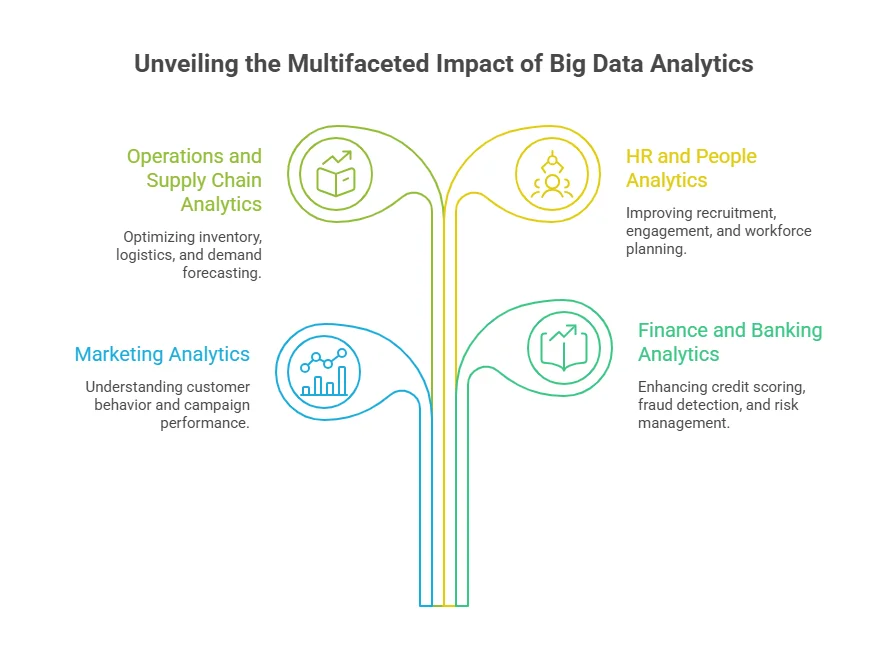
Big data analytics is useful across industries. It helps companies move from guesswork to evidence-based decision-making.
1. Marketing Analytics
Marketing teams use data to understand customer behavior, campaign performance, buying patterns, and digital engagement.
Students interested in PGDM in marketing, post graduate diploma in marketing, PGDM in digital marketing, marketing program, PGDM in marketing management, PGD in marketing management, or marketing diploma courses can benefit from analytics knowledge.
Analytics can answer:
Which campaign generated leads?
Which customer segment is more profitable?
Which product category is growing?
Which digital channel gives better ROI?
This is why marketing and analytics are increasingly connected.
2. Finance and Banking Analytics
Banks and financial service companies use analytics for credit scoring, fraud detection, customer segmentation, risk management, and investment decisions.
Students searching for diploma in finance, banking diploma courses, banking financial services, PGD in banking, post graduate diploma in financial management, PGD in banking and finance, PGDM in banking and finance, or PGDM in banking should understand the role of data in BFSI careers.
Asia Pacific Institute of Management also offers PGDM programs in Banking & Financial Services, Marketing, General, and Big Data Analytics, allowing students to explore different management pathways.
3. Operations and Supply Chain Analytics
Operations teams use data to reduce delays, improve inventory, manage logistics, and forecast demand.
Analytics can help companies answer:
Which product needs restocking?
Where are delivery delays happening?
Which supplier is unreliable?
How can costs be reduced?
What is the expected demand next month?
This is useful for students interested in e-commerce, retail, logistics, manufacturing, and consulting.
4. HR and People Analytics
HR teams now use data for recruitment, employee engagement, retention, performance tracking, and workforce planning.
For example, analytics can show:
Which hiring source gives better candidates?
Why employees leave?
Which training improves performance?
Which departments need more manpower?
This proves that analytics is not only for technology companies. It is becoming useful across every business function.
Career Scope After PGDM in Business Analytics
A PGDM in business analytics can lead to several career paths, especially for students who build tool knowledge, business understanding, and communication skills.
Career Role
What You May Do
Business Analyst
Convert data into business recommendations
Data Analyst
Clean, analyze, and report data
Marketing Analyst
Track campaigns, leads, and customer behavior
Financial Analyst
Study financial data, risk, and forecasts
Analytics Consultant
Help companies solve data-led business problems
BI Executive
Build dashboards and business reports
Product Analyst
Study product usage and customer journeys
AI Consultant Trainee
Support AI-led business solutions
Predictive Analytics Associate
Build models for forecasting
Decision Intelligence Executive
Support management decisions through data
The PGDM Big Data Analytics program at Asia Pacific Institute of Management highlights career areas such as data science, artificial intelligence, business analytics, consulting, machine learning, automation, cloud and big data engineering, financial analytics, marketing analytics, predictive modelling, and decision intelligence.
Is PGDM Better Than a Short Big Data Course?
Many students compare a PGDM in data analytics with short-term big data analytics courses, BDA courses, or a diploma in data analytics.
Short-term courses can help students learn tools. However, a PGDM offers a broader management foundation.
Factor
Short Big Data Course
PGDM Analytics Pathway
Duration
Short-term
Usually two years
Focus
Tools and concepts
Business, analytics, leadership, industry exposure
Career Preparation
Limited, depending on course
More structured
Internships
Not always included
Often part of the program
Management Learning
Limited
Stronger
Communication Skills
Usually limited
Built through presentations, GDs, projects
Business Application
May vary
Core focus
Students should not decide only by data analyst course fee in Delhi. Instead, they should check curriculum depth, hands-on exposure, internships, faculty, placement support, and business relevance.
Master Business Tech
Accelerate executive careers by tackling massive industry datasets. Gain mastery in artificial modeling tools, consumer intelligence, and cloud automation.
PGDM in Delhi: Why Location Matters for Analytics Students
Students searching for PGDM in Delhi, PGDM courses in Delhi NCR, PGDM course in Delhi, PGDM institute in Delhi, or PGDM colleges in Delhi NCR often want industry exposure.
Delhi NCR offers access to corporate offices, consulting firms, analytics teams, technology companies, BFSI firms, digital agencies, e-commerce companies, and startups.
This matters because analytics students need:
Internships
Live projects
Corporate interaction
Case study exposure
Placement preparation
Networking opportunities
Business problem exposure
A PGDM institute in Delhi can support students when the curriculum connects classroom learning with industry requirements.
Dual Specialization in PGDM for Analytics Careers
A dual specialization in PGDM can help students build a wider career profile.
For analytics careers, useful combinations may include:
Combination
Career Relevance
Analytics + Marketing
Digital marketing, customer analytics, campaign insights
Analytics + Finance
Risk analytics, fintech, financial forecasting
Analytics + Operations
Supply chain analytics, process improvement
Analytics + HR
People analytics and workforce planning
Analytics + General Management
Consulting and strategy roles
Asia Pacific Institute of Management’s PGDM General option highlights cross-functional expertise with dual specializations, helping students build versatile management skills.
This flexibility is useful for tech graduates who want analytics knowledge with business domain depth.
Students planning to apply for a PGDM should prepare early.
At Asia Pacific Institute of Management, applicants for the two-year PGDM program must hold a bachelor’s degree with at least 50% marks. Final-year students may also apply. Candidates need a valid score in CAT, XAT, CMAT, MAT, GMAT, or ATMA. Shortlisted candidates are invited for Group Discussion and Personal Interview rounds.
Tech graduates should prepare:
Entrance exam score
Graduation marksheets
Updated resume
Analytics project details
Basic programming or Excel skills
Career goal statement
GD and PI preparation
Awareness of AI and big data trends
This helps them present a strong analytics-focused profile.
How to Build Your Analytics Profile During PGDM
Students should not wait until placement season. They should build a portfolio from the first trimester.
1. Learn Core Tools
Start with Excel, SQL, Python, Power BI or Tableau, and basic cloud concepts.
2. Work on Business Problems
Do projects on sales forecasting, customer segmentation, campaign analysis, or financial risk.
3. Build Dashboards
Create dashboards that show KPIs, trends, and insights.
4. Write Case Reports
Explain the problem, data used, method, insight, and recommendation.
5. Take Internships Seriously
A summer internship can help convert analytics learning into corporate experience.
6. Improve Communication
A good analyst must explain insights clearly to business leaders.
Common Mistakes Tech Graduates Should Avoid
Tech graduates sometimes focus too much on tools and ignore business context.
Avoid these mistakes:
Learning tools without business application
Ignoring communication skills
Not building dashboards
Not documenting projects
Using data without checking quality
Not understanding marketing, finance, or operations basics
Ignoring internships
Choosing a course only by fee
Not preparing for GD and PI
Assuming coding alone is enough
Analytics careers reward students who can combine technical thinking with business judgment.
Why Asia Pacific Institute of Management Can Be Considered
Students exploring a PGDM in Delhi with analytics ambitions can consider Asia Pacific Institute of Management.
The institute’s PGDM Big Data Analytics program is AICTE-approved, two years long, and divided into six trimesters. It combines management learning with AI, machine learning, cloud computing, predictive analytics, coding, hands-on projects, real-world case studies, and a mandatory summer internship.
For tech graduates, this matters because the program connects analytics with management decision-making. It also supports exposure to areas such as business analytics, consulting, financial analytics, marketing analytics, machine learning, automation, and decision intelligence.
Conclusion
India’s big data crisis is not only a technology problem. It is a talent and decision-making problem. Companies have data, but they need professionals who can convert that data into strategy.
A PGDM in business analytics helps solve this gap by combining management knowledge with analytics, AI, machine learning, cloud computing, predictive modelling, and business communication.
For tech graduates, this is a strong pathway. It can help them move from technical execution to data-driven leadership.
Lead Big Data Era Now
Bridge crucial market gaps through specialized administration metrics. Acquire dual expertise in strategic operations analytics and modern tech architecture.
Dr. Vikas Gupta is a distinguished academic in the education and research domain, specializing in finance and related interdisciplinary studies. He is known for his...
A PGDM in business analytics is a management program that teaches students how to use data, statistics, tools, and business knowledge to solve organizational problems and support better decisions.
02.
Is PGDM in business analytics good for tech graduates?
Yes. Tech graduates can use their analytical and technical background while building management, communication, consulting, and business decision-making skills.
03.
What is the difference between business analytics and big data analytics?
Business analytics focuses on solving business problems through data. Big data analytics focuses on large and complex data sets. Both areas overlap in modern business roles.
04.
What jobs can I get after PGDM in analytics?
Students can explore roles such as business analyst, data analyst, marketing analyst, financial analyst, BI executive, analytics consultant, product analyst, and predictive analytics associate.
05.
. Is PGDM better than short big data analytics courses?
A PGDM offers broader management learning, internships, industry exposure, communication development, and career preparation. Short-term courses may be useful for tool-specific learning.
06.
Is PGDM in data analytics useful for finance careers?
Yes. Analytics is useful in banking, fintech, investment, credit risk, fraud detection, financial forecasting, and customer segmentation
07.
Is PGDM in analytics useful for marketing careers?
Yes. Marketing teams use analytics for customer insights, campaign tracking, lead generation, digital marketing, and consumer behavior analysis.
08.
. Why choose a PGDM course in Delhi NCR for analytics?
Delhi NCR offers corporate exposure, internships, technology firms, consulting companies, BFSI organizations, digital agencies, and analytics-driven businesses.

















.webp) Call Us
Call Us