The Economics of Public-Private Partnerships (PPP) in the Indian Healthcare Sector
Posted on 30 Jul 2026
By Dr. Vikas Gupta
Introduction
India's healthcare system serves one of the world's largest populations, creating significant demand for accessible, affordable, and high-quality medical services. While government healthcare facilities continue to play a vital role, challenges such as limited infrastructure, workforce shortages, and uneven regional development have encouraged greater collaboration between the public and private sectors. As a result, public private partnership in healthcare has emerged as a practical approach to improving healthcare delivery across the country.
Public-Private Partnerships (PPPs) combine the strengths of government institutions and private organizations to expand healthcare infrastructure, enhance service quality, and improve operational efficiency. These partnerships support the development of hospitals, diagnostic centers, emergency services, medical education, and digital healthcare initiatives while sharing financial and operational responsibilities.
This blog explores the economics behind public private partnership in healthcare, its benefits, challenges, policy impact, and its role in strengthening India's healthcare ecosystem.
Build PPP Expertise
Learn healthcare economics, infrastructure planning, and partnership strategy to manage public-private healthcare projects with confidence and impact.
What Is a Public-Private Partnership in Healthcare?
A public private partnership in healthcare is a collaborative arrangement where government agencies and private organizations work together to finance, develop, manage, or deliver healthcare services. The government typically provides policy support, funding, or public assets, while private partners contribute expertise, technology, investment, and operational efficiency.
The objective is to improve healthcare accessibility, affordability, and quality while optimizing the use of public resources.
Why India Needs Public-Private Partnerships in Healthcare
India faces several healthcare challenges that require innovative and collaborative solutions.
These include:
Growing population and healthcare demand
Uneven distribution of healthcare facilities
Shortage of specialized medical professionals
Increasing burden of chronic diseases
Limited healthcare access in rural and remote regions
Rising healthcare costs
PPPs help address these challenges by leveraging private-sector capabilities while ensuring public health objectives remain a priority.
The Economics Behind Public-Private Partnerships
Healthcare infrastructure requires substantial long-term investment. Governments often face budget constraints, making it difficult to build and maintain healthcare facilities at the required pace.
A public private partnership in healthcare helps distribute financial responsibilities while improving efficiency.
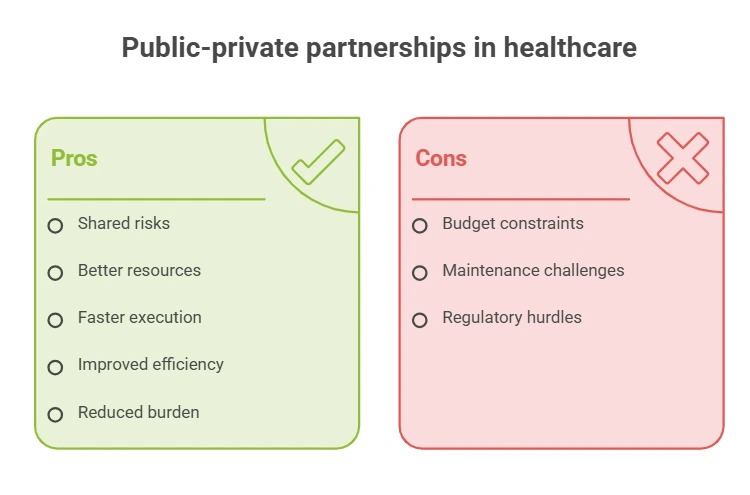
Economic Benefits Include:
Shared investment risks
Better resource utilization
Faster project execution
Improved operational efficiency
Reduced burden on public finances
Enhanced service quality
By combining public funding with private expertise, healthcare systems can achieve greater value for investment.
Models of Public-Private Partnerships in Healthcare
PPPs can take different forms depending on project objectives.
Common models include:
Infrastructure Development
Private organizations design, build, and maintain healthcare facilities while governments oversee policy and service delivery.
Diagnostic Services
Private partners operate diagnostic laboratories and imaging centers within government hospitals.
Emergency Medical Services
Public agencies collaborate with private operators to manage ambulance services and emergency response systems.
Hospital Management
In some cases, governments partner with private organizations to improve hospital administration and operational efficiency.
Telemedicine and Digital Health
Technology companies collaborate with public healthcare systems to extend medical consultations and specialist services to underserved areas.
Government Hospital Outsourcing: Opportunities and Challenges
One important aspect of PPPs involves government hospital outsourcing, where selected non-core or specialized services are managed by private organizations.
Common outsourced services include:
Laboratory diagnostics
Medical imaging
Housekeeping
Facility management
Biomedical equipment maintenance
Ambulance operations
Information technology services
Benefits
Improved efficiency
Access to specialized expertise
Reduced operational costs
Faster service delivery
Better equipment maintenance
Challenges
Maintaining service quality
Performance monitoring
Contract management
Regulatory compliance
Accountability
Effective governance is essential to ensure outsourcing supports patient-centered care.
The Ayushman Bharat PPP model demonstrates how public and private collaboration can expand healthcare access.
Through partnerships with empaneled hospitals, the initiative enables eligible beneficiaries to receive cashless treatment across a wide network of healthcare providers.
The model contributes to:
Increased healthcare accessibility
Reduced financial burden on patients
Greater participation of private healthcare providers
Improved treatment availability
Expanded healthcare coverage
This collaborative framework highlights how PPPs can support large-scale public health objectives while strengthening healthcare delivery.
Lead Healthcare Partnerships
Prepare for PPP, policy, operations, and infrastructure roles through practical MBA learning, industry exposure, and expert mentorship support.
Many smaller cities and semi-urban regions continue to experience:
Limited specialist availability
Inadequate diagnostic facilities
Shortage of advanced medical equipment
Long travel distances for treatment
Public-private collaborations help bridge these gaps by:
Establishing specialty hospitals
Introducing telemedicine services
Improving diagnostic capabilities
Expanding emergency care
Strengthening referral networks
Improved healthcare access supports better health outcomes and regional economic development.
Health Economics in India: Why PPPs Matter
Understanding health economics India is essential for evaluating healthcare investments and policy decisions.
Healthcare economics examines how resources are allocated to maximize health outcomes while controlling costs.
PPPs contribute by:
Optimizing public expenditure
Improving healthcare efficiency
Encouraging innovation
Expanding service capacity
Supporting preventive healthcare
Reducing long-term healthcare costs
When designed effectively, PPPs create sustainable healthcare systems that balance financial efficiency with public welfare.
Technology Driving Successful PPPs
Technology has become a critical enabler of modern healthcare partnerships.
Digital innovations include:
Electronic Health Records
Integrated patient records improve continuity of care across healthcare providers.
Telemedicine
Remote consultations increase specialist access in underserved regions.
Artificial Intelligence
AI supports diagnostics, resource planning, and operational efficiency.
Data Analytics
Healthcare analytics help governments and private partners monitor performance and improve decision-making.
Digital Supply Chain Management
Technology ensures efficient procurement and distribution of medicines and medical equipment.
Challenges Facing Public-Private Partnerships
Despite their advantages, PPPs face several implementation challenges.
These include:
Regulatory complexity
Funding uncertainties
Contractual disputes
Performance monitoring
Data privacy concerns
Political and policy changes
Public accountability
Quality assurance
Addressing these challenges requires transparent governance, clearly defined responsibilities, and robust monitoring frameworks.
Future of Public-Private Partnerships in Indian Healthcare
India's healthcare sector is expected to witness increasing collaboration between government institutions and private organizations.
Emerging opportunities include:
Digital health initiatives
Smart hospitals
Artificial intelligence in healthcare
Rural healthcare expansion
Medical education partnerships
Preventive healthcare programs
Public health data management
Healthcare innovation ecosystems
As healthcare demands continue to evolve, PPPs are likely to remain an important strategy for improving healthcare accessibility and efficiency.
Career Opportunities in Healthcare Management
The expansion of public-private healthcare initiatives has created demand for professionals skilled in healthcare management, public policy, operations, and strategic planning.
Career opportunities include:
Healthcare Administrator
Hospital Operations Manager
Public Health Consultant
Healthcare Policy Analyst
PPP Project Manager
Healthcare Infrastructure Planner
Health Economics Analyst
Healthcare Strategy Consultant
Students interested in these careers benefit from management programs that combine healthcare knowledge with business, operations, public policy, and leadership skills. Institutions such as Asia Pacific Institute of Management emphasize experiential learning, industry engagement, and practical management education to prepare graduates for leadership roles in India's evolving healthcare sector.
The public private partnership in healthcare model has become an important pillar of India's healthcare transformation. By combining public responsibility with private-sector expertise, PPPs strengthen healthcare infrastructure, improve operational efficiency, and expand access to quality medical services across urban and rural regions.
From government hospital outsourcing and the Ayushman Bharat PPP model to healthcare infrastructure development, tier 3 city medical access, and health economics India, these collaborations demonstrate how strategic partnerships can address complex healthcare challenges. As India's healthcare landscape continues to evolve, professionals equipped with expertise in healthcare management, policy, and economics will play a key role in shaping a more resilient and inclusive healthcare system.
Expand Public Health
Turn interest in healthcare access into career-ready skills for PPP projects, hospital outsourcing, and tier three expansion planning.
Dr. Vikas Gupta is a distinguished academic in the education and research domain, specializing in finance and related interdisciplinary studies. He is known for his...
01.
What is a public-private partnership in healthcare?
A public-private partnership in healthcare is a collaborative arrangement where government and private organizations jointly develop, finance, or manage healthcare services and infrastructure.
02.
Why are PPPs important in India's healthcare sector?
PPPs improve healthcare access, enhance infrastructure, increase operational efficiency, encourage innovation, and reduce pressure on public healthcare resources.
03.
What services are commonly outsourced in government hospitals?
Common outsourced services include laboratory diagnostics, medical imaging, ambulance operations, housekeeping, facility management, biomedical maintenance, and IT services.
04.
How does the Ayushman Bharat PPP model improve healthcare?
It enables collaboration between government and empaneled healthcare providers, expanding access to cashless treatment and improving healthcare availability for eligible beneficiaries.
05.
How do PPPs support healthcare infrastructure development?
They facilitate investment in hospitals, diagnostic centers, medical colleges, digital health systems, and emergency care facilities while sharing financial and operational responsibilities.
06.
What role does health economics play in healthcare policy?
Health economics helps policymakers allocate resources efficiently, evaluate healthcare investments, improve service delivery, and maximize public health outcomes.

















.webp) Call Us
Call Us