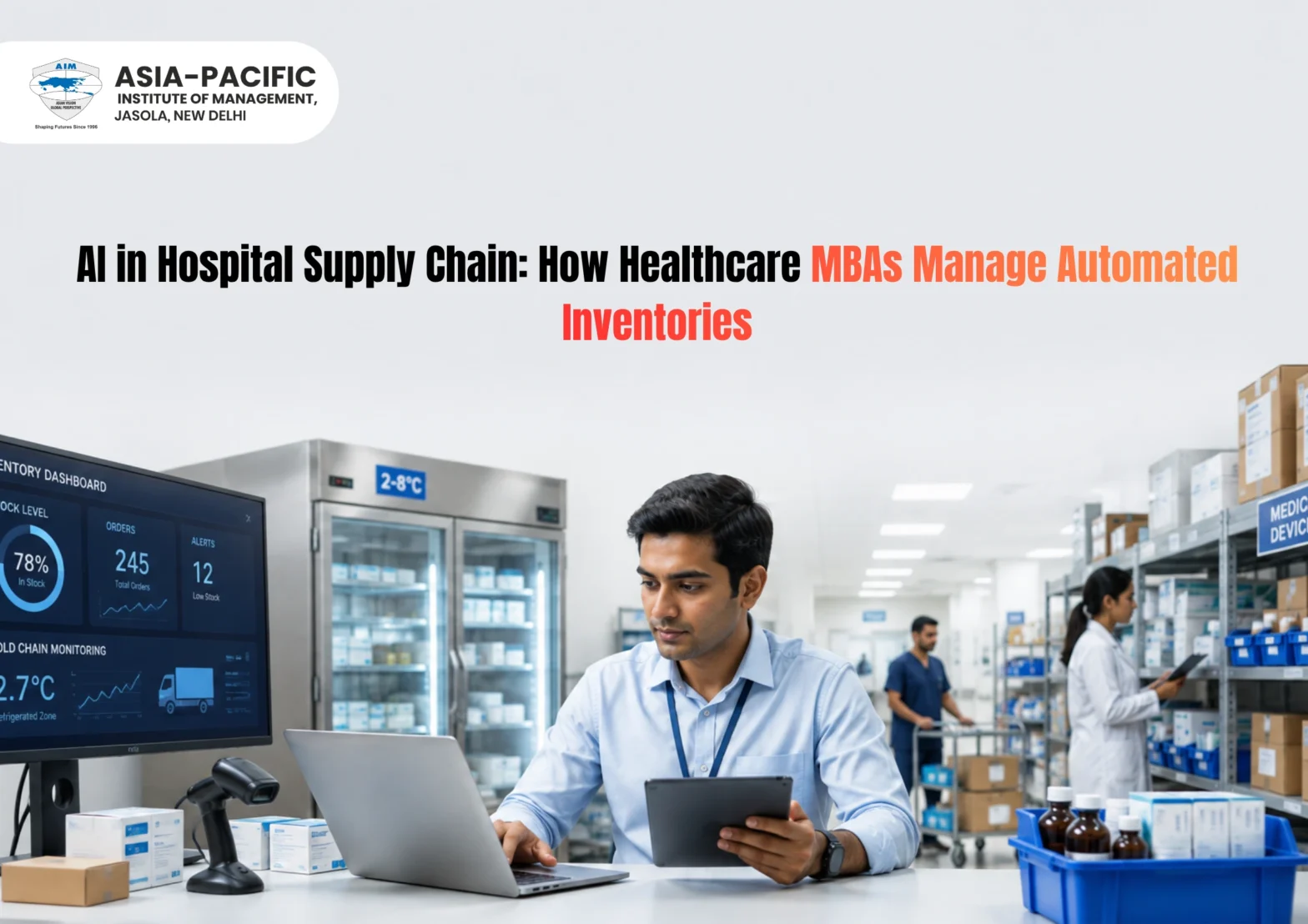
AI in Hospital Supply Chain: How Healthcare MBAs Manage Automated Inventories
Posted on 25 Aug 2026
By Dr. Vikas Gupta
Introduction
A surgeon needs the correct implant before an operation. An ICU needs critical medicines around the clock. Laboratories require reagents, while pharmacies must maintain adequate drug availability. Vaccines and other temperature-sensitive products may require controlled storage and transportation.
However, maintaining excessive inventory is not the solution.
Overstocking can lock up working capital and increase expiry risks. Understocking can disrupt patient care.
Artificial intelligence, predictive analytics, automated inventory systems, IoT sensors, and integrated hospital platforms can help managers forecast demand, monitor stock, detect unusual consumption, and improve procurement decisions.
For healthcare MBA students, this development creates an important career lesson.
Future hospital administrators will not simply manage stores. They will increasingly manage data-driven supply networks where technology supports purchasing, inventory, logistics, and operational decisions.
Lead Digital Healthcare Operations
Build management, analytics, and technology skills to lead smarter hospital operations, supply chains, procurement, and digital transformation initiatives confidently.
AI in healthcare supply chain refers to the use of artificial intelligence, machine learning, predictive analytics, and automation to improve forecasting, procurement, inventory control, logistics, and supply availability across healthcare organizations. These systems can help managers reduce shortages, excess stock, expiry, and inefficient purchasing.
However, AI should support managerial decision-making rather than operate without appropriate oversight.
Healthcare supplies can directly affect patient safety.
Therefore, technology needs to operate alongside:
Procurement policies
Clinical requirements
Quality controls
Regulatory requirements
Human verification
Vendor management
The objective is not simply automation.
It is better supply-chain decision-making.
Why Hospital Supply Chains Are Difficult to Manage
A large hospital may manage thousands of stock-keeping units.
These can include:
Medicines
Surgical consumables
Implants
Laboratory reagents
PPE
Medical gases
Linen
Vaccines
Medical devices
Office supplies
Demand also varies significantly.
A hospital cannot always predict exactly how many emergency surgeries will occur tomorrow.
Seasonal disease patterns can increase medicine consumption.
A sudden outbreak can increase demand for PPE or diagnostic supplies.
Meanwhile, some expensive items may move slowly but remain clinically essential.
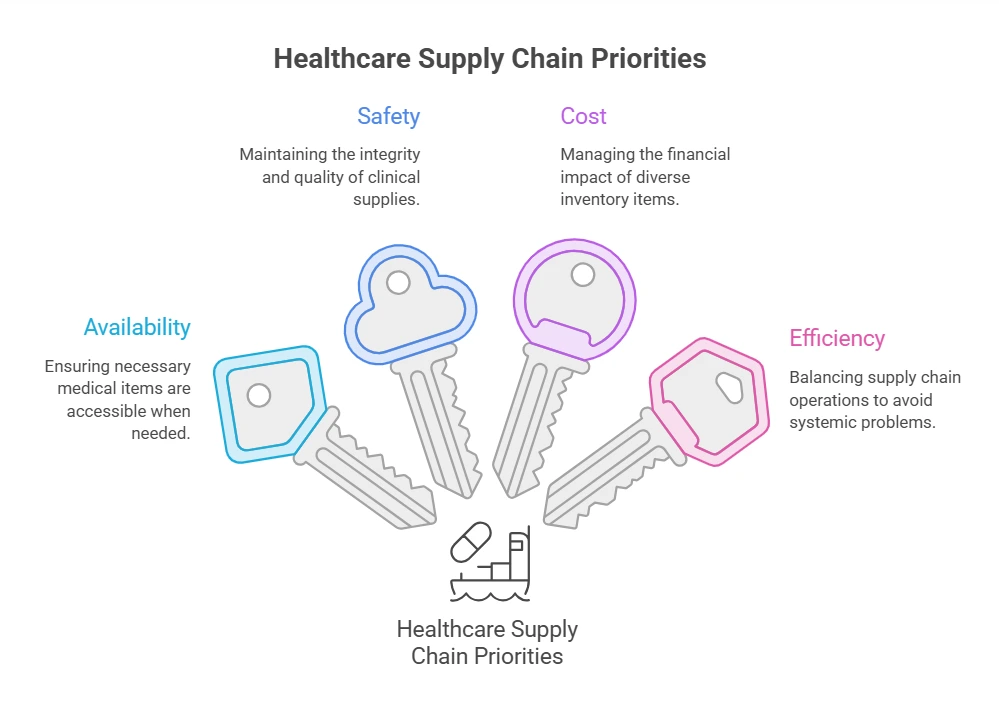
Therefore, healthcare supply chains need to balance four priorities:
Availability + Safety + Cost + Efficiency
Optimizing only one can create problems elsewhere.
Why AI Is Entering Hospital Inventory Management
Traditional inventory systems often depend heavily on historical averages and manual stock reviews.
These methods can work.
However, hospitals now generate much more operational data.
An intelligent system can potentially analyze:
Historical consumption
Current stock
Patient volumes
Seasonal patterns
Procedure schedules
Lead times
Expiry dates
Vendor performance
Department demand
AI can identify patterns that may be difficult to detect manually.
For example, the system may recognize that consumption of a particular item consistently rises during certain months.
It can then support more informed forecasting.
However, forecasting remains probabilistic.
AI cannot guarantee future demand.
Managers still need contingency plans.
Automated Hospital Inventory: How Does It Work?
Automated hospital inventory combines software, identification technologies, system integrations, and workflow rules to track supplies with less manual intervention.
When stock falls below an approved threshold, the system can alert the purchasing team or trigger an approved workflow.
Barcode Tracking
Barcodes can identify products during:
Receiving
Storage
Issue
Consumption
This improves traceability.
RFID
Radio-frequency identification can provide additional visibility for selected assets and supplies.
RFID has been studied extensively in healthcare supply chains because of its potential for inventory visibility and traceability. A systematic review found RFID applications across areas including inventory management, patient safety, and medical asset tracking.
Automated Dispensing Systems
Hospitals may use controlled dispensing technology for certain medicines and supplies.
These systems can record transactions and improve accountability.
Inventory Dashboards
Managers can view:
Available stock
Reorder alerts
Expiring products
Stock-outs
Consumption trends
Purchase orders
Vendor status
This moves inventory management from periodic checking toward continuous visibility.
AI vs Automation: Understand the Difference
Healthcare management students should not use the terms AI and automation interchangeably.
Automation follows predefined rules.
For example:
“If inventory falls below 100 units, generate an alert.”
AI or predictive analytics may identify patterns and estimate future requirements.
For example:
“Based on procedure volume, seasonal consumption, and historical demand, stock may fall below the required level within seven days.”
The difference matters.
Hospitals can automate inventory without using sophisticated AI.
Similarly, AI predictions still require workflows that convert insights into action.
Demand forecasting is one of the most promising applications of AI in healthcare supply chain management.
A hospital could potentially combine:
Historical usage
Occupancy
OPD volume
Surgery schedules
Disease trends
Seasonal factors
Lead times
to forecast future demand.
Suppose a hospital typically uses more respiratory medicines during winter.
Historical consumption can help establish a baseline.
However, an AI-enabled forecasting model may incorporate several variables simultaneously.
Procurement teams can then prepare earlier.
Better forecasting can potentially reduce both:
Stock-outs
Excess inventory
However, unusual events can still make forecasts inaccurate.
Therefore, managers need safety-stock policies.
What Is Safety Stock in Hospitals?
Safety stock is additional inventory maintained to protect against uncertainty.
It may be necessary because:
Demand suddenly increases
Deliveries are delayed
Vendors experience shortages
Transport is disrupted
Hospitals should not use AI forecasting as a reason to eliminate all safety inventory.
For critical products, the consequences of stock-outs may be serious.
Therefore, safety-stock decisions should consider:
Clinical criticality
Demand variability
Lead time
Supplier reliability
Availability of alternatives
A low-cost but lifesaving medicine may justify a different stocking strategy from an expensive non-critical consumable.
ABC Analysis in Automated Hospital Inventory
Traditional inventory techniques remain useful even when hospitals adopt AI.
ABC analysis classifies inventory according to value.
A typical conceptual model is:
A Items
High-value items requiring close financial control.
B Items
Moderate-value items.
C Items
Lower-value items that may be numerous.
However, cost alone is insufficient in healthcare.
An inexpensive item can still be clinically essential.
Therefore, hospitals may combine ABC analysis with criticality-based methods such as VED analysis.
Why VED Analysis Matters
VED stands for:
Vital
Essential
Desirable
A vital product can significantly affect care if unavailable.
Therefore, managers should combine financial and clinical perspectives.
For example:
An expensive but rarely required product may need strict inventory control.
Meanwhile, an inexpensive emergency item may require constant availability.
AI systems should therefore reflect hospital-defined clinical priorities rather than optimizing only for purchasing cost.
Reducing Expiry With Predictive Inventory Management
Expiry is a major inventory concern.
Medicines and medical supplies often have limited shelf lives.
Poor inventory control can lead to:
Financial loss
Disposal costs
Emergency repurchasing
Storage congestion
Technology can help managers identify products approaching expiry.
The system can generate alerts based on:
Expiry date
Quantity
Consumption rate
Department usage
Managers can then take approved actions.
For example, they may review whether stock can be appropriately redistributed within the organization where regulations and clinical policies permit.
The principle of FEFO — First Expiry, First Out — is particularly relevant.
The item expiring first should generally be prioritized for appropriate use before later-expiring stock, subject to clinical and organizational requirements.
Preventing Hospital Stock-Outs
A stock-out occurs when an item needed by the organization is unavailable.
In healthcare, this can create serious operational problems.
Possible causes include:
Poor forecasting
Vendor delays
Unexpected demand
Procurement delays
Incorrect inventory records
Supply disruptions
AI-enabled systems can help identify early warning signals.
A dashboard may flag:
Critical item + falling inventory + rising consumption + long supplier lead time
This allows procurement teams to act before inventory reaches zero.
The important word is before.
Good supply-chain management is proactive.
Pharmaceutical Supply Chain Management
The pharmaceutical supply chain requires particularly strong controls because medicines directly affect patient care.
Hospital pharmacy supply chains may involve:
Manufacturer/Supplier → Distributor → Hospital Store → Pharmacy → Ward/Patient
Managers need to consider:
Authorized procurement
Batch numbers
Expiry
Storage conditions
Recall management
Stock availability
Controlled medicines
Temperature requirements
Technology can strengthen traceability across these stages.
For example, batch-level tracking can help hospitals identify affected stock during a product recall.
This can reduce the time required to locate specific inventory.
AI and Pharmaceutical Demand Forecasting
Pharmaceutical consumption can vary by:
Specialty
Season
Patient volume
Disease patterns
Prescribing patterns
Predictive models can potentially detect changes earlier.
Suppose antibiotic consumption increases sharply in one department.
The system could flag the trend.
However, AI should not independently determine whether the increase is clinically appropriate.
The information may need review by:
Pharmacy
Infection control
Clinical leadership
Administration
This illustrates an important principle.
AI identifies patterns. Qualified professionals interpret their meaning.
For expensive assets, improved visibility can reduce unnecessary purchases.
The Challenge of Consignment Inventory
Some high-value medical devices or implants may operate under consignment arrangements.
The supplier retains ownership until the product is used, depending on contractual terms.
This creates additional management requirements.
Hospitals need accurate information on:
Physical stock
Supplier ownership
Consumption
Replacement
Billing
Expiry
Automation can reduce reconciliation errors.
However, procurement teams should ensure system records match contract terms.
Master Healthcare Supply Chains
Develop practical expertise in healthcare operations, inventory, analytics, procurement, and technology to prepare for tomorrow’s data-driven management careers.
Cold chain management refers to maintaining specified temperature conditions for temperature-sensitive healthcare products during storage and transportation.
Products may include certain:
Vaccines
Biological products
Medicines
Laboratory materials
The exact temperature requirements depend on the product.
Therefore, managers should always follow manufacturer instructions and applicable regulatory guidance.
India's Universal Immunization Programme, for example, uses a structured cold-chain network and electronic systems to support vaccine stock and temperature monitoring. The Ministry of Health and Family Welfare describes eVIN as providing real-time information on vaccine stocks and storage temperatures across cold-chain points.
This demonstrates how digital visibility can support temperature-sensitive healthcare logistics.
IoT in Cold Chain Management
Internet of Things sensors can support continuous temperature monitoring.
Instead of checking a refrigerator manually only at fixed intervals, connected sensors can record conditions continuously.
Alerts may be triggered when temperature moves outside approved limits.
The administrator of the future does not necessarily need to write AI algorithms.
However, they should understand:
What the technology does
Which data it uses
Where errors can occur
How performance should be measured
When human intervention is necessary
This is digital management literacy.
How Healthcare MBAs Use Supply Chain Dashboards
A supply-chain dashboard should help managers make decisions.
Important indicators may include:
Stock-Out Rate
How often required items are unavailable.
Inventory Turnover
How quickly inventory is consumed and replenished.
Expiry Value
Financial value of inventory lost to expiry.
Supplier Lead Time
Time between ordering and receiving goods.
Fill Rate
Percentage of requested quantities successfully supplied.
Emergency Purchase Rate
Frequency of unplanned urgent procurement.
Inventory Accuracy
Difference between system inventory and physical stock.
Cold Chain Excursions
Number of temperature deviations requiring investigation.
Managers should track trends rather than only isolated numbers.
Using AI to Detect Inventory Anomalies
AI can also help identify unusual activity.
Suppose a department normally uses 100 units of a particular item each week.
Consumption suddenly rises to 300.
The system could flag the anomaly.
Possible explanations include:
Increased patient volume
New procedure
Wastage
Incorrect recording
Inventory leakage
The system should not automatically assume misconduct.
Instead, the alert triggers investigation.
This is another example of AI supporting rather than replacing management judgement.
Procurement Automation
Procurement involves several repetitive processes.
These may include:
Requisition
Approval
Purchase order
Vendor communication
Receipt
Invoice matching
Automation can reduce administrative effort.
For example:
Department raises approved requisition → Workflow routes request → Purchase order generated → Supplier notified → Goods received → Invoice matched
Managers can then spend more time on:
Negotiation
Supplier strategy
Risk
Category management
However, approval controls should remain strong.
Automation should not weaken procurement governance.
Supplier Performance Analytics
Hospitals depend on vendors.
Managers should measure vendor performance objectively.
Potential metrics include:
On-time delivery
Fill rate
Quality rejection
Lead time
Price variance
Documentation accuracy
Emergency responsiveness
AI and analytics can identify performance patterns across thousands of transactions.
For example, a vendor may offer the lowest price but repeatedly deliver late.
The true cost may therefore be higher.
Managers should evaluate total supply reliability, not simply purchase price.
AI and Hospital Procurement Fraud Detection
Analytics can also help identify unusual procurement patterns.
Examples may include:
Duplicate invoices
Repeated split purchases
Unusual pricing
Unexpected order frequency
Supplier concentration
These patterns do not automatically prove fraud.
However, they can trigger review.
Hospitals should combine technology with:
Internal controls
Approval limits
Segregation of duties
Audit procedures
AI can strengthen monitoring, but governance remains essential.
Managing AI Risks in Healthcare Supply Chains
AI introduces its own risks.
Healthcare managers should understand them.
Poor Data
If inventory records are inaccurate, predictions can also be inaccurate.
Historical Bias
Past purchasing patterns may contain inefficiencies.
Training a model on poor historical decisions can reproduce them.
System Failure
Hospitals need contingency procedures when technology is unavailable.
Over-Automation
Critical purchases should not occur without appropriate controls simply because an algorithm recommends them.
Cybersecurity
Connected inventory and IoT systems create additional digital-security requirements.
Lack of Explainability
Managers should understand why important recommendations are being generated.
Therefore:
Automation without governance creates new risks.
Human-in-the-Loop Supply Chain Management
Healthcare supply chains should maintain human oversight for significant decisions.
A practical model is:
AI predicts → System alerts → Manager reviews → Authorized decision → Outcome monitored
This model combines technological speed with professional accountability.
For example, AI may predict a shortage of a critical medicine.
The procurement manager should then verify:
Current stock
Open purchase orders
Clinical demand
Supplier availability
Alternatives
Only then should an appropriate action follow.
A Practical Example: AI Managing ICU Consumables
Imagine an ICU uses several high-volume consumables.
The traditional process relies on weekly manual stock counts.
This creates delayed visibility.
An automated model could:
Record each issue transaction.
Track current inventory.
Analyze historical consumption.
Monitor ICU occupancy.
Estimate near-term requirements.
Flag likely shortages.
Alert the store manager.
Monitor the replenishment order.
The manager still validates the recommendation.
However, decision-making becomes faster and more data-driven.
A Practical Example: Predicting Surgical Implant Requirements
Hospitals may carry expensive surgical implants.
Keeping too much inventory can tie up capital.
Keeping too little can create procedure delays.
An analytics system could combine:
Scheduled procedures
Surgeon requirements
Historical usage
Current inventory
Supplier lead time
It can then highlight likely requirements.
Procurement professionals can use this information to coordinate inventory more effectively.
However, clinical product selection should remain with appropriately authorized professionals.
Financial Benefits of Automated Inventory
Efficient inventory management can potentially improve hospital finances in several ways.
Lower Expiry Losses
Better visibility can reduce avoidable expiry.
Lower Excess Inventory
Improved forecasting may reduce unnecessary stock.
Fewer Emergency Purchases
Early warnings can reduce last-minute procurement.
Better Working Capital
Hospitals can avoid locking unnecessary cash in slow-moving stock.
Reduced Manual Effort
Automation can reduce repetitive administrative work.
However, hospitals should measure actual benefits.
Purchasing expensive AI software does not automatically create savings.
Calculate the Business Case Before Investing
Healthcare MBAs should know how to evaluate technology investments.
Before adopting an AI inventory platform, ask:
What problem are we solving?
What is the current financial loss?
How much does implementation cost?
Does it integrate with existing systems?
What training is required?
What measurable improvement is expected?
A basic ROI framework is:
Net Benefit = Financial Benefits – Technology and Implementation Costs
Potential benefits may include reductions in:
Expiry
Emergency procurement
Overstocking
Administrative workload
The business case should also consider patient-safety and operational benefits that may not be easily expressed in rupees.
Career Opportunities for Healthcare MBA Students
AI-driven supply chains can create opportunities for management graduates.
Possible career directions include:
Hospital supply chain executive
Procurement analyst
Inventory manager
Hospital operations manager
Healthcare analytics professional
Medical device operations manager
Pharmaceutical supply-chain professional
Digital transformation analyst
The strongest candidates may combine management fundamentals with healthcare and technology understanding.
Skills Healthcare MBAs Should Build
Students interested in AI in healthcare supply chain should develop several capabilities.
Excel
Still essential for analysis and reporting.
Data Visualization
Dashboard skills can help managers communicate inventory performance.
Supply Chain Fundamentals
Understand:
Procurement
Inventory
Forecasting
Logistics
Vendor management
AI Literacy
Understand the strengths and limitations of predictive systems.
Healthcare Operations
Know how hospitals function.
Financial Analysis
Inventory decisions affect working capital and costs.
Communication
Supply-chain managers coordinate with clinical, finance, pharmacy, stores, and vendor teams.
Technology skills alone are not enough.
How MBA Students Can Build a Supply Chain Project
A student project can demonstrate practical understanding.
For example:
“Designing a Predictive Inventory Dashboard for Hospital Consumables.”
The project could use simulated data containing:
Item name
Daily consumption
Current stock
Reorder level
Lead time
Expiry
Supplier
Students could then create:
Stock-out alerts
Expiry alerts
Consumption trends
Reorder recommendations
Vendor performance metrics
Clearly identify simulated data as simulated.
Do not invent hospital results.
Such a project can strengthen a management CV because it demonstrates application rather than only theoretical knowledge.
Why Healthcare MBAs Need Technology Literacy
Hospital management is becoming increasingly digital.
Future administrators may not personally configure RFID readers or build machine-learning models.
However, they may approve technology investments and manage teams using these systems.
Therefore, managers need to ask intelligent questions.
For example:
Is the data reliable?
Does the system integrate with our hospital platform?
Who validates AI recommendations?
What happens if the system fails?
How will ROI be measured?
How is sensitive information protected?
These are management questions.
Healthcare MBAs who understand both operations and technology can contribute more effectively to digital transformation.
At Asia Pacific Institute of Management, an industry-oriented curriculum, experienced faculty, practical learning, corporate exposure, and placement support can help learners build broader managerial capabilities.
For students interested in healthcare operations, combining management fundamentals with analytics, supply-chain knowledge, and digital literacy can strengthen career readiness.
The rise of AI in healthcare supply chain is changing how hospitals think about inventory.
Instead of relying only on periodic stock counts and historical averages, healthcare organizations can increasingly use real-time information, predictive analytics, automated alerts, and connected devices.
These tools can support:
Better demand forecasting
Automated hospital inventory
Pharmaceutical supply-chain planning
Medical device logistics
Cold chain management
Vendor monitoring
Expiry reduction
Stock-out prevention
However, automation does not eliminate management responsibility.
Therefore, the most effective model combines technology with human judgement.
For healthcare MBA students, this creates an important career opportunity.
Future hospital administrators will need to understand not only how to purchase and store supplies, but also how to interpret data, evaluate AI recommendations, manage digital systems, measure ROI, and build resilient supply networks.
Future-Proof Your MBA Career
Combine healthcare management fundamentals with AI literacy, analytics, supply-chain knowledge, and financial skills for emerging digital healthcare opportunities.
Dr. Vikas Gupta is a distinguished academic in the education and research domain, specializing in finance and related interdisciplinary studies. He is known for his...
AI in healthcare supply chain involves using artificial intelligence and predictive analytics to improve demand forecasting, inventory management, procurement, logistics, and supply availability across healthcare organizations.
02.
What is automated hospital inventory?
Automated hospital inventory uses technologies such as inventory software, barcodes, RFID, integrated systems, and automated workflows to track supplies and support replenishment with less manual intervention.
03.
Can AI prevent medicine stock-outs?
AI can help predict potential shortages by analyzing consumption, stock, demand, and supplier lead times. However, forecasts are not perfect, so hospitals still need safety stocks and managerial oversight.
04.
How does AI help the pharmaceutical supply chain?
AI can support demand forecasting, inventory optimization, expiry management, supplier analysis, anomaly detection, and procurement planning.
05.
How is technology used in medical device logistics?
Hospitals can use barcodes, RFID, inventory systems, and asset-management platforms to track devices, implants, locations, usage, maintenance, and other relevant information.
06.
How does AI support cold chain management?
AI and IoT systems can analyze temperature data, generate alerts for excursions, identify patterns, and support inventory planning. Product disposition after an excursion should follow approved procedures.
07.
Will AI replace hospital supply chain managers?
AI is more likely to change their work than eliminate the need for management. Professionals remain responsible for procurement strategy, supplier relationships, governance, risk management, and important decisions.
08.
What skills should MBA healthcare students learn for AI-driven supply chains?
Useful skills include supply-chain fundamentals, Excel, analytics, dashboards, financial analysis, AI literacy, hospital operations, procurement, and communication.
















.webp) Call Us
Call Us