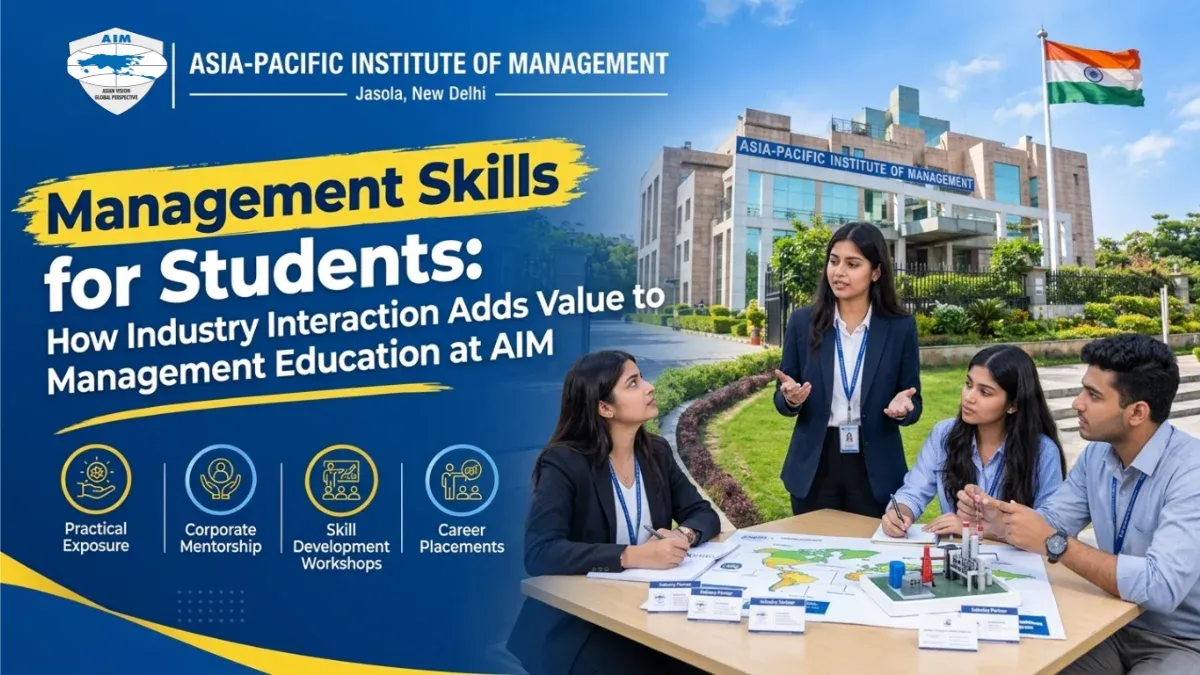
Management Skills for Students: How Industry Interaction Adds Value to Management Education at AIM
Posted on 10 Oct 2026
By Dr. Vikas Gupta
Introduction
Choosing a management programme often comes down to one quiet question: will it teach me how to work, or only what to know? Management skills for students are built less by memorising frameworks than by using them with real people, deadlines and trade-offs. That is why industry interaction deserves a close look when you compare institutes. At Asia-Pacific Institute of Management (AIM), New Delhi, this interaction is coordinated through the Centre for Corporate Relations, which describes its role as linking academic learning with industry expertise.
This deep dive explains what industry interaction means and which forms AIM publishes on its official pages. It shows how each form can build communication, leadership, problem solving and business management skills, and how to judge such claims at any business school. The aim is to help you evaluate depth rather than logos. Programme details can change by academic session, so confirm current information with AIM before you decide.
Executive MBA in Healthcare
Explore the curriculum, eligibility, career opportunities, and key details of the Executive MBA in Healthcare.
Why Does Industry Interaction Matter in Management Education?
Industry interaction matters because management is learned by applying ideas to real constraints, not only by studying them. Contact with practitioners, live projects and internships helps students test concepts, receive feedback and build the skills that lectures alone rarely develop, such as communication, judgement and teamwork under pressure.
Consider a student who understands market segmentation from a textbook. Presenting a segmentation recommendation to a practitioner who asks about budget, timing and risk is a different test. The concept has not changed, but the student must now explain it clearly, defend it and adjust. That gap between knowing and doing is the one industry interaction is meant to narrow.
It helps to separate three ideas. Industry interaction is contact with practitioners and organisations. Experiential learning is the act of applying concepts to problems. Placement support is preparation for recruitment. A programme can offer all three, but they are not the same, and the first two shape skills most directly.
None of this guarantees a job, salary or role. Interaction creates chances to practise, and what a student gains depends on preparation, participation and reflection.
What Forms of Industry Interaction Does AIM Describe?
AIM's official pages describe several forms of industry interaction: corporate lectures, pre-placement talks and mentorship through the Centre for Corporate Relations, HR roundtables and industry dialogues, industrial visits and corporate immersions, and internships with live industrial training. Together they connect classroom concepts with practitioner perspectives and real business tasks.
Corporate Lectures, Pre-Placement Talks and Mentorship
AIM's Centre for Corporate Relations (CCR) page says it connects students with recruiters, HR leaders and business heads through corporate lectures, pre-placement talks and mentorship programmes. The stated purpose is to help students build industry networks and relationship management skills.
HR Roundtables and Industry Dialogues
The institute describes regular HR Roundtables and Industry Dialogues where CEOs, entrepreneurs and thought leaders discuss recruitment trends, leadership philosophies and changes in the workplace. For a student, these sessions are a chance to hear how practitioners frame decisions and to ask questions of their own.
Industrial Visits and Corporate Immersions
AIM's news page describes an industrial visit to IFFCO. It included a session on cooperative governance by a senior manager, followed by a question-and-answer round with the company's Director (HR & Legal). The CCR page also lists industrial visits, corporate immersions and on-ground projects as ways for students to see how business functions operate across sectors.
Internships and Live Industrial Training
AIM's internships page says students work on live projects and corporate assignments, supported by a network of more than 150 industry partners. In PGDM – General, the published curriculum places a Summer Internship Project Report Seminar in Trimester IV. The programme page also describes every trimester as blending theory with live projects, case studies, simulations and corporate internships.
Which Management Skills for Students Does Industry Interaction Build?
Industry interaction can build communication, leadership, problem solving and business management skills, along with the wider soft skills MBA students need, such as adaptability and teamwork. The skill grows only when students take part actively, by presenting, questioning, coordinating or delivering work, rather than simply attending.
Form of Interaction
What a Student Can Do
Skills It Can Build
Corporate lecture or roundtable
Prepare questions, take notes, follow up
Communication, business awareness
Industrial visit
Observe processes, join the Q&A, write a reflection
Observation, business management skills
Live project or corporate assignment
Define the problem, analyse, present a recommendation
Problem solving, teamwork
Internship
Own a deliverable under supervision
Adaptability, professional discipline
Student-led placement activities
Coordinate schedules, outreach and data
Leadership, coordination, project management
The table shows possible links, not guaranteed outcomes. AIM's own pages use similar language. The internships page lists problem-solving, leadership and professional discipline among the skills it aims to build. The CCR page describes outcomes such as leading cross-functional teams and adapting communication styles to different contexts. Treat these as the institute's stated aims, and test them against what you can see and verify.
How Do Communication and Leadership Skills Develop Beyond the Classroom?
Communication and leadership skills develop through repetition with real audiences and real responsibility. Presenting to practitioners, managing a stakeholder, coordinating a team or running a process gives students feedback that classroom exercises rarely match. Industry interaction supplies both the audience and the responsibility.
Communication Skills for MBA and PGDM Students
Strong communication skills for MBA and PGDM students start with instruction and mature with practice. AIM's PGDM – General curriculum lists Business Communication in Trimester I and a workshop-based Interview & Presentation Technique subject in Trimester II. Industry settings then add an unforgiving audience. A visiting manager does not grade on effort, so a vague answer in a Q&A round shows quickly.
The CCR page adds a practical example. It says students gain hands-on experience in storytelling, employer branding and stakeholder engagement through work on placement brochures and recruitment materials. Writing for people who will read it critically is a skill in itself.
Leadership Skills in a PGDM Programme
Leadership skills in a PGDM are rarely about titles. In many workplaces, a manager must lead colleagues over whom they have no direct authority. AIM's published curriculum includes Personal Growth and Leadership subjects in Trimesters IV and V, and its CCR page says students take leadership roles in placement drives, outreach events and talent management activities. Its Clubs & Committees page lists the Finance Club, the Marketing Maestro Club and the HR Club as further places to practise coordination and influence.
Leading a small team through a real deadline teaches things a case discussion cannot, such as how to persuade, delegate and recover from a missed task.
How Do Live Projects Build Problem Solving and Business Management Skills?
Live projects build problem solving skills by presenting messy, incomplete situations with competing priorities, where no textbook answer fits exactly. They build business management skills by requiring students to plan, allocate effort, work with stakeholders and present a recommendation that someone can act on.
Take a generic example. A student is asked to help a small retailer reduce delays in processing customer returns. The data is patchy, the owner has a favourite theory, and the budget is limited. A useful approach follows a cycle:
Frame the problem. Separate the symptom (delays) from the cause (perhaps a handoff between two teams).
Analyse what exists. Use the available data and talk to the people involved.
Compare options. Weigh cost, speed, risk and effort.
Recommend and defend. Explain the choice and respond to objections.
Reflect. Note what worked, what did not and what to change next time.
AIM's published PGDM – General structure gives students material for this cycle. Subjects such as Research Methodology for Decision Making, Optimisation Models for Management Decisions and Strategic Management supply the tools. In the second year, students carry out a six-month research project in their specialisation area. It involves a synopsis, supervision by a faculty guide, periodic reviews and a final presentation to a panel that includes external members from industry or academia. The CCR page also says experiential exposure builds business acumen, situational adaptability and decision-making capability.
How Can Students Get More From Industry Interaction?
Students get more from industry interaction by preparing beforehand, taking a defined responsibility, asking specific questions and reflecting afterwards. Passive attendance yields contacts and context, but active participation builds the soft skills MBA students are later asked to demonstrate in interviews and workplaces.
Prepare before every session. Read about the speaker or company, and write one question that cannot be answered with a search.
Take a defined role. Present a section, manage the schedule or write the summary instead of staying in the background.
Write a short debrief. Three lines on what you learned, what surprised you and what you would do differently turn an event into evidence.
Follow up professionally. A concise thank-you note or a thoughtful follow-up question builds the relationship skills that CCR-style networking is meant to develop.
Connect it to a goal. A student drawn to marketing, finance or HR can choose projects, clubs and internship tasks that build that direction.
Soft skills develop through habit, not through a single event. A student who prepares, participates and reflects across two years builds a record of examples. That record becomes useful when an interviewer asks for a time you led a group, persuaded someone or solved a problem.
How Should Aspirants Evaluate Industry Interaction at a B-School?
Evaluate industry interaction by asking what students actually do, how often, with what supervision and with what evidence of learning. Compare formats, not logos. Look for structured participation, current programme documents and dated information, and treat any placement or salary claim as separate from skill development.
Question to Ask
Why It Matters
Where to Check for AIM
Is practical work part of every trimester?
Built-in learning is stronger than occasional events
PGDM – General page: live projects, cases, simulations, internships
Who supervises projects and how are they assessed?
Feedback quality shapes skill growth
Research project structure: faculty guide, reviews, panel
Internships & Industry page; ask for current details
Is the information current?
Programmes and activities change by session
Official pages; campus visit
AIM publishes a daily guided campus tour on weekdays, and the CCR page lists a placement cell contact for questions. These are practical ways to ask the questions above in person. Compare the answers with those from the other institutes on your shortlist, using the same questions for each.
Industry interaction adds value to management education when it gives students something to do, not only something to hear. AIM's official pages describe corporate lectures, HR roundtables, industrial visits, internships and live projects as parts of this picture. Each can strengthen communication, leadership, problem solving and wider business management skills, provided the student participates and reflects.
For an aspirant, the sensible step is to move from claims to specifics. Ask what students do, how it is supervised and how current the information is. Choose the environment where you expect to practise these skills, not only to read about them.
Executive MBA in Healthcare
Explore the curriculum, eligibility, career opportunities, and key details of the Executive MBA in Healthcare.
Dr. Vikas Gupta is a distinguished academic in the education and research domain, specializing in finance and related interdisciplinary studies. He is known for his...
These questions cover how industry interaction supports management skills for students, what AIM describes on its official pages, and how aspirants can check such claims before applying.
01.
What are management skills for students?
Management skills for students are the abilities needed to plan, communicate, lead, analyse and make decisions in business settings. They include communication, leadership, problem solving, teamwork and business judgement. Management programmes build them through coursework, projects, internships and interaction with practitioners, though growth depends on how actively a student participates.
02.
What forms of industry interaction does AIM describe?
AIM’s official pages describe corporate lectures, pre-placement talks and mentorship, HR roundtables and industry dialogues, industrial visits, corporate immersions, and internships with live industrial training. The internships page refers to a network of more than 150 industry partners. Details can change by session, so confirm current activities with AIM.
03.
Does industry interaction improve communication skills for MBA and PGDM students?
It can. Presenting to practitioners, asking questions in Q&A rounds and writing for real audiences give students practice that classroom exercises only approximate. AIM’s curriculum also lists Business Communication and a workshop-based Interview & Presentation Technique subject. The improvement depends on preparation, participation and feedback.
04.
How can industry exposure help build leadership skills in a PGDM?
Industry exposure gives students real responsibility, such as coordinating events, managing schedules or leading project teams. AIM’s CCR page says students take leadership roles in placement drives and outreach activities, and its curriculum includes Personal Growth and Leadership subjects. Leadership grows from taking ownership, not from attending sessions alone.
05.
What problem solving skills do live projects develop?
Live projects develop skills such as framing a problem, using incomplete data, comparing options against constraints and defending a recommendation. They differ from textbook exercises because priorities compete and answers are less clear. A short reflection after each project helps students notice which approaches worked and which did not.
06.
How can I show soft skills in interviews after a PGDM?
Use specific examples instead of general claims. Describe the situation, what you did, the result and what you learned. A club role, internship deliverable or project presentation can all work. Soft skills MBA students describe with concrete evidence usually sound more credible than lists of adjectives.
07.
Does industry interaction guarantee a job or placement?
No. Industry interaction can build skills, contacts and evidence of capability, but placement and compensation depend on individual effort, specialisation, prior experience and market conditions. Be cautious of any institute that implies a guaranteed outcome, and read placement figures with their reporting year and methodology.
08.
How can I verify AIM's industry interaction before applying?
Read the official pages on the Centre for Corporate Relations, internships and the PGDM programme. Ask the admission team for recent, dated examples of sessions and projects, and take the weekday guided campus tour. Compare your findings with the same questions put to other institutes on your shortlist.











.webp) Call Us
Call Us