

14 Oct 2026
AI and Management Education: How AIM Is Preparing Students for the Future of Business


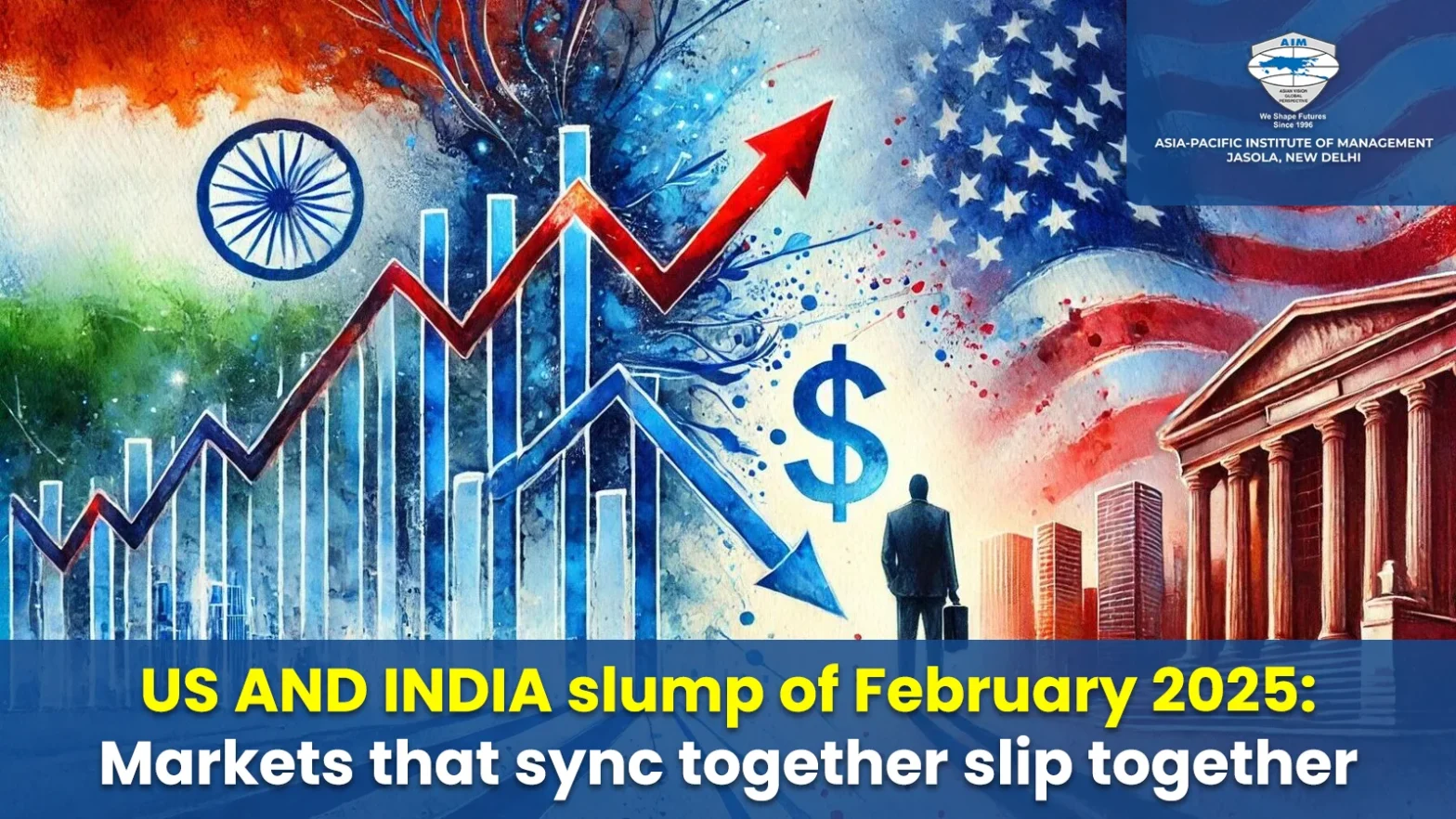
In the past 20 days, the US stock market has lost $4 trillion, wiping out $4 trillion in market value from the S&P 500. The S&P 500 had its biggest one-day drop, and the chance of a recession is higher than most people believe. The dip has been so sharp that many experts predict the US could enter a recession this year.
To put things into perspective, $4 trillion is equivalent to wiping out the entire GDP of India in just 20 days. This bloodbath did not spare any giant—Apple lost $174 billion in a single day, Tesla lost $127 billion, and Nvidia lost $140 billion. The US stock market is bleeding, with Apple shares posting their worst month in over two years. In total, America's biggest technology companies have lost around $750 billion.
Even Tesla, it turns out, is not in favour of tariffs. The company, owned by President Trump's close associate Elon Musk, sent a letter to the administration warning that it could be affected by retaliatory tariffs from the escalating trade war.
This isn't just a market crash—it is the beginning of something very alarming. It is not just the stock market that is suffering; interest rates in the US are at a 20-year high, housing has become unaffordable for many Americans, and credit card defaults have hit a 14-year high.
Trump has declared a trade war against China and other nations. He claims that America has been on the wrong end of the stick in terms of international trade. The Trump administration’s tariffs on Chinese goods are officially in effect and are creating a trickle-down effect that could harm American businesses and consumers.
A new invisible wall of tariffs built by Donald Trump could act as a barrier for millions of American families. And if you think this only affects Americans, think again—when the United States sneezes, the entire world catches a cold. In India, we are already witnessing the impact: foreign investors are pulling money out, markets are volatile, and economic uncertainty is rising daily.
If so, how will this affect India? And most importantly, since we are expecting a recession, how can you protect your family? What’s coming next could change everything you know about the economics of the 21st century.
Most people think a recession is simple: if GDP declines for two consecutive quarters, they call it a recession. But that’s not exactly how it works. A recession could be of two types:
Right now, the US economy is sending mixed signals. The situation is fuelling uncertainty, adding to concerns over how tariffs will impact inflation and economic growth. It is crucial to bring inflation down to the 2% target.
Recent reports show that GDP growth has slowed from 3.1% to 2.3%. The job market is cooling but not collapsing, while the stock market remains highly volatile, and interest rates are high.
That’s because of one chart that has predicted every major US recession in the past 50 years. And right now, that chart is flashing warning signals.
It is called the yield curve. Every single time it has inverted, a recession has followed:
Now, the yield curve is on the verge of inverting again.
In a healthy economy, investors are confident about the future. As a result:
However, when a recession is imminent, investors get scared. Instead of keeping their money in the stock market, they rush to buy long-term government bonds for safety. This sudden demand pushes up bond prices and lowers long-term yields. At the same time, short-term bond prices fall, causing their yields to rise.
This results in an inverted yield curve, a historically reliable recession indicator.
When Trump took office, Wall Street was optimistic, businesses were expanding, and the stock market was soaring. But now, everything has changed. The stock market just closed its worst week of the year.
On February 22, the NASDAQ plummeted 4% in its steepest one-day drop since 2022. Investors suddenly lost confidence due to Trump’s trade war, which is back with full force. In retaliation for US tariffs, China has imposed tariffs on American exports.
The US depends heavily on imported goods, and its trade deficit with China is $279 billion. Tariffs on Chinese goods make imports more expensive, but American consumers and businesses ultimately bear the cost.
For example, before Trump’s tariffs, an American could buy a Chinese-made smartphone for $1,000. After a 10% tariff, the price rises to $1,100. Who pays the extra $100? The American consumer.
Many major US companies depend on China for raw materials and manufacturing, including:
Higher raw material costs mean lower profits, falling stock prices, and investor panic, leading to a massive market sell-off. As a result, the NASDAQ, S&P 500, and Dow Jones have all plunged.
The impact on India is real.
If American businesses cut spending, India’s IT sector will suffer. Other industries at risk include:
During the 2008 crash, foreign portfolio investors pulled ₹52,000 crores from Indian markets, leading to a 60% crash. If history repeats itself, we can expect high volatility in Dalal Street.
If the US enters a recession, it will trigger two years of market decline (until June 2027), followed by a smaller dip in June 2030. A cost-of-living crisis could last five years.
For now, all we can do is prepare and hope that the US avoids a full-blown recession.
We at the Asia-Pacific Institute of Management encourage you to think innovatively with an ethical paradigm. We are a top rated PGDM College in Delhi and North India. We encourage you to connect and interact with us and build a career at one of the best MBA colleges in Delhi.
Note: This blog was written by a faculty member of the Asia-Pacific Institute of Management
Keywords: US stock market crash 2025, Recession warning signs, US-China trade war impact, Stock market downturn effects, Yield curve inversion recession, Economic slowdown in the US, Impact of US recession on India


14 Oct 2026
AI and Management Education: How AIM Is Preparing Students for the Future of Business

13 Oct 2026
Practical Learning in PGDM: Why It Matters and How AIM Integrates It Into Management Education

12 Oct 2026
Management Skills for Students: How AIM Builds Communication, Leadership and Problem-Solving

10 Oct 2026
Management Skills for Students: How Industry Interaction Adds Value to Management Education at AIM

09 Oct 2026
Classroom to Corporate: How AIM Prepares Students for the Business World






BBA Brochure

PGDM Brochure
MBA Brochure


.webp) Call Us
Call Us