

14 Oct 2026
AI and Management Education: How AIM Is Preparing Students for the Future of Business


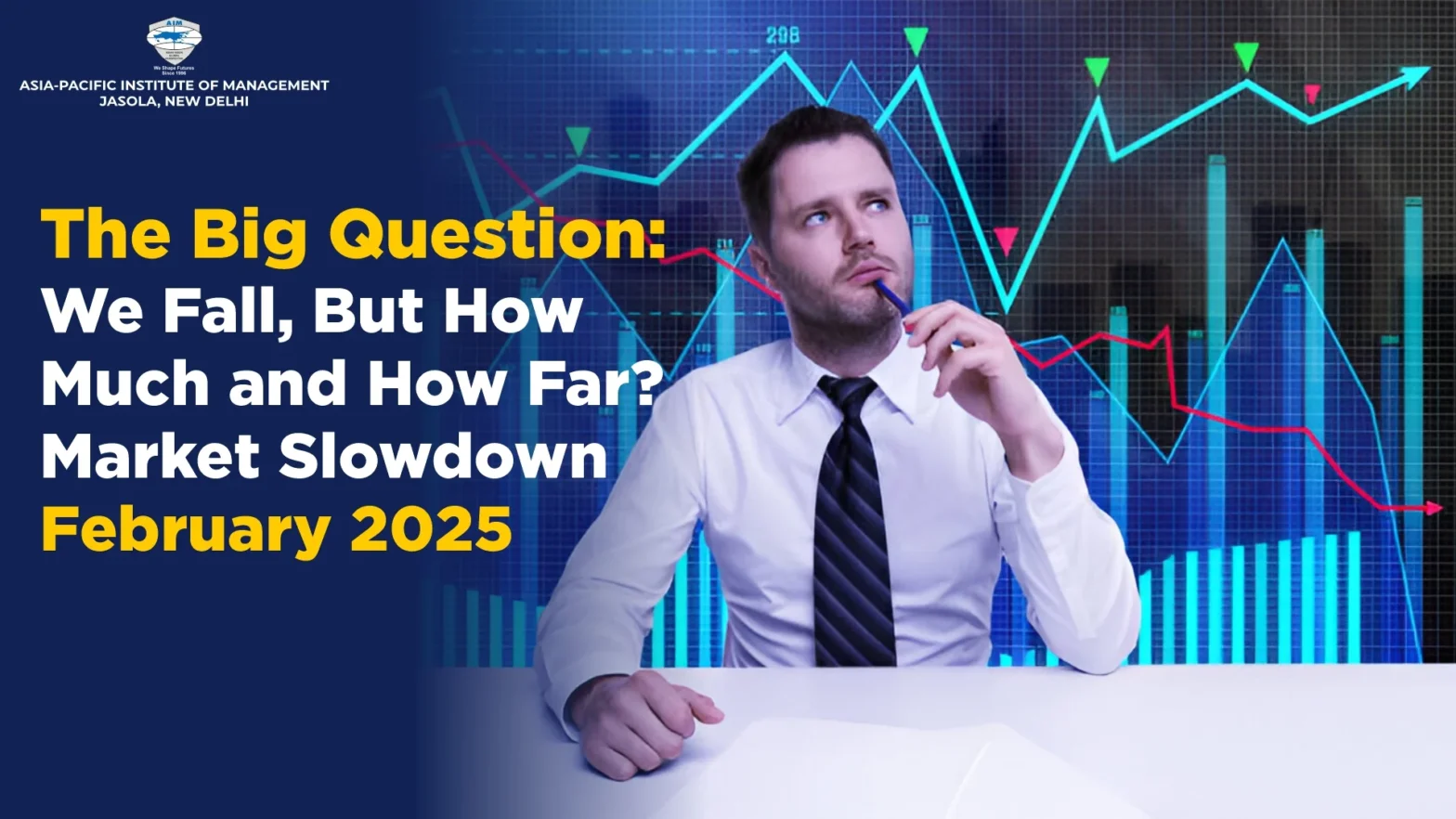
The biggest concern for investors today—whether small, medium, or large—is not just that the market is falling, but understanding how much it will fall and how far the slowdown will go. Historically, markets undergo a correction every four to four-and-a-half years due to high stock or commodity prices. However, the current situation demands a deeper analysis.
While investors speculate, insiders and policymakers hold critical knowledge about the economic outlook. These decision-makers, having secured their constituencies and elections, now control fiscal policies that affect markets. A clear indicator of this is the salary hikes granted to Members of Legislative Assemblies (MLAs) and Members of the Legislative Council in Karnataka, where their salaries were raised by 100 pc. For other states, for example, in Delhi, it is 25% to 27%. This increase was justified on the grounds of inflation and the rising cost-of-living index.
This raises a crucial question: What does this mean for the broader economy and investors?
To better understand the economic landscape, we must examine credit rating agencies in both India and the USA. The financial structures of both countries follow a strikingly similar pattern, making comparisons useful.
In India, four major credit rating agencies evaluate financial risk. In the USA, three primary agencies—Equifax, Experian, and TransUnion—play a similar role. Notably, the Reserve Bank of India (RBI) recently imposed a fine of ₹1.1 crore on Experian for non-compliance. A similar situation unfolded in the USA, where the Consumer Financial Protection Bureau (CFPB) pursued legal action against Equifax and Experian. TransUnion was the only agency that remained unaffected by legal disputes.
The implication here is significant: these credit agencies were allegedly hiding unfavourable financial data about consumers, investors, and businesses. In doing so, they supported government growth narratives while suppressing crucial information that might have indicated financial distress.
This distortion of credit data can have severe long-term consequences, leading to a bubble economy where loans are extended based on manipulated creditworthiness.
The concealment of financial risks has direct consequences for lending patterns. When governments and financial institutions overlook risks, loans may be granted indiscriminately to:
A prime example of this is unfolding in Madhya Pradesh and Rajasthan, where students are demanding a one-time fee to appear in all government recruitment exams. Many of these students are surviving on meagre funds from their families- as low as ₹5,000 per month—while preparing for government entrance exams. Such financial stress increases reliance on government aid and easy credit, further straining the economy.
Another major contributor to financial instability is private equity (PE). Large PE firms have been accused of unethical financial practices that have negatively impacted the economy.
For example, BlackRock, the world’s largest asset management firm, has been at the centre of controversy, ranking in the top spot out of 300 PEI firms worldwide. Larry Fink, CEO of BlackRock, was a prominent guest at the lavish Ambani wedding in India. Meanwhile, BlackRock along with other private equity investment funds, has been accused of financial mismanagement and contributing to a ₹4,200 crore financial discrepancy between 2021 and 2025.
To put this into perspective, a simple Google search of chit fund scams in India reveals numerous scams valued at ₹2,000 to ₹2,500 crore each. Such massive financial frauds contribute to non-performing assets (NPAs), creating widespread financial instability.
A big worry is that the light at the end of the tunnel, ‘pension funds’ are being carelessly lent out to these PE firms. This means that if the market suffers a loss, your pension suffers a loss. Put this into perspective, an old individual retired from a government job is likely to be worth much more to banks than a young graduate who has just completed 1 year of his first job.
The combination of rising NPAs, global warming, unpredictable harvests, and protectionist trade policies exacerbates economic struggles. The agricultural sector, which serves as the backbone of the FMCG (Fast-Moving Consumer Goods) industry, is severely impacted by unpredictable weather patterns and trade restrictions.
Key government interventions, such as:
are further straining both consumers and producers. Farmers and businesses reliant on imports are struggling to maintain profitability, ultimately leading to:
For small and retail investors, the recent market downturn should not be mistaken for a short-term correction. Rather, this downturn reflects a longer period of economic uncertainty, similar to the 2008-2010 financial crisis.
The likelihood of a W-shaped recovery—where markets rise and fall multiple times before stabilizing—is high. Investors should prepare for at least two more years of economic stagnation before a sustainable recovery takes hold.
Key Takeaways
The market slowdown of February 2025 is not just a temporary dip but an indicator of deeper structural economic issues. Investors must navigate these challenges carefully, staying informed and making calculated investment decisions. Understanding the interplay between government policies, financial institutions, and global economic forces is crucial for making sound financial choices in the coming years.
We at Asia-Pacific Institute of Management encourage innovative thinking with an ethical paradigm. This is why we are considered a top-rated PGDM College in Delhi and in North India. We encourage you to connect with us and grow at one of the best MBA colleges in Delhi.
Note: This blog was written by a faculty member of the Asia-Pacific Institute of Management
Market slowdown February 2025, economic downturn 2025, financial crisis prediction, credit rating agencies India, private equity risks, BlackRock financial controversy, Indian economic policy, stock market correction 2025, non-performing assets India, FMCG industry challenges, W-shaped recovery, RBI financial penalties, inflation impact India, investor strategies 2025, global trade policies India.


14 Oct 2026
AI and Management Education: How AIM Is Preparing Students for the Future of Business

13 Oct 2026
Practical Learning in PGDM: Why It Matters and How AIM Integrates It Into Management Education

12 Oct 2026
Management Skills for Students: How AIM Builds Communication, Leadership and Problem-Solving

10 Oct 2026
Management Skills for Students: How Industry Interaction Adds Value to Management Education at AIM

09 Oct 2026
Classroom to Corporate: How AIM Prepares Students for the Business World






BBA Brochure

PGDM Brochure
MBA Brochure


.webp) Call Us
Call Us