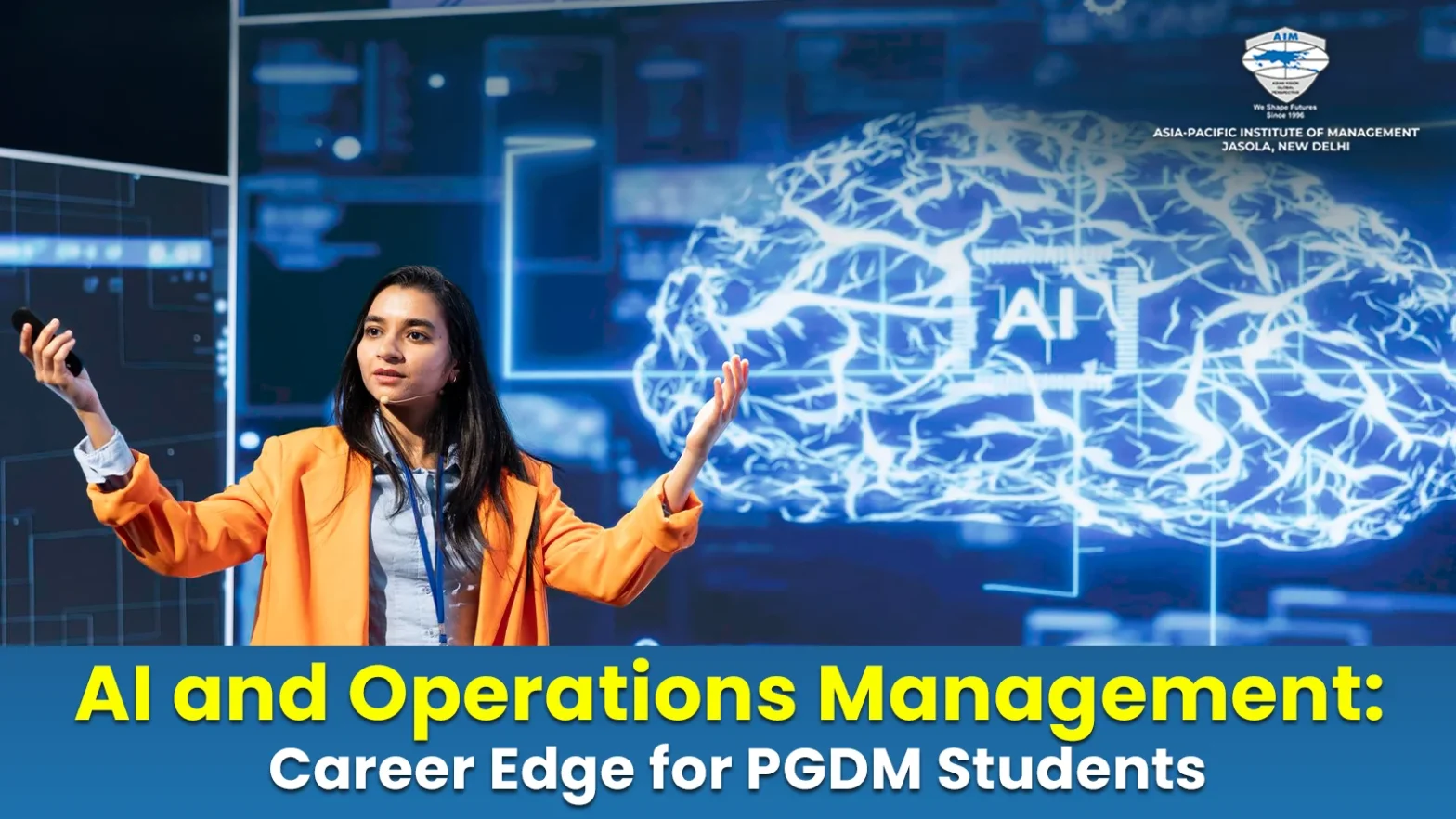
Technology is not just a tool; it is one of the most vital tools that helps reshape how operations work, determine what skills an individual needs, and identify what role matters in the future. For PGDM Students, technology especially those specialising in Operating Management, understanding Artificial Intelligence to operate across businesses is very important. It is no longer just an option but has become a real life-changer in handling business operations. Explore in this blog how AI for PGDM students is transforming operations, the PGDM Operations Management career scope, the benefits of AI in Operations Management, and how institutions like the Asia‑Pacific Institute of Management are equipping their students to lead in this AI‑enabled operations landscape.
Understanding Why AI Matters in Operations Management?
Operations management, over the years, has been about ensuring that every product and service of every organisation is delivered efficiently and effectively, ensuring high-quality, cost-effective products. As competition intensifies with high customer demands, supply chain management becomes more complex, and the traditional operating system and practices are under stress to cope up with the advanced requirements. Therefore, AI has become the next tool to ease Operational Management work.
AI brings to operations management capabilities like predictive analytics, automation, real‑time decision support, process optimisation, and resource allocation. These aren’t just buzzwords—they’re solutions to big operational problems: demand forecasting that takes into account seasonality and external events and automates repetitive tasks; predictive maintenance to reduce downtime, optimising supply chains even under uncertainty. Sources such as IBM report that AI can significantly reduce forecasting errors and help businesses respond dynamically.
For PGDM students, learning AI isn’t just about knowing the tech—it’s about knowing how to align technology with business strategy, how to lead operations in a way that leverages AI to create value, and how to stay relevant as the operational world evolves.
PGDM Operations Management Career Scope: What’s Changing?
For those considering the PGDM Operations Management career scope, there are several exciting trajectories that are expanding thanks to AI:
- Operations Analyst / Data‑Driven Planner: With AI, operations teams need analysts who can interpret large datasets, build forecasting models, monitor operations dashboards, and suggest improvements. PGDM students with strong quantitative skills and knowledge of AI tools will be in strong demand.
- Supply Chain Optimisation Roles: Using AI tools in operations management helps optimise routing, inventory, demand forecasting, and logistics planning. Careers in supply chain management roles that specialise in analytics, AI‑powered decision-making, and procurement optimisation are proliferating.
- Automation & Process Design: Many operations jobs aren’t just about oversight but designing efficient processes that use automation and intelligent systems (like RPA) to reduce waste, errors, and cost. PGDM students can lead these transformation projects.
- Predictive Maintenance and Quality Assurance: Heavy Operations equipment for manufacturing, utilities, and other sectors such as factories, production lines, etc, increasingly use sensors, IoT, and AI tools to examine and predict the product quality and ensure quality standards. Obtaining the skills in machine learning, anomaly detection, and data interpretation becomes useful in operations management.
- Operations Strategy and Leadership: As AI becomes embedded in operations, there's a need for leaders who understand both tech and operations—someone who can strategise AI adoption, balance cost vs ROI, manage change, ethics, data privacy, etc. PGDM graduates who combine operations expertise with AI fluency are well placed to move into leadership roles.
- Emerging fields like sustainability & green operations: AI also supports optimising energy usage, reducing waste, and designing sustainable operations. Students seeking a career in sustainability and operations will find niche roles with AI support in the emerging fields.
The career scope for PGDM in Operations Management is expanding, in which roles once confined to manual oversight are now moving toward strategic, analytical, tech‑savvy positions. Overall, PGDM students who embrace AI will likely have a competitive edge.
Benefits of AI in Operations Management
Improved Forecasting & Demand Planning: AI tools analyse the historical data of the organisations, such as sales, market trends, and external signals, to predict future demand. This helps avoid overstock or stockouts.
Resource Optimisation: AI helps allocate workforce, machinery, tools more efficiently. For example, scheduling and task assignment, balancing load across resources.
Automation of Routine Tasks: Several things that are repetitive in nature, like order processing, data entry, and standard reporting, can be automated accordingly. This reduces the human workforce in such cases and focuses on value‑added and strategic work.
Real‑Time Monitoring and Decision Making: AI simplifies the functionality of the organisations’ operations. It can be monitored live to ease the bottlenecks, delays, and deviations by early detection.
Cost Reduction & Efficiency Gains: Another benefit of using AI in Opereations management is minimising waste, Optimised inventory and better scheduling all lead to lower operational costs.
Improved Customer Experience: Service delivery is of utmost importance for all organisations. AI helps operations teams ensure timely delivery, accurate tracking, better response times, and fewer disruptions.
Resilience & Risk Management: Using AI tools helps anticipate disruptions, weather, supply chain delays, and demand shocks. Helps firms build resilient operations with contingency planning.
AI for PGDM Students: What Should You Learn / Focus On
PGDM students aiming for a strong career in operations should build relevant skills, knowledge, and mindset. Here are recommendations:
-
Data Analytics & Machine Learning Basics: Understanding statistical methods, clustering, regression, predictive modeling, and classification. It enables students to understand how data insights are generated and interpreted.
-
Familiarity with Tools & Platforms: Incorporating AI for PGDM students enables them to understand the tools such as Python/R, basic ML libraries, AI platforms, and analytics dashboards. It also includes the operation‑specific software that incorporates AI (inventory management tools, process mining tools, and supply chain analytics).
-
Operations & Supply Chain Knowledge: Concepts like process design, queuing, forecasting, logistics, inventory theory, lean operations, Six Sigma etc. Pairing domain knowledge with AI understanding is powerful.
-
Change Management & Strategy: AI adoption isn't just a technical process, it involves people, culture, strategy, investment, and ethical concerns. Being able to guide operations workflow using AI tools through change is valuable.
-
Soft Skills: Leaders must be able to communicate in the complex corporate world. AI insights to non‑technical stakeholders, manage diverse teams, ensure data privacy, and manage risks. Therefore, leaders must obtain skills like critical thinking, communication, cross‑functional collaboration, etc.
-
Hands‑on Projects & Internships: Apply AI in real‑life operations settings by attending Internship programs with operations/supply chain firms, projects in process improvement using AI, case studies, and simulation.
-
Continuous Learning: AI evolves faster than one could imagine. Therefore, it is important to stay up‑skilled on the latest developments of the AI tools for predictive and prescriptive analytics, computer vision, edge AI, IoT integration, robotics, etc.
Conclusion
For PGDM students, specialising in operations management means more than managing workflows or overseeing logistics. It means being part of digital transformation. AI for PGDM students isn’t just a trending phrase; it’s a toolkit, a mindset, and a lever to a more dynamic, impactful career. The PGDM Operations Management career scope has expanded from being reactive and focused on execution to being forward‑looking, analytical, and strategic.
Asia‑Pacific Institute of Management, one of the
best PGDM colleges in Delhi, is helping students bridge the gap between knowledge and application, equipping them with skills, opportunities, tools, and the mindset to take leadership roles in operations in an AI‑enabled world.













.webp) Call Us
Call Us
 WhatsApp