

24 Oct 2026
Fintech and BFSI Careers in India: Skills, Roles and Management Pathways


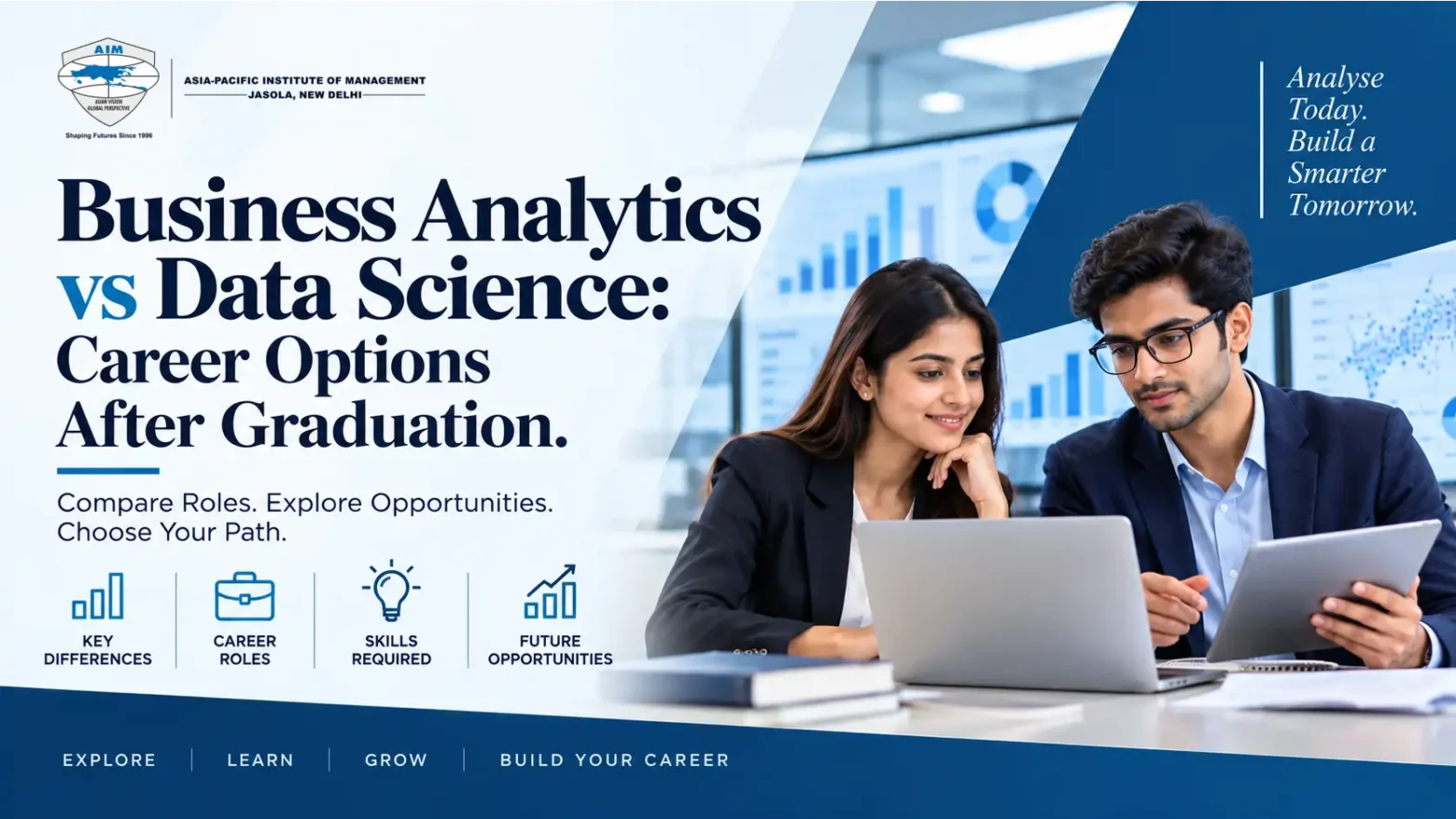
The two paths sound alike and are often mixed up. Business analytics asks what the business should do next. Data science asks whether a model can predict or automate something. Both use data, but they differ in the depth of maths, the amount of coding, and where the professional sits in a company. Many graduates exploring business analytics courses after graduation are unsure how these options differ from data science.
Knowing this before choosing a course saves a lot of confusion later.
Graduates can choose from several routes: management programmes with an analytics specialisation, postgraduate diplomas, MSc degrees in data science, and short certification courses. The MSc route generally expects a strong foundation in maths, statistics, or programming.
Management-based programmes are a good fit for commerce, arts, and engineering graduates who want to work closely with business teams. While comparing courses, students should check for SQL, statistics, data visualisation, and a capstone project. A course built only on theory may leave a candidate unprepared for interviews.
Asia Pacific Institute of Management, New Delhi, offers an AICTE-approved PGDM in Big Data Analytics. The programme blends business understanding with data science, AI, and predictive analytics, and it takes place within a two-year management framework.
It works well for graduates who wish to use analytics within business roles rather than build a purely technical career. Admission follows the institute's standard process, based on CAT, XAT, CMAT, MAT, ATMA, or GMAT scores, and is followed by a group discussion and a personal interview. Applicants should find out which tools are taught and how many live projects they will work on.
A business analytics career in India draws demand from BFSI, e-commerce, retail, telecom, consulting, healthcare, and IT services. Most people start as analysts and grow into senior analysts, analytics managers, or heads of analytics. Some move into product or strategy roles.
Hiring leans heavily on proof. A dashboard a candidate has built, a case study they have solved, or an internship project with real data will carry more weight than a list of tools on a resume.
The data analytics skills for managers that matter are about reading results sensibly, since managers rarely build models themselves. The useful set includes SQL, Excel, one dashboard tool, and basic statistics such as averages, distributions, and regression.
Beyond tools, two habits count. A manager should ask what question the data is meant to answer and should also question the data quality before trusting a chart. Storytelling matters as well, because an insight nobody understands changes nothing.
Career opportunities for business analysts appear under many titles: business analyst, data analyst, BI developer, product analyst, operations analyst, credit analyst, marketing analyst, and analytics consultant.
In IT firms, a business analyst often links clients with developers by documenting requirements. In other companies, the role means studying performance and recommending changes. Candidates should read job descriptions closely, since the same title can mean quite different work.
The right choice depends on a student's comfort with maths and coding and their interest in business problems. Those who lean towards decision-making and communication will find the business route a better fit. AIM's analytics-focused PGDM sits at that business-heavy end.


24 Oct 2026
Fintech and BFSI Careers in India: Skills, Roles and Management Pathways

24 Oct 2026
Digital Marketing and AI: Career Opportunities for Management Graduates

24 Oct 2026
How AI Is Changing Management Careers and the Skills Students Need

24 Oct 2026
PGDM vs MBA in 2026: Which Is Better for Your Career?

24 Oct 2026
CAT 2026 Last-Month Preparation Strategy: A Practical Study Plan






BBA Brochure

PGDM Brochure
MBA Brochure



.webp) Call Us