MBA Healthcare vs General MBA: Which Is Better for Healthcare Careers?
Posted on 09 Oct 2026
By Dr. Vikas Gupta
Introduction
The healthcare industry needs skilled professionals who understand both business management and patient-focused operations. From hospital administration to healthcare technology, management professionals help organizations improve efficiency, service quality, and business performance. Therefore, choosing the right MBA specialization can shape your career opportunities.
If you are comparing MBA healthcare vs general MBA, you may wonder which option offers better career prospects, salary potential, and long-term growth. Both programs develop essential management skills. However, they differ in their curriculum, industry focus, and career pathways.
An MBA in Healthcare Management focuses on the business and operational challenges of healthcare organizations. In contrast, a General MBA develops broader business skills applicable across multiple industries.
In this guide, we will compare both options, explore career opportunities, and explain how to choose the right MBA for your professional goals.
Build Your Healthcare Career
Explore management programs designed to strengthen your business knowledge, develop leadership skills, and prepare you for emerging healthcare management opportunities.
An MBA in Healthcare Management combines business administration principles with healthcare industry knowledge. It prepares students to understand healthcare operations, organizational strategy, service delivery, and resource management.
Unlike a traditional management program, this specialization focuses on the unique challenges of healthcare organizations. These include operational efficiency, patient experience, healthcare regulations, and coordination between departments.
What Do You Learn in an MBA in Healthcare Management?
Depending on the institution and curriculum, subjects may include:
Healthcare operations and hospital administration
Healthcare finance and budgeting
Healthcare marketing and service management
Healthcare quality management
Healthcare information systems
Strategic planning for healthcare organizations
Human resource management in healthcare
Healthcare policy and regulatory fundamentals
Additionally, students may explore healthcare technology, insurance operations, and medical service delivery.
This combination helps learners understand how healthcare organizations operate as businesses while maintaining service quality and patient-focused priorities.
Who Should Consider an MBA in Healthcare Management?
This specialization may suit students who want to build careers in hospitals, healthcare networks, health insurance, pharmaceutical management, or healthcare technology.
It can also interest professionals working in healthcare administration or related services. However, eligibility requirements vary by institution, and some healthcare roles require additional professional qualifications.
What Is a General MBA?
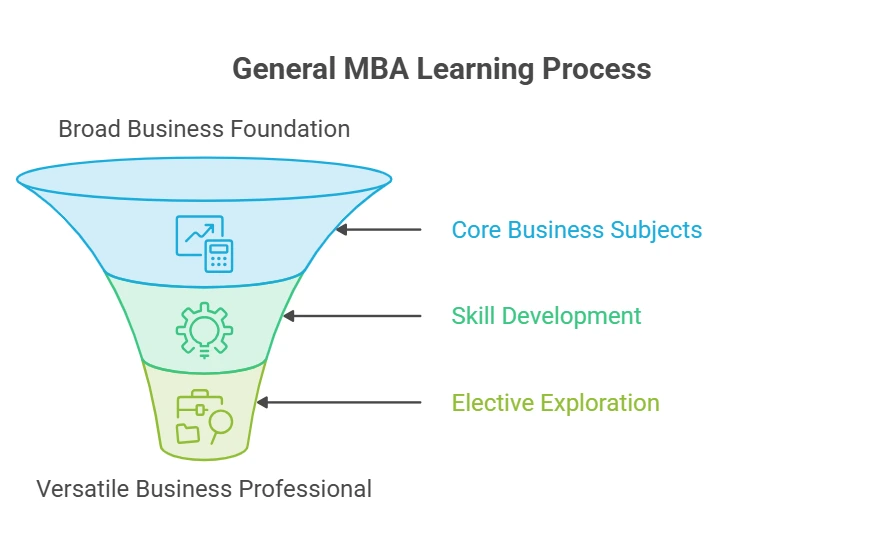
A General MBA provides a broad foundation in business administration and management. Instead of focusing primarily on one industry, it develops skills that organizations across different sectors can use.
Students typically study finance, marketing, human resources, operations, strategy, and business analytics. They also develop decision-making, leadership, communication, and problem-solving skills.
What Do You Learn in a General MBA?
A General MBA curriculum commonly includes:
Financial management and accounting
Marketing management
Human resource management
Operations and supply chain management
Business strategy
Organizational behaviour
Business analytics
Leadership and managerial decision-making
Furthermore, some programs offer electives, projects, internships, or industry assignments that allow students to explore healthcare-related business problems.
Yes. A General MBA can provide a pathway into healthcare businesses, especially roles focused on finance, marketing, operations, consulting, and business development.
For example, a hospital network may need professionals to manage budgets, improve operational processes, or develop marketing strategies. These responsibilities require business skills that a General MBA can help develop.
However, healthcare-specific knowledge can become important for roles involving hospital operations, healthcare regulations, or specialized service delivery.
MBA Healthcare vs General MBA: Key Differences
The main difference lies in the focus of each program. An MBA in Healthcare Management develops management skills within a healthcare context. A General MBA emphasizes transferable business skills across industries.
Comparison factor
MBA in Healthcare Management
General MBA
Primary focus
Healthcare business and operations
Broad business management
Curriculum
Management subjects with healthcare applications
Core business and management subjects
Industry exposure
Primarily healthcare-related
Multiple industries, depending on opportunities
Career direction
Healthcare-focused management roles
Cross-industry management roles
Relevant employers
Hospitals, health insurers, healthcare companies
Healthcare firms and organizations across other sectors
Flexibility
More focused industry preparation
Broader industry flexibility
Best suited for
Students committed to healthcare management
Students exploring multiple business sectors
Nevertheless, the actual learning experience depends on the institution, faculty, electives, internships, and industry exposure. Therefore, compare the curriculum and practical learning opportunities before making a decision.
Healthcare MBA vs MBA: Which Offers Better Career Opportunities?
When comparing healthcare MBA vs MBA, it is important to consider your preferred job responsibilities rather than the degree title alone.
Both pathways can support careers in healthcare businesses. However, they may prepare students differently for particular roles.
Career Opportunities After an MBA in Healthcare Management
Graduates may explore the following career paths, depending on their skills, experience, and employer requirements.
1. Hospital Operations Manager
Hospital operations professionals help coordinate administrative processes, staff resources, service workflows, and operational performance. They work with different departments to support efficient service delivery.
2. Healthcare Business Development Executive
These professionals identify business opportunities, build partnerships, and support organizational growth. Their work may involve market research, client relationships, and strategic planning.
3. Healthcare Quality Management Professional
Quality-focused professionals help monitor service standards, improve processes, and support compliance initiatives. Some positions may require additional knowledge of healthcare quality frameworks.
4. Health Insurance Operations Professional
Health insurance organizations need managers who understand business processes, customer service, claims operations, and service performance. Healthcare industry knowledge can be useful in these roles.
5. Healthcare Consulting Professional
Healthcare consultants help organizations examine operational challenges, improve business processes, and evaluate strategic opportunities. Analytical skills and relevant industry knowledge are particularly valuable.
6. Healthcare Technology Business Professional
Healthcare technology companies need professionals who can connect business requirements with digital products and services. Depending on the position, opportunities may involve product operations, partnerships, implementation, or business development.
These roles illustrate how healthcare management combines business knowledge with an understanding of industry-specific challenges.
Career Opportunities After a General MBA
A General MBA can also support healthcare-related careers, especially when students develop relevant experience or industry knowledge.
Potential roles include:
Business development manager in a healthcare company
Marketing professional for healthcare services
Finance or business planning professional
Operations management professional
Healthcare consulting analyst
Business strategy or growth professional
Additionally, a General MBA may allow graduates to explore careers outside healthcare. This can be helpful when their industry preferences change over time.
However, neither qualification guarantees a particular role. Employers also consider experience, practical skills, internships, recruitment requirements, and individual performance.
Choose Your MBA Path
Compare management learning opportunities and discover a program that aligns with your healthcare ambitions, career interests, and long-term professional goals.
A specialized MBA may offer a more focused understanding of an industry's business environment. A General MBA, meanwhile, provides a wider foundation that can support different career directions.
Choose an MBA in Healthcare Management If:
You want to build a long-term career in healthcare management.
You are interested in hospital administration and healthcare operations.
You want to understand healthcare-specific business challenges.
You prefer industry-focused learning and relevant practical projects.
You plan to explore management roles within healthcare organizations.
For example, a student interested in improving hospital efficiency may benefit from studying healthcare operations and service management.
Choose a General MBA If:
You are still exploring different industries.
You want broad exposure to business functions.
You are interested in finance, marketing, strategy, or operations across sectors.
You want the flexibility to consider healthcare and non-healthcare employers.
You plan to build healthcare expertise through electives, internships, or professional experience.
For instance, a student interested in corporate finance could pursue healthcare finance opportunities with a General MBA, provided the employer's requirements are met.
Ultimately, your preferred job role should guide your decision more than the popularity of a particular specialization.
MBA Healthcare Management vs MBA: What About Salary and Career Growth?
Salary is an important consideration when choosing a management program. However, comparing salaries based only on specialization can be misleading.
Compensation varies according to job responsibilities, location, employer size, prior experience, and individual performance. It can also differ significantly between entry-level positions and senior management roles.
What Influences Salary After an MBA?
Several factors can affect your earning potential:
Work experience: Relevant experience can strengthen your suitability for managerial roles.
Practical skills: Analytical thinking, communication, problem-solving, and project management are valuable.
Industry knowledge: Understanding healthcare operations can help with industry-specific responsibilities.
Employer and location: Compensation varies across organizations, cities, and job markets.
Internships and projects: Relevant experience can help demonstrate your capabilities to recruiters.
Career progression: Greater responsibility and demonstrated performance may support advancement.
An MBA in Healthcare Management does not automatically guarantee a higher salary than a General MBA. Similarly, a General MBA does not automatically provide better compensation or faster career growth.
Therefore, review recent placement information, role descriptions, internship opportunities, and employer expectations before comparing programs.
What Is the Best MBA for Healthcare Career Opportunities?
The best MBA for healthcare career opportunities is the program that aligns with your intended role, learning needs, and long-term professional plans.
Students should evaluate more than the specialization name. A strong management education should help them develop practical business skills and understand real organizational challenges.
Factors to Consider Before Choosing an MBA
1. Curriculum relevance
Review the subjects offered and determine whether they support your career interests. Healthcare-focused roles may require knowledge of hospital operations, healthcare finance, or service quality.
2. Faculty experience
Look for faculty members with relevant academic expertise and practical industry understanding. Experienced faculty can help connect management concepts with workplace situations.
3. Industry exposure
Check whether the program offers industry interactions, guest sessions, projects, case studies, or internships. These experiences can help students understand professional expectations.
4. Practical learning
Business simulations, group projects, case discussions, and applied assignments can strengthen decision-making and analytical skills.
5. Placement support
Review the institution's placement process, employer participation, role profiles, and available placement reports. Ask how the program supports students pursuing their preferred industries.
6. Alumni and career outcomes
Where reliable information is available, examine alumni career paths and the kinds of organizations that recruit graduates. Remember that individual outcomes vary.
How Asia Pacific Institute of Management Fits Into Your Decision
Asia Pacific Institute of Management emphasizes industry-oriented management education, experienced faculty, practical learning, corporate exposure, and placement support.
These factors can be relevant when evaluating a management program and its ability to prepare students for professional responsibilities.
However, students interested specifically in healthcare management should verify the current program offerings, curriculum, electives, and industry exposure directly with the institute. This ensures that the available program matches their intended career direction.
How to Prepare for a Healthcare Management Career During Your MBA
Your specialization matters, but your preparation outside the classroom also plays an important role.
You can strengthen your career readiness through a few practical steps.
Step 1: Research healthcare business roles. Identify whether you prefer hospital operations, healthcare marketing, consulting, insurance, or technology-related work.
Step 2: Build analytical skills. Learn to interpret business data, evaluate operational problems, and communicate evidence-based recommendations.
Step 3: Develop industry awareness. Follow developments in digital health, healthcare service delivery, insurance, and healthcare business models.
Step 4: Seek relevant projects. Whenever possible, select assignments or internships related to healthcare organizations and their management challenges.
Step 5: Improve communication and leadership. Healthcare businesses involve collaboration across departments. Clear communication and effective teamwork are therefore important.
Step 6: Understand employer expectations. Review job descriptions to identify the qualifications, experience, and skills required for your preferred roles.
Conclusion: MBA Healthcare vs General MBA — Which Should You Choose?
The decision between an MBA in Healthcare Management and a General MBA depends on your career priorities.
If you want to focus on hospital administration, healthcare operations, or healthcare business services, a healthcare-focused specialization may be a suitable choice. It can help you understand industry-specific challenges while developing management capabilities.
On the other hand, a General MBA may suit students who want broader business knowledge and the flexibility to explore multiple industries, including healthcare.
Before making your decision, compare curricula, practical learning opportunities, faculty experience, industry exposure, and placement support. Additionally, research the qualifications employers expect for your preferred roles.
Ready to take the next step in your management career? Explore the management education opportunities at Asia Pacific Institute of Management. Review the available programs, curriculum, and admission requirements to identify the pathway that best supports your professional goals.
Advance Your Management Future
Take the next step toward your management goals by exploring MBA programs, practical learning opportunities, and admission requirements today.
Dr. Vikas Gupta is a distinguished academic in the education and research domain, specializing in finance and related interdisciplinary studies. He is known for his...
01.
Is an MBA in Healthcare Management better than a General MBA?
An MBA in Healthcare Management may suit students committed to healthcare-focused careers. A General MBA may be better for students seeking broader industry flexibility. The right choice depends on your intended role, curriculum preferences, and career plans.
02.
Can I work in a hospital after a General MBA?
Yes. A General MBA can support applications for suitable hospital business and administrative roles. However, employers may require healthcare experience or specific knowledge for certain positions.
03.
What is the difference between healthcare MBA vs MBA?
A healthcare MBA focuses on management challenges within healthcare organizations. A General MBA develops broader business skills that can apply across industries, including healthcare.
04.
Is a specialized MBA better than a General MBA?
Neither option is universally better. A specialized MBA provides more focused industry preparation, while a General MBA offers broader business exposure. Your career objectives should determine which approach is more suitable.
05.
Can non-medical students pursue an MBA in Healthcare Management?
Many healthcare management programs accept graduates from different academic backgrounds. However, eligibility criteria vary by institution. Students should check the specific program’s admission requirements before applying.
06.
What jobs can I pursue after an MBA in Healthcare Management?
Potential roles include hospital operations manager, healthcare business development professional, health insurance operations professional, healthcare consultant, and healthcare technology business professional. Actual eligibility depends on employer requirements and relevant experience.
07.
Does a General MBA offer career opportunities in the healthcare industry?
Yes. General MBA graduates may explore healthcare marketing, finance, business development, operations, and consulting roles. Relevant projects, internships, and industry knowledge can strengthen their profiles.
08.
How should I choose the best MBA for healthcare career growth?
Compare the curriculum, faculty expertise, practical learning, industry exposure, placement support, and relevant career outcomes. Additionally, verify eligibility requirements and ensure the program aligns with your preferred healthcare role.


















.webp) Call Us
Call Us