PGDM Applications at AIM Are Closing Soon | Secure Your Seat Now

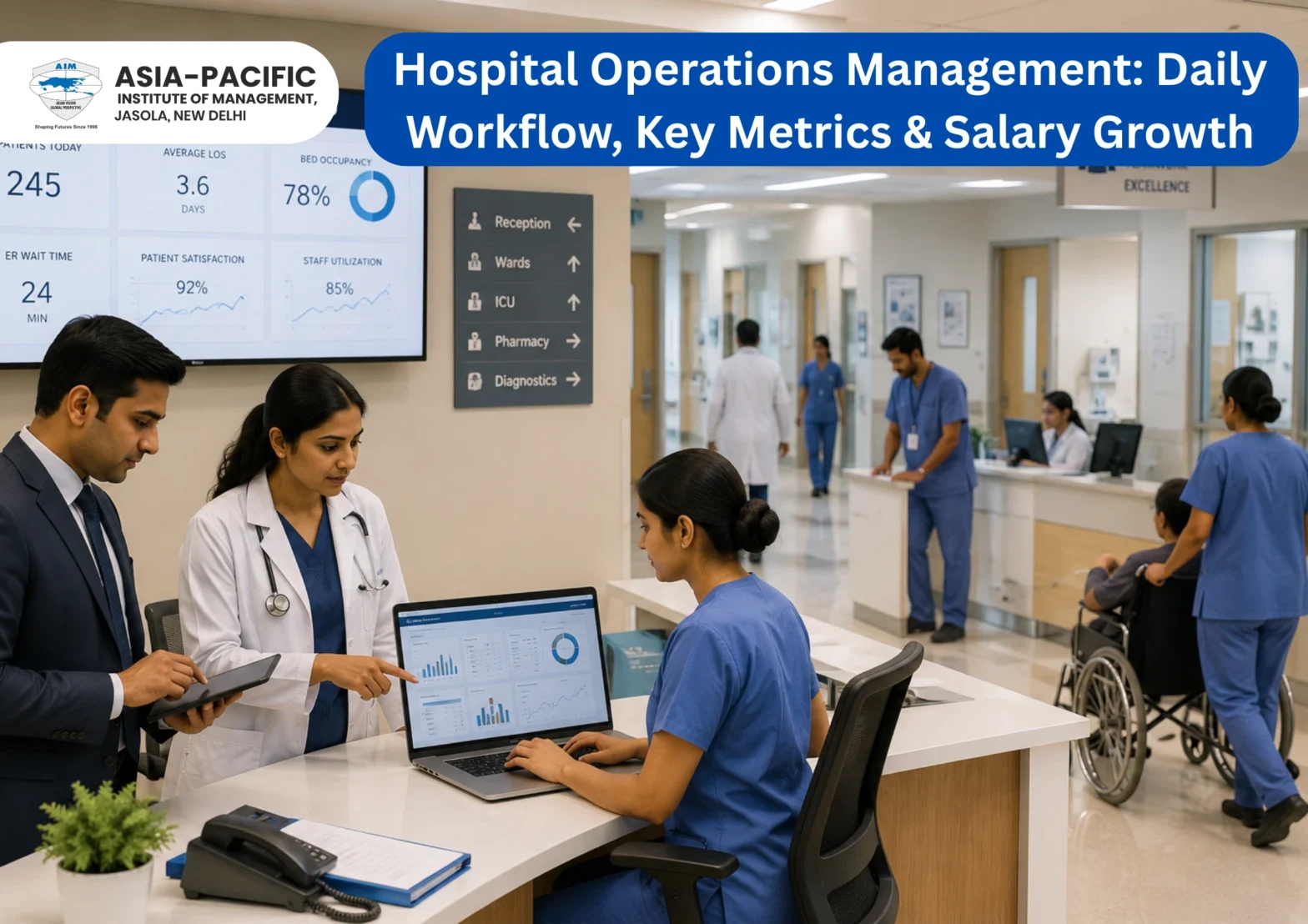
Hospital Operations Management: Daily Workflow, Key Metrics & Salary Growth

By Dr. Vikas Gupta

Hospital Operations Management: Daily Workflow, Key Metrics & Salary Growth

Introduction

A hospital can have experienced doctors, advanced equipment, and strong clinical departments. Yet patients may still face delayed admissions, long OPD queues, unavailable beds, slow diagnostics, and discharge bottlenecks.

These problems often come back to operations.

Hospital operations management focuses on making different hospital departments work together efficiently while supporting safe and timely patient care.

Operations managers coordinate patient flow, beds, departments, staffing, support services, complaints, emergency requirements, and performance data. They do not replace doctors or nurses. Instead, they create systems that help clinical teams work effectively.

For MBA and healthcare management students, hospital operations can offer a practical career pathway because it combines people management, analytics, process improvement, technology, and healthcare administration.

This guide explains a hospital operations manager's daily workflow, important KPIs such as bed turnover rate and average length of stay, OPD queue management, clinical workflow optimization, and realistic salary growth in India.

Lead Hospital Operations

Build practical skills in patient flow, analytics, quality, technology, and leadership to prepare for rewarding hospital management careers.

Apply Now

What Is Hospital Operations Management?

Hospital operations management is the planning, coordination, monitoring, and improvement of the processes required to deliver healthcare services efficiently. It covers patient flow, bed utilization, departmental coordination, staffing, support services, resource availability, and operational performance while keeping quality and patient safety central.

The role connects several departments.

These may include:

  • Emergency
  • OPD
  • Inpatient wards
  • ICU
  • Operation theatres
  • Diagnostics
  • Pharmacy
  • Billing
  • Housekeeping
  • Security
  • Facilities
  • Patient services

Therefore, hospital operations is highly cross-functional.

NABH's current hospital accreditation framework also emphasizes coordinated patient journeys, defined processes, performance indicators, and continuous quality improvement across hospital functions.

What Does a Hospital Operations Manager Do Daily?

No two days are exactly the same.

However, the typical workflow involves reviewing the hospital's current status, identifying operational risks, coordinating departments, and tracking unresolved issues.

Morning Operations Review

The day may begin with a review of:

  • Current occupancy
  • Available beds
  • Expected discharges
  • Emergency admissions
  • ICU availability
  • Planned surgeries
  • OPD schedules
  • Staffing shortages
  • Equipment issues

The manager needs to identify potential bottlenecks early.

For example, if occupancy is high and few discharges are expected, emergency admissions may become difficult later.

Therefore, bed planning begins before the problem occurs.

Department Coordination

Hospital services are interdependent.

A discharge may require:

Doctor clearance → Nursing completion → Pharmacy return → Discharge summary → Billing → Patient counselling → Transport

If one stage is delayed, the bed remains occupied.

An operations manager therefore follows issues across departments rather than looking at each department in isolation.

This is one of the central principles of clinical workflow optimization.

Floor Rounds

Operations managers often conduct physical rounds.

Dashboards provide useful information.

However, a dashboard may not reveal:

  • A crowded waiting area
  • Poor signage
  • An unattended patient
  • Housekeeping delays
  • A damaged wheelchair
  • Confusion at registration

Floor rounds allow managers to compare reported performance with actual conditions.

Managers may speak with:

  • Nursing teams
  • Front-office staff
  • Patients
  • Department coordinators
  • Housekeeping
  • Security

These observations can reveal operational problems early.

Bed Management

Bed availability is one of the most critical operational responsibilities.

Managers need visibility into:

  • Occupied beds
  • Vacant beds
  • Expected discharges
  • Beds awaiting cleaning
  • Beds blocked for maintenance
  • ICU capacity
  • Isolation requirements

The challenge is not simply maximizing occupancy.

Very high occupancy can reduce the hospital's ability to handle emergencies.

Therefore, bed utilization must balance efficiency with capacity resilience.

What Is Bed Turnover Rate?

Bed turnover rate measures how frequently available hospital beds are used by different patients during a defined period.

Conceptually:

Bed Turnover Rate = Number of discharges, including deaths, ÷ Number of available beds

Hospitals may use slightly different definitions or reporting conventions.

Therefore, managers should follow their organization's approved KPI methodology.

A higher turnover may indicate efficient use of beds.

However, the number should never be optimized without context.

High turnover could also reflect:

  • Short-stay services
  • Different patient mix
  • High admission demand

Similarly, excessively rapid turnover should not result in unsafe discharge decisions.

Managers should therefore interpret bed turnover alongside other metrics.

What Is Average Length of Stay (ALOS)?

Average length of stay (ALOS) measures the average number of days patients remain admitted during a specified period.

It is one of the most useful indicators in inpatient hospital operations.

A simplified conceptual formula is:

ALOS = Total inpatient days for discharged patients ÷ Number of discharges

ALOS can help managers understand:

  • Bed utilization
  • Patient flow
  • Discharge efficiency
  • Specialty patterns
  • Capacity requirements

However, lower ALOS is not automatically better.

A complex surgical patient may appropriately remain hospitalized longer than a routine short-stay patient.

Therefore, managers should compare similar patient groups and specialties.

The goal is to reduce avoidable delays, not medically necessary hospitalization.

How Hospital Managers Can Improve ALOS

Operations teams should investigate why patients remain admitted after they are clinically ready to move forward.

Potential reasons include:

  • Delayed investigations
  • Specialist review delays
  • Discharge-summary delays
  • Pharmacy clearance
  • Billing
  • Transport
  • Home-care arrangements

Managers can map the discharge process.

For example:

Expected discharge identified → Clinical clearance → Documentation → Pharmacy → Billing → Counselling → Exit

Each stage can be timed.

The team can then identify the actual bottleneck.

This is better than simply instructing employees to "discharge faster."

OPD Queue Management

OPD queue management is another major part of hospital operations.

Patients may wait at several points:

  • Registration
  • Consultation
  • Diagnostics
  • Billing
  • Pharmacy

A manager must identify where waiting occurs.

Suppose patients complain about long doctor waiting times.

The actual issue may be registration.

Alternatively, appointment scheduling may create too many patients during one hour.

Therefore, managers should map the complete patient journey.

How to Improve OPD Queue Management

Analyze Arrival Patterns

Patient demand usually changes throughout the day.

Managers should identify peak periods.

For example, if most patients arrive between 9 AM and 11 AM, staffing should reflect that demand.

Separate Patient Categories

The hospital may have different workflows for:

  • New patients
  • Follow-up patients
  • Appointment patients
  • Walk-ins
  • Senior citizens
  • Emergency cases

Appropriate segmentation can reduce unnecessary congestion.

Use Digital Registration

Where suitable, digital pre-registration can reduce repeated data entry.

However, support should remain available for patients who are uncomfortable with technology.

Improve Doctor Scheduling

Appointments should reflect actual consultation duration and historical demand.

Scheduling 30 patients into one short time block creates predictable queues.

Monitor Waiting-Time KPIs

Managers can track:

  • Registration waiting time
  • Consultation waiting time
  • Diagnostic waiting time

NABH's current standards include defined KPIs and emphasize systematic monitoring rather than relying only on informal impressions.

Clinical Workflow Optimization

Clinical workflow optimization means improving how patients, information, staff, and resources move through healthcare processes.

The manager does not redesign clinical decisions independently.

Instead, operations teams work with clinicians to remove avoidable process inefficiencies.

Consider a diagnostic workflow:

Doctor orders test → Patient reaches diagnostic unit → Test performed → Result generated → Doctor reviews result

Delays can occur at every stage.

A manager may investigate:

  • Order communication
  • Patient transport
  • Scheduling
  • Equipment capacity
  • Reporting turnaround
  • Result notification

The objective is to reduce avoidable waiting without compromising quality.

Advance Healthcare Management

Turn your interest in hospital operations into career-ready expertise across process improvement, analytics, finance, quality, technology, and management.

Apply Now

Key Hospital Operations Metrics

Strong operations teams use data.

However, measuring everything can create information overload.

A useful dashboard may focus on a manageable group of indicators.

Bed Occupancy Rate

Shows how much inpatient capacity is being used.

Bed Turnover Rate

Shows how frequently beds serve different patients.

Average Length of Stay

Measures average inpatient duration.

OPD Waiting Time

Measures patient-flow performance.

Discharge Turnaround Time

Measures the time required to complete discharge after the relevant clinical decision.

Emergency Department Length of Stay

Helps track ER flow.

Diagnostic Turnaround Time

Shows how quickly priority tests and reports are completed.

Patient Satisfaction

Helps identify service problems.

Complaint Resolution Time

Measures responsiveness.

The best KPI is not necessarily the most sophisticated.

It is one that helps managers decide what action to take.

Bonus: Healthcare Jobs Abroad: Salary & Visa Guide 

A Sample Daily Hospital Operations Dashboard

A morning dashboard could display:

MetricCurrent StatusManagement Question
Bed occupancyHighAre enough discharges expected today?
Available ICU bedsLimitedDo we need escalation planning?
Expected dischargesBelow targetWhich departments have delays?
OPD waiting timeIncreasingWhere is the bottleneck?
OT utilizationBelow planWere procedures cancelled or delayed?
Diagnostic TATAbove targetWhich investigation is causing delay?

The purpose is not to create attractive charts.

It is to trigger action.

Hospital Operations and Patient Experience

Operations directly influence how patients perceive a hospital.

Patients often judge service through everyday experiences.

These include:

  • Waiting
  • Staff responsiveness
  • Cleanliness
  • Room readiness
  • Billing
  • Discharge
  • Communication

Therefore, operations managers may work closely with patient-experience teams.

A complaint such as:

"My discharge took four hours"

should become an operational question.

Where did those four hours go?

The manager can trace the process and identify the delay.

Managing Housekeeping and Bed Turnaround

A discharged patient does not immediately create a usable bed.

The room may require:

  • Cleaning
  • Linen replacement
  • Waste removal
  • Equipment preparation
  • Inspection

Managers therefore need to track bed turnaround time.

A possible workflow is:

Patient leaves → Housekeeping notified → Cleaning begins → Room inspected → Bed marked available

Delays in communication can waste valuable capacity.

Digital bed-status systems can improve visibility.

However, technology only works when responsibilities are clearly defined.

Managing Emergency Admissions

Emergency admissions create unpredictability.

An operations manager may begin the day expecting 20 vacant beds.

Several emergencies can change the situation quickly.

Therefore, managers need escalation procedures.

Possible actions may include:

  • Prioritizing pending discharges
  • Reviewing blocked beds
  • Coordinating inpatient transfers
  • Activating additional operational resources

Clinical decisions must remain with qualified healthcare professionals.

The administrator supports the resources required to implement those decisions.

Operation Theatre Management

Operating theatres are expensive resources.

Poor utilization can affect both patient care and financial performance.

Managers may monitor:

  • Scheduled surgeries
  • Actual start times
  • Cancellation rates
  • Turnaround between cases
  • OT utilization
  • Equipment availability

A delayed first surgery can affect the entire day's schedule.

Therefore, operations teams coordinate with:

  • Surgeons
  • Anaesthesia
  • Nursing
  • Sterilization
  • Blood bank
  • Patient transport

This demonstrates why hospital operations requires cross-functional management.

Managing Support Services

Clinical care depends heavily on non-clinical support.

Operations may therefore coordinate:

Housekeeping

Cleanliness and infection-control support.

Security

Patient, visitor, and employee safety.

Facility Management

Power, water, air-conditioning, elevators, and infrastructure.

Patient Transport

Wheelchairs, stretchers, ambulances, and internal movement.

Food Services

Patient meals and dietary coordination.

A breakdown in any support service can affect healthcare delivery.

The Role of Technology in Hospital Operations

Modern hospital administrators increasingly use digital systems.

These can include:

  • Hospital information systems
  • Bed-management software
  • Queue-management systems
  • Dashboards
  • Electronic medical records
  • Patient feedback platforms

Technology improves visibility.

For example, a manager can see whether a bed is:

  • Occupied
  • Under discharge
  • Awaiting cleaning
  • Available

However, technology should support processes rather than compensate for badly designed workflows.

Hospital Floor Manager Role

The hospital floor manager is often one of the closest operational roles to daily patient care.

Responsibilities may include:

  • Monitoring ward operations
  • Coordinating patient movement
  • Handling service concerns
  • Following discharges
  • Coordinating departments
  • Ensuring room readiness
  • Escalating operational issues

A floor manager may act as the link between patients, clinical teams, and hospital administration.

This role can provide valuable early-career exposure for healthcare management graduates.

Hospital Floor Manager Salary in India

Searches for hospital floor manager salary are common among MBA students exploring operations careers.

However, salary data should be interpreted carefully.

Current online sources show significant variation. For example, Indeed lists a general India floor-manager average of about ₹24,116 per month as of March 2026, while a hospital-specific listing reported approximately ₹25,257 per month. Other current job-market estimates vary significantly by city and role definition.

Therefore, there is no reliable universal hospital floor manager salary.

Compensation depends on:

  • City
  • Hospital size
  • Qualification
  • Experience
  • Shift requirements
  • Responsibilities
  • Employer type

Candidates should verify salary through current job postings and formal employer offers.

How Salary Growth Works in Hospital Operations

Hospital operations careers usually develop through increasing responsibility.

An illustrative pathway may look like:

Management Trainee → Operations Executive → Floor Manager/Assistant Manager → Operations Manager → Senior Manager → Unit Operations Head → Hospital Administrator/COO

Titles vary between hospitals.

Salary growth usually comes from greater responsibility rather than years of service alone.

Professionals who manage larger:

  • Teams
  • Departments
  • Budgets
  • Projects
  • Hospital units

may gain access to higher-level opportunities.

What Can Improve Salary Growth?

Experience

Hospital operations knowledge develops through practical exposure.

Larger Responsibility

Managing one ward differs from managing an entire facility.

Analytical Skills

Managers who understand KPIs and dashboards can contribute to better decisions.

Quality Knowledge

NABH and process-improvement knowledge can strengthen hospital-management profiles.

Financial Understanding

Senior operations leaders need to understand costs and budgets.

Leadership

Managing conflicts and multidisciplinary teams becomes increasingly important at senior levels.

Therefore, students should focus on building capability rather than chasing a job title alone.

Skills Required for Hospital Operations Management

Process Management

Understand how hospital workflows connect.

Data Analysis

Managers should interpret KPIs rather than only collect them.

Communication

Operations requires continuous interdepartmental coordination.

Problem-Solving

Hospital situations change quickly.

Healthcare Quality

Managers should understand patient safety and accreditation principles.

Financial Awareness

Operational decisions affect costs.

Leadership

Managers need to influence teams across multiple professional groups.

Hospital Operations Management vs Hospital Administration

The terms sometimes overlap.

However, hospital operations usually focuses more heavily on daily execution.

Hospital administration may involve a broader range of functions.

These can include:

  • Strategy
  • Finance
  • HR
  • Governance
  • Operations

An operations manager may therefore eventually progress into broader hospital administration.

How Freshers Can Enter Hospital Operations

MBA and healthcare management students can begin through roles such as:

  • Operations executive
  • Management trainee
  • Floor coordinator
  • Patient services executive
  • Quality executive
  • Administrative executive

The first role should help you understand actual hospital workflows.

Do not underestimate entry-level operational exposure.

Following admissions, discharge, OPD, and patient complaints can build knowledge that textbooks cannot fully provide.

A Practical Hospital Operations Project for MBA Students

Students can build a project around:

“Improving Patient Flow Using Hospital Operations KPIs.”

Use simulated or authorized de-identified data.

Track:

  • OPD arrival time
  • Consultation waiting time
  • Admission
  • Discharge
  • Bed occupancy
  • ALOS

Then identify:

  • Bottlenecks
  • Peak hours
  • Delayed processes
  • Potential improvement opportunities

The final project can include a simple operations dashboard.

Such practical work can strengthen a healthcare management profile.

Why Healthcare MBA Students Should Learn Hospital Operations

Hospital operations brings together almost every major management discipline.

It requires:

Operations + Analytics + HR + Finance + Quality + Technology + Communication

This makes it a valuable learning environment for MBA students.

At Asia Pacific Institute of Management, an industry-oriented curriculum, experienced faculty, practical learning, corporate exposure, and placement support can help students develop broader managerial capabilities.

For students interested in healthcare, understanding real-world operational challenges can support preparation for roles in hospital administration, quality, analytics, and service management.

Bonus: Top Healthcare Internships for Career Growth 

Conclusion

Hospital operations management is where healthcare strategy becomes daily execution.

Operations managers ensure that beds become available, patients move efficiently, OPDs remain organized, support services function, and departments communicate.

They also use metrics such as:

  • Bed turnover rate
  • Average length of stay
  • OPD waiting time
  • Discharge turnaround
  • Bed occupancy
  • Diagnostic turnaround

However, good operations management is not about making every number smaller or larger.

A lower ALOS is useful only when discharge is clinically appropriate.

A high bed turnover rate is valuable only when safety and quality remain strong.

Therefore, effective hospital managers combine data with context.

For MBA and healthcare management students, hospital operations offers an opportunity to build practical skills across analytics, process improvement, technology, quality, and leadership.

As responsibilities grow from floor-level coordination toward hospital-wide operations, professionals can also build pathways toward senior administration and leadership.

Build Operations Leadership

Prepare for growing healthcare responsibilities with industry-focused learning in hospital workflows, performance metrics, problem-solving, technology, and strategic leadership.

Apply Now

About the Author

author

Dr. Vikas Gupta

Dr. Vikas Gupta is a distinguished academic in the education and research domain, specializing in finance and related interdisciplinary studies. He is known for his...

Read Full Bio →

Frequently Asked Questions (FAQs)

01. What is hospital operations management?

Hospital operations management coordinates daily healthcare processes such as patient flow, beds, departments, staffing, support services, resources, and performance indicators.

02. What does a hospital operations manager do every day?

Typical responsibilities include reviewing occupancy, managing beds, coordinating departments, conducting rounds, resolving patient-flow issues, tracking KPIs, and escalating operational problems.

03. What is bed turnover rate?

Bed turnover rate measures how frequently hospital beds are used by different patients during a defined period. It should be interpreted alongside occupancy, ALOS, patient mix, and clinical needs.

04. What is average length of stay (ALOS)?

Average length of stay measures the average inpatient duration for discharged patients over a defined period. Managers use it to understand capacity and patient-flow performance.

05. How can hospitals improve OPD queue management?

Hospitals can analyze arrival patterns, improve appointment scheduling, separate appropriate patient streams, strengthen registration workflows, and monitor waiting-time data.

06. What is a hospital floor manager salary in India?

Salary varies widely by employer, city, experience, qualification, and responsibilities. Current public salary data show substantial variation, so applicants should verify compensation directly with employers.

07. What is clinical workflow optimization?

Clinical workflow optimization involves improving how patients, information, and resources move through healthcare processes while keeping clinical decisions under qualified professional authority.

08. Is hospital operations a good career after an MBA?

It can be a strong career path for students interested in healthcare, process improvement, analytics, patient experience, and cross-functional management. Career outcomes depend on skills, experience, employer needs, and performance.

Follow Us

Subscribe to Our Newsletter

Download Brochure

BBA Brochure

PGDM Brochure

MBA Brochure

Apply Now Call Us Email WhatsApp