Hospitals operate in one of the most legally sensitive service environments.
A patient may arrive with an emergency, undergo an invasive procedure, share highly sensitive personal information, or depend on several departments during one episode of care. A failure in communication, documentation, consent, clinical coordination, or data handling can therefore become more than an operational problem.
It can create legal exposure.
For hospital managers, understanding medical negligence laws India is not about practising law or making clinical decisions. It is about building systems that help healthcare professionals provide safe, documented, transparent, and accountable care.
The Consumer Protection Act, 2019 provides a statutory framework for complaints involving deficiency in services, while Indian courts continue to hear medical-negligence matters through consumer forums and other legal routes. In a February 2026 judgment, the Supreme Court dealt with a consumer dispute involving findings of deficiency in service and medical negligence, confirming the continuing practical importance of consumer-law exposure for healthcare providers.
This guide explains the areas hospital administrators should understand, including consumer complaints, informed consent, medico-legal cases, patient records, data protection, and the role of the hospital legal team.
Important: This article is for educational and management-learning purposes. It is not legal advice. Hospitals should obtain advice from qualified legal professionals and follow applicable central, state, local, professional, and regulatory requirements.
Transform Healthcare Into Leadership
Turn your healthcare background into strategic management expertise and prepare for leadership opportunities across hospitals, rehabilitation, operations, and administration.
What Do Medical Negligence Laws in India Mean for Hospital Managers?
Medical negligence laws India generally concern whether healthcare professionals or organizations failed to meet an applicable standard of reasonable care and whether that failure caused legally recognized harm. For managers, the key responsibility is to create systems that support competent care, accurate documentation, informed consent, communication, escalation, and regulatory compliance.
Negligence is not established merely because treatment produced an undesirable result.
Medicine involves uncertainty.
A patient may experience a complication even when appropriate care was provided.
Therefore, managers should avoid equating every complaint, complication, readmission, or death with negligence.
At the same time, poor systems can increase legal risk.
Examples include:
Delayed emergency response
Missing clinical records
Incorrect patient identification
Inadequate consent processes
Poor handovers
Failure to escalate deterioration
Miscommunication about procedures
Medication-process failures
Inappropriate disclosure of patient information
Weak medico-legal documentation
The National Medical Commission’s published Code of Medical Ethics states that a registered medical practitioner should not wilfully commit negligence that deprives a patient of necessary medical care.
Hospital managers therefore need to support clinicians with reliable systems.
How the Consumer Protection Act Affects Hospitals
The Consumer Protection Act, 2019 establishes mechanisms through which consumers can seek remedies for matters including deficiency in services. It provides for District, State, and National Consumer Disputes Redressal Commissions within the statutory framework.
Healthcare disputes have long been litigated under consumer law in India.
Supreme Court decisions continue to demonstrate that hospitals and medical professionals can face consumer proceedings involving alleged negligence and deficiency in service.
For administrators, this means patient service cannot be viewed only as a clinical relationship.
It also creates responsibilities around:
Service delivery
Communication
Documentation
Billing transparency
Records
Complaint handling
Follow-up
Organizational accountability
The hospital should therefore have systems that can demonstrate what happened.
A legally defensible process usually depends heavily on reliable evidence.
Consumer Court Hospital Cases: What Managers Should Learn
Consumer court hospital cases often reveal an important management lesson: documentation, communication, and process discipline matter.
A hospital may believe its team acted appropriately.
However, if records are incomplete, inconsistent, illegible, or unavailable, reconstructing the episode later becomes difficult.
Managers should ensure that important records are:
Created at the correct time
Legible
Complete
Dated
Time-stamped where appropriate
Attributable to the responsible professional
Stored securely
Retrievable when lawfully required
Records should not be created retrospectively merely because a complaint has arisen.
Improper alteration can create additional legal and ethical concerns.
Therefore, organizations should establish clear medical-record policies before disputes occur.
The Difference Between a Bad Outcome and Negligence
Hospital managers should understand this distinction clearly.
A poor clinical outcome does not automatically prove negligence.
Complications may occur despite appropriate care.
Similarly, a treatment may fail even when accepted standards were followed.
A negligence allegation generally requires examination of questions such as:
Was a duty of care present?
What standard of care applied?
Was there a breach?
Did the breach contribute to the claimed harm?
These are legal and expert questions.
Administrators should not independently determine legal liability.
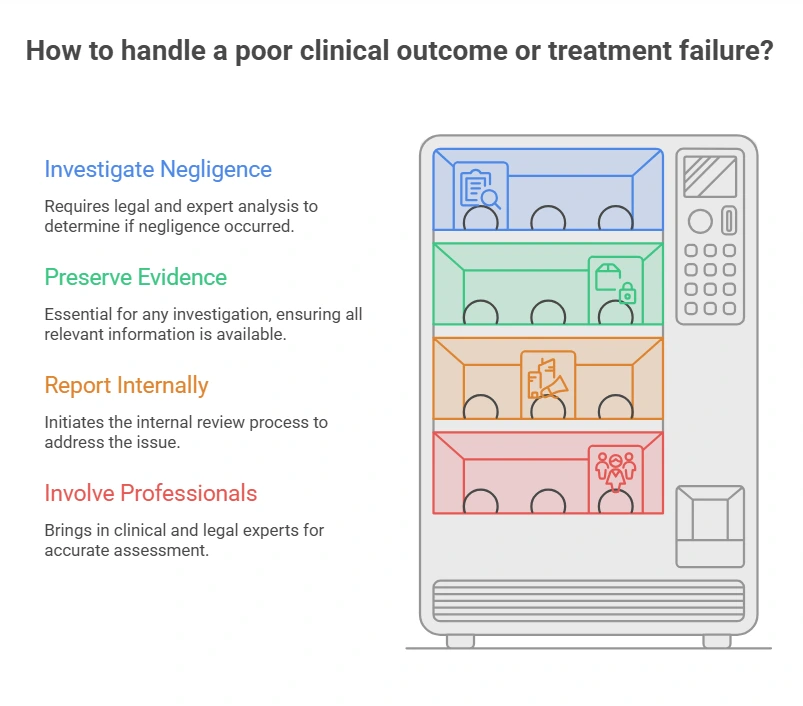
Instead, they should preserve evidence, report the matter internally, and involve the appropriate clinical and legal professionals.
Informed Consent Management: More Than a Signature
Consent should not be treated as a form collected immediately before a procedure.
The signature is only evidence of a broader communication process.
Depending on the procedure and applicable requirements, the patient may need information about:
The proposed procedure
Its purpose
Material risks
Expected benefits
Reasonable alternatives
Possible consequences of refusing
Anaesthesia, where relevant
Blood or blood products, where relevant
Additional procedures that may become necessary
The NMC-hosted Code of Medical Ethics requires written consent before an operation and sets out consent expectations in specified circumstances.
However, hospital managers should ensure their policies are aligned with current law, professional requirements, and legal advice.
Who Is Responsible for Explaining a Procedure?
Administrative employees should not independently explain clinical risks that require medical judgement.
The clinician responsible for the procedure, or another appropriately qualified and authorized professional, should provide the required clinical explanation.
Hospital administration supports the process by ensuring:
Correct consent forms are available
Appropriate languages are supported
Patient identity is verified
Required signatures are obtained
Date and time are documented
Witnessing requirements are followed
Forms are stored in the record
Staff understand escalation procedures
Therefore, management owns the reliability of the system.
Clinical professionals remain responsible for clinical explanations within their scope.
Common Consent Management Errors
Hospital managers should audit for common weaknesses.
These may include:
Blank sections
Missing patient identifiers
Generic procedure descriptions
Consent obtained after the procedure begins
Missing doctor signatures
Unclear corrections
Language barriers not addressed
Forms that do not match the actual procedure
Consent signed by inappropriate persons
Failure to document refusal
A signed form should never create false confidence.
If the patient did not understand what was being discussed, the consent process may still be challenged.
Refusal of Treatment
Patients may refuse recommended treatment in circumstances where they are legally capable of doing so.
Hospitals should have clear procedures for documenting refusal.
The record may need to capture:
Advice provided
Risks explained
Alternatives discussed
Patient questions
Patient decision
Persons present
Follow-up or emergency advice
Managers should ensure employees do not use threatening or coercive language.
The objective is informed decision-making and appropriate documentation.
What Is a Medico-Legal Case?
A medico-legal case, commonly called an MLC, is a case in which medical care intersects with a matter requiring legal investigation or documentation.
Examples can include certain:
Road traffic injuries
Assaults
Poisoning cases
Burns
Suspected sexual offences
Unexplained injuries
Brought-dead cases
Other circumstances requiring legal reporting
However, precise classification and reporting obligations depend on applicable law, institutional policy, and circumstances.
Therefore, employees should follow the hospital’s approved protocol rather than making informal assumptions.
The Directorate General of Health Services Hospital Manual issued in April 2025 contains specific guidance for maintaining medico-legal records and emphasizes completeness and legibility in MLC documentation.
A hospital MLC process may need to define:
Identification of potential medico-legal cases
Immediate medical stabilization
Registration
Notification to authorized personnel
Police intimation where legally required
Clinical examination
Documentation
Evidence handling
Record security
Discharge, transfer, or death procedures
Clinical care should not be unnecessarily delayed while administrative formalities are completed.
Records should accurately describe observations rather than speculation.
For example, clinicians may document the size, location, appearance, and characteristics of an injury rather than making unsupported conclusions about how it occurred.
Managers should support clear documentation systems.
The hospital may need processes for:
MLC numbering
Police communication
Record custody
Evidence transfer
Identification of authorized staff
Court requests
Copies of records
Death documentation
Because these areas can have criminal and civil implications, hospitals should involve qualified legal and forensic professionals when necessary.
Never Alter a Medical Record After a Complaint
A complaint can create pressure to “complete” missing documentation.
Managers should resist any attempt to improperly alter records.
If a legitimate correction is required, it should follow the hospital’s approved record-correction procedure.
The system should preserve traceability.
Electronic systems should ideally maintain audit trails.
Administrators should train employees that inaccurate retrospective entries can create serious credibility problems.
Emergency Care and Legal Risk
Emergency departments create significant legal and operational risk because decisions must be made quickly.
Managers should ensure clear protocols for:
Triage
Immediate assessment
Stabilization
Consultant escalation
Transfer
Ambulance coordination
Documentation
Unknown patients
Brought-dead cases
Medico-legal cases
The NMC-published ethics framework states that physicians should respond to requests for assistance in emergencies.
From a management perspective, emergency readiness requires adequate staffing, equipment, escalation channels, and reliable documentation.
Hospital Liability Can Extend Beyond an Individual Doctor
A legal dispute may involve more than one clinician.
Hospitals can face allegations relating to organizational failures.
These may involve:
Staffing
Credentialing
Equipment maintenance
Pharmacy systems
Nursing care
Patient identification
Infection control
Laboratory processes
Communication
Infrastructure
Record keeping
Therefore, hospital managers should not assume that legal risk belongs only to doctors.
Healthcare quality is organizational.
Poor systems can expose multiple individuals and the institution itself.
Credentialing and Privileging
One important risk-control responsibility is ensuring that healthcare professionals are appropriately qualified and authorized.
Hospitals should maintain processes for:
Qualification verification
Registration verification
Experience review
Credentialing
Privileging
Scope of practice
Renewal
Competency review
A clinician should perform only those activities for which appropriate authorization exists.
Managers should also control locum and temporary appointments.
Rapid staffing should not bypass credential checks.
India’s Digital Personal Data Protection Act, 2023 establishes a legal framework for processing digital personal data while recognizing individuals’ interest in protecting their personal data.
Additionally, the Digital Personal Data Protection Rules, 2025 were notified on November 14, 2025, alongside an implementation timeline. Hospitals should therefore work with legal, information-security, privacy, and technology teams to determine which requirements are currently applicable to their operations.
Move Beyond Clinical Practice
Build business, leadership, and analytical skills to expand beyond clinical practice and pursue meaningful healthcare management career opportunities.
At Asia Pacific Institute of Management, an industry-oriented curriculum, practical learning, experienced faculty, corporate exposure, and placement support can help students develop broader management capabilities.
For learners interested in healthcare management, understanding risk, compliance, operations, data, and organizational accountability can strengthen preparation for complex hospital environments.
Understanding medical negligence laws India is an essential part of modern hospital administration.
Managers do not make legal findings.
They also should not interfere with independent clinical judgement.
However, they are responsible for creating systems that support safe, documented, transparent, and accountable healthcare delivery.
That includes reliable informed consent management.
It includes strong medico legal case MLC protocols.
It also includes protecting patient information, preserving records, responding appropriately to complaints, and involving the hospital legal team before sensitive matters escalate.
Consumer disputes frequently expose weaknesses that began as operational problems.
Missing documentation, poor communication, unclear responsibilities, and weak escalation can all increase risk.
Therefore, legal risk management should not begin when the hospital receives a notice.
It should begin with everyday operations.
Hospitals that build strong processes around patient rights, clinical accountability, data governance, documentation, and complaint resolution are better positioned to protect both patients and the organization.
Build Healthcare Management Skills
Combine clinical insight with practical management learning to strengthen decision-making, lead teams, and create impact across healthcare organizations.
Dr. Vikas Gupta is a distinguished academic in the education and research domain, specializing in finance and related interdisciplinary studies. He is known for his...
Medical-negligence disputes in India may involve consumer law, civil principles, professional regulations, criminal-law issues in appropriate circumstances, and other applicable legal frameworks. The specific route depends on the facts of the case.
02.
Can a patient file a consumer case against a hospital?
Healthcare providers can face proceedings before consumer commissions concerning alleged deficiency in service and medical negligence, depending on the applicable facts and legal position. Indian courts continue to decide such disputes.
03.
Does an unsuccessful treatment automatically mean medical negligence?
No. An adverse or unsuccessful outcome does not automatically establish negligence. The applicable standard of care, conduct, causation, evidence, and individual circumstances must be examined.
04.
Why is informed consent important for hospital managers?
Informed consent helps protect patient autonomy and supports transparent care. Managers must ensure that hospitals have reliable systems for documentation, identity verification, authorized explanations, signatures, and record retention.
05.
What is a medico-legal case?
A medico-legal case is a healthcare case involving circumstances that may require legal investigation, reporting, evidence preservation, or specific documentation. Hospitals should follow approved MLC protocols and applicable legal requirements.
06.
Can hospital staff share patient reports through personal messaging apps?
Hospitals should restrict patient-data sharing to approved, secure, and lawful channels. Sensitive information should not be shared casually through personal accounts or unauthorized platforms.
07.
What does a hospital legal team do?
Hospital legal teams may support consumer disputes, medico-legal matters, contracts, regulatory compliance, patient complaints, data privacy, insurance issues, employment matters, and court proceedings.
08.
How can hospital managers reduce legal risk?
Managers can strengthen documentation, consent processes, credentialing, complaint handling, data security, MLC protocols, staff training, incident reporting, and legal escalation systems.

















.webp) Call Us
Call Us