Medical Tourism in India 2026: Career Opportunities for Healthcare MBAs
Posted on 25 Aug 2026
By Dr. Vikas Gupta
Introduction
India’s healthcare sector does not serve only domestic patients. International patients also travel to the country for medical treatment, diagnostics, surgery, rehabilitation, and wellness services.
This creates a specialized healthcare-management ecosystem.
An international patient may require support before arriving in India, during hospitalization, and after returning home. Hospitals may need teams for medical documentation, treatment coordination, accommodation, language assistance, billing, insurance, travel support, and follow-up care.
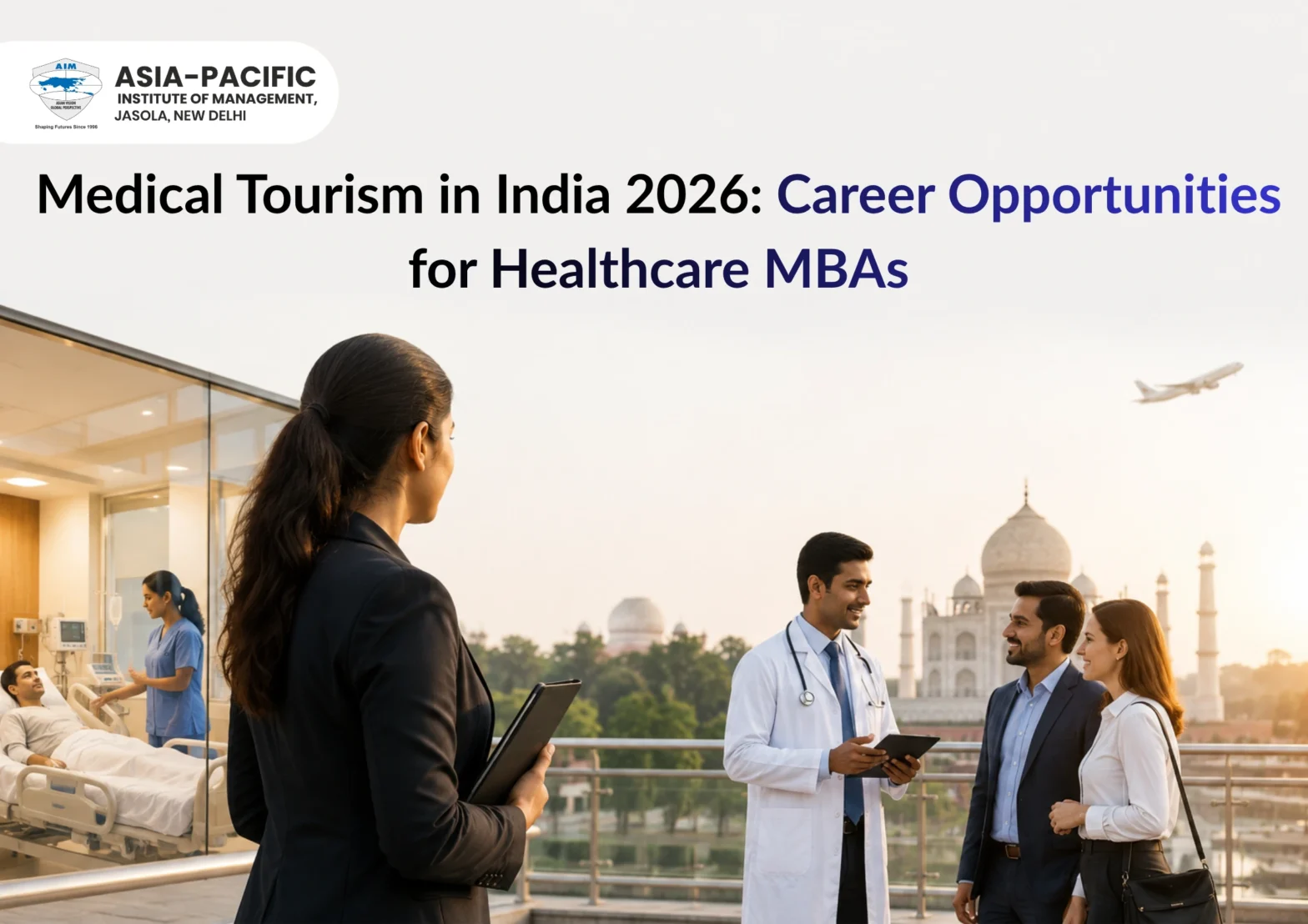
For MBA and healthcare management students, medical tourism can create career pathways in international patient services, hospital operations, healthcare marketing, business development, patient experience, and global partnerships.
India has also introduced initiatives intended to facilitate medical-value travel, including the Government of India’s Heal in India initiative and dedicated e-medical visa provisions for eligible international travellers.
This guide explains the career opportunities, skills, roles, and realities healthcare MBA students should understand in 2026.
Build Global Healthcare Careers
Develop healthcare management, international business, operations, and communication skills to pursue exciting opportunities across India’s growing medical tourism sector.
Medical tourism is the practice of travelling outside one’s home country to receive medical treatment or healthcare services. In India, the medical travel ecosystem can involve hospitals, doctors, facilitators, hotels, airlines, insurers, government agencies, and international patient-management teams.
Patients may travel for services such as:
Cardiac care
Orthopaedics
Oncology
Organ transplantation, subject to applicable laws
Fertility treatment
Dental care
Rehabilitation
Diagnostics
Traditional wellness services
However, medical tourism is not ordinary tourism.
The patient's primary objective is healthcare.
Therefore, clinical quality, patient safety, ethics, privacy, and regulatory compliance must remain central.
Why Is Medical Tourism Important for India in 2026?
India has several characteristics that support medical-value travel.
These include:
Large healthcare infrastructure
Skilled healthcare professionals
Specialized tertiary and quaternary services
English-speaking healthcare workforce
International air connectivity
Cost competitiveness for selected procedures
Growing digital-health capabilities
Traditional wellness systems
The Government of India has also identified medical-value travel as an important opportunity within the healthcare and tourism ecosystem.
For healthcare MBA students, the important point is not simply that international patients visit India.
It is that these patients create complex management requirements.
Someone has to coordinate the journey.
That creates specialized careers.
Medical Tourism Careers India: Where Are the Opportunities?
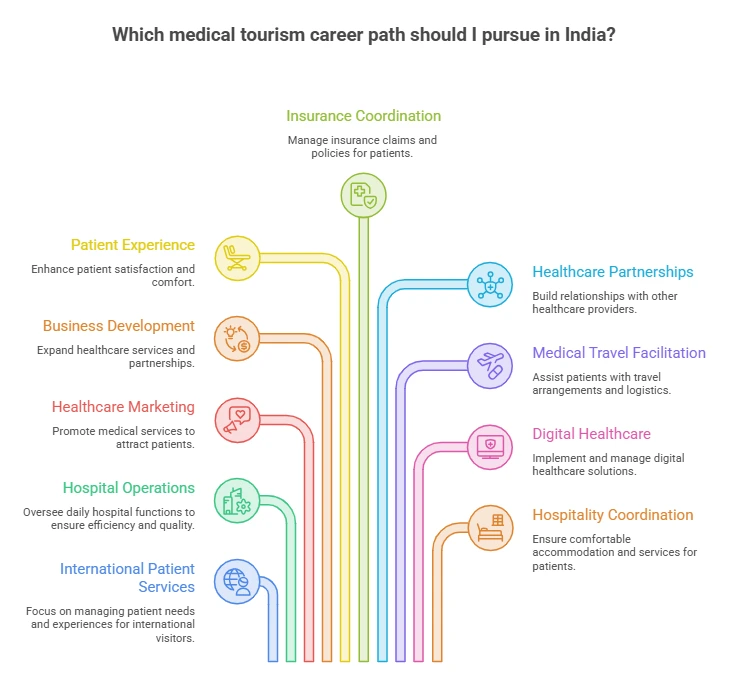
Students researching medical tourism careers India should understand that “medical tourism manager” is not the only possible designation.
Relevant roles can exist across:
International patient services
Hospital operations
Healthcare marketing
Business development
Patient experience
Insurance coordination
Healthcare partnerships
Medical travel facilitation
Digital healthcare
Hospitality coordination
Job titles vary between organizations.
Therefore, students should search by function rather than one specific designation.
The international division needs to work closely with the rest of the hospital.
For example:
An overseas patient cannot be promised an appointment unless the relevant clinical department confirms availability.
Similarly, cost estimates should follow approved processes.
Therefore, the international wing should not operate as an isolated sales department.
It needs integration with:
Clinical teams
Finance
Billing
Admissions
Diagnostics
Pharmacy
Operations
Lead International Healthcare
Build practical expertise in patient management, healthcare marketing, analytics, operations, and business development for rewarding international healthcare management careers.
India provides specific visa categories for medical travel.
Healthcare organizations may help patients understand which hospital documents they need for their application.
However, hospital staff should not misrepresent themselves as immigration authorities.
Their role may include providing appropriate institutional documentation.
Patients should rely on official government channels for visa requirements and approvals.
This distinction is important.
Administrative support should facilitate legitimate medical travel without creating unrealistic guarantees.
9. Interpreter and Language Service Management
Language can become a significant operational issue.
Miscommunication in healthcare can affect both experience and safety.
Hospitals serving international patients may use:
In-person interpreters
Language coordinators
Remote interpretation
Translated patient information
Managers need systems for identifying language requirements early.
Important medical communication should not rely casually on another patient's relative or an unqualified staff member when professional interpretation is required.
For MBA graduates, language capabilities can become a useful additional skill in certain international markets.
10. Post-Treatment Follow-Up Coordination
The patient journey does not necessarily end when the patient leaves India.
After returning home, patients may need:
Follow-up consultations
Reports
Medication instructions
Rehabilitation guidance
Remote consultations
Therefore, medical tourism requires continuity systems.
Digital healthcare can support this.
For example, hospitals may use teleconsultation for appropriate follow-up according to applicable clinical and regulatory requirements.
Managers need to coordinate:
Scheduling
Documentation
Communication
Technology
Patient records
This creates another intersection between healthcare operations and digital management.
This prevents inquiries from becoming disconnected across email, phone, and messaging channels.
Managers can also analyze:
Response times
Lead sources
Geographic markets
Follow-up status
However, international patient information can contain sensitive health data.
Therefore, access controls and privacy practices are essential.
How AI Could Affect Medical Tourism Careers
Artificial intelligence can support parts of the international patient journey.
Possible applications include:
Inquiry classification
Translation assistance
Scheduling
Document organization
Analytics
Communication support
However, healthcare managers should use AI carefully.
Sensitive patient information requires strong privacy controls.
Clinical interpretation should remain with qualified professionals.
AI should not independently promise treatment outcomes.
Therefore, future international patient managers will need both digital literacy and healthcare governance awareness.
Major Operational Challenges in Medical Tourism
The sector also has significant challenges.
Clinical Uncertainty
Treatment plans can change after physical examination or additional investigations.
Language Barriers
Miscommunication can affect patient experience.
Cultural Differences
Expectations may vary significantly.
Documentation
Incomplete medical records can delay clinical decisions.
Travel Risk
A patient may not always be clinically fit to travel.
Follow-Up
Long-distance continuity can be difficult.
Pricing Expectations
Patients may misunderstand initial estimates.
Coordination Complexity
Multiple hospital departments may need to work together.
Therefore, medical tourism requires disciplined operations.
Ethical Issues Healthcare Managers Must Understand
Medical tourism should never become purely a sales business.
Healthcare managers need to protect patient interests.
Important principles include:
Accurate communication
Informed consent
Patient privacy
Transparent estimates
Appropriate clinical referral
Ethical marketing
Continuity of care
International patients may be particularly vulnerable because they are away from familiar healthcare systems and support networks.
Therefore, trust is fundamental.
Skills Needed for Medical Tourism Careers in India
Healthcare MBA students interested in the sector should develop a combination of skills.
Hospital Operations
Understand the patient journey.
Communication
International coordination requires clear professional communication.
Cross-Cultural Management
Learn to work respectfully with people from different backgrounds.
Healthcare Marketing
Understand ethical digital and international marketing.
Business Development
Learn partnership and market-development fundamentals.
Data Analytics
Track international-patient KPIs.
Financial Literacy
Understand estimates, billing, and healthcare economics.
Digital Skills
CRM, spreadsheets, dashboards, and digital communication are increasingly relevant.
Problem-Solving
International patient journeys rarely go exactly according to plan.
How MBA Students Can Prepare for Medical Tourism Careers
Students can begin building their profiles before graduation.
Study the International Patient Journey
Understand every stage from inquiry through follow-up.
Learn One Foreign Language
Language capability can potentially add value when aligned with relevant patient markets.
Develop Excel and CRM Skills
International patient departments are data-driven.
Build Digital Marketing Knowledge
Understand search, content, analytics, and lead management.
Study Healthcare Operations
You cannot coordinate international patients effectively without understanding hospitals.
Follow Global Healthcare Trends
Learn about:
Medical travel
Digital health
International insurance
Patient experience
Healthcare accreditation
A Practical MBA Project Idea
Students can create a project titled:
“Designing an International Patient Management Dashboard for a Multi-Specialty Hospital.”
Use simulated data to track:
Country
Inquiry date
Response time
Specialty
Consultation
Estimated treatment
Travel status
Admission
Length of stay
Patient feedback
The dashboard could analyze:
Top source markets
Inquiry conversion
Response times
Specialty demand
Patient satisfaction
Clearly identify all simulated data.
Such a project can demonstrate healthcare operations, analytics, and international business understanding.
Career Progression in Medical Tourism
A possible career pathway might look like:
International Patient Executive → Senior Coordinator → International Patient Manager → International Business Manager → Global Healthcare Business Leader
Another pathway could be:
Healthcare Marketing Executive → International Marketing Manager → Healthcare Destination Marketing Lead
Career progression varies significantly by employer.
However, the sector allows professionals to combine healthcare with international business.
Is Medical Tourism a Good Career for Healthcare MBAs?
It can be a strong option for students who enjoy:
Healthcare
International business
Operations
Communication
Marketing
Patient experience
However, candidates should not enter the field simply because the word “international” sounds attractive.
The work can involve demanding coordination.
Patients may be seriously ill.
Plans can change quickly.
Families may be under significant emotional and financial pressure.
Therefore, professionalism and empathy are essential.
Why Management Education Matters
Medical tourism demonstrates why healthcare organizations need professionals with both business and sector understanding.
An international patient manager may need to coordinate clinical teams while also understanding:
Marketing
Operations
Finance
Technology
Customer experience
Strategy
At Asia Pacific Institute of Management, an industry-oriented curriculum, experienced faculty, practical learning, corporate exposure, and placement support can help students develop broader managerial capabilities.
For students interested in international healthcare, combining management fundamentals with healthcare operations, digital skills, analytics, and cross-cultural communication can strengthen career readiness.
The growth of medical-value travel is creating a specialized management ecosystem around international healthcare.
For students exploring medical tourism careers India, opportunities can extend well beyond the role of medical travel coordinator.
Hospitals and healthcare organizations may require professionals in:
International patient management
Healthcare destination marketing
Business development
Patient experience
Operations
International billing
Digital healthcare
Global partnerships
However, medical tourism management carries an important responsibility.
International patients are not ordinary travellers.
They are healthcare consumers who may be dealing with serious illnesses while navigating an unfamiliar country and healthcare system.
Therefore, successful managers need more than sales skills.
They need healthcare understanding, empathy, operational discipline, cultural awareness, ethical judgement, and strong communication.
For healthcare MBA students who can combine these capabilities with business knowledge and digital skills, India's medical-value travel ecosystem can offer an interesting pathway into international healthcare management.
Go Beyond Hospital Management
Prepare for global healthcare opportunities with industry-focused learning in international patient services, digital marketing, strategy, analytics, and cross-cultural management.
Dr. Vikas Gupta is a distinguished academic in the education and research domain, specializing in finance and related interdisciplinary studies. He is known for his...
01.
What are the main medical tourism careers in India?
Potential careers include international patient management, medical travel coordination, healthcare destination marketing, hospital operations, international business development, patient experience, billing coordination, and healthcare partnerships.
02.
What does an international patient manager do?
An international patient manager coordinates non-clinical aspects of an overseas patient’s journey, including inquiries, appointments, documentation, admission, communication, billing coordination, and follow-up.
03.
What is a medical travel coordinator salary in India?
There is no universal salary. Compensation varies by experience, employer, location, responsibilities, language skills, and international market exposure. Candidates should verify current employer offers rather than relying on a single online figure.
04.
Can MBA graduates work in a corporate hospital global wing?
Yes, subject to employer requirements. MBA graduates may find opportunities in international patient services, operations, marketing, business development, finance, analytics, and patient experience.
05.
What is healthcare destination marketing?
Healthcare destination marketing involves ethically communicating a hospital or healthcare destination’s services and capabilities to appropriate domestic or international audiences.
06.
What is the health tourism scope in India?
Health tourism can include medical-value travel, wellness tourism, preventive services, diagnostics, and rehabilitation. Each segment has different operational and regulatory considerations.
07.
What skills are needed for international patient management?
Important skills include communication, hospital operations, cultural sensitivity, documentation, digital literacy, CRM, problem-solving, financial understanding, and patient-experience management.
08.
Is medical tourism a good career after an MBA in healthcare?
It can be relevant for MBA healthcare graduates interested in international business, hospital operations, marketing, business development, and patient services. Career value depends on the role, employer, skills, and practical experience.














.webp) Call Us
Call Us