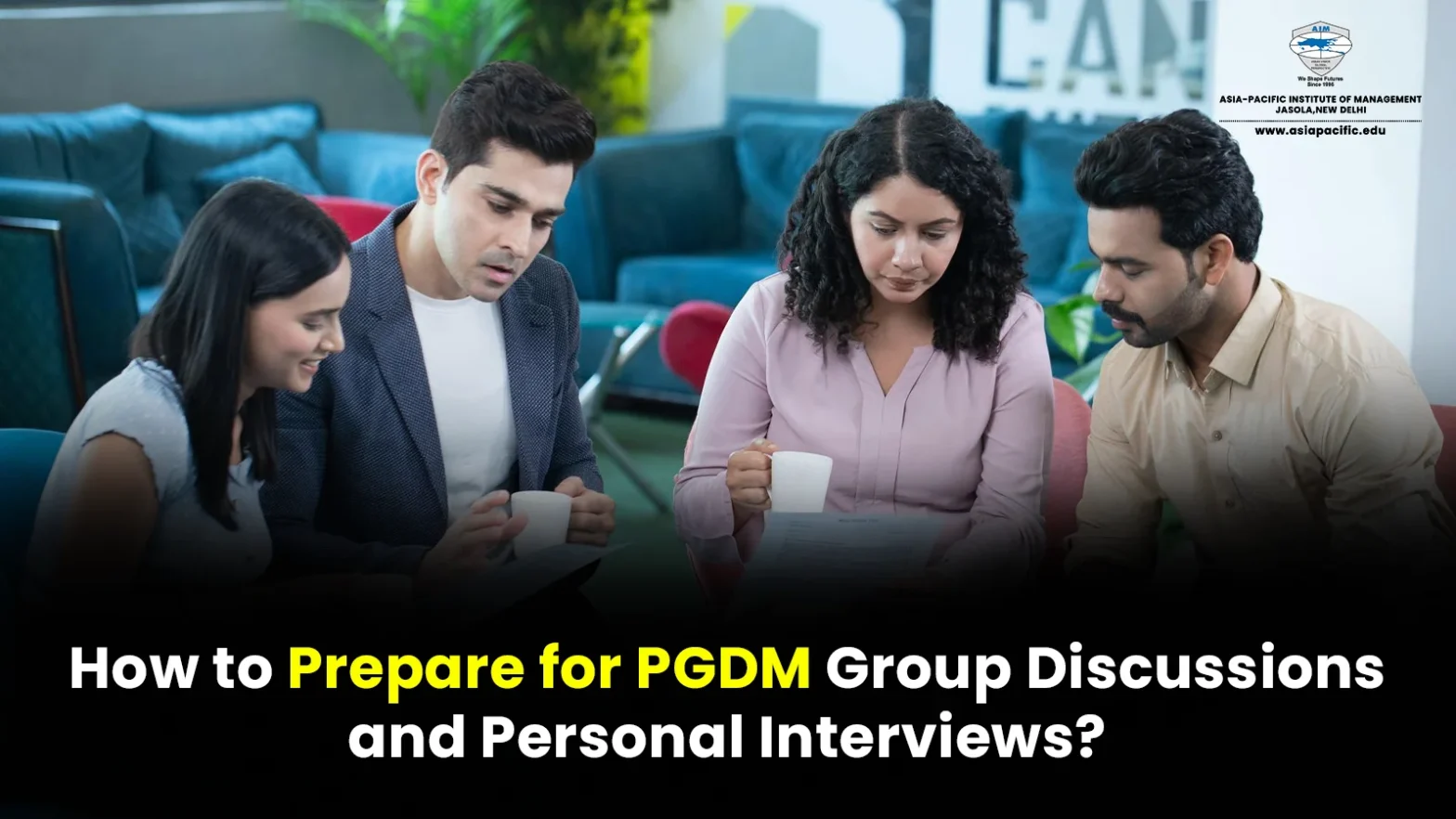
Admission to the best PGDM College in Delhi, according to the criterion of the entrance examination, is not achieved simply by getting high scores in the entrance examination. The Group Discussion (GD) round and the Personal Interview (PI) round form the ultimate decision/norms of the final admission decision, thus, representing communication prowess, personality traits, and clear thinking of an aspirant. The guide outlines realistic goals, lists practical tips and tricks, and gathers the suggestions of professionals to perform effectively and successfully in both scenes.
Introduction to Group Discussion and Personal Interviews
The GD and PI stages evaluate the traits otherwise not expressed in response to writing. A Group Discussion examines one's reflective thinking ability, excellent communication skills, and team performance in a group, but a Personal Interview reveals personal drives, hopes, and personal temperaments. Understanding the overall intentions of such exercises will enable pre-planned preparation.
| Round |
What does it test? |
What to Showcase? |
| Group Discussion |
Teamwork, awareness, and communication |
Leadership, logic, cooperation |
| Personal Interview |
Personality, goals, decision-making |
Authenticity, clarity, confidence |
What is a Group Discussion (GD)?
A Group Discussion is an activity of 15-20 minutes of interaction between 8 and 12 interlocutors on a predetermined topic. The main aim is not to take over the debate but to make meaningful contributions based on a well-organised presentation of arguments and convincing logic.
PGDM colleges in Delhi utilise GDs when assessing critical thinking skills, the ability to express oneself, and the collaborative skills of participants.
Why B-Schools Conduct GDs?
- Both communication and active listening skills are measured through GD sessions.
- They determine how to lead the body, other potential and contribution in a team.
- They measure an understanding of modern and business-based pressures and check under examination.
Common GD Formats
- Topic-based sessions are usually on topics of current affairs, concentrating on policy or even social and political issues.
- Case-based discussions require participants to come up with solutions to a real business environment.
- The abstract forms investigate the abstract concept that change is the only constant.
What is a Personal Interview (PI)?
This will provide an opportunity to explore the personality of an applicant, his/her motivation, and career clarity. It will give the interviewers a chance to understand the background, hobbies, and suitability of a candidate for a management programme. The main elements of success in this round will be measured on the basis of authenticity, deep preparation, and the ability to match personal experiences with claims of ambitions.
Objective of the Personal Interviews
- The interview will aim at getting to know the reasons behind the decision to pursue management education by the applicant.
- It assesses the situational awareness and relevant professional knowledge, tests the reputation of responding to situational demands, and shows how harmonious the goals of the candidate and the values of the institution were.
Common Question Categories
- Introduce about yourself
- What is the reason behind pursuing PGDM ?
- Why especially this college?
- Strengths and Weaknesses.
- Elaborate about professional leadership or team experience.
What to Prepare in Group Discussions?
The knowledge of good preparation in GD means developing knowledge, communication practice, and learning how to manage the impacts of groups. It aims at expressing opinions with complete assurance and at the same time maintaining respect towards the opposite point of view.
-
Establish a powerful knowledge foundation.
In order to build a strong knowledge base, it is urgently needed to keep abreast of the latest matters and business trends. Researchers are expected to read reliable sources like the Hindu, the Mint, and the Economic Times and can use accorded apps like Inshorts and Flipboard as brief summaries. Special attention should be paid to key areas such as government statements, industry news, social issues, and economic conditions around the world.
-
Enhance the skill of communication.
Daily use of English language skills and involvement in a group discussion should be relied on. Analytic frameworks, like SWOT or PESTLE, might assist in organising thoughts, thus, allowing one to present clear, balanced, and sustainable views. There is no use of irrelevant jargon, and it is at the same time accessible and professional.
-
Manage Good Body Language.
The power of making an impression is comprised of non-verbal channels. Strong attitudes, the preservation of the erect posture, maintaining eye contact with every interlocutor, and the use of natural gestures with the hands are the traditions accepted. Crossing of the arms, fidgeting, or even interrupting the other person should be avoided knowingly. It is this confidence by stunts and listening, therefore.
-
Add Value During GDs
The beginning of a discussion must be made in terms of setting the subject matter and defining its main aspects. Any deviation of the conversation into the wrong channel should be redirected mildly. The final observations should readily represent the range of opinions. A contributor must focus on providing quality rather than flowery insights.
Students give well-organised GD workshops and role plays that simulate actual admission tests at schools like the
Asia-Pacific Institute of Management (AIM). These will be sessions aimed at impressing the articulation, practicing as a team, and feeling the presence of mind before the real interviews.
Pre-Personal Interview Preparation.
Personal interview is also a means of evaluation to evaluate how a candidate self-understands themselves and their career expectations. Response that is most successful is through open introspection and statement of encouraging factors.
-
Know Yourself Well
A methodical study of scholarly records, projects, and internships is justified. Applicants must be ready to share the lessons that they learned in these experiences and how it has led them to their development of professional goals. Problem-solving or leadership competencies should be illustrated by concrete examples.
-
Master Common Questions
Such formulated general answers include “Tell me about yourself. Why PGDM? What are your long-term goals? Many others have become popular and should be properly prepared by the candidates. Comprehensive digging of the preferred institution will provide the capacity to persuasively justify their career goals in terms of the reasoning behind his/ her selection of the program.
-
Dress Individually and Behave Personally.
This is because formal dress and proper grooming send the message of seriousness and appreciation to the interview process. Greetings should be spoken confidently, calmness should be observed throughout, and at the end, the panel should also be thanked. Being authentic, polite, and calm are all the elements that help to make an indelible positive impression.
-
Practice: Mock Interviews.
It is best to be involved in simulated interviews with their mentors or seniors, or via online methods. The inspection of the recorded sessions will help in refining where to improve, such as in areas of tonal modulation, structural coherence, or body-muscle nuances.
30 Days of GD-PI Preparation Plan
A detailed approach ensures complete revision before your actual GD-PI in an organisation
| Timeline |
Focus Areas |
| Week 1–2 |
Build awareness of business and current topics |
| Week 3 |
Practice 2–3 GDs per week, note feedback |
| Week 4 |
Focus on mock PIs and refining your story |
| Last Days |
Light review; stay relaxed and confident |
Selection of the Right PGDM College in Delhi.
The right institution not only defines what one gets in terms of management education but also his or her professional network as well as mindset. In the decision, the factors to put into consideration are academic quality, faculty competence, placement opportunities, and campus culture.
Key Factors:
- AICTE accreditation and student accommodation
- Senior staff with industrial experience.
- Updated industry curriculum.
- Internship and placement opportunities.
The Asia-Pacific Institute of Management (AIM) is an exceptional college of Post-Intensive levels among the
Top PGDM College in Delhi with a delicate combination of corporate and academic exposure. With practical learning through live projects and simulation, AIM provides special PGDM programmes in Marketing, Human Resource, Finance, Business Analytics, and Operations with specialisations in various domains.
Why Select Asia Pacific Institute of Management (AIM)?
The AIM has always held a top position in the ranks of the most prominent management schools in Delhi due to its innovative approach to teaching and the industry-driven curriculum. Its highly experienced faculty and corporate associations guarantee that students get hard knowledge and theory.
Key advantages include:
- Intensive GD and PI training and counselling.
- Well-established placement network in key industries.
- Guest lectures, regular visits to industries, and live projects.
- Modern infrastructure and well-equipped facilities for learning.
- Global partnerships and Certification programmes.
Its highly experienced faculty and corporate associations guarantee that students get hard knowledge and theory.
Common Mistakes to Avoid
Some of the highly qualified candidates may actually score low due to avoidable mistakes. It is important to know and avoid these traps.
- Speaking without substance
- Lack of studies conducted at the college.
- New weaknesses in knowledge of background.
- Not standing upright or looking at her eyes.
Final Takeaway
The GD-PI process is more than just the admission form; it is an opportunity to find and fill one with the best. Be organised and updated, and communicate authenticity. To learn more about the PGDM programmes and admission procedure of AIM, check out the online site.
The right decision on which institution to select, as the case of the Asia-Pacific Institute of Management provides, complements the preparation and provides the lifetime value of academic excellence, connections in industries and career opportunities.
















.webp) Call Us
Call Us