The education of business is experiencing a fundamental change determined by the global competition, the innovation of digital projects and the changing character of work.
These changes have been rapidly embraced within institutions like the AsiaPacific Institute of Management (AIM), which is a top PGDM Private College in Delhi . AIM curriculum practices are future-focused and make the curriculum holistic, combining both theoretical and practical acquisition of knowledge, where graduates have gained competencies most appropriate by employers. Business education depends on the future, which is based on the integration of creativity and practice and international acumen.
The Changing Place of Business Educators.
Contemporary business teachers are being held in a mobile position. Instead of simply imparting managerial theories, they focus on the growth of analytical minds, innovation, and leadership. The teacher acts as a learning partner, and he or she takes the students through case studies, simulations, and real-world problem-solving.
The following are the priorities of the current educators:
- Promoting collaboration and innovativeness.
- Culture and idea of use of technology and analytics in teaching.
- Starting action research with academic content and corporate practice.
- Nurturing ethics and emotional intelligence.
This development warrants graduates of PGDM to take office ready to face and adjust to realistic business concerns.
Major Trends that have influenced Modern PGDM Programs.
1. Technology‑Driven Learning
The use of technology has transformed management education. Virtual simulators, AI tools, digital dashboards, and Virtual environments are simulated replicas of real business surroundings that can be used to make data-driven decisions, which are similar to real corporate systems.
- Virtual Simulations: Nurture strategic decision-making.
- Online Collaboration: Improve global collaboration.
- Hybrid Classrooms: Flexible and customised education.
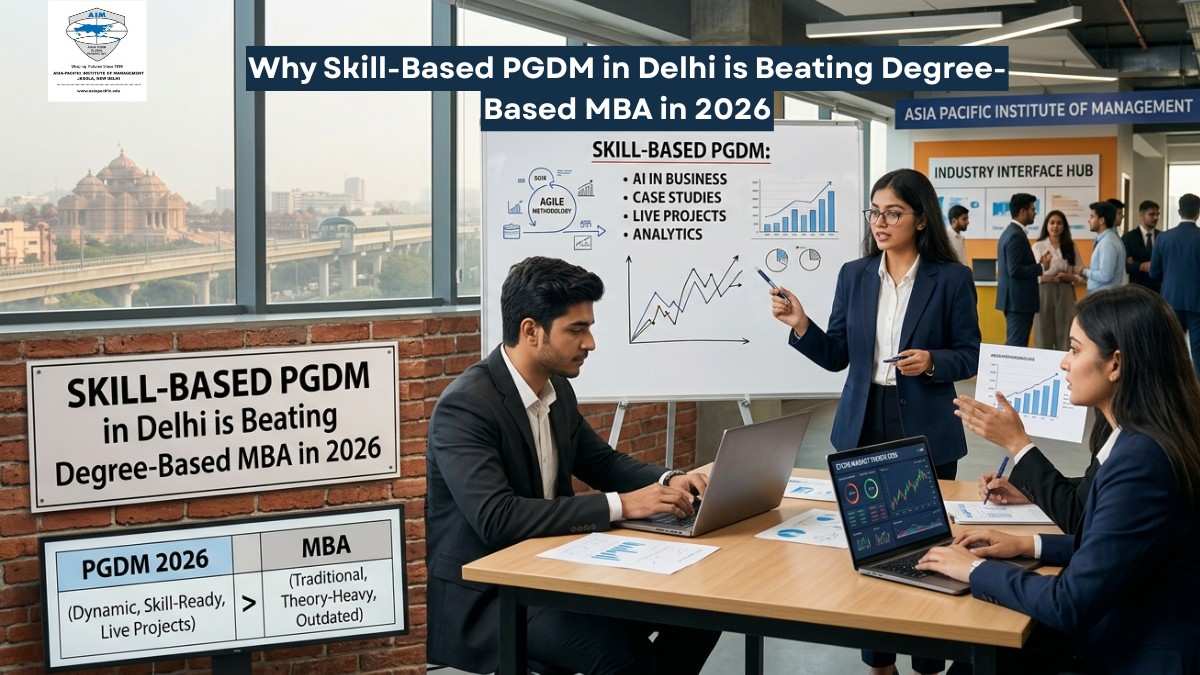
Modern programs of PGDM are based on practice. All students take part in live corporate projects, case analysis, and internships, which provide a transition between theory and the real world. This practice-based method develops problem-solving and leadership and boosts employment.
2. Diverse and Global Curriculum.
Due to the internationality of business, curricula that are connected to international realities are required. International projects, cross-border case studies and global exposure are the new features of the PGDM programs. Business schools go hand in hand with the industry players to revise curricula, including the new technology and market demands, hence providing the students with knowledge on global markets, sustainability and innovation, all essential in producing future-ready leaders.
3. Focus on Future‑Ready Skills
Skills that breed innovation, and agility are now on the list of priorities for employers. The present day PGDM programs focus on:
- Critical Thinking: Solve complicated business problems.
- Innovation Management: Turn ideas into success.
- Sustainability: Be a responsible, ethical leader.
- Leadership and Empathy: Work with multicultural teams.
All these competencies set graduates with high validity of the programs, like the one provided by AIM, a premier Post Graduate Degree of Diploma with Management College based in Delhi.
4. Hybrid Learning Models and Flexible.
E-learning is another modern characteristic of the present day. Students have a virtual-physical equilibrium and do not need to give up on the quality provided. This distance learning program renders the institution of higher learning (PGDM) more reachable to practitioners in employment so that they can possess education, including practical exposure.
5. Collaboration within the scene and Innovation of curriculum.
The strategies of applying theoretical knowledge to real-life situations are done through guest lectures, internships, and mentorship programmes.
Industry partnerships present several important advantages such as:
- Immediate job readiness
- Practical experience of live business challenges.
- Networking within the company.
- Academic industry correspondence.
The curriculum elements set by institutions are created in collaboration with corporate professionals, whereby students learn skills directly relating to the business requirements.
Asia-Pacific Institute of Management: case of consecutive learning.
The presence of AIM as one of the leading colleges in providing PGDM courses in Delhi is a vivid account of the transformations that the business education underwent. Its programmes in the field of PGDM ensure a combination between excellence and relevance. The curriculum offered by AIM is based on hands-on learning, innovation and world awareness. The students engage in live corporate assignments, mod-sim activities, and the international exchange programmes.
The main features of the AIM programmes of PGDM include:
- Industry-Relevant Curriculum: During the process of cooperation with corporate stakeholders.
- Learning Exposure: Association with foreign universities.
- Expert Faculty: A combination of academicians and experts in the industry.
- Practical Skill Development: Case-based, experienced based learning.
Through the implementation of the above factors, AIM equips students to not just land a good job but also to continuously remain successful in the dynamic business environment.
The Future of Masterplace Products.
With the changing business environment, the programmes offered in the PGDM too are enlarged to accommodate high-demand areas of specialisation that meet the modern-day careers.
| Specialisation |
Professional Effect |
| Business Analytics |
Data-driven decision making. |
| FinTech |
Bridges finance and technology innovation. |
| Digital Marketing |
Develops online brand strategy skills. |
| Sustainability Management |
Forges responsible leadership. |
| Artificial Intelligence, Robotisation |
Provides students with future jobs. |
The focus on such emerging areas puts the programmes and institutions like AIM among the
Best PGDM College in Delhi, which makes these institutes top regarding the best in offering programmes to learners.
Issues of Next Generation Business Educators.
The future requires constant recreation. Business teachers need to keep up with reskilling to have new technologies and pedagogies, and maintain academic rigour and industry relevance. Also, they need to develop empathy, morality, and flexibility among students, which are critical to leaders in a digitally oriented and still humanised world.
The Future of PGDM Education
The future of the PGDM will keep on changing with digital education, individualised programmes, and international teamwork. Learning trajectories will be personalised using artificial intelligence; meanwhile, full-time programmes will be supported by micro-credentials. The priority will be on experiential learning, creativity, and leader-development.
This change will still be driven by institutions that are innovative and adaptive, like AIM, the leading PGDM private college in Delhi.
Conclusion
Very essential to the future of management education are innovation, flexibility, and global vision. Communication of technology, creative options, and ethical leadership in the PGDM programmes should empower students to address the dynamic business conditions.
AIM is one of the
Top PGDM colleges in India in terms of excellence, innovation, and industry relevance. To the aspiring individuals who want to study in a progressive and future-oriented private college in Delhi, Asia-Pacific Institute of Management will always remain a safe haven where the leaders of tomorrow can be nurtured to succeed in the dynamic world that we live in today.















.webp) Call Us
Call Us