Preparing for an MBA begins with choosing the right entrance exam, and for thousands of management aspirants across India, the CAT Exam is the first choice. Every year, lakhs of students appear for this national-level examination to compete for admission into some of the country's most respected management institutes.
However, many students starting their MBA journey often have similar questions. What is the CAT Exam? What is the CAT full form? Who can apply? How much is the CAT exam fee? What does the syllabus include?
If you're searching for clear and reliable answers, this guide covers everything you need to know. Whether you're planning to apply this year or simply exploring management entrance exams after graduation, this article explains the complete CAT examination process in a simple and practical way.
What Is the CAT Exam?
The CAT Exam, or Common Admission Test, is one of India's most competitive management entrance examinations. It is conducted annually by one of the Indian Institutes of Management (IIMs) on a rotational basis for admission to MBA and management programmes.
While CAT is primarily known as the gateway to the IIMs, many other reputed business schools across India also consider CAT scores during their admission process. As a result, the exam has become one of the most widely accepted entrance tests for students planning careers in business management, consulting, finance, marketing, analytics, operations, and entrepreneurship.
The examination measures a candidate's aptitude rather than subject-specific knowledge. Instead of testing what you studied in college, CAT evaluates how effectively you can solve problems, analyse information, think logically, and communicate.
Master complex data interpretation, quantitative tools, and verbal skills. Unlock your premium management potential with top industry preparation models today.
Many students also search for CAT full form in MBA, as the examination serves as one of the primary entrance routes for MBA and PGDM admissions in India.
The exam is designed to assess whether a candidate possesses the analytical thinking, reasoning ability, quantitative aptitude, and communication skills expected in a future management professional.
Simply put, CAT is not a knowledge-based examination—it is an aptitude test that evaluates how efficiently you think and solve problems under time constraints.
Why Is the CAT Exam Important?
The CAT Exam plays a significant role in the MBA admission process because it opens opportunities at some of India's leading management institutions.
A good CAT score can help candidates apply to:
Indian Institutes of Management (IIMs)
AICTE-approved PGDM institutes
Leading private business schools
Universities offering MBA programmes
Management institutes accepting CAT scores as part of their admission process
Since many reputed institutions use CAT scores during shortlisting, strong performance can increase your chances of securing admission to quality management programmes.
CAT Exam Highlights
Particular
Details
Exam Name
Common Admission Test
Popular Name
CAT Exam
Exam Level
National
Exam Mode
Computer-Based Test (CBT)
Conducting Body
One of the Indian Institutes of Management (IIMs)
Course Level
MBA & PGDM Admission
Duration
120 Minutes
Sections
VARC, DILR & Quantitative Ability
Who Can Apply for the CAT Exam?
One of the most common questions among MBA aspirants is whether they are eligible to appear for the CAT Exam.
In general, candidates who have completed a bachelor's degree from a recognised university can apply, subject to the eligibility criteria mentioned in the official CAT notification. Students in the final year of graduation are also usually allowed to register, provided they complete their degree requirements within the prescribed timeline.
Since admission policies may change over time, candidates should always refer to the latest official notification before submitting their application.
Unlike traditional university examinations, CAT focuses on aptitude rather than memorisation.
The examination is designed to evaluate several skills that are considered essential for management education and future leadership roles.
These include:
Quantitative problem-solving ability
Logical reasoning
Data interpretation
Reading comprehension
Verbal communication
Analytical thinking
Decision-making under time pressure
Business schools use these skills as indicators of a candidate's readiness for a rigorous management programme.
CAT Exam Structure at a Glance
Although the exact number of questions may vary from year to year, the CAT Exam generally consists of three major sections.
Verbal Ability and Reading Comprehension (VARC)
This section evaluates a candidate's understanding of written English. Questions typically assess reading comprehension, grammar, vocabulary, sentence arrangement, and verbal reasoning.
Strong reading habits and consistent practice can significantly improve performance in this section.
Data Interpretation and Logical Reasoning (DILR)
The DILR section measures analytical thinking and the ability to interpret complex data.
Candidates are expected to solve problems involving:
Tables
Charts
Graphs
Seating arrangements
Logical puzzles
Case-based reasoning
Accuracy and logical analysis are often more important than attempting a large number of questions.
Top MBA Percentiles
Learn advanced logical reasoning techniques and speed math formulas. Optimize your test score benchmarks to secure your ideal business school selection now.
The Quantitative Ability section tests mathematical aptitude required for management education.
Common topics include:
Arithmetic
Algebra
Geometry
Number System
Percentages
Time & Work
Profit & Loss
Probability
Permutation & Combination
Rather than focusing on advanced mathematics, this section rewards conceptual clarity and efficient problem-solving techniques.
What Makes the CAT Exam Challenging?
The CAT Exam is widely recognised for its competitive nature, but the difficulty does not arise only from the questions themselves.
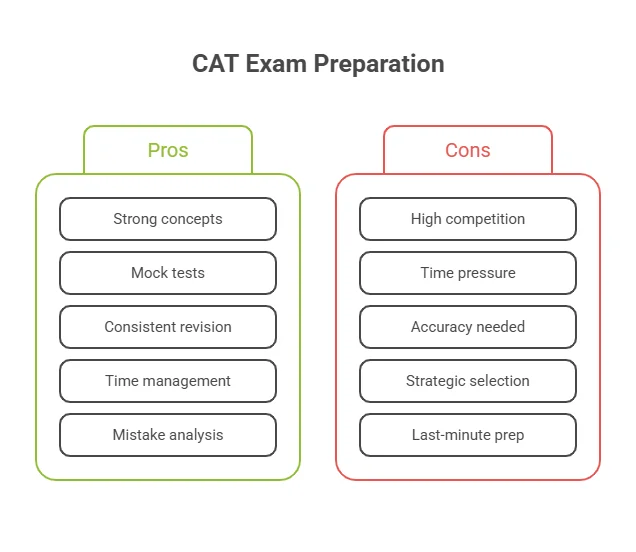
Candidates compete against a very large number of applicants every year, making time management, accuracy, and strategic question selection equally important.
Success often depends on:
Strong conceptual understanding
Regular mock test practice
Consistent revision
Effective time management
Careful analysis of mistakes
Students who prepare systematically over several months generally perform better than those who rely solely on last-minute preparation.
CAT Registration Process
The CAT registration process is conducted online through the official examination portal. Candidates are advised to complete their registration well before the deadline to avoid last-minute technical issues.
The registration process generally involves the following steps:
Create a new user account using a valid email ID and mobile number.
Verify your registered credentials.
Fill in personal, academic, and communication details.
Upload the required documents, including a recent passport-size photograph and signature.
Select your preferred exam cities.
Review the application carefully before submission.
Pay the CAT exam fee through the available online payment methods.
Download and save the confirmation page for future reference.
Before submitting the application, ensure that all information matches your official documents, as incorrect details may create issues during the admission process.
CAT Exam Fee
One of the most searched questions among MBA aspirants is "What is the CAT exam fee?"
The examination fee is announced every year in the official CAT notification and may differ based on the applicant category. Since fee structures are revised from time to time, candidates should always refer to the latest notification before making the payment.
Apart from the application fee, students should also plan for additional expenses such as:
Study material
Mock test series
Coaching (if required)
Travel expenses for the examination centre
MBA application fees for individual institutes
Preparing a realistic budget in advance helps candidates avoid unnecessary stress during the admission cycle. Bonus:PGDM Eligibility Criteria
CAT Syllabus
Unlike many competitive examinations, CAT does not publish an official chapter-wise syllabus. However, based on previous years' papers, experts identify the major topics that candidates should prepare.
Quantitative Ability (QA)
This section focuses on mathematical concepts and problem-solving skills. Important topics include:
Arithmetic
Algebra
Geometry
Number System
Percentage
Ratio and Proportion
Profit and Loss
Time, Speed and Distance
Time and Work
Probability
Permutation and Combination
Conceptual clarity is more important than memorising formulas.
Verbal Ability and Reading Comprehension (VARC)
This section evaluates language comprehension and communication skills.
Common topics include:
Reading Comprehension
Para Jumbles
Odd Sentence Out
Sentence Completion
Vocabulary
Grammar
Critical Reasoning
Candidates who develop a regular reading habit often perform better in this section.
Data Interpretation and Logical Reasoning (DILR)
This section tests logical thinking and analytical ability.
Frequently covered topics include:
Tables
Charts
Graphs
Caselets
Seating Arrangement
Blood Relations
Logical Puzzles
Data Sufficiency
Instead of speed alone, the focus should be on selecting the right sets and solving them accurately.
CAT Admit Card
The CAT admit card is released online a few weeks before the examination.
Candidates can download it by logging into the official CAT website using their registered credentials.
Before the exam day, carefully verify:
Candidate's name
Photograph
Roll number
Exam date
Reporting time
Test centre address
Candidates should carry a printed copy of the admit card along with a valid government-issued photo ID to the examination centre.
CAT Important Dates
Although the schedule may vary each year, the CAT admission cycle generally follows this timeline:
Activity
Expected Timeline
Registration Begins
August
Registration Deadline
September
Application Correction (if applicable)
September
Admit Card Release
November
CAT Exam
November
Result Declaration
December
Candidates should regularly visit the official CAT website for the latest updates regarding important dates and announcements.
How to Prepare for the CAT Exam
Preparing for the CAT Exam requires consistency rather than last-minute study sessions. Since the examination evaluates aptitude, success depends on regular practice and conceptual understanding.
Here are some practical preparation tips:
Build Strong Fundamentals
Start by strengthening your basics in mathematics, logical reasoning, and English comprehension.
Create a Study Plan
Allocate dedicated time for each section every week and maintain a balanced preparation schedule.
Practice Mock Tests
Full-length mock tests help candidates become familiar with the exam environment and improve time management.
Analyse Your Performance
Attempting mock tests is only half the preparation. Reviewing mistakes and identifying weak areas is equally important.
Read Daily
Reading newspapers, business magazines, and editorials improves vocabulary and reading speed while also enhancing general awareness.
Revise Regularly
Consistent revision helps retain concepts and improves confidence before the examination.
Common Mistakes to Avoid
Many candidates lose marks due to avoidable mistakes rather than lack of preparation.
Some common mistakes include:
Ignoring one section completely
Attempting every question without strategy
Spending too much time on difficult questions
Not practising mock tests
Ignoring previous years' trends
Beginning preparation too late
A balanced approach with regular practice usually delivers better results than focusing on only one subject.
CAT vs Other MBA Entrance Exams
While CAT is one of the most popular management entrance exams, it is not the only option available.
Students can also consider:
XAT
CMAT
MAT
SNAP
ATMA
GMAT
Many AICTE-approved management institutes accept scores from one or more of these examinations, giving students multiple pathways to pursue an MBA or PGDM.
Conclusion
The CAT Exam continues to be one of India's most respected management entrance examinations and remains a preferred choice for students aspiring to pursue an MBA or PGDM. A good score can open doors to leading management institutes and create opportunities in diverse career fields, including consulting, finance, marketing, operations, analytics, and entrepreneurship.
Success in CAT is not determined by intelligence alone but by consistent preparation, strategic planning, regular mock test practice, and effective time management. By understanding the exam pattern, focusing on conceptual clarity, and following a disciplined study plan, candidates can significantly improve their chances of performing well.
Whether you aim for an IIM or another reputed business school, starting your preparation early and staying committed throughout the journey will give you a strong foundation for success.
Elite Business Study
Step beyond standard entry problems with structured practice questions. Build high-level administration frameworks for global executive leadership tracks today.
Dr. Vikas Gupta is a distinguished academic in the education and research domain, specializing in finance and related interdisciplinary studies. He is known for his...
CAT stands for Common Admission Test, a national-level entrance examination for MBA and management programmes.
02.
What is the CAT Exam?
The CAT Exam is a computer-based entrance examination conducted annually by an Indian Institute of Management (IIM) for admission to MBA and PGDM programmes.
03.
What is the CAT exam fee?
The application fee is announced in the official notification every year and may vary by category.
04.
Who can apply for the CAT Exam?
Candidates with a recognised bachelor’s degree and eligible final-year students can apply, subject to the official eligibility criteria.
05.
Is CAT compulsory for MBA admission?
No. Many management institutes also accept entrance exams such as MAT, CMAT, XAT, SNAP, ATMA, and GMAT.


















.webp) Call Us
Call Us