

24 Oct 2026
What to Do After Graduation in 2027: PGDM, MBA or a Job?


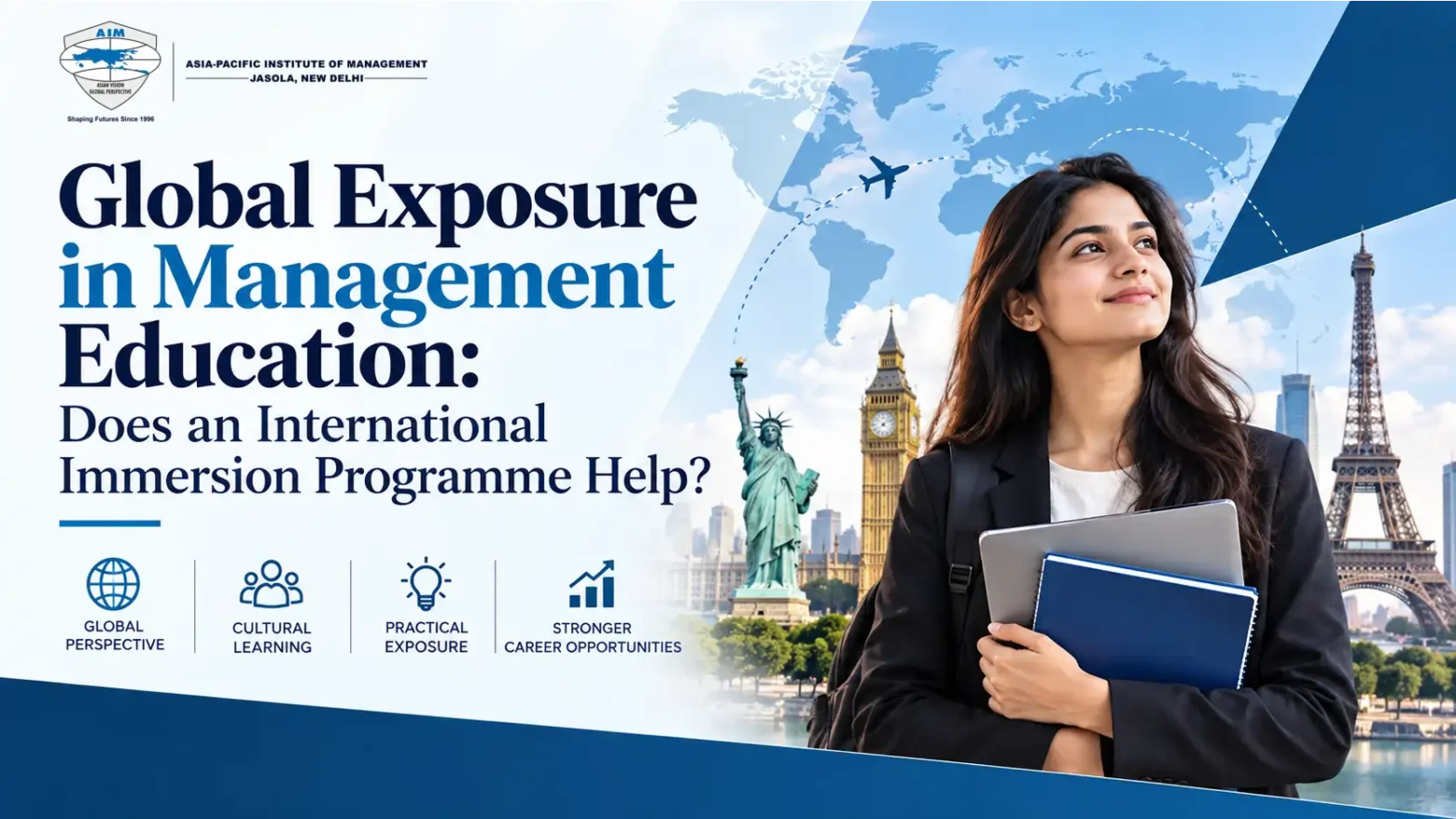
A B-school classroom can feel global without leaving Delhi, but experiencing another country's business environment first-hand changes how students think. The real question is how much a short stay abroad adds to a career. Many students weighing global exposure in management education want an honest answer.
Here is a balanced look at what such exposure offers and what it does not.
It can mean international faculty, case studies from other markets, study tours, exchange programmes, or cross-cultural projects. The point is to understand how business works under different rules, customers, and cultures.
This matters most for roles that touch global clients, exports, consulting, or multinational firms. It supports core skills but cannot replace them, so strong fundamentals still come first.
Asia Pacific Institute of Management runs an international immersion programme for PGDM students, called the Global Immersion Programme. Students spend six to seven days at partner universities in Dubai, Singapore, Japan, Malaysia, and Thailand, combining classes with company visits and cultural experiences.
The institute lists partners such as Rochester Institute of Technology in Dubai, Nanyang Business School in Singapore, Kansai University of International Studies in Japan, Lincoln University College in Malaysia, the University of the Thai Chamber of Commerce, and Abu Dhabi University.
Study abroad opportunities for management students range from short immersions to semester exchanges, dual degrees, internships abroad, and postgraduate study overseas. Each differs in cost, duration, visa needs, and credit transfer.
A short immersion gives a taste of a market, while a semester abroad gives depth. Planning should begin early, since passports, visas, and budgets take time. Students should also be clear about what they want from the experience before signing up.
The most useful international business skills are cross-cultural communication, negotiation across cultures, basic knowledge of trade and currency movements, and comfort working across time zones.
You can practise these skills at home by working with international classmates, joining case competitions, and following global business news. A little language learning goes a long way, and so does simple curiosity about how others do business.
Global business education in India is now widely advertised, with many schools announcing international tie-ups. The better question is what students actually do on these programmes: classes, projects, company visits, or sightseeing.
Recruiters value exposure when a candidate can explain what they learned and how they apply it. A short trip alone will not change a profile, but a thoughtful account of lessons learned can.
International exposure helps most when treated as a learning experience, not a line on a resume. Students should ask what the programme includes, what it costs, and how they will use it. AIM in New Delhi offers its Global Immersion Program for PGDM students.


24 Oct 2026
What to Do After Graduation in 2027: PGDM, MBA or a Job?

24 Oct 2026
PGDM Fees vs Return on Investment: How to Evaluate a B-School
24 Oct 2026
MBA in Healthcare Management: Career Scope, Skills and Job Roles in India

24 Oct 2026
Fintech and BFSI Careers in India: Skills, Roles and Management Pathways

24 Oct 2026
Digital Marketing and AI: Career Opportunities for Management Graduates






BBA Brochure

PGDM Brochure
MBA Brochure


.webp) Call Us