How to Prepare for Your First PGDM Academic Presentation
Posted on 25 Aug 2026
By Dr. Vikas Gupta
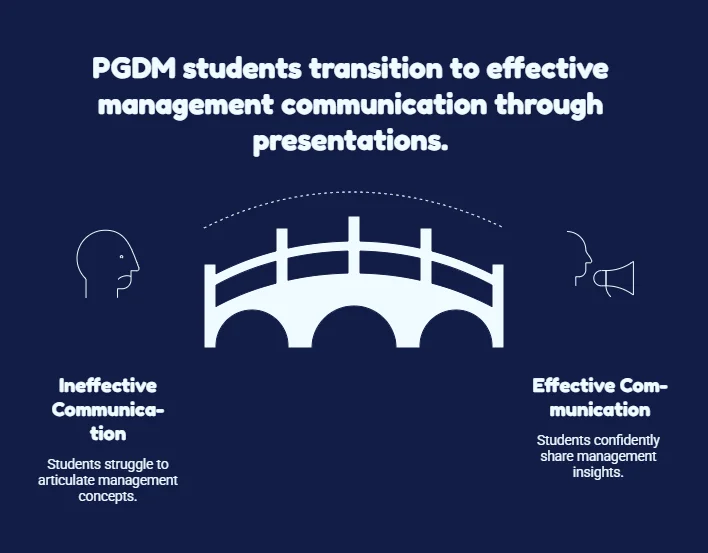
Your first PGDM academic presentation can feel challenging because it tests more than subject knowledge. You need to research a topic, organise your argument, create effective slides, speak clearly, manage time, and respond to questions—all while presenting in front of faculty and classmates. For newly enrolled students, these expectations may be unfamiliar at first.
The good news is that presentation skills improve through a structured process rather than confidence alone. Whether your assignment involves a case study, business concept, market analysis, financial problem, or data-driven topic, careful preparation can make your presentation clearer and more convincing. This step-by-step guide explains how to move from understanding the assignment to delivering your presentation and handling the Q&A professionally.
Ace PGDM Case Slides
Build compelling pitch decks and impress your professors today. Elevate your executive presentation abilities for maximum impact in your management studies!
Start by understanding the presentation objective, evaluation criteria, audience, and time limit.
Build your presentation around one clear central message instead of trying to include everything you researched.
Keep slides concise, readable, and visually supportive rather than turning them into speaking notes.
Rehearse aloud with a timer and practise transitions, opening lines, conclusions, and likely questions.
Treat questions and feedback as part of academic learning rather than simply as a test of confidence.
What Is a PGDM Academic Presentation?
A PGDM academic presentation is a structured oral presentation in which students explain, analyse, or evaluate a management-related topic using relevant evidence and clear reasoning. It may involve business concepts, case studies, research findings, projects, or recommendations and typically requires effective communication, logical organisation, visual support, and preparation for questions. Bonus: presentation and communication skills for PGDM students
Step 1: How Should You Understand the Presentation Brief?
Before researching, identify exactly what the assignment asks you to accomplish. A presentation that requires analysis needs a different approach from one asking for explanation, comparison, evaluation, or recommendations. Check the topic, duration, assessment instructions, group or individual format, required sources, submission rules, and expected presentation style before planning your content.
Read the brief carefully and highlight the action words. Terms such as analyse, compare, evaluate, recommend, and explain indicate different levels of academic work.
For example, explaining a company's marketing strategy is not the same as evaluating whether that strategy is effective. The second task requires evidence, criteria, reasoning, and a defensible conclusion.
Before moving ahead, confirm:
What is the central question?
Who is the audience?
How much time do you have?
Is the presentation individual or group-based?
Are references or specific frameworks required?
Will there be a Q&A session?
How will the presentation be evaluated?
Students in a PGDM program regularly encounter assignments where understanding the business problem is just as important as collecting information.
Step 2: How Do You Research a PGDM Presentation Topic?
Effective presentation research focuses on credible, relevant information that directly supports your argument. Begin with course material and recommended readings, then use reliable academic, government, industry, corporate, or professional sources where appropriate. Take notes around specific questions rather than collecting large amounts of information without knowing how it will contribute to your presentation.
Start by breaking the topic into smaller research questions. If your presentation concerns a company's competitive strategy, for example, you might investigate its market environment, customers, competitors, positioning, strategic choices, challenges, and possible alternatives.
Students pursuing a post graduate diploma in management may present topics across marketing, finance, analytics, operations, human resources, strategy, or economics. The type of evidence required will therefore vary.
As you research, record the source beside each useful point. This makes it easier to verify claims and prepare references later.
Most importantly, distinguish between information and analysis. Finding that a business made a particular decision is information. Explaining why the decision matters, evaluating its consequences, and connecting it to a management framework demonstrates analysis.
Step 3: How Should You Structure Your PGDM Academic Presentation?
A strong presentation follows a logical sequence that allows the audience to understand where the discussion is going and why each point matters. A practical structure includes an opening, context or problem statement, key analysis, evidence, findings or recommendations, and conclusion. Every section should contribute directly to the presentation's central question or objective.
A simple structure can look like this:
Opening: Introduce the topic and its relevance.
Objective: Explain what the presentation will address.
Context: Give the audience essential background.
Analysis: Present your main arguments and supporting evidence.
Findings or recommendations: Explain what follows from your analysis.
Conclusion: Reinforce the central message.
Q&A: Invite and respond to questions.
Think of the presentation as an argument rather than a collection of slides.
A useful test is to describe the entire presentation in one sentence. If you cannot explain its central message clearly, the structure may still need refinement.
This ability to organise complex information is valuable throughout a PGDM course, particularly in case discussions, project reviews, internships, and research assignments.
Step 4: How Can You Create Clear and Professional Presentation Slides?
Presentation slides should help the audience understand your message rather than duplicate everything you plan to say. Use concise headings, readable text, consistent formatting, and relevant charts, diagrams, tables, or visuals. Each slide should have a clear purpose, and unnecessary decoration or excessive information should be removed when it distracts from the main argument.
Avoid filling slides with long paragraphs. When the audience has to read dense text while simultaneously listening to you, attention becomes divided.
Instead, use short phrases and meaningful visual hierarchy. Your slide title can communicate the main point rather than merely naming the topic.
For example, instead of:
Market Analysis
a more informative heading could be:
Price Sensitivity Is Increasing Among the Target Segment
Charts also require context. Do not simply display a graph and move on. Explain what the audience should notice and why the information matters to your argument.
Use consistent fonts, colours, spacing, and heading styles. Before finalising the deck, check it on the screen or device you expect to use whenever possible. Bonus:peer learning and presentation feedback
PGDM Pitch Success!
Gain the poise and confidence needed for corporate seminars. Prepare effectively for your upcoming academic presentations at Asia-Pacific Institute today!
Prepare speaking points rather than memorising every sentence of your presentation. Know the purpose of each slide, the evidence supporting it, and the transition to the next idea. Your opening and conclusion deserve extra practice because they establish the audience's first impression and determine whether your central message remains clear when the presentation ends.
A useful preparation method is to create three notes for every slide:
Main point: What should the audience remember?
Evidence: What supports that point?
Transition: How does it connect to the next slide?
This approach reduces dependence on memorised scripts.
Your opening can briefly establish the topic, relevance, and presentation objective. Avoid spending too long introducing information that the audience already knows.
During the conclusion, return to the original question. Summarise the most important findings and state the overall takeaway without introducing a completely new argument.
Presentation practice is particularly useful for newly enrolled PGDM students because speaking clearly about business problems requires both subject understanding and communication discipline.
Step 6: How Should You Rehearse Before Your First Presentation?
Rehearsal should reproduce the real presentation as closely as practical. Speak aloud, display your slides, and use a timer instead of silently reviewing the deck. Repeated practice helps identify unclear explanations, awkward transitions, overloaded slides, timing problems, and sections where you depend too heavily on notes before you encounter these issues in the classroom.
Complete at least one uninterrupted rehearsal from beginning to end.
If your allotted time is limited, do not plan to use every available second. Leaving some flexibility helps if you pause, clarify an idea, or experience a minor interruption.
Recording a practice attempt can also reveal habits that are difficult to notice while speaking. Listen for unnecessary filler words, rushed explanations, unclear pronunciation, or repeated phrases.
For group presentations, rehearse the handovers between speakers. Everyone should understand the overall argument rather than knowing only their assigned slides. A presentation should feel like one coherent discussion, not several unrelated mini-presentations.
Step 7: How Can You Deliver the Presentation with Confidence?
Confident academic delivery comes from preparation, clarity, and controlled pacing rather than trying to appear fearless. Stand comfortably, maintain appropriate eye contact, speak loudly enough for the room, and use natural gestures. Focus on communicating one idea at a time instead of monitoring every movement or worrying about how nervous you might appear.
Begin slightly slower than your normal conversational pace. Students often speed up when they are nervous, which can reduce clarity and cause the presentation to finish too quickly.
Avoid reading directly from the screen. Look at the slide when you need to reference a figure or visual, then return your attention to the audience.
If you lose your place, use the slide heading to recover the main idea. A brief pause is usually better than rushing through an explanation.
Communication and presentation abilities are relevant across management education, whether students later focus on PGDM in marketing management, PGDM in banking and finance, or PGDM in data analytics.
Step 8: How Should You Handle Questions After the Presentation?
Handle Q&A by listening to the complete question, identifying what is being asked, and answering as directly as possible. Use evidence or reasoning when available, and acknowledge uncertainty when you genuinely do not know. A thoughtful, limited answer is academically stronger than inventing information or attempting to disguise a gap in your knowledge.
Before presentation day, list questions your faculty or classmates could reasonably ask. Pay particular attention to assumptions, evidence, methodology, alternatives, limitations, and recommendations.
When answering:
Listen without interrupting.
Pause briefly if you need to organise your thoughts.
Clarify an ambiguous question when necessary.
Answer the specific question first.
Add supporting reasoning without drifting into unrelated material.
Admit when available evidence does not support a definite conclusion.
Q&A is also useful feedback. Questions can reveal which parts of your reasoning were convincing and which require deeper understanding.
Step 9: What Final Checks Should You Make Before Presenting?
Your final review should cover content, delivery, timing, references, and technical readiness. Confirm that slides appear in the correct order, figures and labels are readable, sources are properly acknowledged, and presentation files open correctly. Review your opening and conclusion once more, then arrive prepared to focus on communication rather than last-minute rewriting.
Use this final checklist:
Confirm the presentation objective and time limit.
Check names, figures, terminology, and references.
Remove unnecessary text from crowded slides.
Test charts, videos, links, or animations if used.
Keep a backup copy of the presentation where appropriate.
Rehearse the complete presentation with a timer.
Review likely questions and difficult concepts.
Confirm speaking order and transitions for group presentations.
Check the opening and closing statements.
Follow any specific submission instructions given by your faculty.
Preparing for your first PGDM academic presentation becomes much easier when you treat it as a sequence of manageable tasks. Begin by understanding the assignment, research only what supports the objective, organise your argument logically, and design slides that reinforce rather than replace your explanation. Then rehearse aloud, check your timing, and prepare for likely questions.
For newly enrolled students, the first presentation is also an opportunity to understand how management education combines knowledge with communication, analysis, and decision-making. Do not judge your progress only by how confident you feel on presentation day. Pay attention to the quality of your reasoning, clarity of delivery, and feedback you receive. Each presentation can become practical preparation for the next academic or professional communication challenge.
PGDM Pitch Success!
Gain the poise and confidence needed for corporate seminars. Prepare effectively for your upcoming academic presentations at Asia-Pacific Institute today!
Dr. Vikas Gupta is a distinguished academic in the education and research domain, specializing in finance and related interdisciplinary studies. He is known for his...
01.
How long should I practise for my first PGDM presentation?
There is no universal number of practice hours because presentation length, topic difficulty, and individual confidence differ. Focus instead on completing multiple purposeful rehearsals. At minimum, practise the complete presentation aloud with a timer, revisit weak sections, and run through it again after making improvements so you know the final version comfortably.
02.
Should I memorise my entire PGDM academic presentation?
Memorising every sentence is usually unnecessary and can make recovery difficult if you forget one line. Learn the sequence of ideas, evidence, and transitions instead. You can memorise or closely practise your opening and closing lines, but the main presentation should demonstrate that you understand the topic well enough to explain it naturally.
03.
How much text should I put on presentation slides?
Use only enough text to guide attention and communicate essential information. Short headings, keywords, figures, and concise supporting points are generally easier to follow than paragraphs. The appropriate amount depends on the content, so prioritise readability and purpose rather than following an arbitrary word count or slide rule.
04.
What should I do if I forget a point while presenting?
Pause briefly and use the slide heading or visual as a cue to recover the main idea. If the forgotten detail is not essential, continue to the next point rather than drawing attention to the mistake. Practising the logical flow instead of memorising sentences makes it easier to recover naturally.
05.
How can I reduce nervousness before an academic presentation?
Preparation can reduce uncertainty even when some nervousness remains. Rehearse in realistic conditions, arrive with enough time to organise yourself, know your opening lines, and concentrate on explaining the topic rather than trying to perform perfectly. Familiarity with your material gives you useful reference points if you become nervous during delivery.
06.
What makes a PGDM presentation academically strong?

















.webp) Call Us
Call Us