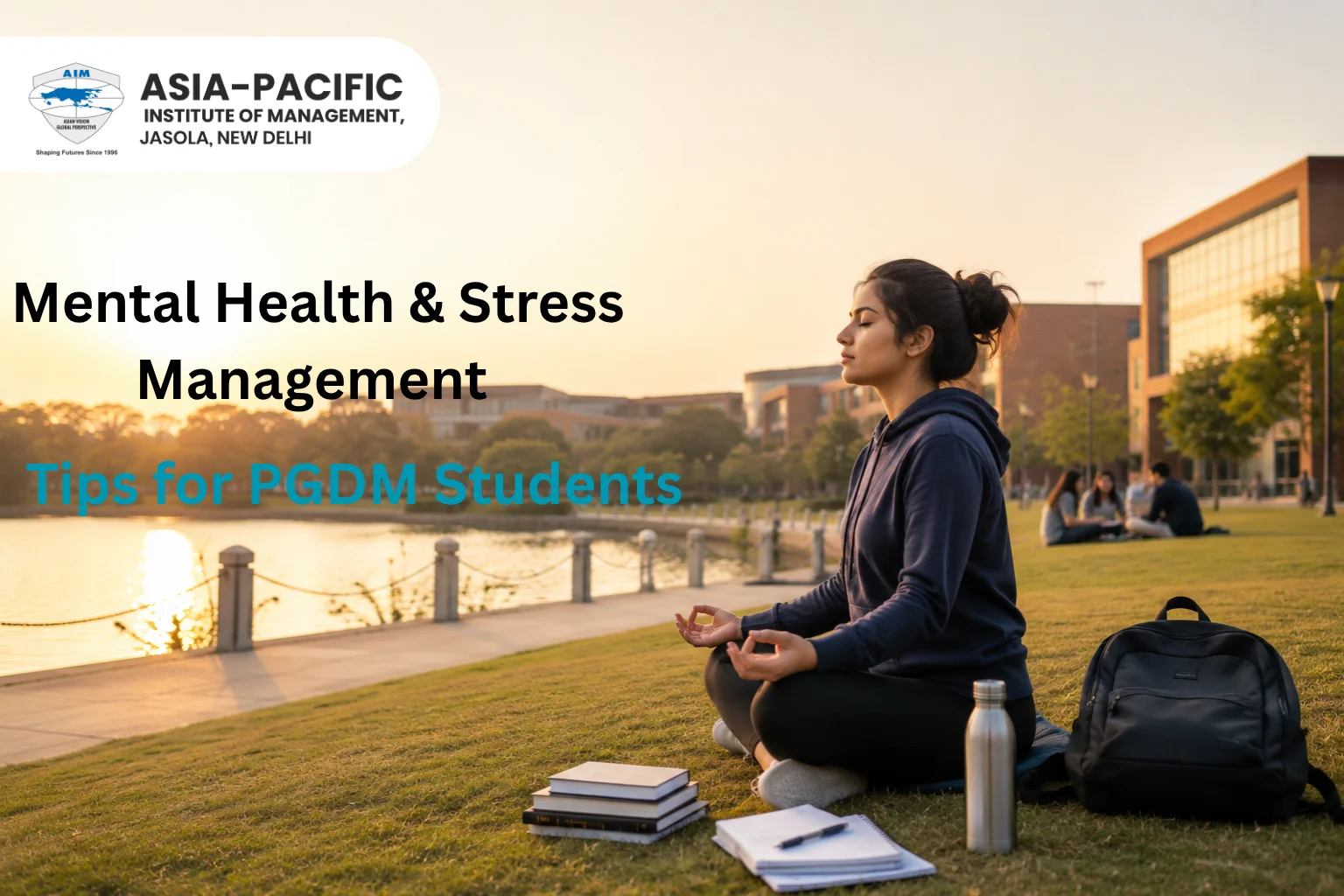
Life of a Management Student: Mental Health & Stress Management Tips for PGDM Students
Posted on 18 Jun 2026
By Dr. Vikas Gupta
The life of a management student can be exciting, fast-paced, and career-shaping. However, it can also feel stressful. A PGDM student handles lectures, case studies, presentations, group projects, internships, networking, exams, and placement preparation.
This pressure is real. A PGDM or post graduate diploma in management prepares students for corporate life. Therefore, the schedule often feels intense.
However, stress does not mean weakness. It simply means your mind and body need better systems, support, and balance.
This guide shares practical stress management tips for students pursuing a PGDM program, especially those studying in a competitive academic environment like Delhi NCR.
Note: This article offers general wellness guidance. It is not medical advice. If stress feels unmanageable, or you feel unsafe, hopeless, or unable to function, contact a qualified mental health professional or emergency support immediately.
What Is the Life of a Management Student Really Like?
The life of a management student includes classroom learning, case discussions, presentations, group assignments, internships, networking, exams, and placement preparation. It can be exciting, but it can also feel stressful when students struggle with time management, competition, workload, and career uncertainty.
A PGDM course is different from a regular academic degree because it focuses on industry readiness. Students are expected to think, speak, analyse, present, and solve problems.
Additionally, many students manage specialization pressure. Some choose PGDM in marketing, some prefer finance or banking, while others explore analytics, digital marketing, or dual specialization in PGDM.
Asia Pacific Institute of Management offers PGDM programmes across areas such as General with dual specialization, Marketing, Big Data Analytics, and Banking & Financial Services. Its PGDM page highlights industry-focused learning, hands-on exposure, live projects, data science, AI, predictive analytics, fintech, and wealth management across different programmes.
Therefore, student life is not only about marks. It is also about confidence, communication, consistency, and emotional resilience.
Thrive Under Pressure
Master corporate emotional wellness strategies. Acquire top leadership frameworks within an elite, supportive ecosystem designed for modern industry success.
PGDM students often feel stressed because they manage many academic and career tasks together.
Common stress triggers include:
Back-to-back classes
Case studies and assignments
Group project conflicts
Presentation anxiety
Internship applications
Placement preparation
Specialization confusion
Peer comparison
Poor sleep
Fear of falling behind
UGC’s student well-being guidelines highlight the need for higher education institutions to support students’ physical, psychological, and emotional well-being through support centres and career counsellors.
Therefore, stress management should not be treated as an extra activity. It should be part of student success.
12 Mental Health & Stress Management Tips for PGDM Students
1. Plan Your Week Before It Plans You
A PGDM student cannot depend only on last-minute effort.
Every week, write down your classes, assignments, presentations, internship tasks, placement preparation, and personal commitments. This gives your mind a clear structure.
Use a simple planner or notes app. Divide tasks into urgent, important, and flexible work.
For example:
Task Type
Example
Urgent
Tomorrow’s presentation
Important
Resume update
Flexible
Reading extra case material
This habit reduces panic. Additionally, it helps you feel more in control.
Students pursuing a PGDM course in Delhi or PGDM courses in Delhi NCR often face a busy schedule because of academics, events, internships, and corporate exposure. Therefore, weekly planning is essential.
2. Break Big Tasks Into Smaller Actions
Large tasks feel stressful because they look unclear.
Instead of writing “prepare presentation,” break it into smaller steps:
Read the case
Find data
Create outline
Make slides
Practice speaking
Review with team
This method works well for case studies, research reports, group assignments, and placement preparation.
Moreover, small progress builds confidence. Once you complete one step, the next step feels easier.
3. Stop Comparing Your Journey With Others
Comparison is one of the biggest stress triggers in the life of a management student.
One student may speak confidently in class. Another may be strong in Excel. Someone else may already have internship experience. However, every student enters PGDM with a different background.
Instead of asking, “Why am I behind?” ask, “What skill can I improve this week?”
This mindset helps students across specializations.
For example:
PGDM in marketing students may focus on presentations and consumer insights.
PGDM in data analytics students may focus on tools and dashboards.
PGDM in banking and finance students may focus on concepts and financial awareness.
PGDM in digital marketing students may focus on campaigns and content strategy.
A good study routine does not mean studying all night.
Instead, use focused blocks. Study for 45 to 60 minutes. Then, take a short break.
A simple routine can look like this:
Time
Activity
30 minutes
Revise class notes
45 minutes
Work on assignment
20 minutes
Read case material
15 minutes
Review next day’s schedule
Additionally, avoid saving all study work for the weekend. Daily revision reduces exam pressure.
CDC recommends healthy coping practices such as taking breaks, deep breathing, stretching, meditation, journaling, spending time outdoors, and making time to unwind.
Therefore, your routine should include both study time and recovery time.
5. Treat Sleep Like Part of Your Syllabus
Many PGDM students sacrifice sleep during exams, presentations, and placement season.
However, poor sleep affects concentration, memory, patience, and confidence. It also makes small problems feel bigger.
Try these simple habits:
Sleep and wake up at similar times.
Avoid late-night scrolling.
Reduce caffeine at night.
Keep your phone away before sleep.
Do not study on the bed.
Take short breaks during long study days.
Additionally, do not glorify all-night study culture. A tired mind cannot perform well consistently.
6. Use Physical Activity to Reset Your Mind
You do not need an intense gym routine to manage stress.
Even simple movement helps.
Try:
20-minute walks
Stair walks between classes
Stretching
Yoga
Sports
Light gym workouts
Dance breaks
UGC’s guidelines on student well-being include physical fitness, sports, health, welfare, and psychological and emotional well-being as important concerns for higher education institutions.
Additionally, physical activity gives your mind a break from screens, assignments, and constant thinking.
7. Talk to Someone Before Stress Becomes Too Heavy
Many students stay silent because they think everyone else is managing better.
That is usually not true.
Talk to someone you trust. It could be:
A friend
A faculty mentor
A family member
A senior
A counsellor
A placement mentor
Sometimes, speaking openly helps you organise your thoughts. Moreover, another person may help you see practical solutions.
However, if stress becomes intense, do not depend only on friends. Speak to a qualified mental health professional.
8. Learn to Say No Without Feeling Guilty
Management students often want to participate in everything.
Events, clubs, competitions, group outings, internships, webinars, live projects, and networking sessions all look useful. However, overcommitting can lead to burnout.
Say yes to activities that match your goals. Say no when your schedule is already full.
For example, you do not need to join every competition. You do not need to attend every social plan. You do not need to help every group at the cost of your own health.
Healthy boundaries protect your performance.
9. Manage Placement Stress Step by Step
Placement season can create anxiety.
Students worry about resumes, interviews, aptitude tests, group discussions, domain knowledge, and salary expectations. However, panic does not improve placement readiness. Preparation does.
Break placement preparation into weekly tasks:
Week
Focus Area
Week 1
Resume update
Week 2
LinkedIn profile
Week 3
Mock interview
Week 4
Aptitude practice
Week 5
Company research
Additionally, prepare your introduction, strengths, projects, internship learnings, and specialization-related answers.
Students from a PGDM institute in Delhi may get access to corporate exposure and placement activities. However, students must still take ownership of preparation.
10. Balance Specialization Pressure Smartly
Specialization decisions can feel stressful.
Students may compare PGDM in marketing management, post graduate diploma in marketing, PGD in marketing management, marketing diploma courses, diploma in finance, PGDM in banking, PGD in banking, PGDM in banking and finance, and analytics-related tracks.
Some students also search for big data analytics courses, BDA courses, big data course, diploma in data analytics, big data analytics in cloud computing, institute of analytics, or data analyst course fee in Delhi.
However, do not choose a specialization only because others are choosing it.
Ask yourself:
Which subjects do I enjoy?
Which roles match my personality?
Do I like numbers, people, strategy, technology, or sales?
Which internships can I target?
Which skills am I ready to build?
A dual specialization in PGDM can support broader career flexibility. However, it should still match your interests and career goals.
11. Keep Social Media From Controlling Your Mood
Social media can increase stress during PGDM.
Students see internship posts, placement updates, certificates, events, and achievements. While these posts can motivate, they can also create pressure.
Use social media wisely.
Follow industry pages, recruiters, alumni, and learning resources. However, avoid endless scrolling and comparison.
Take digital breaks during exams, interviews, and stressful weeks.
CDC also recommends taking breaks from news and social media because constant exposure to upsetting or overwhelming information can increase stress.
Therefore, protect your attention like an important resource.
12. Build a Support System on Campus
A strong support system makes PGDM life easier.
Build relationships with classmates, faculty, seniors, alumni, and mentors. Join groups that help you learn and grow.
A good support system can help with:
Assignment doubts
Presentation practice
Internship advice
Interview preparation
Emotional support
Confidence building
Asia Pacific Institute of Management highlights PGDM learning with academic rigour, practical exposure, live projects, and industry-focused programmes. Its PGDM General page also describes the programme as focused on conceptual clarity, analytical precision, and cross-functional expertise.
Therefore, students should use available academic and mentoring support instead of struggling alone.
Bonus: life in PGDM college
Stress Management Tips by PGDM Specialization
For PGDM in Marketing Students
Marketing students often handle presentations, campaigns, sales simulations, group projects, and public speaking.
Stress may come from speaking in front of others or defending ideas.
Tips:
Practice presentations in small groups.
Record yourself and improve gradually.
Read campaign examples regularly.
Focus on clarity, not perfection.
Learn from feedback without taking it personally.
This applies to students pursuing PGDM in marketing, post graduate diploma in marketing, marketing program, PGDM in digital marketing, or marketing diploma courses.
Beat Academic Stress
Balance your mental health while building a powerful business career. Learn actionable mindfulness habits alongside our premium, global management curriculum.
Analytics students may feel stressed by tools, numbers, dashboards, and technical concepts.
However, tool overload can be managed through step-by-step learning.
Tips:
Learn one tool at a time.
Practice daily with small datasets.
Revise statistics basics.
Build simple dashboards first.
Focus on business interpretation, not only formulas.
This helps students exploring PGDM in data analytics, big data, BDA, big data analytics, diploma in data analytics, and related analytics pathways.
For PGDM in Finance and Banking Students
Finance and banking students may feel pressure from calculations, financial terms, interviews, and market awareness.
Tips:
Revise formulas daily.
Read financial news in short summaries.
Make concept notes.
Practice interview questions weekly.
Connect finance topics with real business examples.
This is useful for students exploring post graduate diploma in financial management, banking diploma courses, banking financial services, PGD in banking and finance, or PGDM in banking and finance.
Signs You Should Ask for Help
Stress becomes serious when it starts affecting daily life.
Ask for help if you notice:
Constant anxiety
Sleep problems
Loss of interest
Frequent crying
Panic before classes
Avoiding people
Difficulty concentrating
Feeling hopeless
Feeling unsafe
These signs do not mean weakness. They mean you may need support.
Speak to a counsellor, doctor, mental health professional, faculty mentor, or trusted family member. Additionally, seek urgent help if you feel at risk of harming yourself or someone else.
How a Supportive PGDM Environment Helps Students
A supportive PGDM environment can reduce unnecessary stress.
Students choosing PGDM colleges in Delhi NCR should look for more than course names. They should check academic support, faculty mentoring, corporate exposure, internship guidance, and placement preparation.
A good post graduate diploma in management PGDM environment should offer:
Clear academic structure
Practical learning
Faculty support
Peer learning
Corporate interface
Placement preparation
Skill-building opportunities
Student development activities
Asia Pacific Institute of Management positions its PGDM programmes around industry-focused learning, hands-on exposure, live projects, data-driven skills, and professional readiness.
Therefore, students should choose a management institute that supports both career growth and personal development.
Conclusion
The life of a management student is challenging, but it is also full of growth. PGDM students learn how to think, present, collaborate, analyse, and prepare for the corporate world.
However, success should not come at the cost of mental health. Stress management, sleep, exercise, planning, support systems, and healthy boundaries can make your PGDM journey more balanced.
Students exploring a PGDM course in Delhi, PGDM in Delhi, or PGDM courses in Delhi NCR should choose a learning environment that supports academic growth, practical exposure, and career readiness.
Balance Campus Life
Our comprehensive executive training program teaches vital mental health resilience tools. Gain unmatched career confidence while protecting physical peace.
Dr. Vikas Gupta is a distinguished academic in the education and research domain, specializing in finance and related interdisciplinary studies. He is known for his...
01.
What is the life of a management student like?
The life of a management student includes lectures, case studies, presentations, group assignments, internships, networking, events, exams, and placement preparation. It is active and career-focused, but it can also feel stressful without planning.
02.
Is PGDM stressful?
Yes, PGDM can be stressful because students handle deadlines, projects, presentations, internships, and placements. However, planning, peer support, faculty guidance, sleep, and regular breaks can make it manageable.
03.
How can PGDM students manage stress?
PGDM students can manage stress by planning weekly tasks, breaking large assignments into small steps, sleeping well, staying active, avoiding comparison, talking to mentors, and seeking professional help when needed.
04.
How do I balance PGDM studies and placements?
Use time blocking. Keep separate slots for classes, assignments, resume work, aptitude practice, mock interviews, and company research. Additionally, update your resume before placement season begins.
05.
Which PGDM specialization is less stressful?
No specialization is stress-free. Stress depends on your interest, preparation, workload, and skills. Choose a specialization based on your strengths, not peer pressure.
06.
Can stress affect academic performance?
Yes, unmanaged stress can affect focus, sleep, confidence, memory, and productivity. Therefore, stress management is important for both health and academic performance.
07.
When should a student seek professional help?
A student should seek professional help when stress feels unmanageable, affects daily functioning, causes frequent panic, disrupts sleep, or leads to hopeless or unsafe thoughts.















.webp) Call Us
Call Us