How to Master Hospital MIS (Management Information Systems) Dashboards
Posted on 31 Jul 2026
By Dr. Vikas Gupta
Hospitals generate large volumes of information every day. Patient admissions, bed occupancy, billing, staffing, pharmacy usage, and clinical services all create valuable data.
However, data alone does not improve hospital performance. Administrators need a structured way to convert information into useful insights. This is where a hospital management information system becomes important.
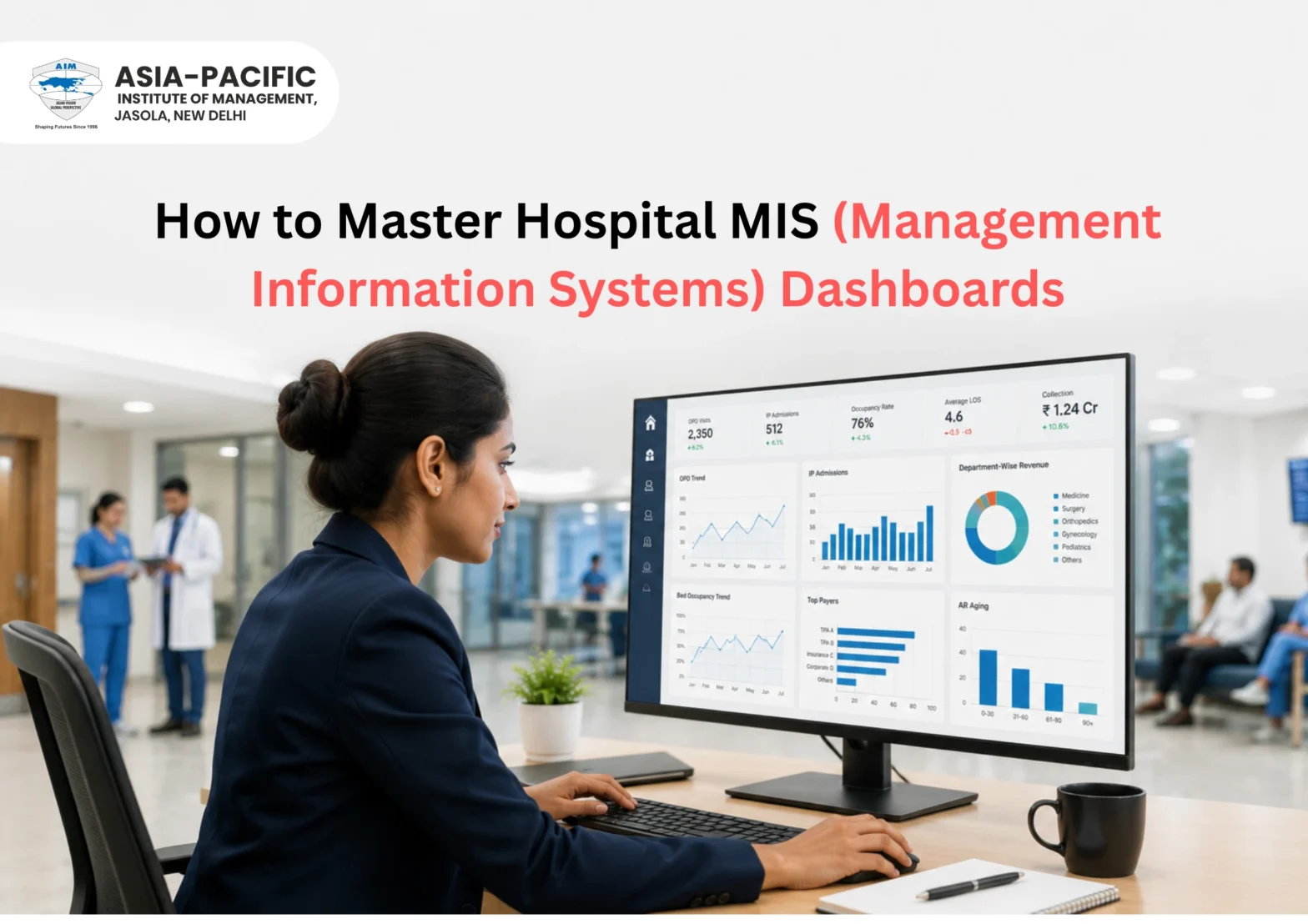
A well-designed Hospital MIS dashboard gives administrators a clear view of critical hospital activities. It helps them monitor performance, identify operational gaps, and make informed decisions.
For students and professionals interested in healthcare management, understanding MIS dashboards is also becoming an important managerial skill. This guide explains how hospital MIS dashboards work, which KPIs matter, and how administrators can use them effectively.
Lead Healthcare With Data
Build practical management skills to understand data, improve decisions, and prepare for leadership opportunities across evolving healthcare organizations.
A hospital management information system is a digital system that collects, organizes, processes, and presents information related to hospital operations. It can support areas such as patient administration, billing, finance, inventory, staffing, and performance monitoring.
MIS dashboards form an important reporting layer within this system.
Instead of reviewing multiple reports separately, administrators can use dashboards to view important indicators in one place. Therefore, they can understand hospital performance faster and respond to emerging issues.
For example, an administrator may monitor bed occupancy, patient waiting times, revenue trends, and staffing levels from one dashboard.
Why Hospital MIS Dashboards Matter
Hospitals are complex organizations. A delay or inefficiency in one department can affect several other functions.
For instance, slow discharge processes may reduce bed availability. Similarly, poor inventory monitoring can create shortages of essential supplies.
Hospital MIS dashboards help administrators connect these operational areas.
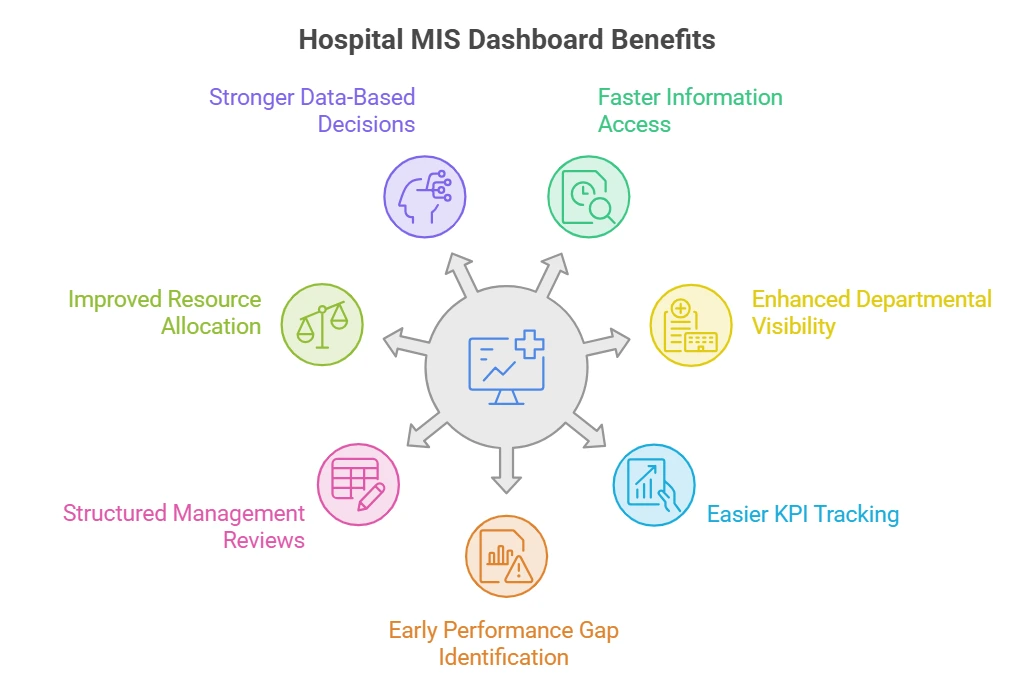
They can support management teams by providing:
Faster access to operational information
Better visibility across departments
Easier tracking of hospital KPIs
Early identification of performance gaps
More structured management reviews
Improved allocation of resources
Stronger data-based decision-making
Consequently, dashboards can help management teams move from reactive problem-solving toward proactive hospital administration.
Key Components of Hospital Admin Dashboards
Effective hospital admin dashboards should provide relevant information without overwhelming users. Therefore, administrators need to focus on metrics connected to specific management objectives.
1. Patient Flow Information
Patient flow shows how efficiently patients move through hospital services.
A dashboard may monitor admissions, discharges, transfers, outpatient visits, and emergency cases.
Administrators can use these insights to understand demand patterns. Additionally, they can identify departments facing congestion or capacity pressure.
2. Bed Occupancy and Utilization
Beds are among the most important hospital resources.
MIS dashboards can display available beds, occupied beds, discharge status, and occupancy trends.
Tracking this information helps administrators understand capacity utilization. Moreover, it can support planning during periods of high patient demand.
3. Financial Performance
Hospital operations also require careful financial management.
Dashboards may display revenue, departmental expenses, billing trends, outstanding payments, and other financial indicators.
However, financial metrics should be interpreted alongside operational information. A change in revenue may result from patient volume, service mix, pricing, or other factors.
4. Workforce Information
Hospitals depend on doctors, nurses, technicians, administrative staff, and support teams.
Therefore, workforce dashboards may track staffing levels, attendance, shift allocation, overtime, and department-wise manpower requirements.
These insights can help managers plan staffing more efficiently.
5. Inventory and Pharmacy Information
Hospitals need consistent access to medicines, consumables, and other essential supplies.
MIS dashboards can help administrators monitor stock availability, consumption patterns, reorder requirements, and inventory movement.
Consequently, management teams can identify potential shortages and reduce unnecessary inventory accumulation.
Tracking Hospital KPIs Effectively
Tracking hospital KPIs is one of the primary purposes of an MIS dashboard. However, displaying too many indicators can make a dashboard difficult to use.
Administrators should select KPIs based on the decision the dashboard needs to support.
Important hospital KPIs may include:
Bed occupancy rate
Average length of stay
Patient waiting time
Admission and discharge volumes
Outpatient footfall
Emergency department volume
Staff utilization
Inventory consumption
Billing performance
Department-wise operational performance
The right combination depends on the hospital, department, and management objective.
For example, an operations manager may prioritize patient flow and bed utilization. A finance manager may focus more heavily on billing and financial indicators.
Therefore, KPI selection should always start with a clear management question.
How to Master a Hospital Management Information System Dashboard
Learning to use a dashboard involves more than understanding charts. Administrators need to know what the numbers mean and how those numbers relate to hospital operations.
Step 1: Understand the Dashboard's Objective
First, determine why the dashboard exists.
Is it designed to monitor patient flow? Is it measuring financial performance? Or does it support senior management reviews?
Knowing the purpose helps users focus on relevant information.
A KPI is useful only when its definition is clear.
Administrators should understand what the indicator measures, how it is calculated, and which data sources contribute to it.
Additionally, they should understand the reporting period.
For example, daily bed occupancy data may support operational decisions. Monthly occupancy trends may be more useful for strategic planning.
Step 3: Look Beyond Individual Numbers
One number rarely tells the complete story.
Suppose patient waiting time increases. Administrators should not immediately assume that staffing is the only problem.
The increase could relate to higher patient volumes, registration delays, diagnostic bottlenecks, or capacity limitations.
Therefore, effective MIS analysis requires connecting multiple indicators.
Step 4: Compare Performance Over Time
Trend analysis adds context to dashboard information.
Instead of reviewing today's figures alone, compare them with previous days, weeks, or months.
This approach can reveal patterns that isolated numbers may hide.
For example, consistently increasing outpatient volume may indicate the need for additional capacity. Similarly, recurring inventory shortages may indicate weaknesses in procurement planning.
Step 5: Identify Variances and Exceptions
Strong dashboards make unusual performance easier to notice.
Administrators should look for indicators that differ significantly from normal patterns or established targets.
However, an exception should trigger investigation rather than an immediate conclusion.
The next step is to understand why the variance occurred.
Step 6: Convert Insights Into Actions
Dashboard analysis becomes valuable when it influences decisions.
If data shows longer waiting times, management may review patient flow processes. If bed occupancy remains consistently high, administrators may examine discharge planning and capacity.
Therefore, every dashboard review should ideally answer three questions:
What happened?
Why might it have happened?
What management action should follow?
This approach turns reporting into practical decision support.
Turn Insights Into Leadership
Strengthen your analytical and managerial capabilities with an MBA designed to prepare you for dynamic, data-driven business environments.
Different HMIS software tools can support different hospital functions. Therefore, managers should focus less on software complexity and more on information quality and usability.
Useful tools should enable decision-makers to access relevant information without unnecessary difficulty.
When evaluating or using HMIS software tools, administrators should consider:
Data accuracy
Ease of dashboard navigation
Reporting flexibility
Integration between departments
User access controls
Data security
Frequency of updates
Ability to identify trends
Customization of KPIs
Additionally, staff training matters. Even a sophisticated information system provides limited value when users do not understand the data.
Healthcare Data Visualization: Turning Numbers Into Insights
Healthcare data visualization makes complex information easier to understand through charts, graphs, tables, indicators, and trend lines.
However, visual complexity does not necessarily create better analysis.
A useful dashboard should make important information easy to identify.
For example, a line chart may show changes in patient volume over several months. A bar chart may compare departmental performance. Meanwhile, status indicators may highlight areas requiring immediate attention.
Good healthcare data visualization follows several principles.
Keep the Dashboard Focused
Avoid placing every available metric on one screen.
Instead, organize information according to management priorities.
Use Appropriate Visual Formats
Different types of information require different visual formats.
Trends work well with line charts. Comparisons may work better with bar charts. Tables can be useful when exact values matter.
Therefore, the visualization should match the management question.
Provide Context
A value without context may be misleading.
Whenever possible, compare current performance with historical trends, targets, or relevant benchmarks.
Highlight Exceptions
Managers should quickly notice significant changes.
Therefore, dashboards can use clear visual signals to draw attention to areas requiring investigation.
Common Mistakes When Using Hospital MIS Dashboards
Even experienced users can misinterpret dashboard information.
One common mistake is focusing on too many KPIs. This creates information overload and makes priorities unclear.
Another mistake is treating correlation as causation. Two indicators changing together does not automatically mean one caused the other.
Administrators should also avoid making decisions from outdated or incomplete information.
Furthermore, poor data quality can reduce confidence in the entire dashboard. Hospitals need reliable processes for entering, validating, and updating information.
Finally, dashboards should not replace managerial judgement. Instead, they should strengthen it.
A hospital management information system can create a common information base for different departments.
For example, patient admission information can support capacity planning. Staffing information can help managers evaluate workforce requirements. Inventory trends can inform procurement decisions.
Moreover, senior administrators can use consolidated dashboards to understand overall operational performance.
The result is a more structured approach to hospital management.
However, becoming data-driven requires more than installing software. Hospitals also need clear KPIs, reliable data, trained teams, and a culture that uses evidence in decision-making.
Skills Needed to Work With Hospital MIS Dashboards
Healthcare administrators do not necessarily need to become programmers or data scientists. However, they should develop strong data literacy.
Important skills include:
Understanding healthcare KPIs
Reading charts and operational reports
Interpreting trends
Identifying performance variances
Asking the right analytical questions
Understanding basic hospital workflows
Communicating insights to teams
Converting findings into management actions
Additionally, administrators need critical thinking.
A dashboard tells users what the data shows. Skilled managers investigate what the information means for patients, employees, resources, and hospital performance.
Why MIS Knowledge Matters for Healthcare Management Students
Healthcare is becoming increasingly digital and information-driven. Consequently, future administrators need to become comfortable working with data.
Students interested in hospital and healthcare management should learn how operational information supports managerial decisions.
Classroom concepts become more valuable when learners understand their practical application.
For example, students can study how patient flow affects capacity planning. They can also examine how workforce information supports scheduling or how inventory data influences procurement.
An industry-oriented management education can help learners develop these practical perspectives.
At Asia Pacific Institute of Management, the emphasis on practical learning, experienced faculty, corporate exposure, and industry-aligned management education can help students develop broader managerial capabilities for evolving sectors.
Such exposure can be valuable for learners interested in data-led decision-making and modern management environments.
Building a Data-Driven Mindset
Mastering an MIS dashboard is ultimately about developing the right mindset.
Do not simply ask, "What does this number say?"
Instead, ask:
What changed?
Is the change significant?
What factors may explain it?
Which departments are affected?
What additional information is needed?
What action should management consider?
How will we know whether that action worked?
These questions transform dashboard monitoring into managerial analysis.
Moreover, they help administrators avoid making decisions based only on assumptions.
A hospital management information system is much more than a reporting tool. When used effectively, it can help administrators understand hospital performance and make better-informed operational decisions.
Mastering hospital MIS dashboards requires an understanding of KPIs, healthcare data visualization, operational workflows, and analytical thinking.
Most importantly, administrators must learn to move from simply viewing data to questioning, interpreting, and acting on it.
For students preparing for management careers, these capabilities are increasingly relevant as organizations adopt data-driven approaches. Industry-oriented learning and practical management exposure can help aspiring professionals prepare for such changing workplace requirements.
Advance Your Management Career
Develop industry-relevant management expertise and strategic thinking to confidently pursue leadership roles in healthcare and other growing sectors.
Dr. Vikas Gupta is a distinguished academic in the education and research domain, specializing in finance and related interdisciplinary studies. He is known for his...
01.
What is a hospital management information system?
A hospital management information system collects, organizes, and presents information related to hospital activities. It can support patient administration, finance, staffing, inventory, reporting, and operational monitoring. Administrators use this information to understand performance and support management decisions.
02.
What is an MIS dashboard in a hospital?
A hospital MIS dashboard is a visual reporting interface that presents important operational and management indicators. It may display information related to patient flow, bed utilization, staffing, finance, inventory, and other hospital functions.
03.
Which KPIs should hospital administrators track?
Relevant KPIs can include bed occupancy, average length of stay, patient waiting time, admissions, discharges, staffing, inventory consumption, and financial indicators. However, the right KPIs depend on the hospital’s objectives and the decisions being made.
04.
Why is healthcare data visualization important?
Healthcare data visualization converts complex information into understandable charts, graphs, tables, and indicators. Therefore, administrators can identify trends, compare performance, and detect potential operational issues more efficiently.
05.
How do HMIS software tools improve hospital administration?
HMIS software tools can centralize operational information and make reporting more structured. Additionally, they can help administrators monitor performance, review trends, coordinate information across functions, and support evidence-based decisions.
06.
Can MIS dashboards improve hospital decision-making?
Yes, dashboards can support better decision-making when they contain accurate, timely, and relevant information. However, administrators should combine dashboard insights with operational context, professional judgement, and further investigation.
07.
What skills are required to understand hospital dashboards?
Administrators should understand KPIs, charts, trends, hospital processes, and basic data analysis. Moreover, they need critical thinking and communication skills to convert dashboard information into practical management actions.
08.
How can students learn hospital MIS management?
Students can begin by learning hospital operations, healthcare KPIs, data visualization, and management information systems. Practical case studies and industry-oriented management education can further help them understand how data supports real-world managerial decisions.
















.webp) Call Us
Call Us