Online MBA Healthcare for Busy Doctors: Study Without a Career Break
Posted on 13 Oct 2026
By Dr. Vikas Gupta
Introduction
Doctors dedicate years to medical education, clinical training, and patient care. However, as healthcare organizations become more complex, clinical expertise alone may not prepare every doctor for leadership and management responsibilities. Many doctors therefore consider business education to expand their career options.
An online MBA healthcare for doctors can be an option for medical professionals who want to understand healthcare operations, finance, strategy, and organizational leadership while continuing their clinical practice.
Unlike a traditional full-time programme, an online learning format may offer greater flexibility. Doctors can potentially study around consultation hours, hospital duties, and personal commitments. However, success depends on programme requirements, workload, and individual time management.
This guide explains how an online MBA can support doctors' professional development, what to check before enrolling, and how to balance medical practice with management education.
Advance Your Healthcare Career
Develop healthcare management knowledge while continuing medical practice, and explore opportunities to strengthen your leadership skills and professional growth.
An online MBA in healthcare is a management programme that combines business education with topics relevant to healthcare organizations. Depending on the curriculum, it may cover healthcare operations, finance, marketing, strategy, leadership, and service quality.
For doctors, this learning can provide a broader understanding of how healthcare organizations function beyond clinical decision-making.
An online MBA healthcare programme for doctors may help medical professionals develop management knowledge while continuing to work. The actual flexibility depends on live classes, recorded lectures, assessments, attendance rules, and examination requirements.
Doctors should also distinguish between an online MBA, a distance-learning programme, and a hybrid programme. These formats can have different teaching methods, attendance expectations, and regulatory requirements.
Why Are Doctors Considering an MBA in Healthcare?
Medical professionals may eventually become involved in responsibilities beyond patient consultations. These can include supervising teams, managing departments, planning services, improving operational efficiency, or participating in organizational decisions.
Management education can help doctors understand these responsibilities more effectively.
1. To develop healthcare leadership skills
Doctors who supervise teams or aspire to leadership positions may benefit from learning about organizational behaviour, communication, strategic planning, and decision-making.
These skills can complement clinical expertise when managing multidisciplinary teams.
2. To understand hospital operations
Healthcare organizations depend on coordinated processes, resource allocation, staffing, and service planning. An MBA may introduce doctors to these operational considerations.
Consequently, doctors can gain a broader perspective on the factors that influence healthcare delivery.
3. To build financial and business knowledge
Healthcare services involve budgets, costs, investments, and resource management. Management education can help doctors understand these business considerations.
This knowledge may be useful when participating in departmental planning or evaluating service improvement proposals.
4. To explore non-clinical career opportunities
Some doctors eventually consider roles in hospital administration, healthcare consulting, health technology, healthcare business development, or organizational leadership.
An MBA may help develop relevant management skills. However, specific roles can require additional qualifications, experience, or employer-specific competencies.
5. To support long-term professional development
Doctors may want to combine clinical knowledge with business understanding without immediately leaving medical practice.
An online learning format may help them pursue this goal while maintaining their existing professional responsibilities.
Can Doctors Pursue an Online MBA While Practising Medicine?
Yes, doctors may be able to pursue an online MBA while practising medicine, provided they meet the programme's eligibility and participation requirements.
The key advantage is potential scheduling flexibility. However, online study still requires consistent time for lectures, assignments, examinations, group projects, and independent learning.
Before enrolling, doctors should assess their weekly workload and understand the programme's academic expectations.
How online learning can fit around clinical duties
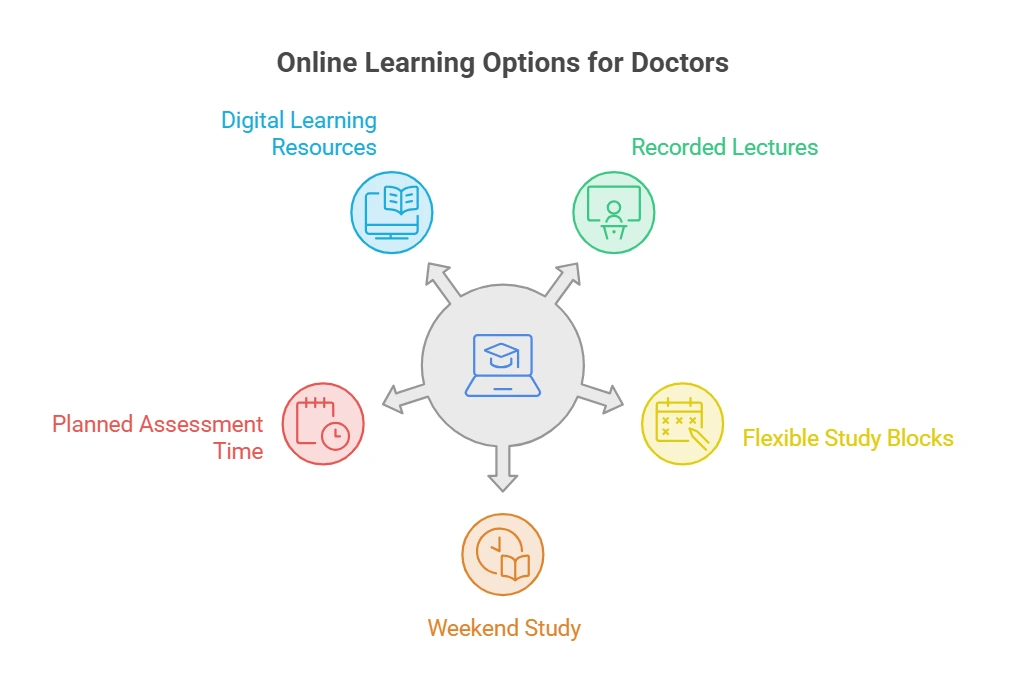
Online programmes may provide some combination of recorded lectures, live virtual sessions, digital learning materials, and online assessments.
These options can help doctors plan study around their schedules. However, not every programme offers completely self-paced learning.
Consider the following arrangements:
Recorded lectures: Study course materials when your schedule allows.
Flexible study blocks: Reserve short periods for reading and revision.
Weekend study: Use available weekends for assignments and deeper learning.
Planned assessment time: Schedule examinations and submissions around clinical commitments.
Digital learning resources: Revisit course materials to reinforce difficult concepts.
Before making a decision, confirm whether live attendance, fixed examination dates, campus visits, or group activities are mandatory.
Balancing an MBA with medical practice requires realistic planning. Doctors already manage demanding schedules, so a sustainable study routine matters more than an ambitious timetable that becomes difficult to maintain.
Step 1: Review your existing commitments
Start by mapping your clinical duties, consultations, emergency responsibilities, family commitments, and rest periods.
Identify the time you can realistically dedicate to learning each week. Avoid planning around an ideal schedule that rarely reflects your actual working conditions.
Step 2: Choose a programme with a suitable format
Compare programmes based on lecture schedules, recorded content, assignment deadlines, examination arrangements, and attendance requirements.
A flexible format may be helpful, but verify the details before paying fees.
Step 3: Create a weekly study plan
Divide study time into manageable sessions. For example, you could reserve shorter sessions for lectures and reading, then use a longer session for assignments.
Your exact schedule should depend on your clinical workload and programme requirements.
Step 4: Set priorities for each study session
Decide what you want to complete before starting. You might review one topic, finish a case study, or prepare notes for an upcoming assessment.
Clear goals help you use limited study time effectively.
Step 5: Connect management concepts with real situations
Where appropriate, relate course concepts to general workplace challenges, such as resource planning, team communication, or service efficiency.
This can make learning more meaningful. Always protect patient confidentiality and never share identifiable patient information in coursework without proper authorization and safeguards.
Step 6: Protect rest and recovery
Doctors should not rely on consistently sacrificing sleep or recovery time to meet study targets.
If your workload becomes unmanageable, reassess your schedule and contact the programme team about available academic support or permitted flexibility.
Lead Beyond Clinical Practice
Explore executive healthcare management education to build business understanding, improve operational decision-making, and prepare for broader professional responsibilities.
What Will Doctors Learn in an MBA Healthcare Programme?
The curriculum varies by institution and programme. However, healthcare-focused management education may include several business and organizational subjects.
Healthcare operations management
This area explores how healthcare services are organized and delivered. Topics may include workflow coordination, resource planning, process improvement, and operational performance.
Doctors can use this knowledge to better understand the administrative factors affecting service delivery.
These topics may be useful for doctors who supervise teams or collaborate across clinical and administrative departments.
Healthcare strategy and marketing
Strategy explores organizational priorities, service development, and long-term planning. Marketing may cover patient engagement, service positioning, and responsible communication.
The exact content depends on the programme's design and specialization.
Quality and performance improvement
Healthcare management education may examine service quality, performance indicators, and improvement methods.
Doctors can gain a broader understanding of how organizations monitor performance and identify opportunities for better coordination.
Before enrolling, review the actual syllabus rather than assuming every online MBA includes the same healthcare subjects.
An MBA can complement clinical qualifications by developing business and management knowledge. However, career outcomes depend on experience, existing qualifications, programme quality, employer requirements, and individual performance.
1. Hospital administration and operations
Doctors interested in organizational responsibilities may explore opportunities involving hospital operations, departmental coordination, or administrative leadership.
The requirements for each position vary. Senior roles often expect substantial professional and management experience.
2. Healthcare management
Healthcare management roles can involve operational planning, service improvement, project coordination, and organizational performance.
Doctors with management education may find this knowledge relevant when pursuing suitable positions.
3. Healthcare consulting
Some professionals explore consulting roles involving healthcare operations, organizational processes, or business improvement.
These positions may require analytical skills, project experience, and additional consulting-related competencies.
4. Health technology and digital health
Healthcare technology organizations need professionals who understand healthcare workflows and business needs.
Doctors who develop management and digital literacy may explore suitable opportunities in health technology operations, product-related work, or healthcare implementation projects. Specific technical roles may require additional training.
5. Healthcare business development
This area involves identifying opportunities, building professional relationships, and supporting service growth.
An understanding of healthcare delivery can be valuable, but commercial roles may also require negotiation, communication, and business development skills.
6. Leadership within an existing medical career
Doctors may also use management knowledge within their current organizations. For example, they may contribute to quality initiatives, departmental planning, service improvement, or administrative projects.
An MBA does not automatically guarantee a promotion or leadership position. It is best viewed as one component of a broader professional development plan.
Is an Online MBA Better Than a Full-Time MBA for Doctors?
The right format depends on your professional goals, learning preferences, and available time.
Factor
Online MBA
Full-time MBA
Work continuity
May allow doctors to continue practising
Often requires a substantial time commitment away from regular duties
Schedule
May offer recorded or flexible learning, depending on the programme
Usually follows a more structured timetable
Campus interaction
May rely more on virtual learning
Often provides more regular in-person interaction
Practical exposure
Depends on projects, case studies, and programme design
Depends on internships, projects, and programme design
Networking
May include online interaction and professional groups
May provide more frequent in-person networking
Suitability
Doctors seeking to combine work and study
Doctors able to commit substantial time to management education
Neither format is automatically superior. Some doctors may prefer online study because it can fit around clinical work. Others may value the immersive experience and networking opportunities of full-time education.
Compare the curriculum, teaching quality, faculty interaction, practical exposure, total cost, and recognition before choosing.
Programme selection requires more than comparing tuition fees or promotional claims. Doctors should carefully evaluate the following factors.
1. Verify recognition and regulatory status
Check the institution's current recognition and the programme's approval or entitlement for the specific mode of delivery.
For online and distance programmes in India, verify the applicable requirements through official regulatory sources, including the University Grants Commission and its Distance Education Bureau where relevant.
Do not assume that every programme described as an online MBA has the same recognition status.
2. Check eligibility criteria
Confirm whether your medical qualification meets the admission requirements. Some programmes may require a bachelor's degree and minimum marks, while others may have additional conditions.
Check whether professional experience is required or preferred.
3. Review the curriculum
Look for subjects that align with your goals. For example, a doctor interested in hospital operations may prioritize operations, finance, leadership, and quality improvement.
Someone interested in healthcare business development may also want strategy, marketing, and project management.
4. Understand the real time commitment
Ask about weekly learning expectations, live sessions, examinations, assignment deadlines, and mandatory activities.
A programme marketed as flexible may still involve fixed academic commitments.
5. Evaluate faculty and academic support
Review faculty qualifications, teaching methods, student support, and access to academic guidance.
Doctors with demanding schedules may benefit from clear communication channels and reliable academic support.
6. Examine total costs and career support
Compare tuition, examination fees, technology requirements, and any additional expenses.
Also ask what career services the institution provides. Understand the difference between career guidance, placement assistance, and guaranteed employment claims.
Asia Pacific Institute of Management can be one institution to research when exploring management education. Before selecting any programme, review its current offerings, admission criteria, delivery format, recognition, curriculum, and career support. Verify whether a suitable online healthcare-focused MBA is currently available rather than assuming the format or specialization is offered.
An online MBA healthcare programme for doctors may provide a way to develop management skills while continuing clinical practice. Its potential flexibility can be valuable for medical professionals who cannot commit to full-time education.
However, online study still requires time, consistency, and careful planning. Doctors should evaluate their schedules, compare programme formats, and verify recognition before enrolling.
An MBA may support career development in hospital operations, healthcare management, consulting, digital health, or leadership-related work. Yet, outcomes depend on the individual's experience, skills, and professional objectives.
If you are considering management education, begin by identifying the responsibilities you want to take on in the future. Then compare current programmes based on curriculum, flexibility, recognition, practical learning, and career support. A well-chosen programme should complement your medical expertise and fit your professional life realistically.
Balance Practice And Progress
Discover management learning options that complement your medical expertise, support career development, and fit your professional aspirations.
Dr. Vikas Gupta is a distinguished academic in the education and research domain, specializing in finance and related interdisciplinary studies. He is known for his...
01.
Can doctors do an online MBA without leaving their jobs?
Yes, doctors may be able to pursue an online MBA while continuing to work, provided they can meet its academic requirements. Flexible lectures can help, but assessments, live sessions, and deadlines may still require scheduled time.
02.
Is an online MBA in healthcare suitable for medical professionals?
It may suit doctors who want to develop knowledge of healthcare operations, finance, leadership, and organizational strategy. Its value depends on the curriculum, recognition, learning experience, and the doctor’s career goals.
03.
How much time does an online MBA require each week?
The required study time varies by programme, subject load, and assessment schedule. Doctors should request a realistic estimate from the institution and compare it with their clinical and personal commitments.
04.
Can doctors continue clinical practice during an MBA?
Many doctors can continue practising while studying online, but this depends on their workload and the programme’s attendance and examination requirements. Planning and a manageable course schedule are important.
05.
What career opportunities can an MBA offer doctors?
Potential directions include healthcare operations, hospital administration, healthcare consulting, digital health, business development, and organizational leadership. Specific roles depend on qualifications, experience, and employer requirements.
06.
Is an online MBA recognised in India?
Recognition depends on the institution, programme, and mode of delivery. Prospective students should verify the current regulatory status through official sources before enrolling.
07.
Should doctors choose healthcare management or general management?
Healthcare management may be more directly relevant to healthcare operations and service delivery. General management may provide broader business coverage. Compare the actual curricula with your intended career path.
08.
Does an MBA guarantee a hospital leadership position?
No. An MBA can develop management knowledge, but it does not guarantee promotion or appointment to a leadership role. Employers may also consider clinical experience, operational exposure, leadership ability, and role-specific requirements.

















.webp) Call Us
Call Us