MBA Healthcare vs MSc Healthcare Management: Which Should You Choose?
Posted on 11 Oct 2026
By Dr. Vikas Gupta
Introduction
The healthcare industry needs professionals who can combine management expertise, operational efficiency, and strategic thinking. As hospitals, healthcare companies, and medical service organizations evolve, the demand for skilled healthcare managers continues to create opportunities for qualified graduates.
However, choosing the right postgraduate qualification can be challenging. Should you pursue an MBA in Healthcare Management or an MSc in Healthcare Management? Both programs can support careers in healthcare administration, but their academic focus, learning approach, and career pathways may differ.
An MBA generally emphasizes business leadership, strategy, finance, and organizational management. In comparison, an MSc often places greater emphasis on specialized healthcare management knowledge, analytical methods, and the academic study of healthcare systems. However, the exact curriculum depends on the institution.
In this guide, we compare both qualifications, explore career opportunities, and explain how to choose the right healthcare management program in India.
Choose Your Healthcare MBA
Explore management education opportunities that build business knowledge, strengthen leadership skills, and help you prepare for a rewarding healthcare management career.
An MBA in Healthcare Management combines core business administration principles with healthcare industry applications. It prepares students to understand organizational strategy, healthcare operations, financial planning, and managerial decision-making.
The program typically focuses on how healthcare organizations operate and how managers can improve efficiency, service delivery, and business performance.
What Do You Study in an MBA in Healthcare Management?
Depending on the institution, the curriculum may include:
Healthcare operations and hospital administration
Financial management and budgeting
Marketing and business development
Human resource management
Healthcare strategy and organizational leadership
Healthcare quality and service management
Business analytics and decision-making
Healthcare information systems
Additionally, some programs offer industry projects, internships, case studies, and corporate interactions. These activities can help students connect classroom learning with practical business challenges.
Who Should Choose an MBA in Healthcare Management?
An MBA may suit graduates who want to develop managerial and leadership skills for healthcare organizations.
It can be particularly relevant for students interested in hospital operations, healthcare business development, health insurance, healthcare consulting, or healthcare technology businesses.
Furthermore, students who want to understand finance, strategy, marketing, and organizational leadership may find the business-focused approach useful.
However, healthcare-specific experience or additional qualifications may be necessary for certain roles. Students should review employer requirements before selecting their program.
What Is an MSc in Healthcare Management?
An MSc in Healthcare Management is a postgraduate qualification that focuses on the management of healthcare organizations and systems through specialized academic study.
Depending on the institution, the program may emphasize healthcare administration, service improvement, healthcare policy, research methods, data analysis, and operational planning.
Compared with many MBA programs, an MSc may provide a more specialized or analytical approach to healthcare management. Nevertheless, some MSc programs also include leadership, finance, and strategic management.
What Do You Study in an MSc in Healthcare Management?
The curriculum varies by institution, but subjects may include:
Healthcare systems and administration
Healthcare policy and planning
Healthcare operations and service improvement
Research methodology
Healthcare data analysis
Quality management in healthcare
Healthcare economics
Health services evaluation
Some programs also include research projects, dissertations, practical assignments, or placements.
These components can help students understand healthcare systems, assess operational challenges, and evaluate evidence-based approaches to improving services.
Who Should Choose an MSc in Healthcare Management?
An MSc may suit graduates who prefer specialized healthcare knowledge, analytical work, research, or healthcare systems management.
It may also interest students who want to understand healthcare policy, service evaluation, operational improvement, or research-oriented roles.
However, the program's suitability depends on its curriculum and the student's intended career. Therefore, applicants should compare course modules, research requirements, practical exposure, and employer expectations.
MBA Healthcare vs MSc Healthcare Management: Key Differences
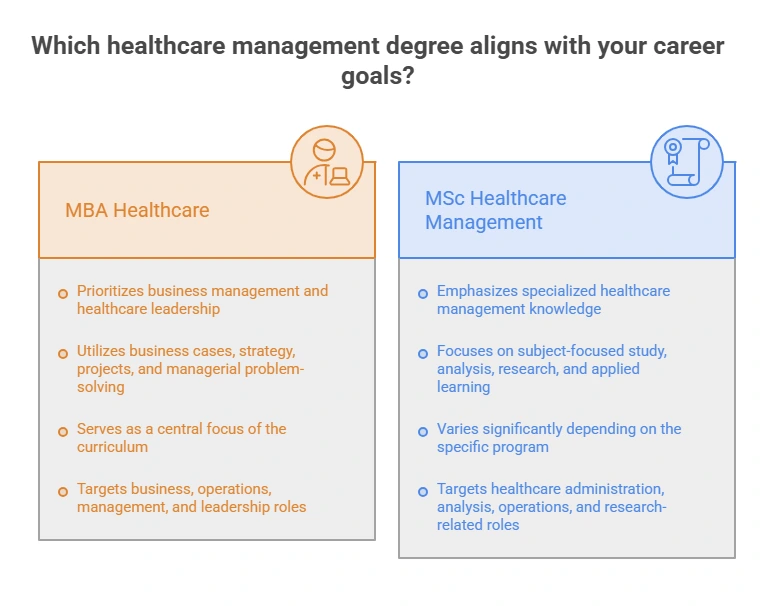
The main difference between these qualifications is their educational emphasis. An MBA generally prioritizes business management and leadership, while an MSc often emphasizes specialized academic knowledge and analytical understanding of healthcare management.
Comparison factor
MBA in Healthcare Management
MSc in Healthcare Management
Primary focus
Business management and healthcare leadership
Specialized healthcare management knowledge
Learning approach
Business cases, strategy, projects, and managerial problem-solving
Subject-focused study, analysis, research, and applied learning
Healthcare systems, policy, research, operations, and service evaluation
Leadership preparation
Often a central focus
Depends on the program
Research emphasis
Varies by institution
May have a stronger research or dissertation component
Career orientation
Business, operations, management, and leadership roles
Healthcare administration, analysis, operations, and research-related roles
Best suited for
Students seeking business leadership and managerial development
Students seeking specialized healthcare knowledge and analytical skills
These differences are general rather than universal. Some MSc programs are strongly business-oriented, while some healthcare MBA programs provide substantial analytical and research training.
Therefore, examine the actual curriculum instead of relying only on the qualification's title.
MBA vs MSc Healthcare Management: Which Is Better for Your Career?
Neither qualification is automatically better for every student. Both may support healthcare management careers, but they can develop different strengths.
Choose an MBA If You Want to Build Business and Leadership Skills
An MBA may be suitable if you want to understand how healthcare organizations manage people, finances, operations, and growth.
Consider an MBA if you are interested in:
Hospital administration and operational management
Healthcare business development
Healthcare marketing and partnerships
Healthcare consulting and strategy
Healthcare finance and business planning
Leadership and management responsibilities
For example, a hospital operations professional may need to coordinate teams, monitor budgets, improve workflows, and support organizational objectives. An MBA can help develop the management skills relevant to these responsibilities.
Additionally, some MBA programs offer transferable business skills that can support career changes across industries.
Choose an MSc If You Want Specialized Knowledge and Analytical Skills
An MSc may be suitable if you prefer detailed study of healthcare systems, service improvement, policy, or research methods.
Consider an MSc if you are interested in:
Healthcare systems and service planning
Healthcare quality improvement
Healthcare research and evaluation
Healthcare policy-related work
Operational analysis
Specialized healthcare administration
For example, a graduate interested in evaluating healthcare service performance may benefit from training in research methods, data analysis, and healthcare systems.
However, career eligibility depends on the individual employer and the program's content. Research-focused positions may also require further qualifications or relevant experience.
Healthcare MBA or MSc: Career Opportunities Compared
Students often compare these qualifications based on the jobs they may pursue after graduation. In practice, employers evaluate several factors, including subject knowledge, practical skills, work experience, and the responsibilities of each role.
Career Opportunities After an MBA in Healthcare Management
Graduates may explore roles such as:
1. Hospital Operations Manager
These professionals coordinate operational activities, support resource planning, and work with departments to improve service efficiency.
2. Healthcare Business Development Manager
Business development professionals identify growth opportunities, develop partnerships, and support the expansion of healthcare services.
3. Healthcare Consulting Professional
Consultants help healthcare organizations assess business challenges, improve processes, and develop strategic recommendations.
4. Healthcare Marketing Manager
These professionals support marketing strategies, patient engagement initiatives, brand positioning, and business development.
5. Healthcare Finance or Planning Professional
Depending on their skills and experience, graduates may work in budgeting, financial planning, business analysis, or operational performance.
6. Healthcare Technology Business Professional
Healthcare technology organizations may recruit management graduates for business operations, product implementation, partnerships, or commercial strategy.
These roles can require different levels of experience. Therefore, entry-level positions may involve coordination and analysis before progressing into management responsibilities.
Career Opportunities After an MSc in Healthcare Management
Graduates may explore roles such as:
1. Healthcare Management Analyst
These professionals examine operational data, processes, and performance indicators to identify improvement opportunities.
2. Healthcare Quality Improvement Professional
They support service evaluation, process improvement, and quality initiatives within healthcare organizations.
3. Healthcare Administration Professional
These roles involve administrative planning, departmental coordination, documentation, and operational support.
4. Healthcare Research or Project Assistant
Depending on the curriculum and research skills developed, graduates may support healthcare studies, program evaluation, or service research projects.
5. Healthcare Program Coordinator
These professionals help organize healthcare initiatives, coordinate stakeholders, monitor activities, and support project reporting.
6. Healthcare Policy or Planning Support Professional
Some graduates may pursue roles related to healthcare planning, policy analysis, or service development, depending on their qualifications and employer requirements.
These pathways are illustrative rather than guaranteed outcomes. Job titles, entry requirements, and advancement opportunities vary by employer and location.
MBA Healthcare Career Scope in India
The MBA healthcare career scope extends across several types of organizations. As healthcare services become more complex, organizations need professionals who understand operations, finance, technology, service quality, and business strategy.
Potential employment settings include:
Hospitals and healthcare networks
Diagnostic and healthcare service providers
Health insurance organizations
Pharmaceutical and medical technology businesses
Healthcare consulting firms
Digital health and healthcare technology companies
Healthcare service management organizations
An MBA may be particularly useful for students interested in the business side of healthcare.
However, the opportunities available to an individual depend on the program, skills, experience, and employer expectations. A qualification alone does not guarantee a particular job or salary.
Students should also explore internships, industry projects, and practical learning opportunities. These experiences can help demonstrate their ability to apply management concepts in real workplace situations.
Advance Your Healthcare Career
Discover management programs, practical learning opportunities, and industry exposure to help align your postgraduate education with your professional ambitions.
MSc Healthcare Management Career Opportunities in India
An MSc Healthcare Management career can involve healthcare administration, operational analysis, service improvement, research support, or planning-related responsibilities.
Graduates may explore opportunities in healthcare providers, consulting organizations, research projects, healthcare service companies, and organizations involved in healthcare planning.
Career pathways may depend significantly on the program's specialization. For example, an MSc with strong research training may suit analytical or evaluation-related roles, while a program emphasizing healthcare operations may support administrative and service improvement work.
Students should also consider whether their target role requires prior healthcare experience, specialized technical skills, or additional professional credentials.
Therefore, compare actual job descriptions with the modules offered by each institution before making a decision.
Salary After MBA vs MSc Healthcare Management
Salary is an important factor when selecting a postgraduate qualification. However, comparing MBA and MSc salaries without considering the job role can lead to misleading conclusions.
Compensation varies according to experience, employer, location, responsibilities, technical skills, and organizational size. Some management roles may offer higher compensation because of their responsibilities rather than the qualification alone.
Factors That Influence Salary
Work experience: Relevant experience can strengthen your profile and improve access to suitable positions.
Practical skills: Analytical thinking, communication, project management, and problem-solving are valuable across healthcare management roles.
Industry knowledge: Familiarity with healthcare operations, service delivery, and regulatory requirements can improve role suitability.
Employer and location: Salary ranges vary across cities, organizations, and employment sectors.
Program quality and exposure: Internships, applied projects, faculty expertise, and industry interactions may help students develop relevant capabilities.
Career progression: Compensation can increase as professionals gain experience and take on greater responsibilities.
Before choosing a program, examine credible placement reports, available job descriptions, and the career outcomes of recent graduates. Compare roles and responsibilities rather than relying on broad claims about one qualification offering a higher salary.
Eligibility and Admission: MBA vs MSc Healthcare Management
Admission requirements differ between institutions and programs. Students should verify the official eligibility criteria before applying.
Typical MBA Admission Requirements
Many MBA programs require a recognized bachelor's degree. Some institutions also consider entrance examination scores, academic performance, interviews, group discussions, or other selection criteria.
Applicants should check the relevant institution's admission process, application deadlines, and any program-specific requirements.
Typical MSc Admission Requirements
MSc eligibility depends on the subject and institution. Some programs accept graduates from a broad range of disciplines, while others prefer applicants with backgrounds in healthcare, life sciences, management, or related fields.
Research-focused programs may also assess academic preparation, research interests, or other requirements.
Before applying, confirm the accepted undergraduate disciplines, minimum marks, selection process, course duration, and curriculum.
How to Choose the Right Healthcare Management Program
Selecting the right program involves more than deciding between an MBA and an MSc. You should also evaluate the quality and relevance of the education offered.
1. Define Your Career Goal
Identify whether you want to focus on leadership, hospital operations, healthcare business development, research, policy, or service improvement.
Your intended role can help determine which curriculum is more relevant.
2. Compare the Curriculum
Review the actual modules rather than relying only on the degree title. Look for subjects that match your interests and future responsibilities.
3. Evaluate Practical Learning
Explore internships, projects, case studies, industry interactions, and other applied learning opportunities. Practical exposure can help you understand workplace expectations.
4. Assess Faculty Expertise
Look for faculty members with relevant academic backgrounds and industry knowledge. Their experience can influence how effectively management concepts connect with real-world challenges.
5. Review Career Support
Ask about career guidance, employer interactions, placement support, and available information about graduate outcomes. Check the relevance of opportunities to your preferred career path.
6. Compare Total Costs and Duration
Consider tuition fees, living expenses, program length, and other costs. Evaluate these alongside curriculum quality and career relevance.
7. Verify Program Recognition and Eligibility
Check the institution's official program information and relevant recognition requirements. Confirm that the qualification meets the expectations of your intended employers or future academic plans.
Exploring Management Education at Asia Pacific Institute of Management
Asia Pacific Institute of Management emphasizes industry-oriented management education, experienced faculty, practical learning, corporate exposure, and placement support.
These factors are useful considerations when evaluating postgraduate management education and its relevance to professional development.
Students specifically interested in healthcare management should review the institute's current program offerings, curriculum, eligibility criteria, and industry exposure. Confirm whether the available qualification aligns with your healthcare career objectives before applying.
The right choice should balance academic learning, practical experience, professional interests, and long-term career plans.
Choosing between an MBA in Healthcare Management and an MSc in Healthcare Management requires a clear understanding of your career goals.
An MBA may be a suitable option if you want to develop business leadership, strategic thinking, financial understanding, and management skills for healthcare organizations.
An MSc may be more appropriate if you prefer specialized healthcare knowledge, analytical work, healthcare systems, or research-related learning.
Neither qualification is universally superior. Your decision should depend on the curriculum, practical exposure, program quality, employer expectations, and the professional responsibilities you want to pursue.
Take time to compare available programs, review eligibility requirements, and research relevant career opportunities before making your choice.
Ready to explore your management education options? Learn more about Asia Pacific Institute of Management, review its current programs and admission requirements, and identify the pathway that best supports your professional ambitions
Shape Your Management Future
Take the next step toward your career goals by exploring MBA curriculum details, admission criteria, and professional development opportunities.
Dr. Vikas Gupta is a distinguished academic in the education and research domain, specializing in finance and related interdisciplinary studies. He is known for his...
01.
Which is better: MBA Healthcare vs MSc Healthcare Management?
An MBA may suit students seeking business leadership, strategy, and managerial development. An MSc may suit students seeking specialized healthcare knowledge, analytical skills, or research exposure. The best choice depends on your career goals and the curriculum.
02.
Is an MBA in Healthcare Management worth pursuing?
It can be a useful option for students interested in healthcare operations, administration, business development, or strategy. However, its value depends on program quality, practical learning, relevant skills, and career opportunities.
03.
Can I work in hospital administration after an MSc in Healthcare Management?
Yes, some graduates may qualify for hospital administration and related roles. Eligibility depends on the employer, responsibilities, program content, and any additional experience or credentials required.
04.
What is the difference between healthcare MBA or MSc programs?
Healthcare MBA programs generally emphasize business management and leadership within healthcare. MSc programs often emphasize specialized healthcare knowledge, analytical methods, or research. However, individual curricula can differ considerably.
05.
Which qualification offers better career scope in India?
Both qualifications can support healthcare management careers. An MBA may suit business-focused roles, while an MSc may suit specialized or analytical pathways. Actual opportunities depend on employer requirements, skills, and experience.
06.
Can students from non-medical backgrounds study healthcare management?
Many programs accept students from non-medical backgrounds, but eligibility varies. Check the institution’s official requirements to confirm whether your undergraduate degree is accepted.
07.
Does an MBA guarantee a higher salary than an MSc?
No. Salary depends on the role, experience, employer, location, and skills. Compare relevant job opportunities and credible graduate outcome data rather than assuming one qualification guarantees better compensation.
08.
How should I compare healthcare management master's programs?
Compare the curriculum, faculty, practical learning, research opportunities, industry exposure, admission requirements, costs, and career support. Most importantly, assess whether the program prepares you for your intended role..


















.webp) Call Us
Call Us