Hybrid Learning in Executive Healthcare MBA: What to Expect
Posted on 10 Oct 2026
By Dr. Vikas Gupta
Introduction
Healthcare professionals often balance demanding work schedules, professional responsibilities, and long-term career ambitions. Doctors, hospital administrators, healthcare consultants, and pharmaceutical professionals may want to develop leadership skills without putting their careers on hold. However, attending regular classroom sessions can be difficult when work commitments change frequently.
This is where hybrid executive MBA healthcare programs can become relevant. By combining online learning with scheduled in-person sessions, hybrid programs aim to provide greater flexibility while preserving opportunities for practical learning and professional interaction.
For working professionals, this learning model can offer a way to strengthen management knowledge, understand healthcare business operations, and prepare for leadership responsibilities. However, the experience depends on the program structure, curriculum, faculty, and opportunities for industry engagement.
In this guide, we explain how hybrid learning works in an Executive Healthcare MBA, what students can expect, and how to evaluate whether this format suits their career goals.
Advance Your Healthcare Leadership
Explore management education that strengthens leadership, builds business expertise, and helps healthcare professionals prepare for broader organizational responsibilities.
A hybrid Executive MBA in Healthcare is a management education program that combines online instruction with selected in-person learning activities. It is designed to help professionals develop business and leadership capabilities while managing ongoing work commitments.
The online component may include recorded lectures, live virtual classes, digital assignments, and discussions. In-person sessions may involve case studies, workshops, group projects, networking, or practical exercises.
However, not every hybrid program follows the same format. Some require regular campus attendance, while others schedule face-to-face sessions periodically.
How Does Hybrid Learning Work?
Hybrid learning combines digital education with classroom-based activities. Students engage with course materials online and attend scheduled in-person sessions for activities that benefit from direct interaction.
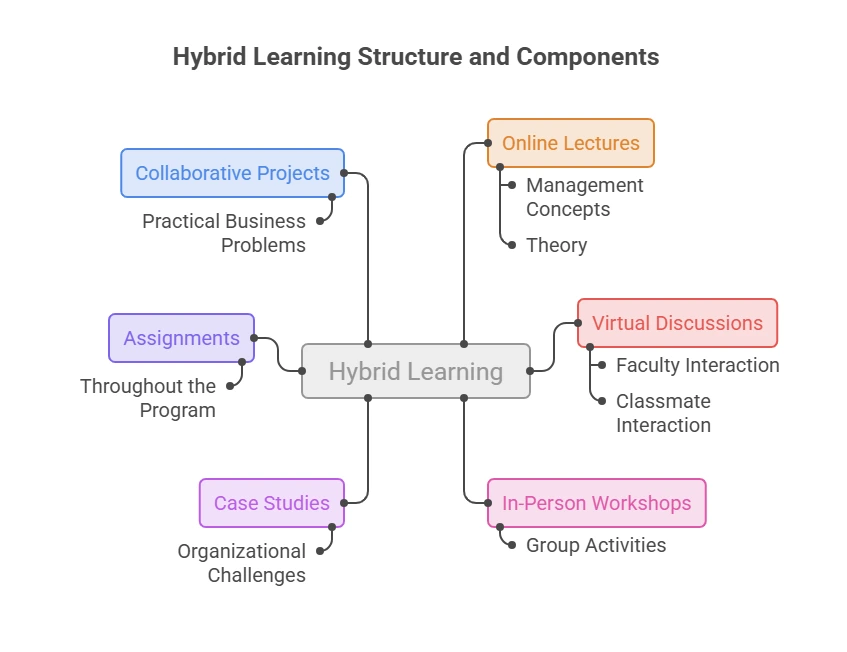
A typical structure may include:
Online lectures covering management concepts and theory
Live virtual discussions with faculty and classmates
In-person workshops or group activities
Case studies based on organizational challenges
Assignments and assessments completed throughout the program
Collaborative projects involving practical business problems
The exact structure depends on the institution. Therefore, applicants should confirm attendance requirements, class schedules, assessment methods, and the number of in-person sessions before enrolling.
Why Is Hybrid Learning Relevant for Healthcare Professionals?
Healthcare professionals frequently work in environments where schedules can change unexpectedly. Hospital operations, patient care responsibilities, administrative deadlines, and team management can make regular classroom attendance challenging.
A hybrid MBA may help address these scheduling difficulties while supporting structured management education.
1. Greater Flexibility for Working Professionals
One advantage of hybrid learning is the ability to complete some academic activities online. This can reduce the need to travel for every class.
For example, a hospital administrator may attend a virtual lecture after work and participate in an in-person workshop on a scheduled weekend.
However, flexibility does not mean that the program requires little time. Students must still plan for assignments, examinations, group projects, and scheduled sessions.
2. Learning Alongside Professional Responsibilities
Students may encounter management challenges involving staffing, budgeting, service delivery, and operational efficiency. They can use relevant academic concepts to analyse these challenges and develop practical solutions.
Nevertheless, students must protect sufficient study time to maintain consistent academic progress.
3. Opportunities for Professional Networking
In-person sessions can provide opportunities to interact with classmates from different professional backgrounds. These discussions may introduce students to new management approaches and industry perspectives.
For healthcare professionals, such interactions can be valuable when exploring leadership, administration, consulting, or business development.
Online discussions can also support collaboration between sessions, particularly when the program includes group assignments and faculty engagement.
4. A Balance Between Theory and Practical Learning
Healthcare management involves more than understanding business terminology. Professionals must apply knowledge to organizational decisions, resource allocation, team coordination, and service improvement.
Hybrid learning can combine theoretical instruction with classroom discussions and practical activities. However, the quality of this experience depends on how the institution designs its curriculum and assessments.
Hybrid MBA Healthcare: What Will You Study?
A hybrid MBA healthcare program may combine core business subjects with healthcare-related management topics. The curriculum varies by institution and may differ depending on whether the program focuses on healthcare administration, hospital management, or broader executive management.
Core Management Subjects
Students may study subjects such as:
Strategic management
Financial management and budgeting
Marketing and business development
Human resource management
Operations management
Leadership and organizational behaviour
Business analytics and decision-making
These subjects help professionals understand how organizations allocate resources, establish priorities, manage teams, and evaluate business performance.
Healthcare Management Subjects
Depending on the program, specialized modules may include:
Hospital administration and operations
Healthcare service management
Healthcare quality improvement
Healthcare finance
Healthcare information systems
Healthcare strategy and planning
Patient experience and service delivery
These topics can help learners understand the operational and business challenges faced by healthcare organizations.
Before applying, review the actual syllabus. A program described as an Executive MBA may not necessarily offer a healthcare specialization, so students should verify the available subjects and learning outcomes.
What to Expect From the Online Learning Component
The online portion of a hybrid executive MBA usually supports flexible access to course materials and academic discussions.
However, the learning experience depends on the institution's digital platform, faculty interaction, and course design.
Recorded Lectures and Live Classes
Recorded lectures may allow students to revisit difficult concepts at convenient times. Live classes provide opportunities to ask questions, discuss cases, and interact directly with faculty.
Applicants should check whether lectures are recorded, whether attendance is mandatory, and how frequently live classes take place.
Digital Assignments and Assessments
Students may submit assignments online, participate in discussions, and complete assessments through the learning platform.
Some courses may require individual reports, group presentations, or examinations. Therefore, learners should understand the assessment structure before committing to a program.
Collaborative Learning
Online group projects can help students practise communication, teamwork, and problem-solving.
For healthcare professionals, projects may involve operational planning, resource management, or service improvement scenarios. Actual project topics depend on the curriculum.
What Happens During In-Person Sessions?
In-person sessions provide opportunities for activities that benefit from direct communication and collaboration.
Although the format varies, students may participate in several types of learning activities.
Case Study Discussions
Case studies allow students to examine organizational challenges and consider different solutions.
For example, a case may explore how a healthcare organization can improve service efficiency without compromising quality. Students may evaluate resource allocation, team coordination, and performance indicators.
Workshops and Group Projects
Workshops may focus on leadership, negotiation, strategic planning, or decision-making. Group projects can help learners develop solutions to practical management problems.
These activities encourage students to explain their reasoning, consider alternative perspectives, and collaborate with others.
Faculty Interaction and Networking
In-person sessions may provide opportunities to discuss career goals, receive feedback, and build professional relationships.
Students should check how frequently these sessions occur and whether they are held on weekdays, weekends, or other scheduled dates.
Balance Work And Learning
Discover management learning opportunities designed to complement professional commitments while developing practical business knowledge and decision-making skills.
Blended MBA Healthcare vs Fully Online and Classroom-Based Learning
Students often compare blended MBA healthcare programs with fully online and traditional classroom-based options.
Each format has advantages and limitations. The right choice depends on work commitments, learning preferences, location, and program requirements.
Feature
Hybrid or blended MBA
Fully online MBA
Classroom-based MBA
Learning format
Online and in-person sessions
Primarily online
Primarily in person
Schedule flexibility
Depends on session frequency
Often greater flexibility, depending on delivery
Depends on the timetable
Face-to-face interaction
Included through scheduled sessions
Limited unless special sessions are offered
Regular classroom interaction
Travel requirements
Needed for in-person sessions
Usually lower, subject to examination requirements
Usually more frequent
Practical learning
Can combine digital work and in-person activities
Depends on projects and virtual activities
Can include classroom-based group activities
Suitable for
Professionals who can attend scheduled sessions
Professionals needing predominantly remote study
Learners who prefer regular campus attendance
Importantly, learning format alone does not determine educational quality. Faculty expertise, curriculum design, academic support, assessment standards, and institutional recognition also matter.
Flexible Executive MBA: How to Balance Work and Study
A flexible executive MBA may help professionals manage education alongside existing responsibilities. However, success requires planning and consistent study habits.
Create a Realistic Weekly Study Schedule
Set aside regular time for lectures, assignments, reading, and revision. Review the course calendar at the beginning of each term and identify weeks with heavier workloads.
A predictable schedule can help prevent academic tasks from accumulating.
Coordinate With Your Employer
Where appropriate, discuss your study plans with your manager or employer. Understanding work expectations in advance can help you prepare for scheduled classroom sessions and examinations.
Some employers may support professional development through study leave or flexible working arrangements, although this varies by organization.
Apply Concepts to Workplace Challenges
Whenever appropriate, connect management concepts with professional experience.
For instance, lessons about operations management may help you examine workflow challenges, while financial management concepts can improve your understanding of budgets and resource allocation.
Always respect patient confidentiality, workplace policies, and data protection requirements when using real-world examples.
Use Online Resources Consistently
Review recorded lectures, course notes, and discussion materials regularly. Seek faculty clarification when a topic is unclear.
Additionally, begin group assignments early and communicate with classmates about deadlines and responsibilities.
Protect Time for Rest and Personal Commitments
Balancing employment and study can become demanding. Avoid assuming that every spare hour will be available for coursework.
Choose a program whose workload and attendance requirements are realistic for your professional and personal circumstances.
Who Should Consider a Hybrid Executive Healthcare MBA?
A hybrid executive healthcare MBA may suit professionals who want management education while continuing to work.
Potential learners include:
Doctors and medical practitioners: Professionals interested in healthcare administration, organizational leadership, or healthcare business management may benefit from management training.
Hospital administrators: Experienced administrators may want to strengthen their understanding of strategy, finance, operations, and leadership.
Nurses and allied healthcare professionals: Eligible professionals may consider management education when exploring supervisory or administrative responsibilities.
Pharmaceutical and medical technology professionals: Employees interested in business development, commercial operations, or management may benefit from broader business knowledge.
Healthcare entrepreneurs: Professionals planning to establish or manage healthcare-related businesses may want to understand finance, operations, marketing, and organizational strategy.
Eligibility varies by program. Students should verify educational qualifications, work experience requirements, and admission criteria before applying.
How to Choose the Right Hybrid Learning MBA
Before enrolling, evaluate the program carefully. A convenient schedule is useful, but it should not be the only factor guiding your decision.
1. Verify Program Recognition
Check the institution's recognition and the qualification's applicable regulatory status. For programs delivered in India, verify current requirements through the relevant official regulatory sources.
Do not assume that all executive, online, or hybrid qualifications have identical recognition or equivalence.
2. Review the Curriculum
Confirm whether the program includes healthcare management subjects or offers a general management curriculum.
Compare the modules with your intended career goals. For example, hospital operations may require different knowledge from healthcare marketing or business strategy.
3. Understand the Attendance Requirements
Ask how many in-person sessions are required, where they take place, and whether attendance is compulsory.
Consider travel time, accommodation costs, and the impact on your work schedule.
4. Evaluate Faculty and Practical Learning
Look for relevant faculty expertise, applied assignments, case studies, group projects, and industry interactions.
Ask how the program connects management concepts with real organizational challenges.
5. Review Career Support
Check whether the institution offers career guidance, professional networking, employer interactions, or placement assistance.
Review any available placement information carefully. Outcomes vary by experience, employer requirements, and individual performance.
6. Compare Total Costs
Consider tuition fees, travel, accommodation, study materials, examination costs, and time away from work.
A complete cost assessment can help you determine whether the program is financially and practically suitable.
Exploring Management Education at Asia Pacific Institute of Management
Asia Pacific Institute of Management emphasizes industry-oriented management education, experienced faculty, practical learning, corporate exposure, and placement support.
These factors can be relevant when evaluating a management program intended to support professional development.
Healthcare professionals interested in an executive or hybrid format should verify the institute's current program offerings, delivery mode, healthcare-related curriculum, admission requirements, and scheduled attendance commitments directly with the institute.
This step helps ensure that the available qualification matches your career objectives and preferred learning format.
Conclusion: Is Hybrid Learning Right for Your Healthcare Career?
Hybrid learning offers healthcare professionals a way to combine management education with ongoing employment. By bringing together digital instruction and in-person activities, a hybrid executive MBA may help learners develop business knowledge, leadership skills, and a broader understanding of healthcare organizations.
However, the right program should offer more than a convenient timetable. Curriculum relevance, faculty expertise, practical learning, institutional recognition, and career support deserve equal attention.
Before enrolling, compare program requirements with your professional goals, work schedule, and financial commitments.
Ready to explore management education opportunities? Connect with Asia Pacific Institute of Management to review its current programs, admission requirements, and learning options. Confirm the available delivery format and curriculum before choosing the pathway that best supports your career ambitions.
Shape Your Executive Future
Explore executive management education to strengthen strategic thinking, enhance operational understanding, and support your long-term healthcare career ambitions.
Dr. Vikas Gupta is a distinguished academic in the education and research domain, specializing in finance and related interdisciplinary studies. He is known for his...
A hybrid executive MBA in healthcare combines online instruction with scheduled in-person learning. Depending on the program, it may include virtual lectures, classroom workshops, case studies, assignments, and group projects.
02.
Is a hybrid MBA suitable for working professionals?
It can be suitable for professionals who want to continue working while studying. However, applicants should check the program’s workload, attendance requirements, examination schedule, and flexibility before enrolling.
03.
What is the difference between a hybrid MBA and a blended MBA?
The terms are often used interchangeably. Both generally describe programs that combine online learning with face-to-face instruction, although the exact balance and structure depend on the institution.
04.
Can doctors pursue an executive MBA in healthcare?
Eligible doctors may pursue an executive MBA to develop management and leadership skills. Admission criteria vary, and an MBA does not replace clinical qualifications or authorize additional clinical practice.
05.
Does a hybrid executive MBA require campus attendance?
Usually, hybrid programs include some in-person sessions. The frequency, location, and attendance requirements vary by institution, so applicants should confirm these details before admission.
06.
What career opportunities can healthcare management education support?
Depending on experience and program content, relevant opportunities may include hospital administration, healthcare operations, business development, consulting, and management-related roles in healthcare organizations.
07.
How can I choose the best hybrid learning MBA?
Compare recognition, curriculum, faculty, practical learning, attendance requirements, academic support, career guidance, and total costs. Choose a program that fits your career goals and schedule.
08.
Is a hybrid MBA better than a fully online MBA?
Neither format is universally better. A hybrid program provides scheduled face-to-face interaction, while a fully online program may offer greater location flexibility. The best option depends on your learning preferences and professional commitments.














.webp) Call Us
Call Us