Online MBA vs Executive MBA: Which Is Better for Healthcare Leaders?
Posted on 07 Oct 2026
By Dr. Vikas Gupta
Introduction
Healthcare leadership is changing rapidly. Hospitals, healthcare organizations, insurers, health-tech companies, and other healthcare businesses need managers who can combine industry knowledge with strong leadership skills.
For working healthcare professionals, pursuing a management degree can be an important career decision. However, choosing between an online and executive format can be challenging.
This raises an important question: online MBA vs executive MBA— which option is better for healthcare leaders?
Both formats can help professionals develop management knowledge. However, they differ in learning structure, interaction, flexibility, professional exposure, and suitability for different career stages.
An online healthcare MBA may provide flexibility for professionals managing work and study simultaneously. An executive healthcare MBA may offer a more structured management-learning experience designed around experienced professionals.
Therefore, the right choice depends on your career goals, work experience, learning preferences, and professional responsibilities.
Online MBA vs Executive MBA: What Is the Difference?
The primary difference between the two formats is the learning structure and target learner profile.
An online MBA is generally designed around flexible digital learning. Students can access lectures, learning resources, assessments, and other academic activities through an online platform.
An Executive MBA is generally designed for professionals who already have meaningful work experience. The learning approach often places greater emphasis on management decision-making, leadership, practical cases, and professional application.
In simple terms:
Online MBA: Greater flexibility and digital learning.
Executive MBA: Professional and leadership-oriented management education.
Online healthcare MBA: Suitable for professionals who need greater schedule flexibility.
Executive healthcare MBA: Suitable for experienced professionals seeking stronger management and leadership development.
However, the exact structure varies by institution. Therefore, prospective students should always evaluate the actual program before applying.
Advance Your Healthcare Career
Build strategic leadership skills and healthcare management expertise to prepare for senior roles and meaningful career growth.
Consider an early-career professional working in healthcare operations. Their priority may be flexibility and building foundational management knowledge.
An experienced hospital professional, however, may already understand healthcare operations. Their next goal may be leadership, strategic thinking, financial decision-making, or managing larger teams.
In that situation, an executive format may provide a stronger fit.
Therefore, ask yourself:
How much work experience do I have?
What role do I want next?
Can I attend structured learning sessions?
Do I prefer self-paced learning?
Do I need stronger peer interaction?
Am I preparing for a leadership position?
Can I manage work and study together?
These questions can help you select the right format.
What Is an Online Healthcare MBA?
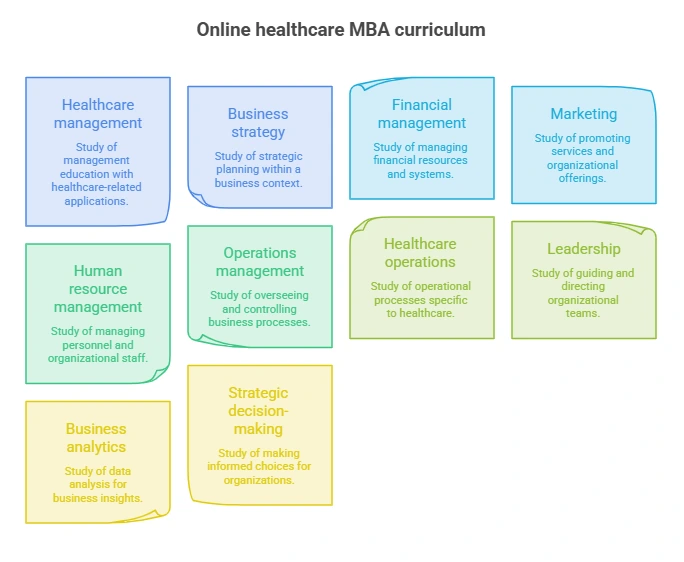
An online healthcare MBA combines management education with healthcare-related applications through an online learning format.
Depending on the program, students may study:
Healthcare management
Business strategy
Financial management
Marketing
Human resource management
Operations management
Healthcare operations
Leadership
Business analytics
Strategic decision-making
The key advantage is flexibility.
Working professionals can often study around their existing responsibilities. This can be useful for professionals who cannot take extended time away from employment.
However, students should evaluate the academic structure carefully. Flexibility should not come at the expense of learning quality, interaction, practical projects, or career support.
What Is an Executive Healthcare MBA?
An executive healthcare MBA is designed around the needs of working professionals and experienced managers.
The curriculum may cover management concepts while connecting them with real-world healthcare situations.
Potential areas include:
Healthcare leadership
Strategic management
Healthcare operations
Financial management
Organizational behaviour
Business analytics
Change management
Healthcare strategy
Project management
Leadership development
An executive format can be especially useful for professionals who want to move from functional responsibilities toward broader leadership roles.
For example, a healthcare operations professional may want to progress toward senior management. Management education can help strengthen business knowledge and strategic thinking required for that transition.
Healthcare leadership requires more than technical or clinical knowledge.
Modern healthcare managers may need to understand:
Financial planning
Workforce management
Healthcare operations
Quality improvement
Patient experience
Technology adoption
Business strategy
Risk management
Data-driven decision-making
Organizational change
Therefore, an MBA can help healthcare professionals develop a broader management perspective.
For clinicians and healthcare professionals moving toward administrative roles, this can be particularly valuable.
The objective is not to replace healthcare expertise. Instead, management education can complement industry knowledge with business and leadership capabilities.
Online MBA vs Executive MBA: Flexibility
Flexibility is one of the biggest factors in this decision.
Online MBA
An online MBA can be suitable for professionals who need greater control over their study schedule.
Potential benefits include:
Remote learning
Flexible study hours
Reduced commuting
Easier integration with work
Access to digital learning resources
This can make the format attractive to professionals with unpredictable work schedules.
Executive MBA
An Executive MBA may offer a more structured learning environment.
Depending on the program, it may involve:
Scheduled sessions
Live interactions
Case discussions
Group projects
Peer learning
Professional networking
Leadership activities
This structure can create a stronger learning routine.
Therefore, flexibility is not always about studying less. It is about finding a format that fits your professional responsibilities.
Executive MBA vs Online MBA: Learning Experience
The learning experience can differ considerably.
Online programs may depend more heavily on independent learning. Students need strong time-management skills and self-discipline.
Executive programs may provide more opportunities for structured interaction with faculty and experienced peers.
This can be valuable because healthcare leadership involves dealing with complex real-world situations.
For example, a classroom or live discussion may explore how to:
Manage operational disruptions
Improve patient experience
Handle organizational change
Allocate limited resources
Lead multidisciplinary teams
Implement new healthcare technology
These discussions can help professionals connect theory with workplace challenges.
HEALTHCARE MANAGEMENT
Lead With Healthcare Expertise
Strengthen your management capabilities with practical learning designed for healthcare professionals pursuing broader leadership and strategic responsibilities.
Both formats can contribute to career development. However, their value depends on your existing profile.
An online MBA can be useful when you want to add management education without interrupting your current career.
An executive MBA can be particularly relevant when you already have professional experience and want to strengthen leadership and strategic capabilities.
Career growth can involve moving:
From specialist to manager
From manager to senior manager
From operations to strategy
From functional roles to leadership
From clinical roles to management
The degree alone does not guarantee promotion.
Instead, career progression depends on education, experience, performance, leadership skills, organizational opportunities, and industry conditions.
MBA for Working Professionals: How to Choose the Right Format
Both formats can support healthcare management careers.
Potential career areas include:
Hospital operations
Healthcare administration
Healthcare consulting
Healthcare strategy
Business development
Health insurance management
Healthcare technology
Healthcare project management
Healthcare analytics
Corporate healthcare management
However, career outcomes depend on your prior experience and the quality of the program.
A healthcare professional with several years of operational experience may use an executive MBA to complement existing industry expertise.
Meanwhile, an early-career professional may use an online MBA to develop management fundamentals while continuing to gain work experience.
Does an Executive MBA Have More Value Than an Online MBA?
There is no universal answer.
The value of a management degree depends on several factors:
Curriculum
Institution
Faculty
Industry exposure
Program structure
Practical learning
Professional experience
Networking opportunities
Career support
Employer expectations
Therefore, students should avoid assuming that one format is automatically superior.
A well-designed online program can provide meaningful flexibility. Likewise, a strong executive program can provide valuable leadership exposure.
The right question is not simply, “Which format is better?”
Instead, ask:
“Which format provides the skills and learning experience I need for my next career stage?”
What Should Healthcare Leaders Look for in an MBA?
Healthcare professionals should evaluate more than the delivery format.
Industry-Oriented Curriculum
Healthcare changes quickly. Therefore, the curriculum should connect management concepts with current business challenges.
Practical Learning
Look for case studies, projects, simulations, and real-world applications.
Experienced Faculty
Faculty with academic and professional experience can provide stronger contextual understanding.
Corporate Exposure
Interaction with industry professionals can help students understand workplace expectations.
Leadership Development
Future healthcare leaders need communication, strategic thinking, decision-making, and team-management skills.
Career Support
Career guidance and placement support can help students understand possible professional pathways.
Asia Pacific Institute of Management focuses on industry-oriented management education, practical learning, corporate exposure, experienced faculty, and career development. These factors can be relevant for professionals evaluating management education for long-term career growth.
Online MBA vs Executive MBA: Cost and Time Considerations
Cost should be evaluated alongside career value.
Students should consider:
Tuition fees
Study materials
Technology requirements
Travel requirements
Time commitment
Opportunity cost
Career impact
An online program may reduce some logistical costs because students can study remotely.
An executive format may require greater scheduling commitment. However, structured interaction and professional learning can provide additional value depending on the program.
Therefore, compare the total investment, not just tuition fees.
Conclusion: Online MBA vs Executive MBA — Which Is Better?
The online MBA vs executive MBA decision should be based on your career stage, professional experience, learning preferences, and leadership goals.
An online MBA can be a practical option for professionals who value flexibility and want to continue working while studying.
An Executive MBA can be particularly valuable for experienced professionals who want structured management education, leadership development, strategic thinking, and peer learning.
For healthcare leaders, the decision should go beyond the delivery format. Evaluate the curriculum, practical learning, industry exposure, faculty, networking opportunities, and career support.
Most importantly, choose a program that complements your healthcare experience and prepares you for the responsibilities you want to take on next.
For professionals seeking industry-aligned management education, Asia Pacific Institute of Management provides a learning environment focused on practical management knowledge, corporate exposure, experienced faculty, and career development.
Prepare For Leadership
Develop strategic thinking, business knowledge, and leadership skills to confidently take your next step in healthcare management.
Dr. Vikas Gupta is a distinguished academic in the education and research domain, specializing in finance and related interdisciplinary studies. He is known for his...
01.
Is an online MBA better than an Executive MBA?
Neither format is universally better. An online MBA may suit professionals who prioritize flexibility, while an Executive MBA may suit experienced professionals seeking structured leadership and management education.
02.
Online MBA vs Executive MBA: Which is better for healthcare professionals?
The answer depends on career stage. Professionals needing maximum flexibility may prefer online learning. Experienced professionals preparing for leadership roles may find an executive format more aligned with their goals.
03.
Is an online healthcare MBA suitable for working professionals?
Yes, an online healthcare MBA can be suitable for working professionals who need flexibility while continuing their careers. However, students should evaluate the curriculum, academic structure, practical learning, and support services.
04.
Who should pursue an executive healthcare MBA?
An executive healthcare MBA can suit professionals with relevant work experience who want to strengthen leadership, strategy, business, and healthcare management skills.
05.
Can an MBA help healthcare professionals move into management?
Yes. Management education can help healthcare professionals develop skills in leadership, finance, strategy, operations, communication, and organizational decision-making.
06.
Does an Executive MBA guarantee career growth?
No degree can guarantee a promotion or salary increase. Career growth depends on experience, performance, skills, employer opportunities, and market conditions.
07.
Can I pursue an MBA while working full-time?
Many management programs are designed to accommodate working professionals. However, the exact schedule and workload vary, so check the program structure before enrolling.
08.
What should healthcare leaders consider before choosing an MBA?
Consider your career stage, work experience, target role, curriculum, learning format, faculty, practical exposure, industry interaction, networking, and career support.
















.webp) Call Us
Call Us