Healthcare Management vs Pharmaceutical Management: Which Career Is Better?
Posted on 13 Oct 2026
By Dr. Vikas Gupta
Introduction
Choosing the right management specialization can shape your professional future. For students interested in healthcare, two options often create confusion: healthcare management and pharmaceutical management. Understanding healthcare management vs pharmaceutical management can help you select a career path that matches your interests, qualifications, and long-term goals.
Both fields combine business knowledge with healthcare industry expertise. However, they focus on different parts of the healthcare ecosystem. Healthcare management focuses on healthcare services, hospital operations, patient experience, and organizational performance. Pharmaceutical management focuses on the business, marketing, operations, and commercial activities of the pharmaceutical industry.
For Indian students, the right choice depends on the kind of work they want to pursue. This guide compares both specializations, including career opportunities, essential skills, educational pathways, and salary considerations.
Choose Your Career Path
Explore management education that builds business expertise and helps you pursue career opportunities across healthcare services, pharmaceutical companies, and related industries.
Healthcare management involves planning, coordinating, and improving the delivery of healthcare services. It combines management principles with an understanding of healthcare operations, finance, quality, technology, and patient needs.
Healthcare managers help organizations use resources effectively while improving service quality and operational performance. They may work in hospitals, diagnostic networks, healthcare companies, health technology organizations, and other healthcare-related businesses.
Key responsibilities in healthcare management
Healthcare management professionals may handle responsibilities such as:
Healthcare operations: Coordinating services, teams, facilities, and operational processes.
Financial planning: Supporting budgets, cost control, and resource allocation.
Quality improvement: Identifying service gaps and improving operational standards.
Patient experience: Helping organizations improve access, communication, and service delivery.
Project management: Coordinating initiatives involving new services or operational improvements.
Strategic planning: Supporting business decisions, organizational development, and service expansion.
For example, a healthcare operations manager may examine patient waiting times and recommend changes to appointment scheduling. Another professional may coordinate a project to improve service delivery across several healthcare facilities.
Therefore, healthcare management may suit students interested in healthcare delivery, operations, organizational leadership, and service improvement.
What Is Pharmaceutical Management?
Pharmaceutical management focuses on managing the business activities of the pharmaceutical industry. It combines management education with knowledge of pharmaceutical products, markets, distribution, and commercial operations.
The field connects business strategy with the development, production, marketing, and distribution of medicines. Depending on the role, professionals may work with pharmaceutical companies, distributors, contract research organizations, or other life sciences businesses.
Key responsibilities in pharmaceutical management
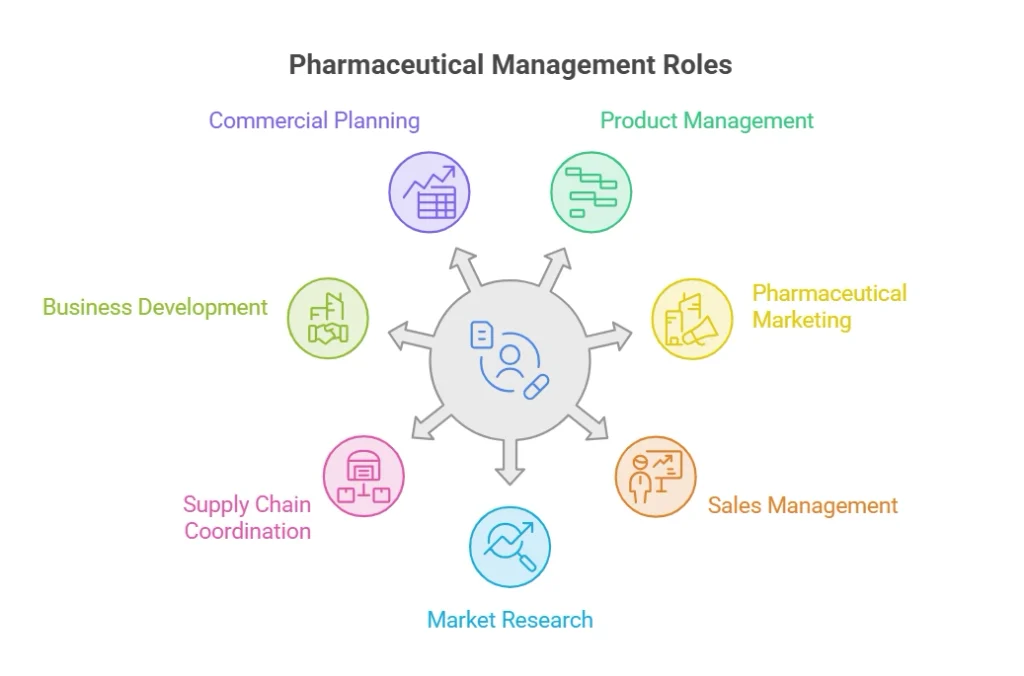
Pharmaceutical management professionals may work across several business functions:
Product management: Supporting product positioning, planning, and lifecycle activities.
Pharmaceutical marketing: Developing marketing plans and communicating product information within applicable regulations.
Sales management: Supporting sales teams, territory planning, and business targets.
Market research: Studying market conditions, customer needs, and competitive dynamics.
Supply chain coordination: Supporting inventory planning, distribution, and product availability.
Business development: Identifying partnerships, market opportunities, and potential growth areas.
Commercial planning: Evaluating business performance and supporting revenue-related decisions.
For example, a pharmaceutical product manager may help plan the launch of a medicine. This work can involve market research, coordination with sales teams, product communication, and compliance review.
Pharmaceutical management may suit students who enjoy business strategy, product marketing, commercial planning, and the pharmaceutical industry.
Healthcare Management vs Pharmaceutical Management: Key Differences
Both specializations require management knowledge and industry awareness. However, their day-to-day responsibilities and career environments can differ considerably.
Comparison factor
Healthcare management
Pharmaceutical management
Primary focus
Healthcare services and organizational performance
Pharmaceutical business and commercial operations
Industry coverage
Hospitals, healthcare networks, health technology, and related services
Pharmaceutical companies, medicine distribution, and related life sciences businesses
Main responsibilities
Operations, quality, finance, projects, and service improvement
Product management, marketing, sales, market research, and commercial planning
Typical work environment
Healthcare facilities, corporate offices, and healthcare service organizations
Pharmaceutical company offices, commercial teams, and distribution-related environments
Key knowledge
Healthcare delivery, operations, finance, and quality
Pharmaceutical markets, product knowledge, marketing, and business strategy
Important skills
Coordination, problem-solving, leadership, and analytical thinking
Marketing, communication, negotiation, market analysis, and commercial planning
Potential career direction
Healthcare operations, service management, and organizational leadership
Pharmaceutical marketing, product management, sales leadership, and business development
These differences are general rather than absolute. Some healthcare organizations manage pharmaceutical procurement, while pharmaceutical companies also employ professionals in operations, analytics, and business strategy.
An MBA or management programme focused on healthcare generally emphasizes healthcare delivery, organizational operations, service quality, and healthcare business management.
A pharmaceutical management specialization usually emphasizes pharmaceutical markets, product strategy, sales, marketing, and commercial operations.
However, curricula vary by institution. Students should compare actual subjects, practical projects, industry exposure, and eligibility requirements before choosing a programme.
Healthcare Management Career vs Pharma Management Career
Your preferred work environment can help you decide between these fields. Consider the kind of challenges you want to solve and the people you want to work with.
Career opportunities in healthcare management
Healthcare management graduates may explore opportunities such as:
1. Healthcare operations executive
These professionals coordinate operational processes and help healthcare organizations improve efficiency.
2. Hospital administration executive
This role supports hospital operations, departmental coordination, administrative processes, and patient services.
3. Healthcare project coordinator
Project coordinators help manage timelines, resources, communication, and implementation activities for healthcare initiatives.
4. Quality improvement coordinator
These professionals support performance monitoring, process improvement, and quality-related initiatives.
5. Healthcare business development executive
This role involves identifying potential partnerships, supporting business growth, and building relationships with relevant organizations.
6. Healthcare operations analyst
Analysts examine operational information and help managers identify performance gaps or improvement opportunities.
With relevant experience and demonstrated capabilities, professionals may progress into management positions. However, senior roles typically require a combination of practical experience, leadership ability, and sector knowledge.
Career opportunities in pharmaceutical management
Pharmaceutical management graduates may pursue roles such as:
1. Pharmaceutical sales executive
These professionals support sales activities, develop professional relationships, and work towards assigned business targets.
2. Pharmaceutical marketing executive
Marketing executives help implement product campaigns, coordinate promotional activities, and support brand communication.
3. Product management executive
Product management teams support product positioning, marketing plans, market analysis, and coordination across business functions.
4. Market research analyst
These professionals study market conditions, customer needs, industry developments, and commercial opportunities.
5. Business development executive
Business development professionals identify potential partnerships, support commercial negotiations, and explore opportunities for business expansion.
6. Pharmaceutical supply chain coordinator
These professionals support inventory planning, distribution coordination, and product availability across relevant channels.
Some pharmaceutical positions require additional scientific knowledge, prior industry experience, or specific professional qualifications. Always review individual job descriptions before applying.
Develop strategic thinking, communication, and analytical skills to prepare for evolving responsibilities in healthcare management or pharmaceutical business.
Both specializations require communication, teamwork, ethical judgment, and analytical thinking. However, employers may prioritize different skills depending on the position.
Essential skills for healthcare management
1. Operational planning
Healthcare professionals must understand how teams, resources, facilities, and services work together. Planning skills help improve coordination and reduce avoidable delays.
2. Communication and leadership
Healthcare managers often coordinate clinical and non-clinical teams. Clear communication supports collaboration and helps resolve operational challenges.
3. Financial understanding
Budgeting, cost analysis, and resource allocation help managers evaluate operational decisions.
4. Problem-solving
Healthcare organizations face changing patient needs, resource constraints, and service challenges. Managers must identify practical solutions while considering quality and safety.
5. Data interpretation
Understanding performance indicators, operational reports, and basic analytics helps professionals make evidence-informed decisions.
Essential skills for pharmaceutical management
1. Marketing and sales understanding
Pharmaceutical professionals need to understand product positioning, customer needs, commercial objectives, and appropriate communication practices.
2. Negotiation and relationship management
Many roles involve working with business partners, distribution networks, healthcare professionals, or internal commercial teams.
3. Market research
Professionals should be able to interpret market information and identify relevant business opportunities.
4. Product knowledge
An understanding of pharmaceutical products and their intended uses can support product-related business responsibilities. Scientific and regulatory claims must remain accurate and compliant.
5. Commercial analysis
Sales performance, market trends, business targets, and product performance can influence commercial decisions.
Additionally, digital skills are valuable in both fields. Spreadsheet analysis, presentations, data visualization, and familiarity with business software can strengthen a candidate's professional profile.
Pharmacy graduates often have a useful starting point because they already understand medicines, pharmaceutical concepts, and aspects of healthcare delivery. However, the best management path depends on their career interests.
When healthcare management may be a better fit
Healthcare management may suit pharmacy graduates who want to move beyond medicine-focused roles and explore the broader healthcare services sector.
Consider this path if you are interested in:
Hospital and healthcare operations.
Healthcare service planning and coordination.
Quality improvement and patient experience.
Healthcare business development.
Management roles across healthcare organizations.
For example, a pharmacy graduate interested in how hospitals coordinate services, allocate resources, and improve patient flow may find healthcare management relevant.
When pharmaceutical management may be a better fit
Pharmaceutical management may suit pharmacy graduates who want to build on their existing knowledge of medicines and pharmaceutical products.
Consider this path if you are interested in:
Pharmaceutical marketing and product strategy.
Sales management and commercial operations.
Market research and product positioning.
Pharmaceutical distribution and supply chain activities.
Business development within the pharmaceutical sector.
For example, a pharmacy graduate who enjoys understanding product markets and developing commercial strategies may prefer pharmaceutical management.
Can non-pharmacy graduates choose pharmaceutical management?
Eligibility depends on the programme and the employer. Some management programmes accept graduates from a range of academic backgrounds, while certain pharmaceutical roles prefer or require relevant scientific qualifications.
Therefore, check the admission criteria and employment requirements for your intended career path. Do not assume every pharmaceutical management role has the same eligibility rules.
Career Scope in India: Healthcare vs Pharmaceutical Management
Both fields offer potential career pathways in India. However, opportunities vary by location, employer, qualifications, experience, and the specific skills a candidate develops.
Healthcare management career scope
Healthcare management supports the functioning and development of healthcare services. Potential employment settings include:
Hospitals and healthcare networks.
Diagnostic and specialty healthcare facilities.
Healthcare service organizations.
Health technology and digital health businesses.
Healthcare consulting and project-based services, where candidates meet the requirements.
Professionals may find opportunities in operations, administration, quality improvement, business development, and project coordination.
Digital health services and the use of operational data can also create relevant work across some organizations. However, the availability of these positions varies by employer and market conditions.
Pharmaceutical management focuses on the business activities surrounding medicines and pharmaceutical products. Potential employment settings include:
Pharmaceutical manufacturers.
Pharmaceutical marketing and sales organizations.
Medicine distribution and supply chain businesses.
Contract research and related service organizations.
Pharmaceutical business development and market research teams.
Career opportunities may involve sales, product marketing, market analysis, commercial operations, and distribution coordination.
Some roles are target-driven and involve frequent travel or extensive relationship management. Others focus more on research, planning, analytics, or internal coordination.
Which field offers more flexibility?
Healthcare management may provide exposure to multiple types of healthcare organizations. Pharmaceutical management offers a more concentrated focus on pharmaceutical products and their commercial ecosystem.
Neither option guarantees broader career mobility or faster growth. Your flexibility will also depend on transferable skills, work experience, and willingness to develop expertise in new areas.
Salary Expectations: Which Career Pays More?
Salary is an important factor when comparing healthcare management and pharmaceutical management. However, neither field has a single salary range that applies to all graduates.
Compensation can vary according to:
Academic qualifications and specialization.
Relevant work experience.
Employer size and location.
Job responsibilities and seniority.
Sales incentives or performance-linked compensation.
Analytical, technical, and leadership skills.
Pharmaceutical sales positions may include performance-linked incentives, depending on the employer. Healthcare management positions may offer different compensation structures based on operational responsibility and organizational level.
A specialized management qualification does not automatically guarantee a higher starting salary. Similarly, an attractive job title does not always indicate better long-term prospects.
Before deciding, compare current vacancies for equivalent experience levels. Review fixed pay, variable compensation, travel expectations, working conditions, learning opportunities, and promotion criteria.
How to Choose the Right Management Specialization
Use the following steps to evaluate your options before enrolling in a management programme.
Step 1: Identify your preferred industry
Decide whether you want to focus on healthcare services or the pharmaceutical business. Consider which industry's problems and working environment interest you more.
Step 2: Review the curriculum
Compare the subjects offered by the programmes you are considering.
For healthcare management, look for relevant coverage of operations, finance, quality, healthcare systems, and organizational leadership.
For pharmaceutical management, examine coverage of pharmaceutical marketing, product strategy, market research, sales management, and pharmaceutical business operations.
Step 3: Evaluate practical learning opportunities
Case studies, internships, projects, and industry interaction can help you apply management concepts. Check how each programme incorporates practical learning into its curriculum.
Step 4: Check eligibility and recognition
Confirm the academic requirements, applicable approvals, programme recognition, and total fees. Pharmacy graduates should also verify whether their preferred career roles require additional qualifications.
Step 5: Research actual job opportunities
Read job descriptions for entry-level roles in both fields. Compare the required skills, responsibilities, experience, and expected working conditions.
Step 6: Match the choice to your long-term goals
Choose the specialization that supports the work you want to do. Consider the learning environment, career mobility, professional interests, and the skills you want to develop.
Students researching management education can also explore Asia Pacific Institute of Management. Review its current programme offerings, curriculum, admission requirements, practical learning opportunities, and career support to determine whether an available programme fits your goals.
The choice between healthcare management vs pharmaceutical management depends on the industry you want to work in and the responsibilities you find most rewarding.
Healthcare management may be a suitable path if you want to improve healthcare operations, coordinate services, and contribute to organizational performance. Pharmaceutical management may be a stronger fit if you are interested in pharmaceutical products, marketing, sales, market research, and commercial strategy.
For pharmacy graduates, both paths can offer ways to build on their existing education while developing management expertise. Therefore, compare programme curricula, practical exposure, eligibility criteria, and relevant job opportunities before making your decision.
If you are considering management education, explore the current offerings at Asia Pacific Institute of Management and review their suitability for your professional goals. A well-informed choice should align your interests, qualifications, and long-term career plans.
Shape Your Professional Future
Compare your interests, explore management learning options, and take a confident step toward building your future in the healthcare industry.
Dr. Vikas Gupta is a distinguished academic in the education and research domain, specializing in finance and related interdisciplinary studies. He is known for his...
01.
What is the difference between healthcare management and pharmaceutical management?
Healthcare management focuses on healthcare services, operations, organizational performance, and service quality. Pharmaceutical management focuses on the business activities surrounding pharmaceutical products, including marketing, sales, product strategy, and commercial operations.
02.
Which is better: healthcare management or pharmaceutical management?
Neither is universally better. Healthcare management may suit students interested in healthcare services and organizational operations. Pharmaceutical management may suit those interested in medicines, product marketing, commercial strategy, and pharmaceutical business.
03.
Is an MBA in healthcare better than an MBA in pharmaceutical management?
The better option depends on your career objectives. A healthcare-focused MBA may suit hospital operations and healthcare service management. Pharmaceutical management may be more relevant to pharmaceutical marketing, product management, and commercial roles.
04.
Can pharmacy graduates pursue healthcare management?
Yes, pharmacy graduates can explore eligible healthcare management programmes. This route may help them develop management skills and pursue roles across healthcare services. However, admission requirements vary by institution and programme.
05.
What are the main pharmaceutical management career options?
Potential options include pharmaceutical sales executive, marketing executive, product management executive, market research analyst, business development executive, and supply chain coordinator. Requirements differ across employers and positions.
06.
What are the main healthcare management roles?
Potential roles include healthcare operations executive, hospital administration executive, project coordinator, quality improvement coordinator, healthcare business development executive, and operations analyst.
07.
Which field has better career scope in India?
Both fields offer potential opportunities, but their career paths differ. Healthcare management spans various healthcare service settings, while pharmaceutical management concentrates on pharmaceutical products and related business functions. The better fit depends on your skills, interests, and career goals.
08.
Can non-medical students pursue healthcare or pharmaceutical management?
Many management programmes accept graduates from different academic backgrounds. However, requirements vary by institution and specialization. Certain technical or scientific roles may require specific qualifications, so students should verify eligibility before applying.


















.webp) Call Us
Call Us