PGDM in Rural Management: Exploring the Uncapped Potential
Posted on 23 Jul 2026
By Dr. Vikas Gupta
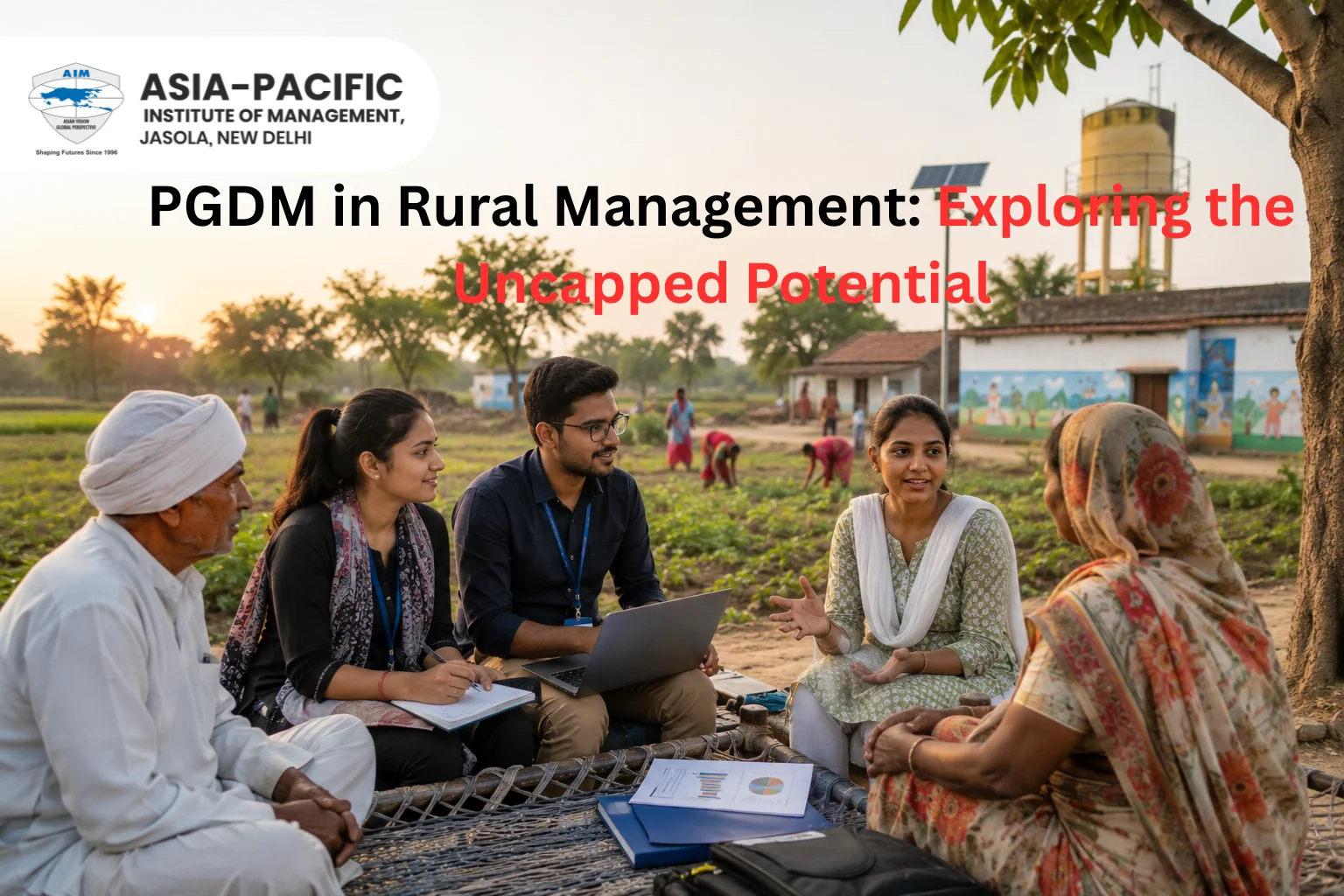
A PGDM in rural management is gaining attention among students who want meaningful careers beyond conventional corporate roles. Rural India is no longer seen only as an agricultural economy. It is now a growing market for banking, digital services, healthcare, retail, FMCG, agri-tech, microfinance, education, logistics, and social enterprises.
For social-impact seekers, this field offers a powerful career path. It combines business skills with community development, financial inclusion, market expansion, and sustainable growth.
However, students should understand one important point. A standalone PGDM in rural management is not the only route into rural-sector careers. A strong PGDM program in marketing, analytics, banking, finance, or general management can also prepare students for rural-impact roles.
Lead Rural Business
Transform rural economies and agribusiness sectors. Join our specialized PGDM program to gain strategic leadership skills for high-impact careers today!
A PGDM in rural management is a management-focused pathway that prepares students to work with rural markets, development projects, agri-businesses, microfinance institutions, rural banking, social enterprises, NGOs, CSR teams, and government-linked development programs.
It helps students understand how rural communities live, earn, consume, save, borrow, adopt technology, and respond to products or services.
A rural management pathway may include:
Rural marketing
Agri-business management
Rural finance
Microfinance
Supply chain management
Development economics
Social entrepreneurship
Livelihood projects
Community engagement
Rural digital adoption
Project monitoring
Impact measurement
In simple terms, rural management connects business strategy with inclusive development. Bonus:PGDM specializations
Why Rural Management Matters in India
India’s rural economy remains central to national growth. World Bank data continues to track India as a majority-rural country through its rural population series, which runs up to 2024. This means rural communities remain important for markets, livelihoods, policy, and development planning.
The Economic Survey 2025–26 backgrounder also states that agriculture and allied activities continue to support rural demand and income security. It notes that a strong agricultural performance has supported rural incomes and consumption.
Therefore, rural management is not only a social-sector subject. It is also a business opportunity.
Companies, banks, fintech platforms, FMCG brands, agri-tech firms, and development organizations need managers who understand rural customers and rural systems.
The Uncapped Potential of Rural India
Rural India is changing quickly. Mobile access, digital payments, direct benefit transfers, rural infrastructure, local entrepreneurship, and financial inclusion are reshaping village economies.
A 2026 PIB release states that Jan Dhan accounts grew to 58.16 crore by April 29, 2026. It also notes that 5G mobile services covered 99.9% of districts and 85% of the population.
This creates new opportunities in:
Rural banking
Digital finance
Agri-tech
Rural e-commerce
FMCG distribution
Healthcare access
Education technology
Rural logistics
Micro-entrepreneurship
Government-linked development
Social impact consulting
The opportunity is not “uncapped” because rural India lacks solutions. It is uncapped because solutions need better execution, local understanding, and skilled managers.
PGDM in Rural Management: Career Scope
A PGDM in rural management can support careers across business, development, finance, and social-impact sectors.
CSR project coordinator, community program associate
Social enterprise
Field operations manager, impact project executive
Development consulting
Research associate, project monitoring executive
FMCG rural sales
Territory executive, distribution trainee
Rural fintech
Customer adoption associate, field partnerships executive
Data and impact
MIS executive, impact analyst, monitoring associate
These roles suit students who want careers with purpose, field exposure, and business learning.
Who Should Consider Rural Management Careers?
A rural management career can suit students who are comfortable with people, fieldwork, data, operations, and social problem-solving.
You may consider this path if you:
Want a career with social impact
Enjoy understanding communities
Are interested in rural markets
Want to work in development or CSR
Like banking, finance, or microfinance
Are interested in agri-business
Want to work with social enterprises
Can handle field visits and ground realities
Want to connect business with inclusion
Prefer meaningful work over desk-only roles
However, this career path needs patience. Rural projects often involve slow trust-building and complex ground-level challenges.
Rural Management Is Not Only About Villages
Many students misunderstand rural management. They assume it means working only in remote locations. That is not true.
Rural management careers may involve both office and field work.
For example:
Work Type
What It Can Include
Field work
Village visits, farmer meetings, branch visits
Office work
Reports, dashboards, strategy, budgeting
Market work
Retailer visits, distributor coordination
Data work
Survey analysis, MIS, impact tracking
Strategy work
Product planning, expansion, partnerships
Communication work
Community engagement and training
A rural manager must understand both the ground and the boardroom.
This makes PGDM-level management education valuable.
How PGDM Skills Support Rural Management Careers
A post graduate diploma in management can prepare students for rural-sector roles by building core business skills.
PGDM Skill
Rural Management Use
Marketing
Helps understand rural consumers
Finance
Supports microfinance and rural banking
Analytics
Helps track impact and performance
Operations
Supports logistics and supply chains
HR
Helps manage field teams
Communication
Builds trust with communities
Strategy
Helps scale rural projects
Research
Supports needs assessment and planning
Leadership
Helps coordinate teams and stakeholders
Rural impact work needs structured thinking. A PGDM course can help students convert social intent into professional execution.
PGDM in Marketing for Rural Markets
A PGDM in marketing can be very useful for rural management careers.
Rural consumers are not a single group. Their needs vary by income, geography, language, occupation, season, culture, and access to services.
Students interested in post graduate diploma in marketing, PGDM in digital marketing, marketing program, PGDM in marketing management, PGD in marketing management, or marketing diploma courses can explore rural marketing roles.
Rural marketing can involve:
FMCG distribution
Retailer engagement
Product awareness campaigns
Local language communication
Rural brand activation
Dealer networks
Customer education
Digital adoption campaigns
Asia Pacific Institute of Management’s PGDM page describes its Marketing pathway as focused on marketing strategy, digital branding, and consumer insights. These areas are useful for students who want to understand rural customers and market expansion.
PGDM in Big Data Analytics for Rural Impact
Rural management is also becoming data-driven.
Organizations now use data for:
Beneficiary tracking
Credit risk assessment
Crop trend analysis
Demand forecasting
Rural campaign tracking
Supply chain planning
Financial inclusion dashboards
Program monitoring
Impact measurement
Students searching for big data analytics courses, BDA courses, big data, BDA, big data course, institute of analytics, PGDM in data analytics, diploma in data analytics, big data analytics, or big data analytics in cloud computing can connect analytics with rural-impact careers.
Asia Pacific Institute of Management’s PGDM in Big Data Analytics is a two-year, AICTE-approved program divided into six trimesters. The program combines management education with data science, AI, predictive analytics, cloud, hands-on labs, and a mandatory summer internship.
For social-impact seekers, analytics can help answer one key question: “Is this rural intervention actually working?”
PGDM in Banking and Finance for Rural Inclusion
Rural India needs strong financial access. This includes savings, credit, insurance, pensions, digital payments, microfinance, and financial literacy.
Students interested in diploma in finance, banking diploma courses, banking financial services, PGD in banking, post graduate diploma in financial management, PGD in banking and finance, PGDM in banking and finance, or PGDM in banking can explore rural finance careers.
Financial inclusion roles may involve:
Rural branch operations
Microfinance lending
Credit assessment
Self-help group finance
Insurance awareness
Digital payment adoption
Fintech onboarding
Financial literacy campaigns
A 2026 PIB release notes that direct benefit transfers had transferred ₹49.09 lakh crore directly to citizens by January 2026. It also states that digital systems have created a data-rich financial ecosystem for inclusive financial participation.
Asia Pacific Institute of Management’s PGDM in Banking & Financial Services covers banking, investment, fintech, financial analytics, credit risk, and financial consulting pathways.
This makes BFSI education useful for students interested in rural finance and inclusion. Bonus:PGDM in Marketing Management
Dual Specialization in PGDM for Rural Careers
A dual specialization in PGDM can help students build flexible rural-sector careers.
Asia Pacific Institute of Management’s PGDM General program offers dual specialization and cross-functional learning across domains such as Marketing, Finance, HR, Operations, Business Analytics, and Big Data Analytics. It also includes live projects, case studies, simulations, and corporate internships.
This flexibility matters because rural problems rarely belong to only one function.
Ace Rural Management
Drive sustainable rural development and supply chain growth. Enroll in our PGDM program to master modern agribusiness strategies for leadership success.
Rural Management Career Path: From Entry-Level to Leadership
Students usually start in field, research, operations, or coordination roles. With experience, they can grow into project leadership or strategy roles.
Career Stage
Possible Role
Entry level
Rural sales trainee, field coordinator
Early role
Project associate, microfinance officer
Early role
Rural marketing executive, MIS executive
Mid-level
Program manager, branch manager
Mid-level
Market development manager
Growth role
CSR project lead, rural strategy manager
Senior role
Regional development manager
Senior role
Social enterprise leader
Growth depends on field experience, communication, data skills, stakeholder management, and leadership.
Sectors Hiring Rural Management Talent
Students with rural management interest can explore several sectors.
FMCG companies need managers who can understand rural consumers, distributors, retailers, and local buying patterns.
3. Microfinance and Rural Banking
These roles support credit, savings, insurance, digital banking, and financial literacy.
4. Social Enterprises
Social enterprises work in livelihoods, health, education, clean energy, agriculture, and local entrepreneurship.
5. CSR and Development Projects
CSR teams need professionals who can manage community projects, partners, budgets, and impact reporting.
6. Rural Fintech
Fintech firms need professionals who understand both financial products and rural adoption challenges.
7. Impact Consulting
Consulting teams need research, monitoring, evaluation, and project management skills.
This range makes rural management a strong career field for students with social purpose and business discipline.
Skills Needed for Rural Management Careers
A PGDM in rural management career requires practical and emotional intelligence.
Skill
Why It Matters
Communication
Helps build trust with communities
Local market understanding
Supports better product decisions
Data interpretation
Helps track results
Financial literacy
Useful in microfinance and banking
Sales ability
Helps in rural market expansion
Field discipline
Supports real-world execution
Empathy
Helps understand people deeply
Problem-solving
Helps handle ground challenges
Reporting
Helps document progress
Leadership
Helps manage teams and partners
Students should build these skills through internships, live projects, field visits, and research assignments.
How Social-Impact Seekers Can Build a Rural Management Profile
Students should not wait until placements. They can start early.
1. Take Field-Based Internships
Choose internships in microfinance, CSR, rural sales, agri-business, or social enterprises.
2. Build Rural Market Projects
Study consumer behaviour, local retail networks, product adoption, or digital payment usage.
3. Learn Data Tools
Excel, Power BI, survey tools, and basic analytics can help in monitoring and reporting.
4. Improve Local Communication
Language comfort, listening skills, and cultural sensitivity matter in rural projects.
5. Study Government Schemes
Understand financial inclusion, livelihoods, agriculture, digital payments, and skill development programs.
6. Build Impact Reports
Write reports that show problem, intervention, outcome, and learning.
7. Prepare for Field Interviews
Recruiters may test patience, empathy, travel readiness, and problem-solving ability.
A strong rural profile needs both heart and skill.
PGDM in Delhi: Why Location Can Still Help Rural Career Seekers
Students searching for PGDM in Delhi, PGDM courses in Delhi NCR, PGDM course in Delhi, PGDM institute in Delhi, or PGDM colleges in Delhi NCR may wonder whether Delhi is useful for rural careers.
The answer is yes.
Delhi NCR offers access to:
CSR teams
Development consulting firms
Financial institutions
NGOs and foundations
Agri-tech startups
Rural fintech companies
FMCG companies
Government-linked organizations
Research and policy networks
Corporate internship opportunities
A PGDM institute in Delhi can support rural career goals when it offers practical learning, internships, live projects, industry exposure, and specialization flexibility. Bonus:how to apply for PGDM course
Admission Readiness for PGDM Aspirants
Students planning to apply for a PGDM course should prepare a strong admission profile.
At Asia Pacific Institute of Management, applicants for the two-year MBA and PGDM programs must hold a bachelor’s degree with at least 50% marks. Final-year students may also apply. Applicants must also have a valid score in CAT, XAT, CMAT, MAT, GMAT, or ATMA. Shortlisted candidates participate in GD and PI rounds.
Social-impact seekers should prepare:
Entrance exam score
Graduation documents
Updated resume
Fieldwork or volunteering examples
Rural project ideas
Career goal statement
GD and PI preparation
Awareness of rural economy trends
Basic finance and marketing concepts
A clear purpose can strengthen your interview answers.
Interview Answer: Why Rural Management?
Use this sample answer during PGDM interviews:
“I am interested in rural management because rural India offers both development challenges and business opportunities. I want to build management skills that help me work in areas such as rural marketing, financial inclusion, agri-business, CSR, or social enterprise projects. A PGDM will help me combine business knowledge with practical impact.”
This answer shows purpose, career clarity, and maturity.
Common Myths About Rural Management
Myth 1: Rural management has limited career scope
This is incorrect. Rural careers exist in banking, FMCG, CSR, development consulting, agri-tech, microfinance, fintech, and social enterprises.
Myth 2: Rural management is only for NGO work
NGOs are one option. However, corporate and startup roles also need rural-market managers.
Myth 3: Rural careers do not need analytics
This is outdated. Rural projects increasingly use dashboards, surveys, digital data, and impact metrics.
Myth 4: Rural management is not corporate enough
Many corporate teams work on rural expansion, distribution, financial inclusion, and CSR. These roles need strong management skills.
Why Asia Pacific Institute of Management Can Be Considered
Students interested in rural-impact careers can consider Asia Pacific Institute of Management for a management-first PGDM foundation.
AIM’s current PGDM pathways include General, Marketing, Big Data Analytics, and Banking & Financial Services. The official PGDM page highlights dual specialization, marketing strategy, consumer insights, data science, AI, predictive analytics, investment banking, fintech, and wealth management.
AIM does not need to be positioned as a standalone rural management institute. Instead, students can use its PGDM pathways to build skills relevant to rural markets, financial inclusion, rural analytics, digital adoption, CSR, and social enterprise work.
This approach is practical because rural careers are cross-functional. They need marketing, finance, analytics, communication, and leadership.
Conclusion
The PGDM in rural management conversation is becoming more important because rural India is full of business and social-impact opportunities. Rural markets need better financial services, digital adoption, healthcare access, agri-business systems, education models, logistics, and livelihood support.
For students who want meaningful careers, rural management offers purpose and growth. However, success requires more than good intentions. It requires marketing knowledge, finance skills, analytics ability, communication, field exposure, and leadership.
A PGDM can help students build these skills and apply them across rural marketing, microfinance, CSR, agri-business, fintech, and social enterprise roles.
Master Agribusiness!
Build an impactful career in rural development and social enterprise management. Join our comprehensive PGDM program to secure top management roles now!
Dr. Vikas Gupta is a distinguished academic in the education and research domain, specializing in finance and related interdisciplinary studies. He is known for his...
A PGDM in rural management prepares students for careers in rural marketing, agri-business, microfinance, rural banking, CSR, development projects, and social enterprises.
02.
Is PGDM in rural management a good career option?
Yes. It is a good option for students interested in social impact, rural markets, financial inclusion, agri-business, and community-focused business models.
03.
What jobs can I get after rural management?
Students can explore roles such as rural sales executive, microfinance officer, CSR project associate, rural banking associate, agri-business executive, and impact analyst.
04.
Can PGDM in marketing help rural careers?
Yes. PGDM in Marketing can help students understand rural consumers, distribution, local campaigns, product adoption, and market expansion.
05.
Can PGDM in data analytics help rural management?
Yes. Analytics helps in impact measurement, beneficiary tracking, rural demand forecasting, credit scoring, campaign analysis, and program monitoring.
06.
Is banking and finance useful for rural management?
Yes. Banking and finance knowledge is useful for microfinance, rural banking, fintech adoption, financial literacy, and credit-linked development roles.
07.
Is PGDM in Delhi useful for rural-sector careers?
Yes. Delhi NCR offers access to CSR teams, development organizations, financial institutions, consulting firms, NGOs, agri-tech firms, and internships.
08.
What skills are needed for rural management?
Important skills include communication, empathy, field discipline, data interpretation, financial literacy, sales ability, reporting, and stakeholder management.













.webp) Call Us
Call Us