Online MBA in Healthcare Management: Benefits, Career Scope & Salary
Posted on 05 Oct 2026
By Dr. Vikas Gupta
Introduction
Healthcare is no longer limited to clinical services. Hospitals, health-tech companies, insurance organisations, diagnostics, and healthcare businesses need skilled management professionals.
For graduates and working professionals, an online MBA in healthcare management can provide a flexible route into this growing management field. It combines business education with healthcare-focused knowledge and can help learners build skills in operations, strategy, finance, analytics, leadership, and administration.
An online format can also suit professionals who want to continue working while developing management capabilities.
However, choosing an online program requires careful evaluation. Accreditation, curriculum, learning format, faculty, assessments, industry exposure, and career support can all affect the value of the qualification.
This guide explains the benefits, career scope, salary factors, eligibility considerations, and important points to check before choosing an online healthcare MBA.
Advance Healthcare Management
Build management skills for healthcare operations, strategy, analytics, and leadership while continuing your professional journey through flexible learning today.
An online MBA in healthcare management is a management program designed for learners who want to develop business and leadership skills relevant to the healthcare sector.
The curriculum can cover areas such as:
Healthcare operations
Financial management
Marketing management
Human resource management
Business strategy
Healthcare administration
Business analytics
Organisational behaviour
Leadership
Project management
The online format allows students to access learning materials and academic activities through digital platforms.
Therefore, it can be particularly useful for graduates and working professionals who need greater flexibility.
The exact curriculum, duration, eligibility, assessment methods, and recognition depend on the institution and program. Students should verify the latest official information before applying.
Why Consider an Online Healthcare MBA?
Healthcare organisations increasingly require professionals who understand both industry needs and business management.
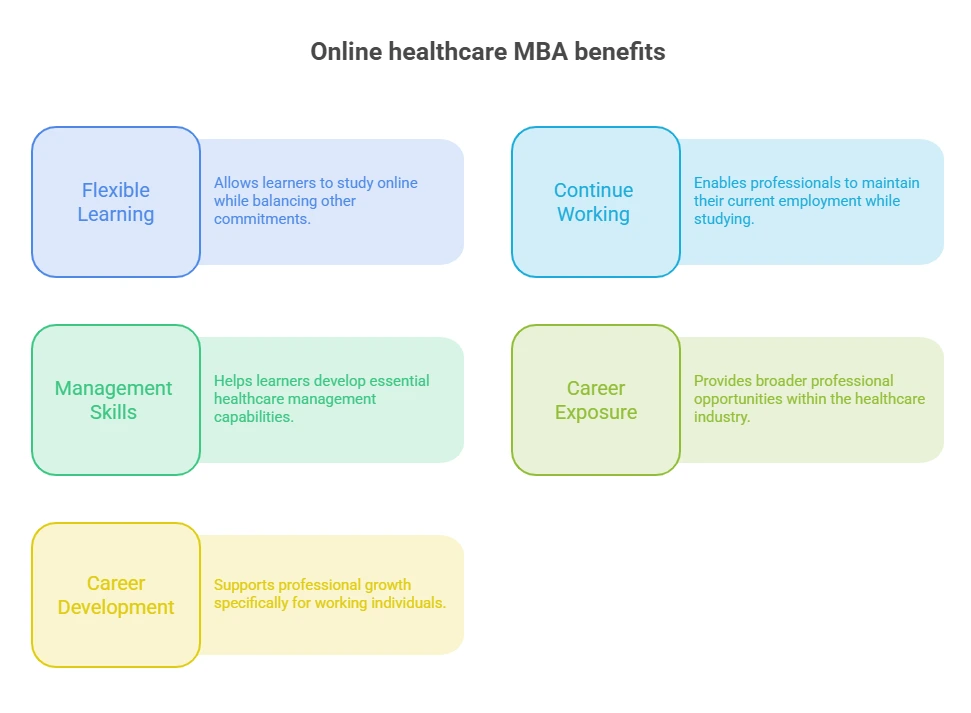
Students can study without following the same daily schedule as a traditional classroom program. This can help working professionals manage employment and education simultaneously.
However, flexibility does not mean low academic commitment. Students still need consistent study time and discipline.
2. Continue Working While Studying
Professionals may not want to leave their existing jobs to pursue management education.
An online format can allow them to continue gaining professional experience while studying.
This combination can be useful because workplace situations can provide practical context for management concepts.
3. Develop Healthcare Management Skills
Healthcare management requires more than healthcare knowledge.
Professionals also need business skills in areas such as finance, operations, strategy, communication, and leadership.
An online MBA can help learners build these capabilities systematically.
4. Broader Career Exposure
Healthcare management is a broad field.
Depending on their qualifications and experience, graduates can explore roles in:
Hospitals
Healthcare services
Health-tech
Insurance
Diagnostics
Pharmaceutical businesses
Consulting
Healthcare operations
Healthcare analytics
Therefore, an MBA can help students move beyond a narrowly defined technical role.
5. Career Development for Working Professionals
Professionals already working in healthcare may use management education to prepare for larger responsibilities.
For example, an employee working in operations may want to move toward team management.
Similarly, a healthcare professional may want to transition from technical responsibilities into administration or business functions.
A strong management curriculum should develop both general business capabilities and healthcare-specific understanding.
Healthcare Operations
Students learn how organisations manage processes, resources, service delivery, and operational efficiency.
Financial Management
Healthcare managers need to understand budgets, costs, financial planning, and business performance.
Marketing Management
Healthcare organisations need effective communication, branding, customer engagement, and market development.
Human Resource Management
Healthcare organisations depend on skilled teams. Therefore, managers need knowledge of recruitment, workforce planning, performance management, and employee development.
Business Analytics
Data can support decisions related to operations, performance, customers, and organisational growth.
Analytics skills are therefore increasingly relevant for management professionals.
Managers work with diverse teams and stakeholders.
Leadership education can help professionals improve communication, collaboration, decision-making, and team management.
Online Hospital Management MBA: Is It the Same?
The terms online healthcare MBA and online hospital management MBA are sometimes used interchangeably. However, their scope can differ.
Healthcare management generally covers a broader healthcare ecosystem.
Hospital management focuses more specifically on healthcare facility operations and administration.
An online hospital management-focused program may emphasise:
Hospital administration
Hospital operations
Patient services
Resource management
Quality processes
Department coordination
Facility management
Healthcare service delivery
A broader healthcare management program may also cover these areas. However, it can include additional topics such as healthcare strategy, health-tech, analytics, business development, insurance, and healthcare consulting.
Therefore, students should examine the actual curriculum instead of relying only on the program title.
Career opportunities depend on qualifications, skills, experience, location, employer requirements, and the chosen specialisation.
1. Healthcare Operations
Operations professionals help healthcare organisations improve processes, resource utilisation, and service delivery.
They may coordinate teams, monitor performance, manage workflows, and support process improvement.
2. Hospital Administration
Hospital administration can involve managing operational and administrative functions within healthcare facilities.
Professionals may work on department coordination, patient services, workforce planning, vendor management, and operational performance.
3. Healthcare Business Development
Business development professionals identify opportunities for organisational growth.
Their work can involve partnerships, client relationships, market research, service expansion, and revenue-related initiatives.
4. Healthcare Consulting
Healthcare consultants support organisations with strategic, operational, transformation, and business challenges.
An MBA can help candidates develop skills in structured problem-solving, analysis, strategy, and communication.
5. Health-Tech Management
Technology is changing how healthcare services are delivered.
Health-tech companies need professionals who understand business operations, healthcare processes, customers, implementation, and technology-enabled services.
6. Healthcare Analytics
Healthcare analytics professionals work with data to support business and operational decisions.
Relevant skills can include data interpretation, reporting, business intelligence, and analytical problem-solving.
7. Healthcare Marketing
Healthcare organisations require professionals who understand market positioning, digital communication, customer engagement, and brand management.
8. Quality Management
Quality professionals help organisations improve processes, service standards, documentation, and operational performance.
Online MBA Healthcare Salary: What Can You Expect?
Students frequently search for online MBA healthcare salary information before enrolling.
However, there is no single salary figure that applies to all online MBA healthcare graduates.
Compensation can vary significantly based on:
Previous work experience
Job role
Employer
Location
Educational background
Management responsibilities
Industry segment
Technical and analytical skills
Communication skills
Career progression
Organisation size
A fresher and an experienced healthcare professional completing an MBA may therefore have very different compensation outcomes.
Similarly, a healthcare operations role can have a different compensation structure from consulting, analytics, business development, or health-tech roles.
Salary Growth After an Online Healthcare MBA
An MBA should not be viewed as an automatic salary-increase qualification.
Instead, it can help professionals build capabilities that support career progression.
For example, a professional may move from an individual contributor role toward:
Executive → Senior Executive → Team Lead → Manager → Senior Manager → Strategic Leadership
The actual progression depends on performance, experience, organisation structure, skills, and available opportunities.
Therefore, students should evaluate the program based on its overall career value rather than a promised salary figure.
Build Healthcare Leadership
Develop practical healthcare management capabilities in finance, strategy, operations, analytics, and leadership to prepare for broader career opportunities.
Healthcare organisations need managers who understand both business principles and real operational challenges.
Therefore, practical learning can complement academic knowledge.
Asia Pacific Institute of Management focuses on an industry-oriented approach to management education. Its emphasis on practical learning, experienced faculty, corporate exposure, and career support can help students develop capabilities relevant to modern management roles.
For students exploring healthcare management, the right program should be evaluated against personal career goals, academic requirements, learning preferences, and long-term professional plans.
Career Roadmap After an Online Healthcare MBA
A practical career roadmap can look like this:
Step 1: Choose your career direction
Decide whether you are interested in hospital operations, consulting, analytics, health-tech, business development, administration, or another healthcare function.
Step 2: Build management fundamentals
Develop knowledge of finance, strategy, operations, marketing, HR, and organisational behaviour.
Step 3: Gain practical exposure
Work on projects, case studies, internships, or workplace assignments.
Step 4: Develop specialised skills
Build expertise in analytics, digital healthcare, project management, quality, or another relevant area.
Step 5: Build professional experience
Apply your knowledge through real responsibilities and cross-functional projects.
Step 6: Target management roles
Use your academic qualification and professional experience to pursue suitable managerial opportunities.
Career progression will depend on individual performance, experience, skills, and market conditions.
An online MBA in healthcare management can provide a flexible pathway for graduates and working professionals who want to build management careers in healthcare.
Its potential value goes beyond the degree itself. The right program can help learners develop skills in strategy, finance, operations, analytics, leadership, communication, and healthcare administration.
The healthcare MBA career scope can extend across hospitals, health-tech, consulting, healthcare services, insurance, diagnostics, and other healthcare-related organisations.
At the same time, salary should be evaluated realistically. Online MBA healthcare salary outcomes vary according to experience, role, skills, organisation, location, and career progression.
Therefore, focus on the complete value of the program rather than one expected salary figure.
If you are considering management education for a healthcare career, evaluate the curriculum, practical learning, faculty, corporate exposure, career support, and overall fit before making your decision.
Explore your career goals, build industry-relevant management skills, and choose an MBA pathway that supports your long-term professional growth.
Shape Your Career Future
Advance your healthcare career by strengthening business knowledge, leadership skills, and strategic thinking for evolving management roles across healthcare organizations.
Dr. Vikas Gupta is a distinguished academic in the education and research domain, specializing in finance and related interdisciplinary studies. He is known for his...
01.
Is an online MBA in healthcare management worth pursuing?
An online MBA can be useful for students and working professionals seeking management skills with greater learning flexibility. Its value depends on program recognition, curriculum quality, practical learning, career support, and alignment with your career goals.
02.
What is the career scope after an online healthcare MBA?
Career options can include healthcare operations, hospital administration, consulting, health-tech, analytics, business development, healthcare marketing, quality management, and project management.
03.
What is the online MBA healthcare salary in India?
There is no standard salary for online MBA healthcare graduates. Compensation depends on experience, role, employer, location, skills, industry segment, and management responsibilities.
04.
Can I pursue an online MBA while working?
Yes. Online programs can be suitable for working professionals because they generally provide greater scheduling flexibility. However, students still need consistent time for classes, assignments, assessments, and self-study.
05.
Is an online hospital management MBA different from an online healthcare MBA?
They can differ in scope. Hospital management generally focuses more on hospital administration and operations, while healthcare management can cover a wider range of healthcare organisations and business functions.
06.
Can healthcare graduates pursue an online MBA?
Healthcare graduates may be eligible for management programs if they meet the specific academic requirements. Eligibility varies by institution and program, so candidates should check current admission criteria.
07.
Does an online MBA guarantee a higher salary?
No. An MBA does not guarantee a specific salary or promotion. Career outcomes depend on qualifications, experience, skills, performance, employer, role, and market conditions.
08.
What should I check before choosing an online healthcare MBA?
Check recognition, eligibility, curriculum, faculty, learning format, assessments, practical projects, student support, career services, total cost, and the program’s fit with your career goals.


















.webp) Call Us
Call Us