How Peer Learning in Management Education Builds Professional Networks at AIM
Posted on 06 Oct 2026
By Dr. Vikas Gupta
Introduction
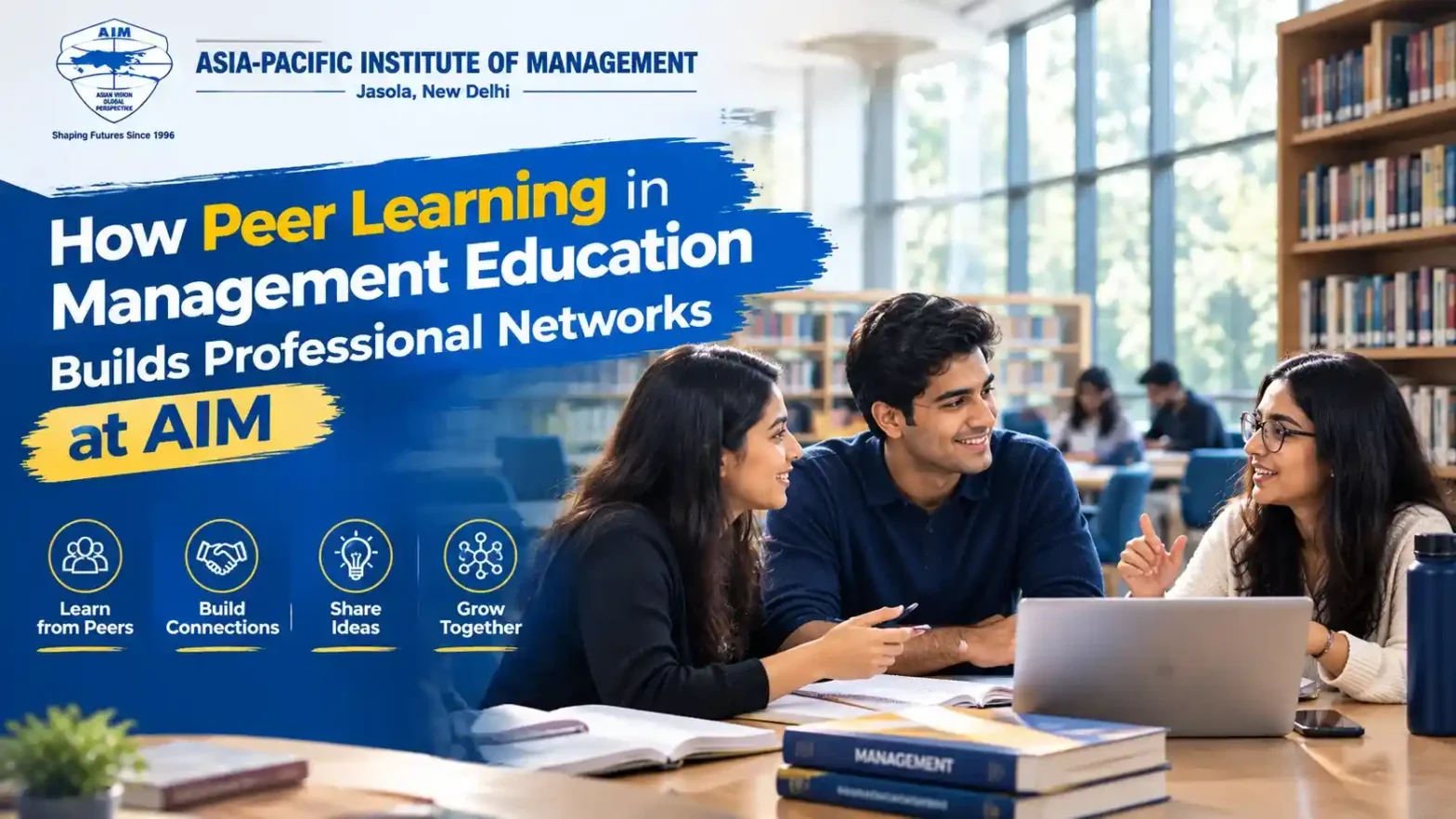
Most applicants research curriculum, fees and placements. Far fewer ask who they will actually learn alongside, even though classmates are often the first professional contacts a management student makes. Peer learning in management education, where students teach, question and depend on one another, is where much of that network begins. At Asia-Pacific Institute of Management (AIM), New Delhi, the PGDM programmes pair classroom study with live projects, case studies, simulations and internships, which gives students repeated reasons to work together.
This deep dive explains what peer learning is, how shared work grows into a professional network, what AIM publishes about its own campus activities, and how a student can get real value from both. It is written for applicants who want to judge networking on evidence rather than slogans.
What Is Peer Learning in Management Education?
Peer learning in management education is a way of learning in which students build understanding through discussion, joint problem-solving and feedback from classmates, instead of relying only on faculty instruction. In a business school, that typically means case discussions, team projects, simulations, presentations and student-run activities.
How It Differs From Ordinary Group Work
A group assignment divides a task and submits it. Peer learning goes further: classmates explain concepts to each other, disagree about approaches and revise their thinking after hearing a different view. A student from a finance background might clarify a cost model, while a classmate with marketing interest questions the customer assumptions behind it. Both leave knowing more than they started with.
This is also why collaborative learning in an MBA or PGDM is more than a teaching method. A programme that places students in mixed teams, again and again, produces many hours of shared work in which people learn how each other think, communicate and handle pressure. Bonus:Peer Learning in PGDM: Benefits of Collaboration Guide
Why It Matters for Networking
Peer learning matters for networking because trust is built through shared work, not introductions. A business card tells someone your name. Spending three weeks on a simulation tells them whether you are reliable, prepared and fair. Those are the qualities people look for when they later recommend a colleague, share a vacancy or suggest a collaboration.
How Peer Learning Turns Into a Professional Network
Networking in business school is often imagined as events and LinkedIn requests. In practice, the stronger connections tend to form earlier and more quietly, through repeated cooperation. The table below shows how that progression generally works.
Stage
What happens
What it can lead to
Shared coursework
Students explain ideas, compare approaches and give feedback
Familiarity and mutual respect
Team projects and simulations
Groups divide work, resolve disagreement and meet deadlines
Trust in each other's reliability
Student-led activities
Clubs, committees and events require coordination
Wider circles beyond one's class group
Internships and early careers
Former classmates work in different organisations and functions
Referrals, advice and industry insight
Two points deserve emphasis. First, these connections are peer-to-peer, which means they grow with the careers of the people in them. A classmate who is a junior executive today may be a hiring manager in a decade. Second, none of this is automatic. The network a student builds depends on how much real work they do with others.
What Makes Management Student Networking Different From Collecting Contacts
Management student networking works best when it is mutual. Students who help classmates prepare for a viva, share notes before an exam or take on the unglamorous part of a project become people others want to stay in touch with. By contrast, students who attend every event but never contribute rarely leave a lasting impression.
What AIM Publishes About Its Learning and Networking Environment
Claims about "strong networks" are easy to make, so it helps to look at what an institute actually documents. The points below come from AIM's official programme and student-life pages. Details can change by academic session, so applicants should confirm current information with the admission cell.
Applied Learning That Requires Teamwork
AIM's PGDM – General page describes a two-year, six-trimester, AICTE-approved programme that uses live projects, case studies, simulations and corporate internships alongside classroom teaching. It also includes a second-year research project covering proposal development, data collection, a report and a presentation. Specialised programmes in Marketing, Banking & Financial Services and Big Data Analytics describe similar applied components.
These formats matter for the peer-learning discussion because each one tends to involve collaboration. Case discussions need multiple viewpoints, and simulations usually involve team decisions. How much students gain still depends on how actively they take part.
Clubs, Events and Alumni Interaction
AIM's Clubs & Committees page lists the Finance Club, the Marketing Maestro Club and the HR Club. Each is organised around a business function, so a student can test an interest in finance, marketing or people management alongside classmates with the same curiosity.
The institute's events page, meanwhile, shows a range of activities, including an Innovation Masterclass on AI, circular economy and sustainable business, an industry-exposure webinar, career seminars, orientation programmes, alumni gatherings and cultural celebrations. AIM's Alumni Connect page also describes an annual alumni meet in which current students interact with former students. Treat these as examples of the types of activity AIM has organised, not a guaranteed calendar for every batch.
An environment offers opportunities. Students decide whether those opportunities become relationships. The following habits tend to separate students who build useful networks from those who simply attend.
Rotate your teams when you can. Working only with familiar friends limits your network to people who already think like you. Mixed groups expose you to different strengths and industries.
Take a concrete responsibility. Owning a section of a project, a budget line or a session in a club event gives classmates something specific to remember you for.
Give before you ask. Explaining a concept, sharing a resource or offering feedback builds goodwill that no message request can replace.
Stay in touch with substance. A short note about an article, an opening or a project update keeps a connection alive far better than a generic greeting.
Look beyond your own batch. Alumni gatherings, faculty conversations and industry sessions extend the circle, but they work best when you arrive with a question rather than a request for a favour.
Protect your academics. A broad network does not compensate for weak preparation. Peers, interviewers and employers still notice the quality of your work.
Professional networking for students also benefits from honesty about goals. A student interested in brand management can use a marketing club to meet like-minded classmates, then follow up with alumni working in related roles. A student drawn to analytics may find more value in project teams and technology-focused sessions. The activities differ, but the principle is the same: pursue depth in a few relationships before breadth.
Questions to Ask Before Choosing a Business School
If peer learning and networking matter to you, evaluate them as carefully as you would evaluate the curriculum. Here are practical questions to raise during a campus visit or counselling session:
How are project teams formed, and do they change across trimesters?
Which clubs, committees and events are active in the current session, not only listed historically?
How do current students interact with alumni, and how often?
What kinds of internships and industry projects are part of the programme?
Can students from different specialisations work together?
What dated, programme-specific evidence is available for career outcomes?
That last question is important. A network can open doors, but it cannot guarantee a job, salary or designation. Individual outcomes depend on skills, effort, prior experience and market conditions. Be cautious with any institute that implies otherwise.
Conclusion
Peer learning in management education turns a cohort into a professional community. The relationships begin in case discussions and team projects, deepen through clubs and events, and continue as classmates and alumni move across industries. At AIM, the published programme structure, clubs and alumni interactions provide the setting for this kind of learning, though the value any student gets depends on active participation.
For applicants, the sensible approach is to look past the word "networking" and examine how an institute actually puts students to work together. Ask for specifics, verify them on the official pages, and choose the environment in which you expect to contribute as much as you receive.
Build MBA Skills!
Gain practical management skills and industry exposure in our MBA program. Secure your admission now!
Dr. Vikas Gupta is a distinguished academic in the education and research domain, specializing in finance and related interdisciplinary studies. He is known for his...
These answers cover how peer learning in management education works, how it supports networking, and what applicants should verify before choosing a programme.
01.
What is peer learning in management education?
It is a learning approach in which students build understanding through discussion, collaboration and feedback from classmates. In business schools it commonly appears in case discussions, team projects, simulations, presentations and student-run activities.
02.
How does peer learning help students build a professional network?
Shared work lets classmates see each other’s reliability, communication and problem-solving up close. That trust often becomes the basis for later advice, referrals and collaboration, especially as peers advance in different organisations.
03.
Is peer learning in a PGDM different from an MBA?
The principle is the same. Whether a programme is called a PGDM or an MBA, collaborative learning relies on teamwork, discussion and applied work. What differs is how each institute structures projects, internships and student activities, so check the specific programme.
04.
What peer-learning formats does AIM describe for its PGDM?
AIM’s PGDM – General page mentions live projects, case studies, simulations and corporate internships. Other PGDM programmes describe similar applied elements. Applicants should review the page for their chosen programme for current details.
05.
Which student clubs does AIM list?
AIM’s Clubs & Committees page lists the Finance Club, the Marketing Maestro Club and the HR Club. Active clubs and events can change by academic session, so confirm the current list with the institute.
06.
Can attending events replace building real connections?
No. Events create introductions, but relationships depend on follow-up and contribution. Students who help others, take responsibility in projects and keep in touch with substance usually build stronger networks than those who only attend.
07.
When should students start networking in business school?
From the first term. Early classroom and project interactions shape how classmates perceive you, and relationships built before placement season tend to feel more natural than those made only when you need something.
08.
Does a strong network guarantee a job after a PGDM?
No. A network can provide advice, introductions and industry insight, but it does not guarantee placement, salary or role. Outcomes depend on your skills, preparation, experience and market conditions.












.webp) Call Us
Call Us