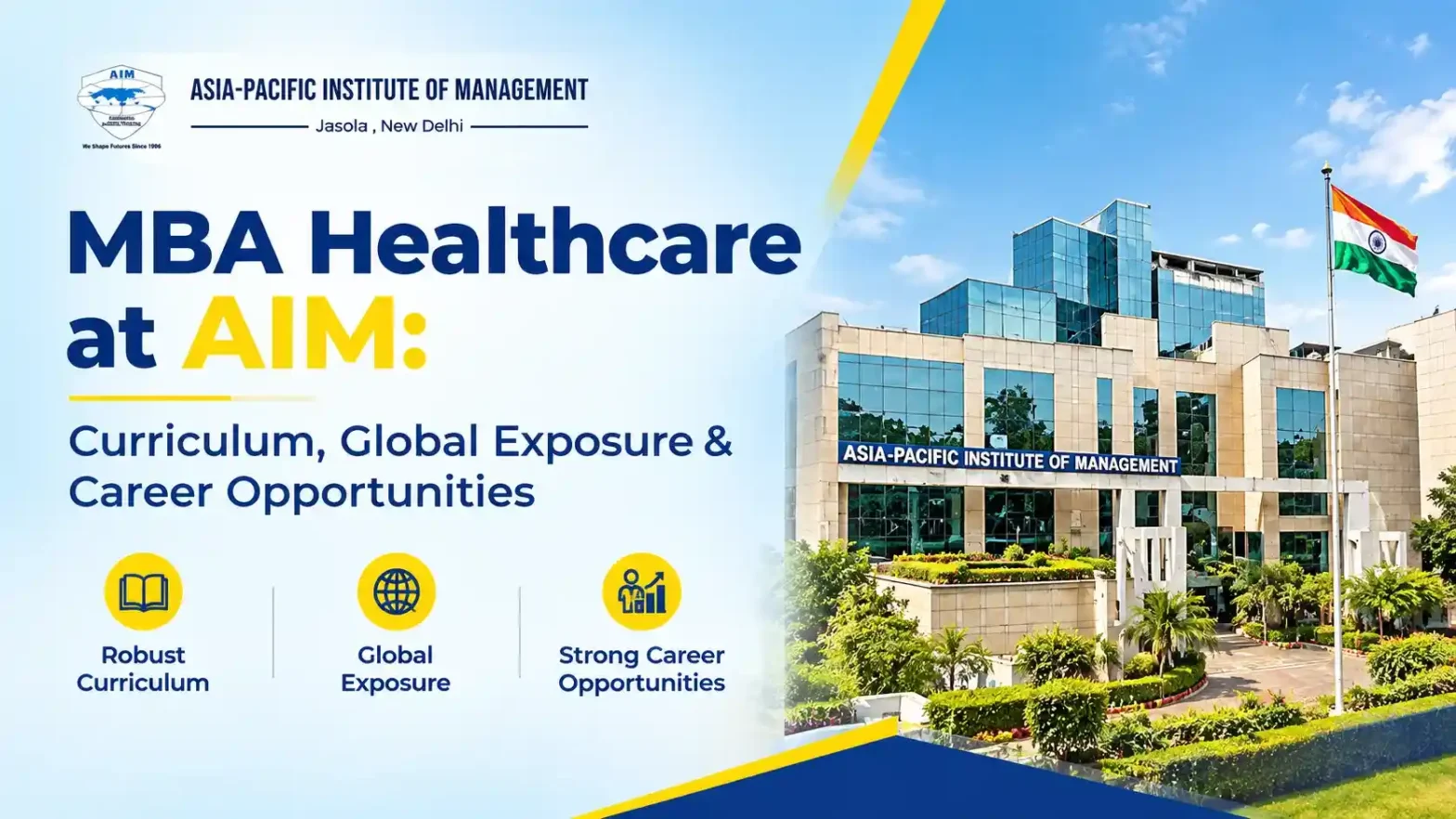
MBA Healthcare at AIM: Curriculum, Global Exposure & Career Opportunities
Posted on 23 Sep 2026
By Dr. Vikas Gupta
Introduction
Healthcare is no longer limited to clinical care. Hospitals, pharmaceutical companies, health-tech businesses, insurers and public-health organisations also need professionals who understand operations, finance, analytics, technology and strategy. This is where an MBA in Healthcare Management can create a management-focused career pathway.
For healthcare aspirants evaluating programmes, the MBA healthcare managementcurriculum matters because it determines the skills developed during the degree. At Asia Pacific Institute of Management (AIM), New Delhi, the current two-year international MBA in Healthcare Management is offered jointly with RUDN University, Moscow. The programme combines healthcare management with hospital administration, health economics, analytics, digital health, artificial intelligence and machine learning, MedTech and global healthcare policy. The structure includes three semesters at AIM and a fourth semester at RUDN University.
Top MBA Tech Track
Master advanced corporate strategies with our elite MBA degree program. Enroll at Asia-Pacific today!
AIM's MBA Healthcare Management combines general management education with specialised healthcare, analytics, technology and hospital-management subjects.
The healthcare MBA syllabus includes healthcare operations, health economics, hospital administration, digital health, analytics, AI/ML, healthcare law and regulatory compliance.
Students complete the first three semesters at AIM, New Delhi, followed by an international semester at RUDN University, Moscow.
Practical learning includes simulation, hospital immersion, field-based projects, research training and an on-the-job hospital administration internship.
Career pathways can extend across hospital administration, healthcare analytics, pharmaceuticals, MedTech, digital health, insurance, consulting and public health.
An MBA in Healthcare Management combines business-management education with specialised knowledge of healthcare organisations. Unlike a clinical qualification, it focuses on how healthcare organisations are managed, financed, operated, digitised and strategically developed.
The healthcare management subjects in such a programme can cover operations, finance, marketing, human resources, healthcare law, quality, health economics, analytics and technology. AIM's current programme adds areas such as telemedicine, electronic health records, AI/ML, healthcare data analytics, health technology assessment and MedTech.
This makes the qualification relevant to graduates who want to work on the management side of healthcare rather than provide clinical treatment.
Understanding the MBA Healthcare Management Curriculum at AIM
A strong curriculum should balance management fundamentals with sector-specific knowledge. AIM's programme follows a four-semester structure that progressively moves from foundations to healthcare applications, practical learning, specialisation and international exposure.
Semester
Location
Major Learning Areas
Semester I
AIM, New Delhi
Healthcare systems, management, marketing, finance, law, digital health, AI and data science
Semester II
AIM, New Delhi
Health economics, HRM, operations, hospital administration, analytics, AI/ML and digital health
Semester III
AIM, New Delhi
Simulation, hospital administration internship, strategy, supply chain, digital transformation and specialisation
Semester IV
RUDN University, Moscow
Global healthcare systems, public health, policy, emerging technologies, innovation and dissertation
The structure is designed to connect classroom learning with practical and international components. AIM's programme page specifically includes an on-the-job hospital administration internship in Semester III and a joint APIM–RUDN dissertation or research project in Semester IV.
What Subjects Are Covered in the Healthcare MBA Syllabus?
The healthcare MBA syllabus at AIM includes a broad combination of management, healthcare and technology-oriented subjects.
Healthcare and Management Foundations
The first semester introduces students to healthcare systems and management while building core business capabilities. Subjects include Principles of Management, Accounting & Finance for Healthcare, Healthcare Marketing & Patient Acquisition, Healthcare Law, Ethics & Regulatory Compliance and Integrated Healthcare Delivery & Value-Based Care.
Students also study Statistical Thinking & Evidence-Based Decision Making, Digital Health & Telemedicine, AI & Data Science in Healthcare and Health Technology Assessment fundamentals.
This combination is useful because healthcare managers need to understand both organisational decisions and the environment in which healthcare services are delivered.
Healthcare Operations and Hospital Administration
The second semester moves further into operational management. Healthcare Operations Management, Hospital Administration, Patient Experience & Clinical Communication and quality-related learning are part of the curriculum.
The programme also references NABH and JCI in its hospital-administration component. These areas can help students understand how quality systems, patient experience and operational processes interact within healthcare organisations.
Analytics, AI and Digital Health
Technology is another significant component of the programme. Students encounter Healthcare Data Analytics & Business Intelligence, AI/ML Applications for Healthcare Operations, IT in Healthcare, electronic health records, electronic medical records, interoperability and Digital Health Product Management.
Cybersecurity and Data Privacy in Healthcare are also included. For students interested in health-tech or analytics, these subjects connect management education with the digital systems increasingly used in healthcare organisations.
What Specialisations Can Students Explore?
AIM currently lists four advanced specialisation areas:
Specialisation
Main Focus
Hospital Administration & Operations
Hospital systems, quality, patient-care processes and operational excellence
Healthcare Analytics & Data Science
Health informatics, business intelligence, predictive modelling and healthcare data
Digital Health, MedTech & Emerging Technologies
Telemedicine, digital platforms, medical devices and technology-led transformation
Healthcare Finance, HRM & Marketing
Financial planning, talent management, service marketing and healthcare strategy
The four pathways illustrate how an AIM healthcare MBA can accommodate different professional interests. Someone interested in hospital operations may investigate the administration pathway, while an aspirant interested in technology may prefer analytics, digital health or MedTech-oriented learning.
How Does Practical Learning Fit Into the Programme?
Healthcare management is an applied field, so practical exposure can help students connect academic concepts with organisational situations.
AIM's current programme includes a Healthcare Simulation Lab, an on-the-job Hospital Administration Internship, field-based learning, research training and a dissertation or research project. The programme also identifies hospital immersion, projects and simulations as components of its practical approach.
For example, a hypothetical hospital-operations project could involve examining patient flow, resource allocation or service quality. An analytics-focused project might explore how healthcare data can support operational decisions. These examples are illustrative; the actual project assigned to a student can vary.
What Does Global Exposure Mean in AIM's Healthcare MBA?
The international component is one of the defining structural features of AIM's programme. Students complete Semesters I–III at AIM in New Delhi and Semester IV at RUDN University in Moscow.
The international semester covers International Healthcare Systems & Policy, Global Health Governance, advanced Public Health & Epidemiology, Cross-Cultural Leadership & Global Healthcare Strategy, and emerging technologies such as AI, robotics and genomics. It also includes Health Innovation Labs, institutional visits and a joint dissertation or research project.
AIM describes the Moscow semester as involving up to four months of study. Its current programme information also states that travel, visa-related expenses and Moscow accommodation are supported, while food expenses remain the student's responsibility. Applicants should verify the applicable terms for their admission cycle before making financial decisions.
This global exposure MBA structure can give students a comparative perspective on healthcare systems, management practices and public-health approaches across different environments.
What Career Opportunities Can an MBA in Healthcare Management Support?
The MBA healthcare career opportunities available to a graduate depend on individual skills, experience, specialisation, employer requirements and the role pursued. Healthcare management is broader than hospital administration alone.
AIM identifies career areas including hospital and healthcare administration, pharmaceuticals and life sciences, healthcare consulting and analytics, public health and policy, health insurance, medical tourism, MedTech and digital health.
Potential career directions include:
Career Area
Typical Management Focus
Hospital Administration
Operations, quality, patient services and organisational coordination
Healthcare Operations
Process improvement, resource planning and service delivery
Healthcare Analytics
Business intelligence, healthcare data and decision support
Digital Health
Digital products, telemedicine and technology transformation
Pharmaceuticals & Life Sciences
Business, operations, marketing and commercial functions
Health Insurance
Operations, healthcare financing and service management
Healthcare Consulting
Analysis, process improvement and strategic projects
Public Health & Policy
Programme management, policy implementation and health systems
MedTech
Product, business and technology-related healthcare functions
These are career areas rather than guaranteed job outcomes. Candidates should evaluate role requirements and employer expectations alongside the programme curriculum.
Who Can Consider the AIM Healthcare MBA?
AIM's published eligibility information states that applicants should have a bachelor's degree with at least 50% marks from a recognised university. Final-year graduation students can also apply. The programme specifically states that both medical and non-medical graduates are eligible, including backgrounds such as MBBS, BDS, Nursing, BAMS, paramedical studies, Pharmacy, Life Sciences, BBA, B.Com and B.Sc.
The published selection process includes CAT, MAT, XAT, CMAT, ATMA or GMAT scores followed by Group Discussion and Personal Interview rounds. Requirements can change, so applicants should verify the current admission criteria for their intake.
How Should Healthcare Aspirants Evaluate the Programme?
A healthcare aspirant should compare an MBA programme on more than its specialisation title. A practical evaluation framework includes five questions.
First, does the curriculum match your intended career? Hospital operations, analytics, digital health and healthcare finance require different skill combinations.
Second, does the programme provide practical exposure? Look for internships, simulations, projects, research and opportunities to understand healthcare organisations in practice.
Third, is the international component academically relevant? Global travel is different from structured international learning. Examine the subjects, university component, research and institutional exposure involved.
Fourth, what are the programme's eligibility and selection requirements? Confirm the current admission criteria rather than relying on older information.
Finally, are career claims supported by identifiable programme information? Review placement assistance, internship structures and available career data carefully, while distinguishing institutional support from an individual employment guarantee.
Why Can a Healthcare Management MBA Be Different From a Clinical Degree?
An MBA in Healthcare Management is designed for management functions rather than clinical practice. A doctor, nurse or other healthcare professional may use management education to develop capabilities in operations, finance, strategy or organisational leadership, while a non-medical graduate can enter the healthcare sector through management-oriented roles.
The distinction is important when comparing programmes. If your objective is patient treatment or another regulated clinical profession, a management degree is not a substitute for the relevant clinical qualification. If your objective is to manage healthcare organisations or contribute to healthcare business and technology, the management route may be more aligned with that goal. Bonus:Scope of MBA Healthcare in India
What Should You Look for Before Choosing an MBA Healthcare Programme?
Use the following checklist before applying:
Review the complete curriculum rather than only the programme title.
Check whether hospital administration, healthcare operations and health economics are covered.
Examine the depth of analytics, AI and digital-health learning if technology interests you.
Check whether practical learning includes internships, projects or simulations.
Understand the structure and academic purpose of any overseas semester.
Verify eligibility and entrance-examination requirements for the relevant intake.
Separate published tuition or academic fees from additional personal expenses.
Review career-support information without treating it as a guarantee of employment.
Compare specialisation options with your intended career direction.
Confirm the latest programme information directly with the institute before applying.
Conclusion
An MBA in Healthcare Management can provide a management-oriented route into a sector that combines organisational, operational, financial and technological challenges. At AIM, the MBA healthcare management curriculum brings together healthcare systems, hospital administration, operations, analytics, digital health, AI/ML, health economics and healthcare strategy. The international semester at RUDN University adds exposure to global healthcare systems, policy and emerging technologies, while practical components connect classroom learning with healthcare settings. For aspirants, the most useful way to evaluate the programme is to match its subjects, specialisations, practical exposure and international structure with their own career interests rather than relying on the degree title alone.
Top MBA Tech Track
Master advanced corporate strategies with our elite MBA degree program. Enroll at Asia-Pacific today!
Dr. Vikas Gupta is a distinguished academic in the education and research domain, specializing in finance and related interdisciplinary studies. He is known for his...
These FAQs address common questions about AIM's curriculum, international exposure, eligibility and career pathways in healthcare management.
01.
What subjects are included in the MBA healthcare management curriculum at AIM?
AIM’s current curriculum includes healthcare systems, management, finance, marketing, healthcare law, health economics, hospital administration, operations, analytics, AI/ML, digital health, healthcare IT, MedTech, strategy and global healthcare policy. The programme also includes practical and research components.
02.
Is the AIM healthcare MBA suitable for non-medical graduates?
Yes. AIM’s published programme information states that both medical and non-medical graduates can apply, subject to the stated eligibility requirements. Listed backgrounds include BBA, B.Com, B.Sc., Life Sciences, Pharmacy and several healthcare-related qualifications.
03.
Does AIM's MBA Healthcare Management include hospital administration?
Yes. Hospital Administration is included in the curriculum, alongside Healthcare Operations Management, patient experience, clinical communication and quality-related learning. Hospital Administration & Operations is also listed as a specialisation area.
04.
What is the global exposure component of AIM's healthcare MBA?
Students complete the first three semesters at AIM in New Delhi and the fourth semester at RUDN University in Moscow. The international component covers global healthcare systems, policy, public health, cross-cultural leadership and emerging technologies.
05.
Which career areas can an MBA in Healthcare Management lead to?
Career areas can include hospital administration, healthcare operations, healthcare analytics, digital health, pharmaceuticals and life sciences, MedTech, healthcare consulting, health insurance and public health. Actual roles depend on the graduate’s skills, experience, specialisation and employer requirements.
06.
Does the programme include practical healthcare exposure?
Yes. AIM’s current programme lists a Healthcare Simulation Lab, an on-the-job hospital administration internship, hospital immersion, field-based projects, research training and a dissertation or research project. The specific projects available can vary.
07.
What specialisations are available in AIM's healthcare MBA?
AIM currently lists four advanced areas: Hospital Administration & Operations; Healthcare Analytics & Data Science; Digital Health, MedTech & Emerging Technologies; and Healthcare Finance, HRM & Marketing. Applicants should confirm the applicable structure for their admission cycle.














.webp) Call Us
Call Us