Executive MBA in Healthcare: Is It Worth It for Doctors & Clinicians?
Posted on 24 Aug 2026
By Dr. Vikas Gupta
Introduction
Years of medical education prepare doctors and clinicians to diagnose conditions, treat patients, and make complex clinical decisions.
However, senior healthcare roles often require an entirely different set of capabilities.
A department head may need to manage budgets. A medical superintendent may handle staffing and quality systems. A hospital leader may need to understand finance, strategy, technology, patient experience, and operational efficiency.
Clinical expertise alone may not fully prepare professionals for these responsibilities.
Designed primarily for experienced professionals, executive management education can help doctors and clinicians understand the business and administrative side of healthcare while continuing their careers.
For some professionals, it can support progression into leadership. For others, it may facilitate a non clinical career shift into hospital administration, healthcare consulting, operations, strategy, or related roles.
But is the investment actually worthwhile?
This guide explains who should consider an Executive MBA in Healthcare, which career paths it can support, and what doctors should evaluate before enrolling.
Lead Beyond Clinical Care
Expand your clinical expertise with business, strategy, operations, and leadership skills designed for ambitious professionals pursuing senior healthcare roles.
An executive MBA in healthcare is management education designed for experienced professionals who want to develop business and leadership skills relevant to healthcare organizations.
Unlike clinical education, it typically focuses on areas such as:
Healthcare operations
Finance
Strategy
Human resources
Marketing
Leadership
Healthcare analytics
Quality management
Digital transformation
Hospital administration
The exact curriculum varies by programme.
Many executive formats are designed to accommodate working professionals through weekend, modular, hybrid, or other flexible learning structures.
Therefore, clinicians may be able to continue professional responsibilities while building management skills.
Why Are Doctors Moving Toward Healthcare Management?
Healthcare organizations have become increasingly complex.
Hospitals today need to manage:
Large multidisciplinary teams
Advanced medical technologies
Insurance systems
Digital health records
Patient safety
Accreditation
Revenue cycles
Supply chains
Data analytics
Regulatory requirements
India's healthcare sector is also expanding rapidly.
Healthcare is already one of the country's largest sectors by both revenue and employment. Industry projections indicate substantial additional employment growth through 2030.
This growth creates greater demand for managerial capability.
Government-backed hospital management education also emphasizes leadership, finance, information systems, communication, quality improvement, and data interpretation as essential competencies for healthcare managers.
Doctors who want to participate in organizational leadership may therefore need skills beyond clinical medicine.
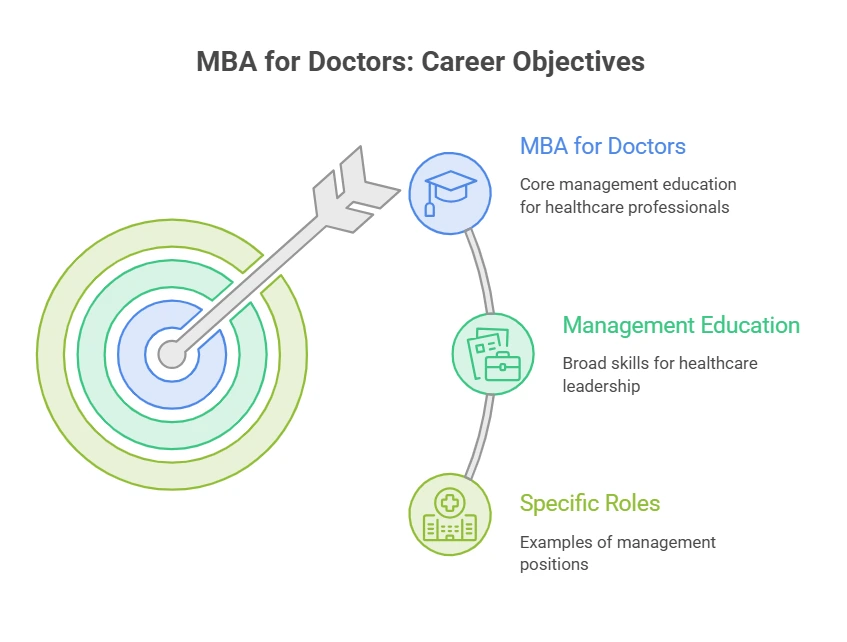
MBA for Doctors: When Does It Make Sense?
An MBA for doctors makes the most sense when the professional has a clear management objective.
Management education may be relevant if you want to:
Lead a hospital department
Move into hospital administration
Manage a healthcare business
Work in healthcare strategy
Enter consulting
Lead quality initiatives
Manage hospital operations
Build a healthcare venture
Move into corporate healthcare roles
However, an MBA should not be pursued simply because clinical work feels difficult.
You should first identify what kind of career you actually want.
For example, a doctor who wants deeper clinical specialization may gain more from advanced clinical education.
Meanwhile, a clinician interested in running hospitals or managing healthcare businesses may benefit more directly from management education.
Clinical Expertise and Management Expertise Are Different
A common misconception is that senior clinical experience automatically creates management capability.
How should we design a system capable of treating 500 such patients efficiently and safely?
The second question involves:
Staffing
Capacity
Finance
Equipment
Quality
Workflow
Technology
Supply chain
Both perspectives are necessary.
However, they require different skills.
This is why healthcare organizations often combine clinical and professional management leadership.
NITI Aayog has previously highlighted the need for professionally trained hospital administration capabilities and structured leadership preparation for clinicians moving toward administrative positions.
What Does a Working Professional MBA Healthcare Format Offer?
A working professional MBA healthcare format aims to help experienced professionals learn management without necessarily leaving employment.
This matters for doctors.
A full career break can create several challenges.
Clinicians may lose:
Income
Clinical continuity
Professional momentum
Patient relationships
An executive format may therefore offer a different approach.
Professionals can potentially apply classroom concepts directly to workplace problems.
For example, a doctor studying operations may examine OPD waiting time in their hospital.
Someone studying finance may better understand departmental budgets.
A quality-management module may help a clinician evaluate audit systems.
This connection between learning and workplace application can be one of the strongest advantages of executive education.
What Do Doctors Learn That Medical School May Not Teach?
Medical education focuses primarily on patient care and scientific knowledge.
Management education examines organizations.
Important areas can include the following.
Healthcare Finance
Doctors moving into management may need to understand:
Budgets
Costs
Revenue
Capital expenditure
Financial statements
Business cases
Suppose a department requests new equipment.
The clinical requirement may be clear.
However, management must also evaluate cost, utilization, maintenance, manpower, and financial feasibility.
Operations Management
Operations focuses on how healthcare services actually flow.
Examples include:
OPD scheduling
Bed management
Operating theatre utilization
Discharge
Diagnostic turnaround
Patient flow
Doctors already understand clinical workflows.
Management knowledge helps them examine those workflows as systems.
Can an Executive MBA Help a Doctor Become a Hospital Administrator?
Potentially, yes.
However, the qualification alone does not automatically create a senior administrative position.
Hospital leadership typically requires a combination of:
Experience
Management knowledge
Leadership ability
Healthcare understanding
Organizational credibility
A doctor with years of clinical experience already understands patients and clinical environments.
Management education can add:
Finance
Operations
People management
Strategy
Analytics
Together, these competencies can support a transition.
Government healthcare-management training itself emphasizes developing professionals capable of managing hospitals through competencies in leadership, budgeting, quality improvement, information systems, and evidence-based decision-making.
What Career Roles Can Clinicians Target After Management Education?
Possible career directions may include:
Medical superintendent
Medical administrator
Hospital operations leader
Healthcare strategy manager
Quality leader
Clinical operations manager
Healthcare consultant
Business development leader
Hospital business-unit head
Healthcare entrepreneur
Eligibility depends on employer requirements, qualifications, experience, and organizational structure.
Doctors should therefore study actual role descriptions before selecting a programme.
When an Executive MBA May Not Be Worth It
An MBA is a significant investment.
It may not be the right choice in every situation.
You Want Only Clinical Advancement
If your primary ambition is to become a stronger specialist clinician, another medical qualification may be more relevant.
You Have No Management Career Objective
An MBA without a clear purpose can become an expensive credential.
Know what you want to do with it.
You Expect an Immediate Senior Title
Education does not automatically create leadership authority.
Experience and performance still matter.
You Cannot Commit Time
Executive programmes are designed for professionals.
However, they still require substantial study.
Balancing hospital duties, family commitments, projects, and classes can be demanding.
You Want Only One Management Skill
If your need is narrowly focused, a shorter specialized course may offer better value.
Is It Worth It Financially?
Doctors often evaluate an Executive MBA through salary.
That is understandable.
However, immediate compensation should not be the only measure.
Evaluate the return across several dimensions.
Career Optionality
Does the programme open credible career pathways beyond clinical work?
Leadership Responsibility
Can it prepare you for larger organizational roles?
Business Capability
Will you understand finances, operations, people, and strategy better?
Network
Will you interact with professionals who broaden your understanding of business?
Opportunity Cost
How much time, income, and professional energy will the programme require?
Long-Term Goal
Will those capabilities still be valuable five or ten years from now?
A management degree may offer high value for one doctor and limited value for another.
The difference is usually career alignment.
How to Calculate Your Personal ROI
Instead of asking, “Is an Executive MBA worth it?”
Ask:
“Is it worth it for my specific career objective?”
Consider:
Total Investment = Tuition + Travel + Study Time + Opportunity Cost
Then evaluate potential returns:
Career Return = New Skills + Career Mobility + Leadership Potential + Network + Long-Term Earnings Potential
Some of these returns cannot be measured immediately.
Therefore, a realistic assessment should consider several years rather than only the first job after graduation.
How to Choose the Right Executive MBA in Healthcare
Doctors should examine programmes carefully before enrolling.
1. Check the Curriculum
Look for meaningful coverage of:
Finance
Operations
Strategy
Leadership
Analytics
Healthcare systems
2. Evaluate Practical Learning
Healthcare management is best understood through application.
Look for:
Case studies
Projects
Industry interaction
Simulations
Practical assignments
3. Understand the Learning Format
Ask whether the schedule genuinely fits clinical responsibilities.
4. Examine Faculty Expertise
Faculty should combine management expertise with relevant healthcare understanding where appropriate.
5. Evaluate Industry Exposure
Corporate and healthcare exposure can help professionals understand management beyond textbooks.
6. Review Career Support
Understand what support is available for career transition.
However, do not assume that career services guarantee a job.
How Doctors Can Prepare Before Starting an Executive MBA
Clinicians can prepare for management education in advance.
Learn Basic Accounting
Terms such as revenue, profit, assets, liabilities, and cash flow may initially feel unfamiliar.
Improve Excel Skills
Managers often work with data.
Spreadsheet confidence can make coursework easier.
Read Healthcare Business News
Follow trends in:
Hospitals
Insurance
Pharmaceuticals
Health-tech
Medical devices
Understand Your Own Hospital as a Business
Ask:
How does the hospital earn revenue?
What are its major costs?
How are beds allocated?
How is staffing planned?
Which KPIs does leadership monitor?
This turns your workplace into a management-learning environment.
From Clinician to Healthcare Leader: The Mindset Shift
The biggest transition may not be academic.
It may be psychological.
Clinicians are trained to focus on individual patients.
Leaders must also think at the system level.
For example:
A doctor treats one patient experiencing delayed care.
A healthcare manager asks why 200 patients experienced the same delay.
A clinician treats an infection.
A quality leader asks whether the hospital has a pattern of infection risk.
A doctor requests additional equipment.
A leader asks how equipment investment should be prioritized across the organization.
Neither perspective replaces the other.
Leadership expands the scale of the problem being solved.
Why Clinical Professionals Can Bring Unique Value to Management
Doctors and clinicians enter management with an important advantage.
They already understand healthcare from inside the system.
They understand:
Patient needs
Clinical workflows
Professional culture
Medical risk
Healthcare terminology
The challenge is adding business understanding.
This combination can create leaders who can communicate with both clinical and corporate teams.
That can be particularly valuable in organizations where business decisions directly affect patient care.
Management Skills Doctors Should Build
Clinicians considering leadership should focus on:
Financial literacy
Strategic thinking
Operations management
Data interpretation
Communication
Negotiation
People leadership
Quality improvement
Change management
These capabilities become increasingly important as professionals take responsibility for larger teams and budgets.
Why Healthcare Leadership Is Becoming More Important
India's healthcare ecosystem is expanding in scale and complexity.
It includes hospitals, insurance, telemedicine, medical devices, healthcare outsourcing, diagnostics, and other services.
At the same time, professionally trained hospital-management capability is increasingly recognized as necessary for effective and cost-efficient healthcare delivery.
This means future healthcare leaders may need to understand both patient care and organizational performance.
For clinicians, management literacy can therefore become an increasingly valuable career capability.
How Management Education Can Support Clinicians
A well-designed management programme should not teach doctors how to become less clinical.
It should help them understand healthcare from another perspective.
At Asia Pacific Institute of Management, an industry-oriented curriculum, practical learning approach, experienced faculty, corporate exposure, and placement support can help learners develop broader managerial capabilities.
For healthcare professionals evaluating management education, the important question is whether the learning environment can strengthen competencies in leadership, operations, strategy, analytics, and business decision-making.
Doctors and clinicians should ultimately choose education that aligns with the role they want to perform.
Conclusion
An executive MBA in healthcare can be valuable for doctors and clinicians who want to expand from managing individual clinical cases toward managing teams, departments, hospitals, healthcare businesses, or strategic initiatives.
However, it is not automatically the right choice for every healthcare professional.
The decision should begin with your career objective.
If you want deeper clinical specialization, management education may not be the most direct investment.
If you want hospital leadership, healthcare strategy, operations, consulting, entrepreneurship, or a structured non clinical career shift, management education can offer relevant capabilities.
Transform Your Healthcare Career
Combine healthcare experience with finance, analytics, strategy, and leadership expertise to unlock broader management opportunities across the healthcare industry.
Dr. Vikas Gupta is a distinguished academic in the education and research domain, specializing in finance and related interdisciplinary studies. He is known for his...
An Executive MBA in Healthcare combines management education with healthcare-sector context. It is generally designed for experienced professionals who want to develop skills in leadership, finance, operations, strategy, analytics, and administration.
02.
Is an MBA useful for doctors?
An MBA can be useful for doctors seeking leadership, administration, strategy, consulting, entrepreneurship, or other management-oriented careers. It may offer less direct value for professionals focused exclusively on clinical specialization.
03.
Can doctors pursue an MBA while working?
Working-professional management formats may allow doctors to continue employment while studying. However, schedules, attendance requirements, and workload differ by programme.
04.
What non-clinical jobs can doctors pursue?
Doctors may explore medical administration, hospital operations, healthcare consulting, quality management, strategy, health-tech, business development, and other healthcare leadership roles.
05.
Is an Executive MBA better than a hospital administration course?
It depends on your goal. Hospital administration programmes may provide deeper hospital-specific training, while an Executive MBA generally provides broader business and leadership education.
06.
Can an Executive MBA help doctors become medical superintendents?
Management education can strengthen skills relevant to medical administration, but appointment criteria depend on qualifications, experience, employer requirements, and applicable organizational rules.
07.
What should doctors look for in a healthcare leadership course?
Look for relevant curriculum, practical learning, experienced faculty, healthcare industry exposure, flexible delivery, and clear alignment with your intended career.
08.
Is a healthcare Executive MBA worth the investment?
It can be worthwhile when the programme addresses a specific career goal and develops capabilities the professional genuinely needs. It should be evaluated against cost, time commitment, career alternatives, and long-term objectives.
















.webp) Call Us
Call Us