MBA Healthcare Management vs Hospital Management: What’s the Difference?
Posted on 06 Oct 2026
By Dr. Vikas Gupta
Introduction
Choosing a management career in healthcare can be confusing. Many students search for MBA healthcare management vs hospital management because the two fields sound similar. However, they focus on different responsibilities, career paths, and management functions.
Healthcare management usually covers a broader part of the healthcare ecosystem. Hospital management focuses more closely on the operations and administration of hospitals.
Therefore, understanding these differences can help students choose the right academic and career direction.
For graduates from healthcare, life sciences, pharmacy, nursing, biotechnology, and other backgrounds, management education can open several non-clinical career opportunities. An industry-oriented management program can also help students develop skills in strategy, operations, finance, communication, analytics, and leadership.
This guide explains healthcare management vs hospital management, their career scope, skills, job functions, and key differences.
Choose Your Healthcare Path
Compare management pathways and build skills in strategy, operations, finance, analytics, and leadership for broader healthcare career opportunities.
Healthcare management refers to the planning, administration, and strategic management of healthcare services and organisations.
It can involve hospitals, healthcare companies, health-tech businesses, insurance organisations, pharmaceutical businesses, diagnostics, consulting, and other healthcare services.
Healthcare managers often work across multiple business functions. Their responsibilities can include operations, strategy, finance, marketing, analytics, business development, quality, and project management.
In simple terms, healthcare management takes a broader view of how healthcare organisations operate, grow, and deliver value.
What Is Hospital Management?
Hospital management focuses specifically on managing hospital operations and administrative functions.
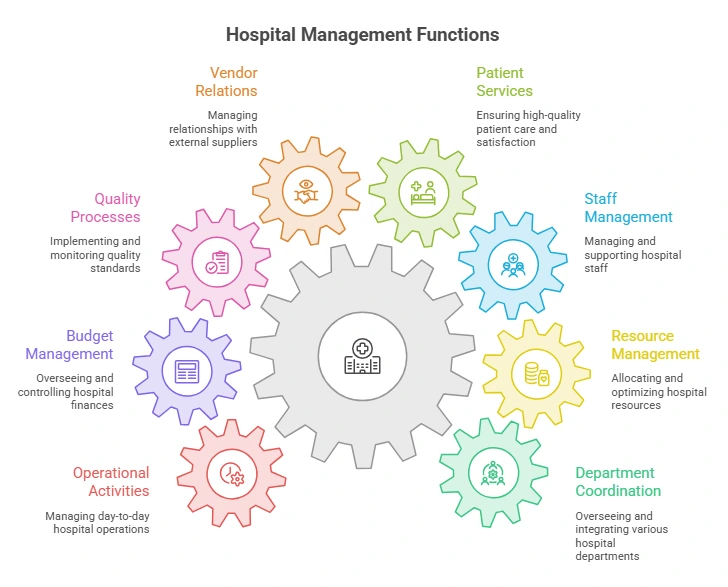
Hospital managers may coordinate departments, resources, staff, patient services, vendors, quality processes, budgets, and operational activities.
The objective is to ensure that hospital services operate efficiently while maintaining appropriate standards of patient care and organisational performance.
Therefore, hospital management is more closely connected to the day-to-day functioning of healthcare facilities.
MBA Healthcare Management vs Hospital Management: Key Difference
The biggest difference is scope.
Healthcare management can cover several types of healthcare organisations and business functions. Hospital management is more focused on hospitals and healthcare facility operations.
Area
Healthcare Management
Hospital Management
Scope
Broad healthcare ecosystem
Mainly hospital operations
Focus
Strategy, operations, business, services
Hospital administration and operations
Workplaces
Hospitals, health-tech, pharma, insurance, consulting and more
Hospitals and healthcare facilities
Career direction
Management across healthcare sectors
Hospital administration and operations
Skills
Strategy, finance, analytics, leadership and operations
Operations, administration, coordination and quality
Career flexibility
Generally broader
More facility-focused
However, there can be significant overlap. A hospital manager may also use healthcare strategy, finance, analytics, and leadership skills.
Healthcare Management vs Hospital Management: Scope
Students often compare these fields based on career scope. The right choice depends on the type of organisation and responsibilities you want to pursue.
Healthcare Management Scope
Healthcare management can lead toward areas such as:
Healthcare operations
Hospital administration
Healthcare consulting
Health-tech management
Healthcare analytics
Business development
Healthcare marketing
Pharmaceutical management
Insurance operations
Quality management
Project management
Healthcare strategy
This broader scope can be useful for students who want flexibility across different healthcare sectors.
Hospital Management Scope
Hospital management can focus on:
Hospital administration
Hospital operations
Patient experience
Department coordination
Resource management
Quality management
Vendor management
Workforce coordination
Process improvement
Healthcare facility management
Hospital business development
Therefore, students interested specifically in managing hospitals may find this pathway more aligned with their career goals.
MBA Hospital Management vs Healthcare Management: Which Is Broader?
Healthcare management generally covers a wider business ecosystem. Students can explore different healthcare organisations and management functions.
Hospital management has a more specialised operational focus. It can be particularly relevant for students who want to build careers in hospital administration and facility management.
However, the actual curriculum depends on the institution and program structure. Students should therefore examine subjects, projects, practical exposure, faculty expertise, and career support before making a decision.
Difference Between Healthcare and Hospital Management
Healthcare management may involve managing healthcare businesses, services, projects, technologies, or strategic initiatives.
Hospital management usually involves managing activities within a hospital environment.
For example, a healthcare manager could work on a healthcare technology project, business development strategy, or operational improvement initiative.
A hospital manager could coordinate hospital departments, improve patient processes, manage resources, or support administrative operations.
Both roles require strong communication and leadership. However, their organisational environments can differ significantly.
Hospital Administration vs Healthcare Management
The terms hospital administration and healthcare management are sometimes used interchangeably. However, they are not always identical.
Hospital administration generally focuses on the administrative and operational functioning of a hospital.
Healthcare management has a broader strategic and organisational scope.
For example, hospital administration may involve:
Coordinating hospital departments
Managing operational processes
Supporting patient services
Monitoring resources
Managing administrative teams
Coordinating vendors
Supporting quality initiatives
Healthcare management may additionally involve:
Business strategy
Healthcare analytics
Market development
Consulting
Digital healthcare
Financial planning
Healthcare projects
Organisational growth
Therefore, hospital administration can be considered one potential career area within the broader healthcare management ecosystem.
Build Healthcare Management Skills
Develop practical management capabilities to explore careers across hospitals, health-tech, consulting, operations, analytics, and healthcare business functions.
Healthcare management can provide access to several career directions.
Depending on qualifications, skills, experience, and employer requirements, graduates may explore roles such as:
Healthcare Operations
Operations professionals help organisations improve processes, resources, productivity, and service delivery.
Healthcare Consulting
Healthcare consultants work on strategic, operational, transformation, and business problems.
Health-Tech Management
The growing use of digital healthcare creates opportunities in product management, operations, implementation, business development, and analytics.
Healthcare Business Development
Business development professionals identify growth opportunities and build relationships with clients, partners, and stakeholders.
Healthcare Analytics
Analytics professionals use data to support operational and business decisions.
Healthcare Marketing
Healthcare marketing involves brand development, communication, patient engagement, digital campaigns, and market outreach.
Therefore, healthcare management can suit graduates who want broader career mobility.
Career Opportunities After Hospital Management
Hospital management can support careers focused on healthcare facility operations.
Potential areas include:
Hospital administration
Hospital operations
Quality management
Patient experience
Department coordination
Healthcare project management
Business development
Facility operations
Process improvement
Administrative management
Career progression depends on experience, organisational structure, skills, performance, and additional qualifications.
An entry-level professional may begin with coordination responsibilities. Over time, they can take on larger teams, departments, budgets, or operational functions.
Healthcare MBA Comparison: What Should Students Evaluate?
Before choosing a course, examine the following factors.
1. Curriculum
Check whether the curriculum includes relevant management subjects.
These may include:
Healthcare operations
Finance
Marketing
Strategy
Human resources
Business analytics
Organisational behaviour
Leadership
Project management
2. Practical Learning
Management education becomes more valuable when students can connect classroom concepts with real-world situations.
Look for case studies, projects, presentations, industry interactions, simulations, and practical assignments.
3. Corporate Exposure
Exposure to real business environments can help students understand how healthcare organisations make decisions.
Therefore, corporate interactions, industry sessions, and practical learning can be useful evaluation criteria.
4. Faculty Experience
Experienced faculty can help students connect management concepts with practical business challenges.
Look at faculty expertise, teaching approach, industry exposure, and academic background.
5. Career Support
Students should also understand how the institution supports career preparation.
Consider areas such as:
Placement support
Interview preparation
Career counselling
Industry interactions
Skill development
Corporate exposure
Who Should Choose Healthcare Management?
Healthcare management may be suitable for students who want a broader management career within the healthcare industry.
It can be a strong option for graduates who want to explore:
Healthcare business
Consulting
Health-tech
Hospital operations
Healthcare analytics
Pharmaceutical management
Business development
Healthcare strategy
It can also suit professionals who want to move from a technical or clinical background into management.
Who Should Choose Hospital Management?
Hospital management may be more suitable for students who specifically want to work within hospitals and healthcare facilities.
It can be relevant for individuals interested in:
Hospital administration
Hospital operations
Patient services
Quality management
Facility coordination
Department management
Healthcare operations
If your long-term goal is to manage hospital functions, a focused hospital management pathway can provide relevant knowledge.
Can Healthcare Management Lead to Hospital Administration?
Yes, healthcare management can support careers in hospital administration.
The broader management skills gained through healthcare education can apply to hospital operations, administration, quality, business development, and strategic functions.
However, employers may have specific qualification and experience requirements for particular roles.
Therefore, students should review job descriptions and understand the skills expected in their target roles.
Can Hospital Management Lead to Broader Healthcare Careers?
It can, particularly when professionals build additional skills and experience.
Hospital management experience can provide exposure to operations, people management, healthcare processes, quality, and service delivery.
Professionals can later develop expertise in areas such as healthcare strategy, consulting, business development, analytics, or health-tech.
Career mobility depends on individual skills, experience, qualifications, and the organisation.
Which Management Path Is Better for Your Career?
There is no universal answer.
The better option depends on your career objective.
Choose a broader healthcare management pathway if you want:
Wider healthcare sector exposure
Multiple career directions
Business and strategy roles
Healthcare consulting opportunities
Health-tech exposure
Analytics and business development roles
Consider hospital management if you want:
Hospital-focused careers
Healthcare facility operations
Hospital administration
Patient service management
Department coordination
Hospital quality and process management
Therefore, do not select a program only because of its title. Evaluate the curriculum and career outcomes carefully.
Healthcare is becoming increasingly dependent on technology, data, efficient operations, and strategic decision-making.
As a result, management professionals need more than theoretical knowledge.
An industry-oriented program can help students understand practical business challenges. Corporate exposure can also provide insight into workplace expectations.
At Asia Pacific Institute of Management, students can develop management capabilities through an industry-oriented learning approach.
The focus on practical learning, experienced faculty, corporate exposure, and career support can help students build relevant management skills.
Students should still evaluate the program curriculum, eligibility requirements, learning format, and current admission information before applying.
How to Choose Between Healthcare Management and Hospital Management
Use this simple decision framework.
Step 1: Define Your Career Goal
Ask yourself where you want to work after graduation.
Do you prefer hospitals, healthcare businesses, health-tech, consulting, or broader management roles?
Step 2: Compare the Curriculum
Look beyond the program name.
Compare subjects, projects, practical exposure, electives, and management skills.
Step 3: Evaluate Career Flexibility
If you want multiple healthcare career directions, broader healthcare management may be useful.
If you want hospital-specific responsibilities, hospital management may be more focused.
Step 4: Consider Your Background
Graduates from healthcare, pharmacy, nursing, life sciences, biotechnology, and other disciplines may explore management education.
However, eligibility varies by program.
Step 5: Assess Long-Term Growth
Think beyond your first job.
Consider whether the program can help you develop leadership, strategy, finance, analytics, and communication skills.
These capabilities can become increasingly important as your responsibilities grow.
The comparison of MBA healthcare management vs hospital management becomes easier when you understand the difference in scope.
Healthcare management generally offers broader exposure across the healthcare ecosystem. Hospital management focuses more specifically on hospital administration and operations.
However, the two areas overlap significantly. Both require leadership, communication, operational knowledge, problem-solving, and decision-making.
Therefore, students should choose based on their career goals rather than the course name alone.
For students seeking industry-aligned management education, Asia Pacific Institute of Management can be considered as part of the decision-making process. Its practical learning approach, experienced faculty, corporate exposure, and career support can help students build relevant management capabilities.
Explore your management career goals, compare the curriculum carefully, and choose a program that supports your long-term professional direction.
Shape Your Management Future
Strengthen business and leadership expertise through industry-oriented learning designed for evolving healthcare management and administration careers.
Dr. Vikas Gupta is a distinguished academic in the education and research domain, specializing in finance and related interdisciplinary studies. He is known for his...
01.
Is MBA healthcare management better than hospital management?
Neither is universally better. Healthcare management generally offers broader exposure across healthcare sectors, while hospital management focuses more on hospital operations and administration. Your choice should depend on your preferred career environment, curriculum, skills, and long-term goals.
02.
What is the difference between healthcare management and hospital management?
Healthcare management has a broader scope across healthcare organisations and functions. Hospital management focuses mainly on hospital administration, operations, resources, patient services, and facility-level management.
03.
Is hospital administration the same as healthcare management?
No. Hospital administration is generally focused on managing hospital functions. Healthcare management has a broader scope and can include hospital operations, health-tech, consulting, analytics, business development, and other healthcare management areas.
04.
Can I work in a hospital after studying healthcare management?
Yes. Healthcare management skills can apply to hospital administration, operations, quality, business development, project management, and other hospital functions. Specific roles may have additional qualification or experience requirements.
05.
Which is better for hospital administration?
A program with strong hospital operations and healthcare management content can be relevant. Students should examine the curriculum, practical learning, industry exposure, and career support before selecting a program.
06.
Is healthcare management a good career option after a healthcare degree?
Healthcare management can be a useful pathway for graduates who want to move toward business, administration, operations, strategy, analytics, or leadership roles. The suitability depends on individual interests and career objectives.
07.
Can hospital management professionals move into healthcare consulting?
They can develop toward consulting roles by building skills in strategy, analytics, problem-solving, communication, and business management. Relevant experience and qualifications can strengthen this transition.
08.
How should I compare healthcare management MBA programs?
Compare curriculum, faculty, practical learning, corporate exposure, career support, learning format, eligibility, and overall alignment with your career goals. Avoid choosing solely based on the program title.


















.webp) Call Us
Call Us