CAT Verbal Ability Tips: Para Jumbles & Odd One Out Strategy
Posted on 07 Jul 2026
By Dr. Vikas Gupta
The Verbal Ability section can confuse many CAT aspirants because it does not always test grammar directly. It tests how well you understand meaning, structure, logic, tone, and sentence flow. That is why students need clear CAT verbal ability tips for para jumbles, odd one out, para summary questions, sentence completion, and VA TITA questions.
Unlike vocabulary-based questions, Verbal Ability needs pattern recognition. You must identify how ideas connect. You must also avoid emotional guessing.
The official CAT 2025 bulletin confirmed that CAT was a computer-based test conducted in three sessions. Students preparing for CAT 2026 should verify the latest official notification when released, as the exact question mix can change each year.
Ace CAT Verbal Now
Master reading comprehension and critical logic skills. Learn advanced linguistic strategies to boost your dynamic percentile scores in top business exams.
The Verbal Ability section in CAT tests a student’s ability to understand sentence logic, paragraph structure, meaning, and flow. It usually includes question types such as para jumbles, odd one out, para summary questions, and other non-MCQ verbal reasoning formats.
In simple terms, Verbal Ability checks whether you can arrange ideas logically.
Para jumbles and odd one out questions are important because they test logical flow in VARC. These questions do not ask you to remember facts. Instead, they ask you to understand how one sentence connects with another.
These questions are also often tricky because options may not always be available. Many Verbal Ability questions appear as VA TITA questions, where students must type the answer.
This means there may be no elimination through options. Therefore, accuracy matters more than speed.
CAT Verbal Ability Tips: Quick Strategy Table
Question Type
What It Tests
Main Skill Needed
Best Strategy
Para Jumbles
Sentence arrangement
Logical sequencing
Identify opening, links, and conclusion
Odd One Out
Paragraph coherence
Theme consistency
Find the sentence that breaks the flow
Para Summary Questions
Main idea
Compression and tone
Choose the option that captures the central point
Sentence Completion
Context and meaning
Grammar plus logic
Read before and after the blank
VA TITA Questions
Accuracy without options
Independent reasoning
Avoid blind attempts
How to Solve Para Jumbles in CAT
Para jumbles ask you to arrange sentences in the correct order. The biggest mistake students make is trying to arrange all sentences at once.
Instead, solve para jumbles in layers.
Step 1: Identify the Opening Sentence
The opening sentence usually introduces the topic. It does not depend heavily on another sentence.
Look for sentences that:
Introduce a broad idea
Define a concept
Start with a general statement
Do not begin with “this,” “these,” “such,” or “however”
Do not refer to something already explained
Example
Sentence A: “Urban farming has become popular in many cities.” Sentence B: “This practice also reduces food transport costs.”
Sentence A is likely the opening sentence because Sentence B uses “this practice,” which refers back to urban farming.
Step 2: Find Mandatory Pairs
A mandatory pair is a pair of sentences that must come together.
Look for:
Link Type
Example
Pronoun link
This, these, it, they
Cause-effect link
Because, therefore, as a result
Contrast link
However, but, yet
Chronology link
First, later, finally
Example link
For instance, for example
Concept-detail link
A broad idea followed by explanation
Example
Sentence A: “Many consumers now compare prices before buying.” Sentence B: “This behavior has forced brands to become more transparent.”
Sentence B should follow Sentence A because “this behavior” refers to price comparison.
Every paragraph has a central theme. If one sentence shifts the theme suddenly, it may not fit in the correct sequence.
Ask:
What is the paragraph mainly about?
Is the author explaining a problem?
Is the author giving examples?
Is the author moving from old idea to new idea?
Is the author presenting cause and effect?
This improves VARC accuracy tips because it reduces random guessing.
Step 4: Identify the Closing Sentence
The closing sentence usually completes the argument. It may give a conclusion, result, implication, or final judgment.
Closing sentences often include:
Therefore
Thus
As a result
This shows
In conclusion
The larger point is
However, not every paragraph has obvious conclusion words. Sometimes, the final sentence simply gives the broad implication.
Para Jumble Practice Method
Use this 4-step method while practicing.
Step
Action
Step 1
Read all sentences once without arranging
Step 2
Identify the topic and opening sentence
Step 3
Find mandatory pairs
Step 4
Build the final sequence and check flow
After solving, read your final sequence like a paragraph. If it sounds broken, review the links again.
Common Para Jumble Mistakes
Avoid these mistakes:
Choosing a sentence only because it sounds good
Ignoring pronouns
Missing contrast words
Treating examples as opening sentences
Not checking the final sequence
Arranging sentences based on grammar alone
Over-attempting TITA questions
Not analyzing wrong answers after practice
Para jumbles improve with review, not only practice.
How to Solve Odd One Out Questions
Odd one out questions give five sentences. Four sentences form a coherent paragraph. One sentence does not fit.
Your job is to identify the sentence that breaks the logical flow.
Step 1: Find the Main Theme
First, ask what four sentences are mainly discussing.
The theme may be:
A concept
A debate
A historical development
A business idea
A scientific argument
A social issue
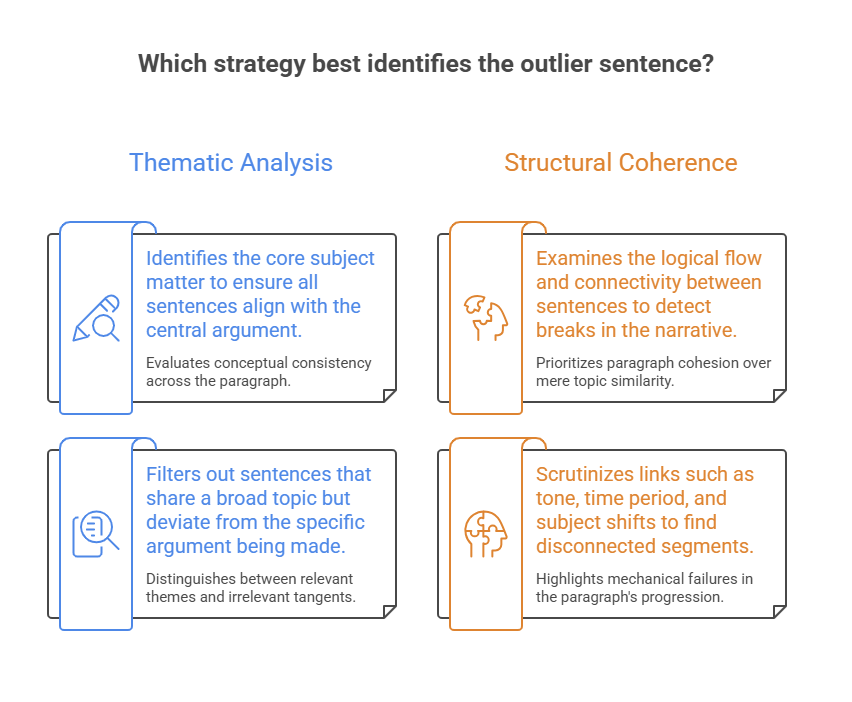
The odd sentence may be related to the same broad topic but not to the same argument.
This is what makes odd one out tricky.
Step 2: Separate Topic Match from Flow Match
A sentence can be on the same topic and still be odd.
For example, if four sentences discuss “online education quality,” and one sentence discusses “internet usage growth,” the fifth sentence may be related but still odd.
The test is not topic similarity alone. The test is paragraph coherence.
Top VARC Strategies
Elevate your core vocabulary and speed reading metrics. Follow this specialized preparation roadmap to secure admission into premium management programs today.
The odd sentence often lacks connection with the rest.
Check for:
Sudden change in subject
Different time period
Different example set
Different tone
Unrelated conclusion
Overly specific detail
New idea that does not develop the paragraph
Example
Four sentences discuss how remote work affects team collaboration. One sentence discusses office rental prices. That sentence may be odd because it shifts the focus.
Odd One Out Strategy Table
Signal
What It Means
Same topic, different angle
Possible odd sentence
No pronoun or idea link
Check carefully
Sudden example shift
May not belong
Sentence feels too broad
Could be opening or odd
Sentence feels too narrow
Could be example or odd
Different tone
Strong odd-one-out clue
Para Summary Questions: How to Improve Accuracy
Para summary questions test whether you can identify the central idea of a paragraph.
The best summary should:
Capture the main point
Avoid extra details
Match the author’s tone
Avoid distortion
Avoid extreme language
Cover the full paragraph
Do not choose an option only because it repeats words from the passage. CAT often uses familiar words in wrong options.
Para Summary Method
Step
Action
Step 1
Read the paragraph once
Step 2
Identify the author’s main point
Step 3
Remove examples and minor details
Step 4
Check the tone
Step 5
Eliminate distorted options
Common Wrong Option Types
Wrong Option Type
Why It Is Wrong
Too narrow
Covers only one part
Too broad
Adds ideas not present
Opposite tone
Changes author’s attitude
Extreme
Uses words like always, never, completely
Fact-heavy
Repeats details but misses main idea
Sentence Completion: What Students Should Practice
Sentence completion questions test context, grammar, tone, and meaning.
Students should read the full sentence before choosing or typing an answer.
Check:
Subject-verb agreement
Tone of the sentence
Contrast words
Cause-effect relationship
Parallel structure
Meaning before and after the blank
Example
“Although the policy was ambitious, its implementation was ______.”
The word “although” creates contrast. So, the blank may need a word like “weak,” “slow,” or “inconsistent,” depending on options.
VA TITA Questions: How to Attempt Smartly
VA TITA questions are Type-In-The-Answer questions. These questions are challenging because there are no answer options to guide you.
The benefit is that TITA questions usually do not carry negative marking, but students should still avoid careless attempts. The real cost is time. Bonus:PGDM admission process
VA TITA Attempt Strategy
Situation
What to Do
You find clear mandatory pairs
Attempt
You identify opening and closing sentences
Attempt
You are confused between two full sequences
Recheck links
You have no clear structure
Skip or mark for review
You are spending too long
Move ahead
The goal is not to attempt every TITA question. The goal is to maximize accuracy.
Logical Flow in VARC: The Core Skill
Logical flow in VARC means understanding how ideas move from one sentence to the next.
A paragraph may follow different structures.
Flow Type
Example Pattern
General to specific
Broad idea → detail → example
Problem to solution
Issue → cause → solution
Cause to effect
Reason → result → implication
Chronological
Past → present → future
Argumentative
Claim → evidence → conclusion
Contrast
Old view → new view → comparison
Students who identify the flow type solve para jumbles and odd one out questions faster.
30-Day CAT Verbal Ability Practice Plan
Use this plan to improve consistency.
Timeline
Practice Focus
Daily Task
Days 1–5
Para jumbles
Solve 5 sets and analyze links
Days 6–10
Odd one out
Solve 5 sets and identify theme shifts
Days 11–15
Para summary
Solve 5 questions and write one-line summaries
Days 16–20
Sentence completion
Practice grammar and context clues
Days 21–25
Mixed VA practice
Solve timed sets
Days 26–30
Mock analysis
Review errors and build attempt strategy
Do not only count correct answers. Maintain an error notebook.
Error Notebook Format for VARC Accuracy
A good error notebook can improve VARC accuracy tips faster than random practice.
Question Type
Mistake Made
Correct Logic
Lesson
Para Jumble
Chose wrong opener
Sentence had pronoun dependency
Avoid pronoun-based openers
Odd One Out
Picked topic mismatch only
Odd sentence broke argument flow
Check flow, not topic alone
Para Summary
Chose detailed option
Best answer captured main idea
Avoid detail traps
TITA
Spent too much time
No clear mandatory pair
Skip faster next time
Review this notebook twice a week.
How Much Time Should You Spend on VA Questions?
Time management depends on your strengths. However, students should avoid spending too long on one para jumble or odd one out question.
A practical time range:
Question Type
Suggested Time
Para Jumble
2–3 minutes
Odd One Out
2–3 minutes
Para Summary
1.5–2 minutes
Sentence Completion
1–1.5 minutes
If a question remains unclear after repeated reading, move ahead. CAT rewards smart selection.
How to Build Reading Ability for Verbal Ability
Even though para jumbles and odd one out are not RC questions, reading helps. Students who read regularly understand sentence flow better.
Read:
Editorials
Business articles
Science explainers
Social issue essays
Book reviews
Long-form opinion pieces
While reading, notice:
How paragraphs begin
How examples are introduced
How contrast is created
How conclusions are written
How authors shift from one idea to another
This improves instinct for para jumbles.
Practice Drill: Para Jumble Linking Words
Train yourself to notice linking words.
Word or Phrase
What It Signals
However
Contrast
Therefore
Result
For example
Illustration
This
Reference to previous idea
Such
Reference to previous category
Moreover
Addition
In contrast
Comparison
Consequently
Effect
First, second, finally
Sequence
Do not ignore small words. They often decide the correct answer.
Practice Drill: Odd One Out Theme Test
For each odd one out set, write the theme in one line before answering.
Example format:
“The paragraph is about how digital payments changed consumer behavior.”
Then check every sentence against this theme.
Ask:
Does this sentence support the theme?
Does it continue the argument?
Does it introduce a disconnected idea?
Does it belong before or after another sentence?
This method improves accuracy.
Common Myths About CAT Verbal Ability
Myth 1: You need advanced vocabulary to score well
Not always. Vocabulary helps, but structure and comprehension matter more.
Myth 2: Para jumbles can be solved by instinct only
Instinct helps after practice. However, beginners need structured logic.
Myth 3: TITA questions should always be attempted
No. Even without negative marking, wrong attempts waste time.
Myth 4: Reading more is enough
Reading helps, but you must also practice question types and analyze mistakes.
Final Week Strategy for Verbal Ability
During the final week, do not learn new techniques. Focus on revision and accuracy.
Use this checklist:
Revise common linking words
Review error notebook
Solve mixed VA sets
Practice timed attempts
Avoid over-attempting
Focus on accuracy
Sleep properly before mocks
Do not panic over one bad set
Confidence comes from clear method and repeated analysis.
Why CAT Verbal Ability Matters for PGDM Aspirants
Strong verbal ability helps beyond the CAT exam. It also supports group discussions, personal interviews, presentations, business communication, case analysis, and classroom participation.
A management student must read, think, speak, and write clearly. Therefore, preparing for VARC can also improve your PGDM readiness.
Asia Pacific Institute of Management accepts valid scores from CAT, XAT, CMAT, MAT, GMAT, and ATMA for PGDM admissions, followed by shortlisting, Group Discussion, and Personal Interview rounds.
Students preparing for PGDM should treat CAT verbal preparation as communication training, not just exam preparation.
Conclusion
Para jumbles and odd one out questions look confusing because they test hidden structure. However, they become easier when you learn how to identify openings, mandatory pairs, pronoun links, contrast, examples, and conclusions.
The most useful CAT verbal ability tips are simple. Do not guess emotionally. Track logic. Read actively. Analyze every mistake. Build an error notebook.
For CAT and PGDM aspirants, Verbal Ability is not only about marks. It is also about clear thinking and communication.
Boost Your CAT Score
Step up your language analysis capabilities. Use structured expert practice frameworks to optimize professional corporate placement options for your career.
Dr. Vikas Gupta is a distinguished academic in the education and research domain, specializing in finance and related interdisciplinary studies. He is known for his...
01.
What are the best CAT verbal ability tips for beginners?
Start with para jumbles, odd one out, and para summary basics. Learn opening sentences, mandatory pairs, theme tracking, tone, and logical flow. Then practice timed sets and review mistakes.
02.
How do I solve para jumbles in CAT?
Identify the opening sentence, find mandatory pairs, track pronouns and linking words, build the sequence, and read the final paragraph for flow.
03.
How do I solve odd one out questions?
Find the main theme first. Then identify the sentence that does not support the paragraph’s logical flow, even if it is related to the broad topic.
04.
Are VA TITA questions difficult?
VA TITA questions can be difficult because there are no options. However, they become manageable if you identify strong links, mandatory pairs, and paragraph structure.
05.
How can I improve accuracy in para summary questions?
Focus on the main idea, avoid extreme options, ignore unnecessary details, and choose the option that best matches the author’s tone.
06.
What is logical flow in VARC?
Logical flow means the way ideas connect in a paragraph. It may move from general to specific, cause to effect, problem to solution, or argument to conclusion.
07.
Should I attempt all Verbal Ability questions?
No. Attempt questions where you have clear logic. Skip questions where you cannot identify sentence links or central meaning within a reasonable time.
08.
How often should I practice CAT Verbal Ability?
Practice daily if possible. Even 30–40 minutes of focused VA practice with proper analysis can improve performance over time.


















.webp) Call Us
Call Us