CAT 2026 Study Plan: 12-Month Month-Wise Preparation Roadmap
Posted on 11 Jul 2026
By Dr. Vikas Gupta
A strong CAT 2026 study plan gives you one major advantage: time. Many aspirants start late, rush through the syllabus, take mocks without analysis, and lose marks due to weak revision. However, an early starter can build concepts slowly, improve accuracy, and enter the exam with confidence.
CAT preparation is not about studying all day from the beginning. It is about following a balanced study schedule for 12 months.
The official CAT 2025 bulletin confirmed that CAT is a computer-based Common Admission Test conducted in three sessions. Students preparing for CAT 2026 should check the official CAT website when the 2026 notification is released.
Ace 2026 CAT Journey
Start your structured study plan today. Master all logical sections, boost your quantitative speed, and gain admission to top management programs in India now.
A CAT 2026 study plan is a month-wise preparation strategy that covers syllabus completion, sectional practice, mock tests, revision, and exam-day readiness.
It should include:
VARC preparation
DILR practice
Quantitative Aptitude basics
Topic-wise revision
Sectional tests
Full-length mocks
Error analysis
Final strategy refinement
A one-year plan helps students avoid panic. Moreover, it gives enough time to improve weak areas. Bonus:CAT 2026 eligibility
Why Early Bird CAT Prep Works Better
Early bird CAT prep is useful because CAT tests thinking ability, not only formula memory. You need time to build reading speed, logic, calculation discipline, and test temperament.
A 12-month plan helps because:
Advantage
Why It Matters
Better concept clarity
You do not need to rush through topics
More practice time
You can revise weak areas repeatedly
Stronger accuracy
Mistakes can be tracked and corrected
Mock readiness
You can attempt mocks in phases
Lower stress
Preparation feels structured
Better admission readiness
You can prepare for GD and PI later
Students should remember that CAT eligibility is only the first step. The official CAT bulletin states that participating institutions may also use academic performance, work experience, and other profile inputs during selection.
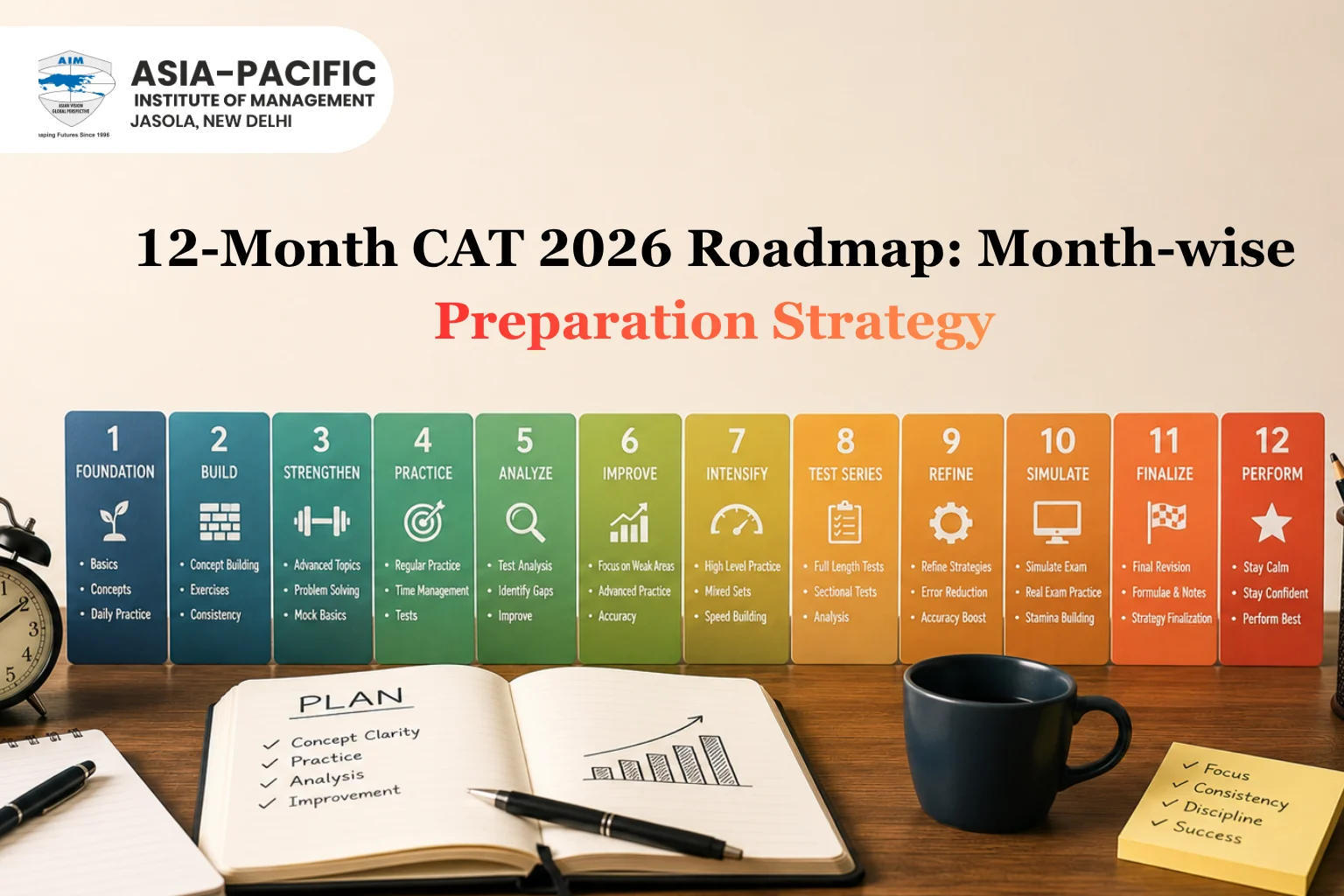
CAT 2026 Study Plan: 12-Month Roadmap Overview
Phase
Months
Main Focus
Phase 1
Month 1–3
Foundation building
Phase 2
Month 4–6
Syllabus completion
Phase 3
Month 7–8
Sectional strengthening
Phase 4
Month 9–10
Mock-test phase
Phase 5
Month 11
Revision and strategy
Phase 6
Month 12
Final polishing
This 1 year CAT roadmap works best when students stay consistent.
Month 1: Understand the Exam and Take a Diagnostic Test
The first month should not be about heavy preparation. It should be about understanding your starting point.
Monthly Target for CAT
Task
Action
Understand exam structure
Learn VARC, DILR, and QA areas
Take diagnostic test
Attempt one untimed or lightly timed test
Identify weak areas
Mark topics that feel difficult
Build study routine
Fix daily and weekly study hours
Start reading
Read editorials, business articles, and essays
Weekly Plan
VARC: 3 reading sessions
DILR: 3 beginner sets
QA: Number system basics
Review: One weekly error log
Do not worry about scores in Month 1. Focus on awareness.
Month 2: Build Quant and Reading Foundation
In Month 2, start basic Quant and reading habits.
Focus Areas
Section
Topics
VARC
Reading comprehension, para jumbles, para summary
DILR
Tables, arrangements, simple puzzles
QA
Arithmetic basics, percentages, ratios, averages
Monthly Target for CAT
By the end of Month 2, you should complete basic arithmetic concepts.
Arithmetic is important because it supports many QA topics. Additionally, it improves business calculation ability.
Daily Study Structure
Time
Activity
45 minutes
Quant concepts
30 minutes
VARC reading
30 minutes
DILR practice
15 minutes
Error review
Students with college or work commitments can reduce weekday hours and compensate on weekends.
Month 3: Strengthen Arithmetic and Verbal Ability
Month 3 should focus on accuracy.
Focus Areas
Section
Topics
VARC
Para jumbles, odd one out, para summary
DILR
Seating arrangements, distribution sets
QA
Profit-loss, time-work, time-speed-distance
Practice Target
Activity
Target
RC passages
12–15 per month
VA questions
80–100 questions
DILR sets
25–30 sets
QA questions
250–300 questions
This is also a good time to create a formula notebook.
Month 4: Start Algebra and Intermediate DILR
Month 4 marks the shift from basic to intermediate preparation.
Focus Areas
Section
Topics
VARC
RC inference questions
DILR
Games and tournaments, routes, networks
QA
Linear equations, quadratic equations, inequalities
Monthly Target for CAT
Your target should be concept completion, not speed.
Avoid solving only easy questions. Add moderate-level questions slowly.
Study Tip
After every DILR set, write:
What was the data structure?
What was the hidden clue?
Where did you waste time?
Could the set be skipped in the exam?
This builds selection judgment.
Month 5: Geometry, Modern Math, and RC Depth
Month 5 should introduce Geometry and deeper reading.
Focus Areas
Section
Topics
VARC
Tone, central idea, assumption-based RC
DILR
Caselets, charts, mixed data sets
QA
Geometry, mensuration, coordinate geometry basics
Monthly Target for CAT
Area
Target
Geometry basics
Complete formulas and diagrams
RC practice
4 passages per week
DILR
8–10 sets per week
QA
60–70 questions per week
Geometry needs visual clarity. Therefore, draw diagrams while solving.
Master CAT 2026 Plan
Ready to succeed in your exam? Leverage our proven roadmap for preparation. Achieve your career goals and join our premium PGDM batch for global leadership.
This month can significantly improve your percentile potential.
Month 9: Start Full-Length Mocks
Month 9 is the beginning of the full mock phase.
The official CAT 2025 bulletin stated that registration opened in August and the test was scheduled in late November. For CAT 2026, aspirants should verify the final notification on the official CAT portal when released.
Mock Target
Week
Mock Plan
Week 1
1 full mock
Week 2
1 full mock + 2 sectionals
Week 3
1 full mock + analysis
Week 4
2 full mocks if stamina allows
Mock Analysis Questions
After each mock, ask:
Which questions should I have skipped?
Which easy questions did I miss?
Which topic caused maximum loss?
Was my accuracy better than last week?
Did I panic in any section?
Mock analysis is more important than mock count.
Month 10: Improve Test Strategy
Month 10 is for strategy refinement.
By now, you should know your strengths and weak areas.
Strategy Goals
Section
Strategy Focus
VARC
Passage order and VA selection
DILR
Set scanning and skip decisions
QA
Easy question identification
Overall
Time discipline and accuracy
Mock Frequency
Attempt 1–2 full mocks per week. However, do not take mocks on consecutive days unless analysis is complete.
Important Rule
Never take a mock only to check your score. Take it to improve your strategy.
Month 11: Revision and Weak Area Repair
Month 11 should focus on revision.
Do not start too many new topics now. Instead, strengthen what you already know.
Revision Plan
Area
Action
QA
Revise formulas and solved examples
VARC
Continue reading and VA practice
DILR
Reattempt old unsolved sets
Mock analysis
Review last 10 mocks
Error notebook
Revise repeated mistakes
Syllabus Completion Deadline Review
Check if any topic remains untouched. If a topic is too large and weak, decide whether to cover basics or skip advanced questions.
This is smart preparation.
Month 12: Final CAT 2026 Preparation Month
The final month is not for panic. It is for controlled execution.
Final Month Plan
Week
Focus
Week 1
Revise major topics and take mocks
Week 2
Analyze weak question types
Week 3
Reduce mock frequency and revise
Week 4
Light practice, sleep, and confidence
Final Week Rules
Do not start new topics.
Do not compare scores daily.
Do not over-attempt mocks.
Sleep properly.
Revise formulas.
Review your strategy notes.
Stay calm during slot variation.
The final week should build confidence, not anxiety.
Weekly Balanced Study Schedule for CAT 2026
Here is a practical weekly schedule for students and working aspirants.
Day
Study Focus
Time
Monday
QA concept + 20 questions
1.5 hours
Tuesday
RC + VA practice
1.5 hours
Wednesday
DILR sets
1.5 hours
Thursday
QA practice + revision
1.5 hours
Friday
Mixed VARC and DILR
1.5 hours
Saturday
Sectional test + analysis
2–3 hours
Sunday
Mock or revision block
3–4 hours
This plan can be adjusted based on college, work, or coaching schedule.
CAT 2026 Daily Study Plan for Early Starters
A daily plan should be realistic.
2-Hour Daily Plan
Time
Task
45 minutes
Quant topic
30 minutes
VARC reading or practice
30 minutes
DILR set
15 minutes
Error log revision
3-Hour Daily Plan
Time
Task
60 minutes
Quant concept and practice
45 minutes
VARC
45 minutes
DILR
30 minutes
Analysis and revision
Consistency matters more than long study hours.
Section-Wise Monthly Target for CAT
VARC Monthly Target
Month Range
Target
Month 1–3
Build reading habit and VA basics
Month 4–6
Practice RC inference and para questions
Month 7–8
Timed sectional tests
Month 9–10
Mock-based strategy
Month 11–12
Accuracy and passage selection
DILR Monthly Target
Month Range
Target
Month 1–3
Learn basic set types
Month 4–6
Practice intermediate sets
Month 7–8
Timed set selection
Month 9–10
Full mock application
Month 11–12
Reattempt tough sets
QA Monthly Target
Month Range
Target
Month 1–2
Arithmetic basics
Month 3–4
Advanced arithmetic and algebra
Month 5
Geometry and modern math
Month 6
First syllabus completion
Month 7–10
Sectional and mock practice
Month 11–12
Revision and accuracy
How to Use Mocks in a 1 Year CAT Roadmap
Mocks should come in stages.
Stage
Mock Type
Purpose
Month 1
Diagnostic mock
Know your starting point
Month 4–6
Sectional tests
Check topic strength
Month 7–8
Mixed sectionals
Build speed and accuracy
Month 9–10
Full mocks
Test strategy
Month 11–12
Final mocks
Improve execution
Aspirants often take many mocks but do not analyze them. This reduces improvement.
Avoid these mistakes during your CAT 2026 study plan:
Starting mocks without syllabus basics
Studying only Quant and ignoring VARC
Solving DILR without analysis
Not maintaining an error notebook
Changing strategy every week
Comparing mock scores with friends
Ignoring sleep and health
Waiting too long to revise
Not preparing documents after notification
Treating CAT score as the only admission factor
The official CAT bulletin says each participating institution may use its own selection process and may consider academic record, work experience, and other inputs.
How to Prepare Alongside College or Job
Many aspirants prepare with college classes or work responsibilities. Therefore, the plan should be flexible.
For College Students
Use mornings for Quant.
Use breaks for reading.
Practice DILR on alternate days.
Take mocks on weekends.
Use semester breaks for backlog clearing.
For Working Professionals
Study 90 minutes on weekdays.
Keep longer sessions for weekends.
Avoid late-night burnout.
Use commute time for reading.
Take leave during the final revision phase, if possible.
A realistic plan is better than an ambitious plan that fails.
CAT 2026 Preparation and PGDM Admission Readiness
A good CAT score helps, but admission readiness goes beyond the exam.
Students should also prepare:
Resume basics
Academic documents
Career goal clarity
GD preparation
Personal interview answers
Work experience examples
Business awareness
Communication skills
Asia Pacific Institute of Management accepts valid scores from CAT, XAT, CMAT, MAT, GMAT, and ATMA. Its admission process evaluates academic background, aptitude test scores, communication skills, and managerial potential.
Therefore, aspirants should prepare for both the entrance exam and the selection process.
Why Consider Asia Pacific Institute of Management After CAT?
Students preparing for CAT 2026 can also explore PGDM pathways at Asia Pacific Institute of Management.
The institute offers PGDM programs in General, Marketing, Big Data Analytics, and Banking & Financial Services. Its PGDM page highlights dual specialization, marketing strategy, digital branding, consumer insights, data science, AI, predictive analytics, fintech, investment banking, and wealth management.
For students who want practical management education, industry exposure, experienced faculty, and placement support, this can be a relevant option after entrance exam preparation.
Conclusion
A CAT 2026 study plan works best when it is simple, consistent, and measurable. The first six months should focus on concepts. The next two months should improve sectional accuracy. The final four months should focus on mocks, revision, and strategy.
Do not prepare randomly. Set a monthly target for CAT, maintain an error notebook, revise regularly, and follow a balanced study schedule.
Early preparation gives you time to improve. More importantly, it gives you confidence
Crush CAT Prep Today
Follow a strategic schedule to ace your exam. Gain the competitive edge needed for high-stakes business roles. Join our elite PGDM program to lead the future.
Dr. Vikas Gupta is a distinguished academic in the education and research domain, specializing in finance and related interdisciplinary studies. He is known for his...
01.
What is the best CAT 2026 study plan for beginners?
The best CAT 2026 study plan starts with a diagnostic test, then covers concepts in the first six months, sectionals in months seven and eight, mocks in months nine and ten, and revision in the final two months.
02.
Is 12 months enough for CAT preparation?
Yes. A 12-month plan is enough if you study consistently, complete the syllabus on time, analyze mocks, and revise weak areas regularly.
03.
What should be the syllabus completion deadline for CAT 2026?
Students should aim to complete the first round of the syllabus by Month 6. This leaves enough time for sectionals, mocks, and revision.
04.
How many hours should I study daily for CAT 2026?
Early starters can begin with 2 hours daily. Later, they can increase study time during mocks and revision phases.
05.
When should I start taking mocks for CAT 2026?
Take one diagnostic mock in Month 1. Start full-length mocks seriously from Month 9, after completing basic syllabus and sectional practice.
06.
What is a balanced study schedule for CAT?
A balanced schedule gives time to VARC, DILR, QA, revision, and mock analysis. Students should not focus only on one strong section.
07.
How should I track monthly target for CAT?
Track topic completion, practice questions, sectional scores, mock accuracy, and repeated mistakes through a simple monthly tracker.
08.
Can I prepare for CAT 2026 without coaching?
Yes. Students can prepare without coaching if they follow a structured plan, use quality material, take mocks, analyze mistakes, and stay disciplined.

















.webp) Call Us
Call Us