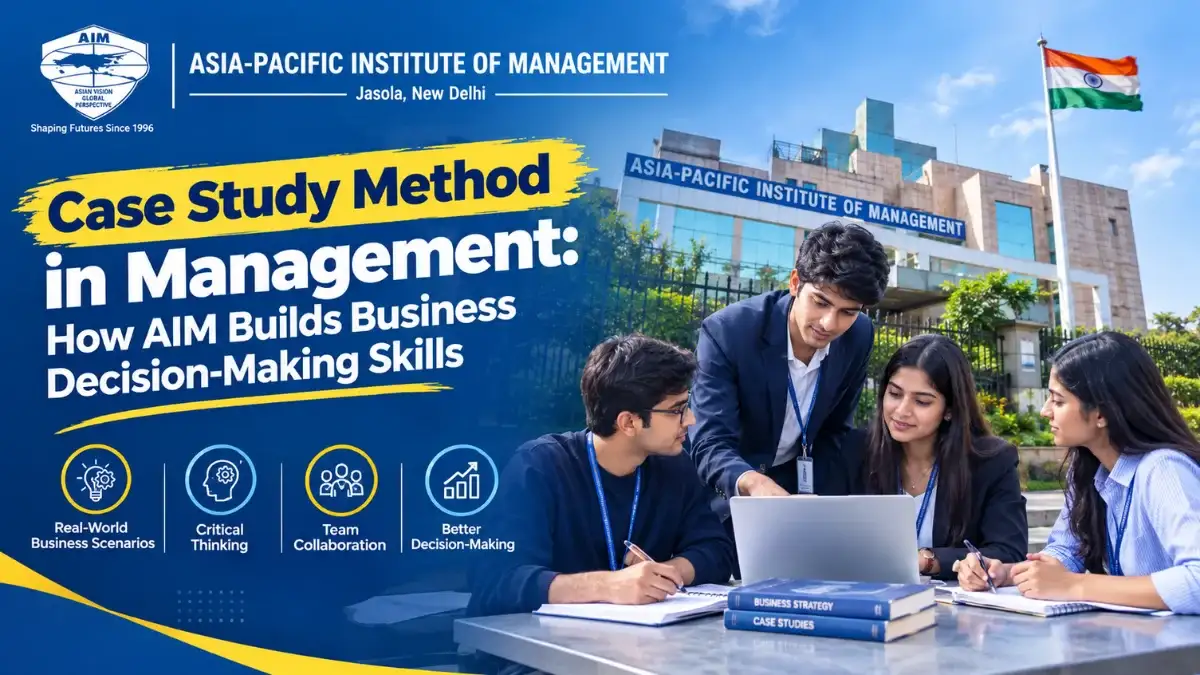
Case Study Method in Management: How AIM Builds Business Decision-Making Skills
Posted on 08 Oct 2026
By Dr. Vikas Gupta
Introduction
Every management aspirant eventually asks a practical question: how does a classroom teach you to decide when real business problems arrive without an answer key? The case study method in management is one of the most common answers. It also features in how the PGDM – General programme at Asia-Pacific Institute of Management (AIM), New Delhi, describes its learning approach.
This deep dive explains what the method is, why it strengthens business decision making, and how a case discussion unfolds. It also covers what AIM publishes about case studies alongside simulations, live projects and internships. You will leave with a short list of questions to test any business school's claims about case-based learning.
Executive MBA in Healthcare
Explore the curriculum, eligibility, career opportunities, and key details of the Executive MBA in Healthcare.
The case study method in management is a teaching approach in which students analyse a detailed account of a real or realistic business situation, weigh the available options and defend a recommendation. Instead of only studying a framework, they use it to decide what a company should do next.
The method is closely associated with Harvard Business School in the early twentieth century, and many management institutes now use some form of it. Case studies in MBA and PGDM classrooms follow a similar logic. A case is a written account with a decision-maker, a problem, background information and data that may be incomplete or even conflicting.
Case-based learning in a PGDM means building courses around such cases, so students meet concepts like segmentation, cost structures or organisational behaviour inside a situation rather than a textbook definition.
What a Typical Case Contains
A decision-maker facing a specific choice, such as whether to enter a new market
Background on the company, its industry and its competitors
Data such as financial figures, customer information or operating constraints
Competing interests, where managers, customers, employees or investors want different things
A case rarely announces which facts matter, so part of the exercise is deciding what to set aside.
How Does the Case Study Method Build Business Decision-Making Skills?
It builds decision-making by asking students to commit to a recommendation using incomplete information, then defend it against classmates who reached a different conclusion. Repeating that cycle across subjects trains habits managers rely on: framing a problem, separating facts from assumptions, comparing options and accepting trade-offs.
Skills Students Practise
Problem framing: identifying the real issue behind the symptoms a case describes
Analytical reasoning: using financial, market or operational data to support a view
Judgement under uncertainty: choosing a course of action without complete information
Communication: presenting a position clearly and responding to challenge
Collaboration: reaching a shared recommendation with people who see the problem differently
Why It Differs From a Lecture
In a lecture, the instructor explains and the student absorbs. In a case discussion, the student has to produce the argument. A classmate may defend an entirely different option with equally sound evidence, and that disagreement is where much of the learning sits.
The method does not replace concepts. A student who has not understood how a balance sheet works cannot judge a company's financing choice, so the strongest management case studies rest on solid grounding in theory. These are general features of the method, and what each student gains depends on preparation and participation.
How Does a Case Discussion Work in a Management Classroom?
A case discussion usually moves through individual preparation, small-group discussion, a faculty-guided class debate and a closing reflection on the concepts involved. Formats vary by course and instructor, so the steps below describe the general pattern, not a specific AIM class.
Read and prepare individually. Students read the case, mark key facts and form a first view before speaking to anyone.
Define the decision. The group agrees on the question being asked and what a good outcome looks like.
Analyse the evidence. Numbers, customer insights and constraints are examined, and assumptions are written down.
Compare options. Two or three alternatives are tested against cost, risk, timing and fit with the company's goals.
Recommend and defend. The group commits to one option and answers challenges from peers and faculty.
Reflect. The class discusses what the case showed about the underlying concept and what could have been done differently.
Consider a hypothetical packaged-food company deciding whether to sell through its own website or through existing marketplaces. A student drawn to marketing may focus on brand control and customer data. A classmate who prefers finance may stress logistics costs and working capital. Neither view is automatically right. Defending a position while acknowledging its weakness is the discipline the method aims to build, and it is how practical management learning moves from knowing a concept to using it in real business decision making.
What Does AIM Publish About Case Studies and Practical Learning?
AIM's PGDM – General page states that every trimester blends theory with practice through live projects, case studies, simulations and corporate internships. The programme runs for two years across six trimesters and is AICTE-approved. Programme details can change by academic session, so applicants should verify the latest information on the official programme page.
The Concepts Cases Test
Cases need concepts to work with. The published PGDM – General curriculum lists Organizational Behavior, Financial Reporting, Statement and Analysis, and Marketing Management-I in Trimester I. Trimester II includes Research Methodology for Decision Making and Production & Operations Management. Trimester III adds Corporate Finance, Strategic Management, Innovation & Entrepreneurship and Optimisation Models for Management Decisions.
This list shows the subject areas where students build the knowledge that cases then test. It does not state which cases are used in which subject. Individual case titles and how often they appear are not published on the programme page, so applicants who want that level of detail should ask the admission team.
Dual Specialisation and Case Work
PGDM – General offers dual specialisation across areas such as marketing, finance, HR, operations and business analytics. Students can therefore direct their practical work towards the two domains they choose. A student combining marketing with analytics, for instance, can look at a customer decision from both a brand angle and a data angle. AIM describes its structure as pairing academic study with real-world exposure through projects, internships and case-driven learning.
How Do Case Studies Work With Simulations, Live Projects and Research?
Case studies train analysis on a problem someone else has already documented, while simulations, live projects and research ask students to act on a problem themselves. Used together, they let students practise the same decision skills at increasing levels of realism and responsibility.
Format
What students do
Decision skill practised
Case study
Analyse a documented business situation and recommend action
Framing problems and weighing options
Simulation
Make decisions over repeated rounds and see the results
Learning from consequences and adjusting
Live project
Work on a real organisation's question
Handling imperfect data and different stakeholder views
Internship
Take part in work inside a company
Applying judgement within real constraints
Research project
Frame a question, collect data and present findings
Building and defending an evidence-based argument
These are general descriptions of each format, not details of particular assignments at AIM.
AIM's published structure also includes a six-month research project in the second year, running alongside Trimesters V and VI. Students choose a topic in their area of specialisation, submit a synopsis for faculty approval and carry out the work under supervision with periodic reviews. They then present a detailed report to a panel that includes faculty and external members from industry or academia. Because the student owns the question from start to finish, this project extends the habits that case discussions begin.
How Can Management Aspirants Judge and Use Case-Based Learning?
Judge case-based learning by asking for specifics: how often cases are used, who facilitates them, how participation is assessed and how they connect to projects and internships. A brochure that mentions cases says little. Concrete answers show whether the method is part of the programme or an occasional add-on.
Useful questions for any institute on your shortlist:
Are case discussions part of regular coursework, and in which subjects?
Do the cases involve Indian and global companies, and how current are they?
How is classroom participation assessed?
How do cases connect with simulations, projects and internships?
Can you visit the campus or speak with current students?
On that last point, AIM publishes a guided campus tour on weekdays, which is a practical moment to put these questions to the team. Its PGDM – General page lists a bachelor's degree with at least 50% marks as the eligibility requirement, and final-year students may apply. Shortlisting uses CAT, MAT, XAT, CMAT, ATMA or GMAT scores, followed by a group discussion and personal interview. AIM describes that last stage as assessing communication and analytical thinking, the same qualities a case discussion draws on.
Preparing Before You Join
Read business news with a decision lens: what did the company choose, and what else could it have done?
Practise stating a recommendation and its main reason in three sentences.
Get comfortable reading basic financial figures, since many cases rely on them.
Treat disagreement as useful, and test your view against a different one.
Case-based learning can build skills and evidence of capability, but it cannot guarantee a job, salary or role. Outcomes depend on effort, specialisation, prior experience and market conditions.
The case study method in management works because business problems rarely look like textbook exercises. Its value lies in committing to a decision, defending it and learning from the challenge, ideally with concepts, faculty guidance and peers to test the thinking against.
AIM's published PGDM – General structure places case studies alongside live projects, simulations, internships and a supervised research project. For an aspirant, the sensible next step is to test any practical-learning claim against specifics. Read the programme page, ask the admission team what is currently offered, and choose the environment where you expect to do the work, not only attend it.
Executive MBA in Healthcare
Explore the curriculum, eligibility, career opportunities, and key details of the Executive MBA in Healthcare.
Dr. Vikas Gupta is a distinguished academic in the education and research domain, specializing in finance and related interdisciplinary studies. He is known for his...
These answers cover how the case study method in management works, what AIM describes on its official pages and how to judge case-based learning before you apply.
01.
What is the case study method in management?
It is a teaching approach in which students analyse a real or realistic business situation, compare options and recommend a course of action. The focus is on applying concepts to a decision rather than memorising them.
02.
How do case studies improve business decision making?
They require students to decide with incomplete information and defend their choice against other views. This practises problem framing, evidence-based reasoning and acceptance of trade-offs, which are skills managers use regularly.
03.
Does AIM use case studies in its PGDM?
AIM’s PGDM – General page states that every trimester blends theory with practice through live projects, case studies, simulations and corporate internships. It does not list individual cases, so ask the admission team for current specifics.
04.
How is case-based learning in a PGDM different from a lecture?
A lecture mainly delivers explanation, while a case discussion asks students to build and defend an argument. Concepts still matter, because a case can only be analysed well by someone who understands the theory behind it.
05.
Do I need prior business experience to take part in case discussions?
Not necessarily. Graduates from different academic backgrounds can apply, and AIM’s curriculum begins with management foundations in the first trimester. Good preparation, willingness to participate and openness to other views matter more than prior experience.
06.
What is the eligibility for PGDM – General at AIM?
AIM’s programme page lists a bachelor’s degree with at least 50% marks, and final-year students may apply. Admission is based on CAT, MAT, XAT, CMAT, ATMA or GMAT scores, followed by a group discussion and personal interview. Confirm current requirements with the admission team.
07.
Are case studies enough to prepare for a management career?
No. Cases work best alongside strong fundamentals, simulations, projects, internships and research. Practical management learning builds skills and evidence of capability, but it does not guarantee a particular job or salary.
08.
How can I check whether a business school's case-based learning is genuine?
Ask in which subjects cases are used, who facilitates them, how participation is assessed and how they link to projects and internships. If possible, visit the campus, speak with current students and compare answers across your shortlist.














.webp) Call Us
Call Us