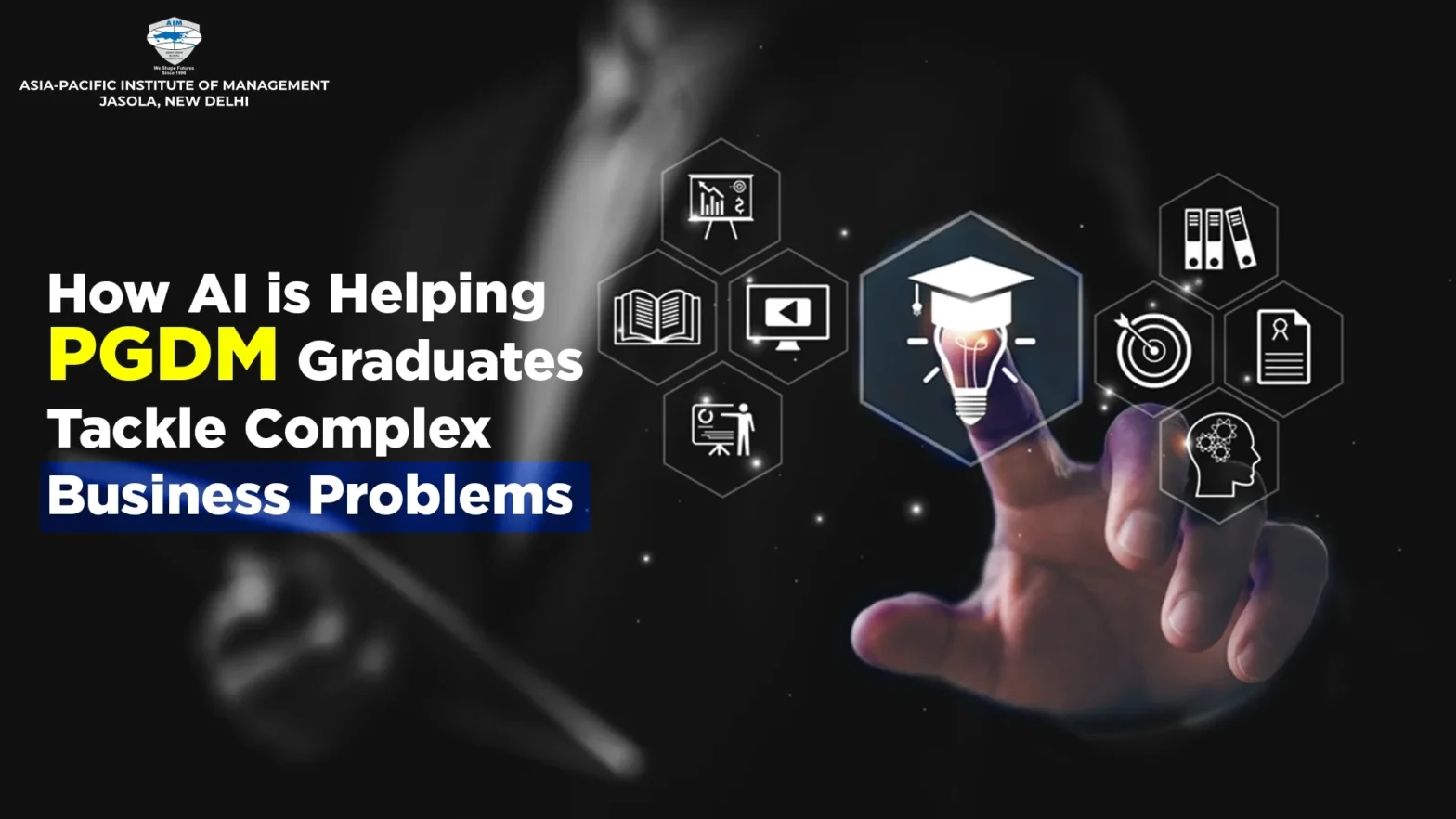
In today’s rapidly evolving business landscape, Post Graduate Diploma in Management (PGDM) graduates are expected to solve increasingly complex business problems. As global markets become more interconnected, the volume of data expands, and the pace of technological change accelerates, the ability to make sound, data-driven decisions has never been more critical. This is where artificial intelligence (AI) comes in.
AI is transforming the way businesses operate, and PGDM graduates are harnessing its capabilities to address the challenges of the modern business world. By equipping themselves with AI tools and methodologies, PGDM graduates can navigate complexity with confidence, delivering innovative solutions to real-world problems. Let’s delve into how AI is empowering PGDM graduates to tackle complex business challenges and become key drivers of organizational success.
The Rising Complexity of Business Problems
The business environment today is marked by rapid technological advances, shifting consumer expectations, increasing competition, and unpredictable global events. These factors create a volatile, uncertain, complex, and ambiguous (VUCA) world, where traditional business solutions no longer suffice. As businesses face an overwhelming amount of data and complex decision-making scenarios, the ability to analyse and interpret information in real time is crucial.
PGDM graduates, who are typically trained in both management principles and business operations, are now confronted with the need to address challenges such as:
- Market unpredictability: How to forecast customer behaviour and economic shifts.
- Operational inefficiencies: How to optimize resources and reduce waste.
- Customer demands: How to provide personalized experiences at scale.
- Strategic decisions: How to make informed, long-term business choices with incomplete or changing information.
AI offers powerful tools to help tackle these challenges, turning complex data into actionable insights and enabling PGDM graduates to make smarter, more informed decisions.
AI Enhances Data-Driven Decision Making
One of the most significant ways AI is assisting PGDM graduates in addressing business problems is by enabling data-driven decision-making. The ability to process and analyse large datasets quickly and efficiently allows graduates to make more informed and precise business decisions.
Traditional decision-making often relies on intuition, past experience, and limited data. However, in today’s data-rich environment, this approach can lead to poor outcomes. AI, through machine learning algorithms, can sift through vast amounts of data, identifying patterns and trends that humans may overlook. For instance, predictive analytics can forecast market trends, customer preferences, and potential risks, allowing PGDM graduates to make proactive decisions rather than reactive ones.
For example, in retail, AI can analyse consumer purchasing patterns to predict future buying behaviour, allowing businesses to optimize inventory management and personalize marketing strategies. By integrating AI into decision-making processes, PGDM graduates can ensure that their business strategies are backed by accurate data, reducing uncertainty and increasing the likelihood of success.
Streamlining Operations and Improving Efficiency
In a fast-paced business world, efficiency is key. Operational inefficiencies can lead to wasted resources, higher costs, and lost opportunities. PGDM College graduates, with their strong management backgrounds, are in prime positions to implement AI technologies that streamline business operations, reduce redundancies, and enhance productivity.
AI-powered automation is one of the most prominent solutions in this area. Repetitive tasks such as data entry, scheduling, and customer service inquiries can now be automated using AI-driven systems like chatbots and robotic process automation (RPA). This frees up human resources to focus on higher-value tasks, such as strategy development and creative problem-solving.
For instance, AI can be employed in supply chain management to track inventory levels, predict demand, and optimize delivery routes. By automating these processes, PGDM graduates can significantly reduce operational costs and improve the efficiency of business functions. AI also aids in identifying bottlenecks and inefficiencies within an organization, allowing for swift corrective actions and continuous improvement.
Personalizing Customer Experiences at Scale
In the digital age, customer experience is a critical differentiator for businesses. Consumers today expect personalized, relevant interactions with brands, and failing to meet these expectations can lead to customer dissatisfaction and attrition. AI has become a game-changer in helping PGDM graduates design personalized customer experiences at scale.
Machine learning algorithms and natural language processing (NLP) enable businesses to analyse customer interactions across various touchpoints, such as websites, social media, and customer support channels. AI can then process this data to segment customers, understand their preferences, and recommend products or services that are tailored to their individual needs. This level of personalization, once reserved for smaller, niche businesses, is now achievable on a much larger scale.
For example, in e-commerce, AI-driven recommendation systems suggest products to customers based on their browsing history and past purchases, significantly improving conversion rates and customer satisfaction. PGDM graduates can leverage these AI tools to enhance customer loyalty, optimize marketing efforts, and ultimately drive business growth.
AI in Financial Decision-Making
For PGDM graduates focusing on finance or those working in organizations where financial management is critical, AI provides invaluable tools to make smarter financial decisions. The finance sector is one of the most advanced users of AI technologies, from algorithmic trading to risk management and fraud detection.
AI can help in real-time analysis of financial data, enabling businesses to make quicker decisions based on current market conditions. Additionally, AI-driven financial models can predict market trends, assess the risk of investment portfolios, and identify opportunities for capital allocation. By using these insights, PGDM graduates can enhance the financial performance of their organizations, avoid costly mistakes, and make more informed strategic decisions.
In risk management, AI tools can analyse large volumes of transactional data to detect fraudulent activity or anomalies. By identifying potential threats early, businesses can take proactive measures to mitigate financial risks and safeguard their assets.
Driving Innovation and Strategic Growth
AI is not just about solving existing problems; it’s also about enabling innovation and creating new opportunities. PGDM graduates, equipped with AI knowledge, can explore new business models, products, and services that were previously unattainable.
AI’s capabilities in areas like natural language processing and computer vision have opened the doors for new business applications, from virtual assistants and autonomous vehicles to augmented reality experiences. By understanding AI, PGDM graduates can drive innovation within their organizations, leading to the development of ground-breaking products that disrupt markets and set new industry standards.
Additionally, AI can assist in strategic planning by providing insights into market trends, competitor activity, and potential growth areas. With these insights, PGDM graduates can make well-informed decisions about where to allocate resources and how to position their businesses for long-term success.
Overcoming Challenges and Embracing AI
While the integration of AI into business operations offers numerous benefits, it also comes with its set of challenges. For PGDM graduates, one of the primary hurdles is ensuring that AI tools are implemented effectively and ethically. Understanding the nuances of AI technology, its potential limitations, and the importance of data privacy and security are critical components of using AI responsibly.
Moreover, while AI can automate many processes, human judgment and creativity are still essential. PGDM graduates must strike a balance between leveraging AI and maintaining human oversight in decision-making processes.
Conclusion
AI is not just a tool—it is a transformative force that is reshaping the business landscape. By equipping themselves with AI knowledge and skills, PGDM graduates are better positioned to solve complex business problems, optimize operations, enhance customer experiences, and drive innovation. As the business world continues to evolve, embracing AI will be crucial for
PGDM College in India graduates who want to stay ahead of the curve and lead their organizations toward long-term success.
Incorporating AI into the decision-making and problem-solving processes is no longer a luxury; it’s a necessity for PGDM graduates aiming to thrive in the modern business environment. AI is the key to unlocking new possibilities, improving efficiency, and making data-driven decisions that lead to tangible business outcomes.













.webp) Call Us
Call Us