Management Labs in PGDM: What Students Learn Through Practical Activities
Posted on 26 Aug 2026
By Dr. Vikas Gupta
Introduction
A management lab in PGDM provides a practical learning environment where management concepts are explored through activities such as simulations, role-plays, case discussions, presentations, problem-solving exercises and team-based tasks. Instead of learning management only through lectures and textbooks, students get opportunities to practise how business decisions are discussed, evaluated and communicated.
For students considering aPGDM program, management labs can make abstract ideas easier to understand by placing them in realistic business situations. For parents, these activities help explain why contemporary management education places significant emphasis on experiential learning. This guide explains what management labs are, the activities students may encounter, the skills they can develop and how practical learning complements academic study in a post graduate diploma in management.
Key Takeaways
A management lab in PGDM connects classroom concepts with practical business situations.
Simulations, role-plays, case discussions, presentations and group exercises encourage active learning.
Practical activities can develop communication, teamwork, analytical thinking, leadership and decision-making.
Management labs can incorporate problems from marketing, finance, analytics, operations and other business functions.
The learning value depends on participation, reflection, feedback and the ability to connect activities with management concepts. Bonus: peer learning in PGDM
What Is a Management Lab in PGDM?
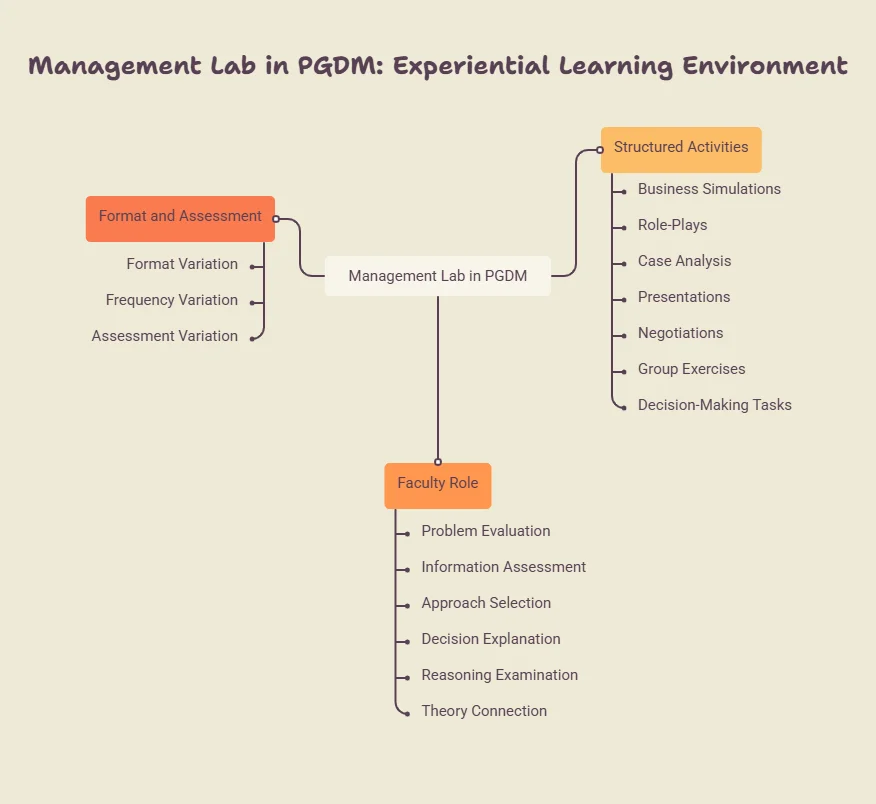
A management lab in PGDM is an experiential learning environment where students practise managerial concepts through structured activities rather than relying only on lectures. Depending on the institution and subject, activities may include business simulations, role-plays, case analysis, presentations, negotiations, group exercises and decision-making tasks designed to connect theory with application.
The word “lab” does not necessarily mean a conventional laboratory filled with technical equipment. In management education, it can describe a structured setting for experimentation, observation and reflection.
Students may encounter a business problem, evaluate available information, choose an approach and explain their decision. Faculty can then help them examine the reasoning behind the decision and connect the experience with relevant management theories.
The exact format, frequency and assessment of management lab activities vary between institutions and individual PGDM course curricula.
PGDM Lab Training
Gain hands-on management insights in our advanced corporate training labs. Join our top institute today!
Why Are Management Labs Important in a PGDM Program?
Management labs are important because managerial competence requires more than knowing definitions and frameworks. Students also need opportunities to analyse uncertain situations, communicate ideas, work with others and justify decisions. Practical exercises create controlled environments in which learners can apply concepts, receive feedback and reflect on how they approach business problems.
A classroom lecture can explain negotiation, leadership or consumer behaviour. A practical activity asks students to use that knowledge.
For example, a negotiation exercise may divide students into two groups with different commercial objectives. Participants must identify priorities, communicate their positions, respond to counterarguments and work toward an outcome. The activity turns negotiation from an academic concept into observable behaviour.
This learning approach is particularly relevant to a post graduate diploma in management PGDM, where students encounter multiple business functions. Practical exercises can show how marketing, finance, operations, analytics and people management interact rather than operating independently.
The objective is not to replace theoretical knowledge. Theory provides frameworks for understanding situations; practical activities provide opportunities to test and apply those frameworks.
What Practical Activities Can Students Experience in Management Labs?
Management lab activities can include business simulations, role-plays, case discussions, presentations, group problem-solving, negotiation exercises and data-based decision tasks. Each activity can focus on different managerial abilities, from communication and leadership to analysis and teamwork. The actual activities offered depend on the curriculum, subject, faculty approach and learning objectives of the institution.
Some common formats illustrate how experiential learning may work. Bonus:PGDM capstone project
Practical Activity
What Students May Practise
Management Application
Business simulation
Decision-making and prioritisation
Strategy and operations
Role-play
Communication and interpersonal behaviour
HR, sales and leadership
Case discussion
Analysis and reasoning
Cross-functional management
Group exercise
Coordination and teamwork
Project management
Presentation
Structured communication
Business reporting
Negotiation exercise
Persuasion and trade-offs
Sales and stakeholder management
Data exercise
Interpretation and evidence-based reasoning
Analytics and finance
Business Simulations
A simulation creates a simplified version of a business environment. Students may need to make choices about pricing, resources, customers, operations or competition and then examine the consequences.
The value lies in understanding relationships between decisions rather than merely finding a supposedly perfect answer.
Role-Plays
Role-playing places students in specific managerial or stakeholder positions. One student might act as a manager, another as an employee, customer or business partner.
Such exercises can help students practise communication, listening, negotiation and conflict handling.
Case Discussions
A business case usually provides information about a company, market or managerial challenge. Students identify the central problem, analyse alternatives and defend a recommendation.
Cases are useful because business problems often contain incomplete information and competing priorities.
How Do Management Labs Develop Decision-Making and Problem-Solving Skills?
Management labs develop decision-making skills by requiring students to interpret a situation, distinguish relevant information, compare alternatives and justify a course of action. Unlike questions based mainly on recall, practical exercises can introduce ambiguity and competing priorities, encouraging students to think about consequences, assumptions and trade-offs before reaching a managerial decision.
Consider a case where a company is losing customers. There may be several possible explanations: pricing, product quality, customer service, competition or changing consumer expectations.
Students must first define the problem correctly. They can then examine evidence, identify alternatives and decide which recommendation is most defensible.
The exercise also teaches an important managerial lesson: making a decision and explaining why that decision is reasonable are different capabilities.
Students in PGDM in data analytics may bring data interpretation into the process. Those interested in marketing may focus on customer behaviour, while finance-oriented students might consider costs and commercial feasibility.
Cross-functional discussion can therefore improve the quality of problem analysis.
How Do Management Labs Improve Communication and Teamwork?
Management labs can improve communication and teamwork because many activities require students to explain ideas, listen to different viewpoints, divide responsibilities, resolve disagreements and work toward shared outcomes. These behaviours closely resemble professional collaboration, where managers must frequently coordinate with colleagues from different functions rather than solve every problem independently.
Group activities reveal challenges that individual assignments may not.
A student may have a strong idea but struggle to communicate it clearly. Another may communicate confidently but need to improve listening. A team may also discover that dividing tasks without discussing the overall problem produces disconnected work.
Practical activities provide opportunities to recognise and improve these behaviours.
Presentations add another dimension. Students learn to organise information, communicate within time limits, respond to questions and support recommendations with reasoning.
Collaborative learning is also relevant across specialisations. A student pursuing a post graduate diploma in marketing can learn from classmates interested in finance or analytics, while students focused on banking financial services may benefit from perspectives on technology, customers and strategy.
How Can Management Labs Support Marketing, Analytics and Finance Learning?
Management labs can support different PGDM specialisations by adapting practical activities to functional business problems. Marketing exercises may focus on customers and campaigns, analytics tasks on interpreting evidence, and finance or banking activities on risk and financial decisions. This helps students understand both their chosen area and its relationship with wider business management.
In marketing-related activities, students may analyse customer segments, develop positioning ideas, interpret campaign information or present a go-to-market recommendation. Such exercises are relevant to learners exploring a PGDM in marketing management or broader marketing program.
Analytics-focused activities can involve datasets, dashboards, visualisations and business questions. Rather than treating big data analytics as purely technical, management exercises can ask students to explain what the evidence means for a business decision.
Finance and banking exercises may involve budgeting, financial analysis, risk scenarios or customer-related decisions. For students interested in PGDM in banking and finance, the practical challenge is often to combine quantitative reasoning with commercial and managerial judgment.
The broader lesson is cross-functional: business decisions rarely belong to only one department.
What Management Skills Can Students Build Through Practical Activities?
Practical management activities can help students develop analytical thinking, communication, teamwork, leadership, negotiation, presentation, time management and decision-making. Development is not automatic, however. Students gain more when they participate actively, evaluate feedback, reflect on their performance and consciously apply lessons from one activity to future academic or professional situations.
Important capabilities include:
Analytical thinking: separating symptoms from underlying business problems.
Communication: presenting complex ideas clearly and concisely.
Teamwork: coordinating with people who have different perspectives and working styles.
Leadership: guiding discussion and creating clarity without necessarily holding formal authority.
Negotiation: understanding interests, alternatives and trade-offs.
Presentation: organising evidence into a persuasive business argument.
Decision-making: choosing among alternatives and explaining the reasoning.
Adaptability: responding when new information changes the situation.
These skills complement subject knowledge within a PGDM course. Knowing a framework matters, but managers also need to decide when and how to use it. Bonus:emotional intelligence in management
How Can Students Get More Value From a Management Lab in PGDM?
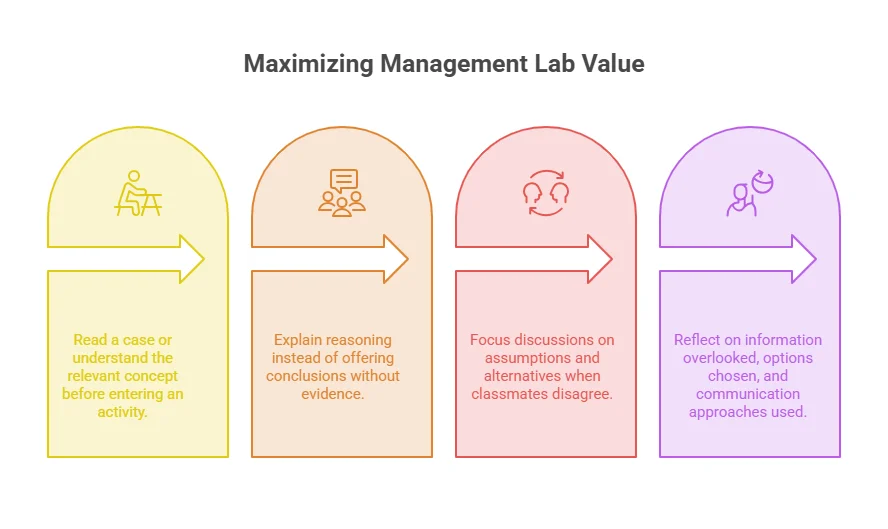
Students can gain more from a management lab by preparing before activities, participating actively, supporting opinions with reasoning, listening to peers and reviewing feedback afterward. The objective should not simply be to complete an exercise or win a simulation. The greater value comes from understanding how decisions were made and what could be improved.
Preparation is important. Reading a case or understanding the relevant concept before entering an activity allows students to contribute more meaningfully.
During the exercise, learners should explain their reasoning instead of offering conclusions without evidence. When classmates disagree, the discussion should focus on assumptions and alternatives rather than personalities.
Reflection after an activity is equally useful. Students can ask: What information did we overlook? Why did we choose that option? What did another team do differently? Which communication approach worked?
Students comparing PGDM courses in Delhi NCR, a PGDM course in Delhi, or a PGDM institute in Delhi can also review official curricula and learning methodologies to understand how practical components are incorporated. The specific structure should always be verified directly with the institution because management lab formats differ across programmes.
How Are Management Labs Different From Regular Classroom Learning?
Management labs emphasise participation and application, while conventional classroom sessions often focus more heavily on explaining concepts, theories and frameworks. Both approaches serve different purposes and work best together. Classroom learning builds conceptual understanding; practical activities allow students to apply, question and refine that understanding through realistic managerial situations.
A lecture might introduce the stages of decision-making. A management lab could present a scenario in which students actually have to make the decision.
Similarly, a classroom session can explain leadership styles, while a team activity allows students to observe how different leadership behaviours affect participation and coordination.
The distinction is therefore not theory versus practice. Effective management education connects the two.
For students and parents comparing PGDM colleges in Delhi NCR, practical learning is one aspect worth examining alongside curriculum, faculty, academic policies, specialisations and other programme characteristics. Applicants should use official institutional information to determine exactly which experiential components a particular programme provides.
Conclusion
A management lab in PGDM helps turn management education into an active learning experience. Through simulations, role-plays, case discussions, group exercises, presentations and other practical activities, students can explore how classroom concepts operate when a problem involves uncertainty, competing priorities and different viewpoints.
The strongest learning occurs when practical experience is combined with conceptual understanding, thoughtful feedback and reflection. Management labs can also demonstrate how marketing, finance, analytics, operations and people management connect within real business decisions. For students considering a PGDM program and parents evaluating management education, practical learning is therefore worth examining carefully. The useful question is not simply whether a programme offers activities, but how those activities help learners analyse problems, collaborate with others and apply management concepts effectively.
PGDM Skill Labs
Master practical business strategies through intensive simulation exercises. Secure your academic seat now!
Dr. Vikas Gupta is a distinguished academic in the education and research domain, specializing in finance and related interdisciplinary studies. He is known for his...
01.
Is a management lab compulsory in every PGDM course?
Not necessarily. The terminology, structure, academic credits and requirements for practical learning vary by institution and programme. Some institutes may use management labs, while others incorporate similar learning through simulations, workshops, case studies, live projects or experiential modules. Applicants should check the official curriculum of the specific PGDM course for accurate details.
02.
Are management labs useful for students without work experience?
Yes, they can be particularly useful for students who have limited professional exposure because structured activities introduce them to realistic managerial situations in an academic environment. They can practise discussing problems, making decisions, presenting recommendations and collaborating with classmates before encountering similar responsibilities in internships or employment.
03.
Do management labs involve only group activities?
No. Although teamwork is common, practical learning can also include individual presentations, analytical exercises, reflection tasks, decision scenarios and independent case analysis. The format depends on the learning objective. Some activities assess individual reasoning, while others deliberately require collaboration to develop communication, coordination and interpersonal skills.
04.
How are management labs useful for PGDM in marketing management?
Marketing-oriented management labs can help students apply concepts related to consumer behaviour, segmentation, positioning, sales, communication and marketing decisions. Activities might involve analysing a market situation, developing a campaign recommendation or presenting customer insights. Specific exercises depend on the curriculum of the PGDM in marketing management programme.
05.
Can management labs help students interested in data analytics?
Yes. Practical activities can require students to interpret datasets, dashboards or business information and translate findings into managerial recommendations. This is particularly relevant to PGDM in data analytics, where the value of analysis depends not only on technical methods but also on understanding business questions and communicating insights clearly.
06.
What should parents look for when evaluating practical learning in a PGDM?
Parents can examine the official curriculum to understand whether practical learning includes case work, simulations, projects, presentations, internships or other experiential components. They should also consider how activities connect with academic subjects and learning outcomes. Because structures vary among institutions, programme-specific details should be verified through official sources rather than assumed.


















.webp) Call Us
Call Us