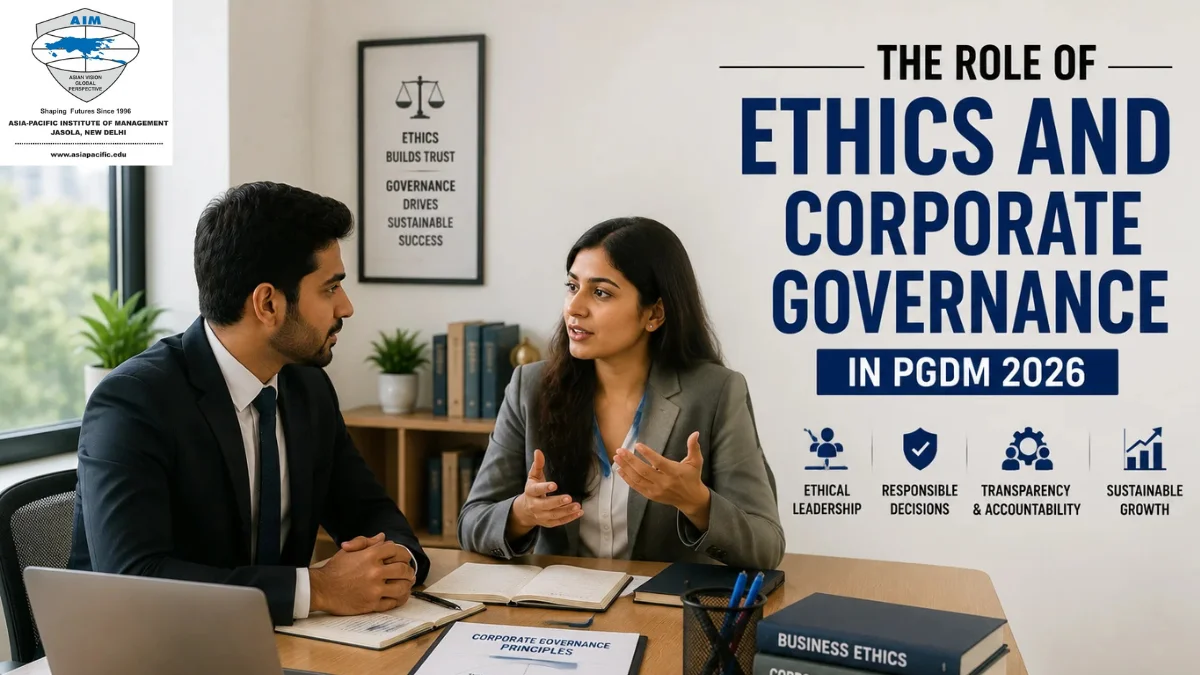
Business success is no longer measured solely by revenue, market share, or profitability. Today, organizations are equally evaluated on how they operate, make decisions, and create value for stakeholders.
From data privacy concerns and environmental responsibilities to financial transparency and workplace diversity, ethical decision-making has become a critical leadership competency. As a result, management education is evolving to prepare future leaders for these challenges.
This is why ethics in management has become an essential component of PGDM programs in 2026.
Modern management education goes beyond teaching strategy, finance, and marketing. It focuses on developing responsible leaders who can balance business objectives with social responsibility, regulatory compliance, and long-term sustainability.
Bonus: How to Build Profile for PGDM
Lead With Integrity
Explore industry-driven PGDM learning that builds ethical leadership, governance expertise, and future-ready management capabilities for responsible business success.
Apply Now
→
What Is Ethics in Management?
Ethics in management refers to the principles, values, and standards that guide decision-making and behavior within organizations.
It involves making choices that are not only legally compliant but also fair, transparent, responsible, and aligned with stakeholder interests.
Ethical management practices influence how organizations:
- Treat employees
- Engage with customers
- Interact with suppliers
- Manage financial resources
- Protect consumer data
- Address environmental concerns
Ethics helps organizations build trust, maintain credibility, and create sustainable value.
What Is Corporate Governance?
Corporate governance refers to the systems, processes, policies, and structures used to direct and control organizations.
It defines how responsibilities are distributed among stakeholders, including:
- Board members
- Executives
- Shareholders
- Employees
- Regulators
Effective corporate governance promotes:
- Accountability
- Transparency
- Risk management
- Regulatory compliance
- Ethical leadership
Strong governance frameworks help organizations maintain stakeholder confidence and reduce operational risks.
Why Ethics and Corporate Governance Matter More in 2026
Business environments are becoming increasingly complex.
Organizations operate in a world shaped by digital transformation, artificial intelligence, sustainability expectations, and evolving regulations.
Growing Stakeholder Expectations
Consumers, employees, and investors increasingly expect organizations to act responsibly.
Digital Privacy Concerns
Organizations must protect customer information and ensure responsible use of data.
Environmental and Social Responsibility
Businesses are expected to address sustainability challenges and social impact.
Regulatory Scrutiny
Compliance requirements continue to evolve across industries.
Reputation Management
Ethical failures can damage brand reputation and stakeholder trust.
These trends make ethical leadership more important than ever.
Why Ethics in Management Is Essential for Future Leaders
Management professionals regularly face difficult decisions involving competing priorities.
Ethical frameworks help leaders navigate these situations responsibly.
Better Decision-Making
Ethical leaders consider both short-term outcomes and long-term consequences.
Stronger Stakeholder Relationships
Trust supports sustainable business growth.
Improved Organizational Culture
Ethical leadership influences employee engagement and workplace behavior.
Reduced Business Risk
Responsible practices help minimize legal, financial, and reputational risks.
Sustainable Growth
Organizations that prioritize ethics often build stronger long-term value.
Bonus: Top PGDM Specializations for Future Careers
PGDM 2026
Shape Ethical Leaders
Gain practical insights into corporate governance frameworks and develop decision-making skills for impactful leadership in modern organizations today.
Apply Now
➜
How PGDM Programs Integrate Ethics and Corporate Governance
Modern PGDM programs increasingly embed ethical considerations throughout the curriculum.
Rather than treating ethics as a standalone subject, institutions integrate ethical thinking across multiple disciplines.
Case Study Analysis
Students evaluate real-world business dilemmas and governance challenges.
Classroom Discussions
Interactive discussions encourage critical thinking and perspective-taking.
Industry Interactions
Corporate leaders share practical insights into ethical decision-making.
Experiential Learning
Projects and simulations help students apply ethical frameworks.
Cross-Functional Learning
Students examine ethical considerations across different business functions.
This approach helps students understand how ethics influences everyday management decisions.
Ethics in Different PGDM Specializations
Ethical considerations vary across functional areas.
PGDM in Marketing
Students pursuing PGDM in Marketing, PGDM in Digital Marketing, or PGDM in Marketing Management explore topics such as:
- Responsible advertising
- Consumer privacy
- Data usage ethics
- Influencer transparency
PGDM in Data Analytics
Students pursuing PGDM in Data Analytics, Big Data Analytics Courses, or Big Data Analytics in Cloud Computing examine issues including:
- Data privacy
- Algorithmic bias
- Responsible AI use
- Information security
PGDM in Banking and Finance
Students pursuing PGDM in Banking and Finance, Post Graduate Diploma in Financial Management, or PGDM in Banking focus on:
- Financial transparency
- Regulatory compliance
- Risk governance
- Ethical investment practices
Understanding these issues prepares students for responsible leadership roles.
Key Ethical Challenges Future Managers Will Face
Future business leaders will encounter increasingly complex ethical questions.
Artificial Intelligence and Automation
How should organizations balance efficiency with fairness?
Data Protection
How can businesses use data responsibly?
Sustainability
How should organizations balance profitability with environmental responsibility?
Diversity and Inclusion
How can leaders create equitable workplaces?
Corporate Transparency
How can organizations maintain stakeholder trust?
Management education must prepare students to address these challenges thoughtfully.
How Ethics Influences Career Growth
Ethical leadership is increasingly valued by employers.
Organizations seek professionals who demonstrate:
- Integrity
- Accountability
- Transparency
- Responsible decision-making
Ethical behavior contributes to:
Strong Professional Reputation
Trust enhances career opportunities.
Leadership Readiness
Ethical judgment supports managerial effectiveness.
Long-Term Career Success
Responsible professionals often build sustainable careers.
Organizational Impact
Ethical leaders influence workplace culture positively.
Technical skills remain important, but values increasingly differentiate professionals.
Bonus: PGDM for Engineers: Why B.Tech + PGDM Works
The Role of Dual Specialization in Ethical Decision-Making
A Dual Specialization in PGDM can help students understand ethical issues from multiple perspectives.
Examples include:
- Marketing and Analytics
- Finance and Technology
- Operations and Sustainability
Cross-functional knowledge improves decision-making and supports responsible leadership.
Choosing a PGDM Program That Emphasizes Ethics
Students exploring PGDM in Delhi, PGDM Courses in Delhi NCR, PGDM Colleges in Delhi NCR, or a leading PGDM Institute in Delhi should evaluate more than placement outcomes.
Consider whether the program offers:
Ethics-Focused Curriculum
Look for dedicated ethics and governance modules.
Industry Engagement
Interactions with business leaders provide practical insights.
Experiential Learning Opportunities
Case studies and simulations improve ethical reasoning.
Faculty Expertise
Experienced faculty members enrich classroom discussions.
Sustainability Initiatives
Institutional values often reflect educational priorities.
These factors contribute to well-rounded management education.
Why Students Consider Asia Pacific Institute of Management for PGDM
Students increasingly seek institutions that balance academic excellence with responsible leadership development.
Industry-Oriented Curriculum
Programs align with contemporary business challenges.
Practical Learning
Case studies and experiential activities encourage application-based learning.
Corporate Exposure
Students gain opportunities to interact with industry professionals.
Experienced Faculty
Faculty members contribute academic expertise and industry perspectives.
Holistic Development
Management education emphasizes both professional competencies and ethical leadership.
Conclusion
In today's business environment, leadership requires more than technical expertise and strategic thinking. It demands integrity, accountability, and the ability to make responsible decisions in complex situations.
As organizations face growing expectations around sustainability, transparency, and stakeholder trust, ethics in management will continue to play a central role in business success.
Modern PGDM programs must prepare students not only to lead organizations but also to lead responsibly.
For aspiring managers, understanding ethics and corporate governance is no longer optional. It is a fundamental requirement for building meaningful careers and creating long-term value.
Drive Responsible Growth
Advance your management career with ethics-focused PGDM education designed to strengthen strategic and responsible leadership across industries globally.
Apply Now
→
About the Author
Dr. Vikas Gupta
Dr. Vikas Gupta is a distinguished academic in the education and research domain, specializing in finance and related interdisciplinary studies. He is known for his...
Read Full Bio →










.webp) Call Us
Call Us