Top 7 Pharma Supply Chain Challenges Facing Indian Companies in 2026
Posted on 24 Jun 2026
By Dr. Vikas Gupta
Introduction
Pharma supply chain challenges have become a major concern for Indian pharmaceutical companies in 2026. India plays a critical role in global healthcare by supplying affordable medicines, generics, vaccines, and formulations to many countries. However, this global role also brings complex operational risks.
The pharmaceutical sector must manage raw material sourcing, cold chain logistics, warehousing, regulatory compliance, quality control, export documentation, and last-mile drug distribution. Moreover, geopolitical tensions, changing global regulations, and rising logistics costs are making supply chain management more difficult.
For management students, this field offers strong career opportunities in operations, logistics, analytics, procurement, quality systems, and healthcare management.
Master Pharma Supply Chains
Build operations and logistics expertise to solve pharma supply chain challenges with industry-focused MBA learning and placement support.
Why Pharma Supply Chain Management Matters in 2026
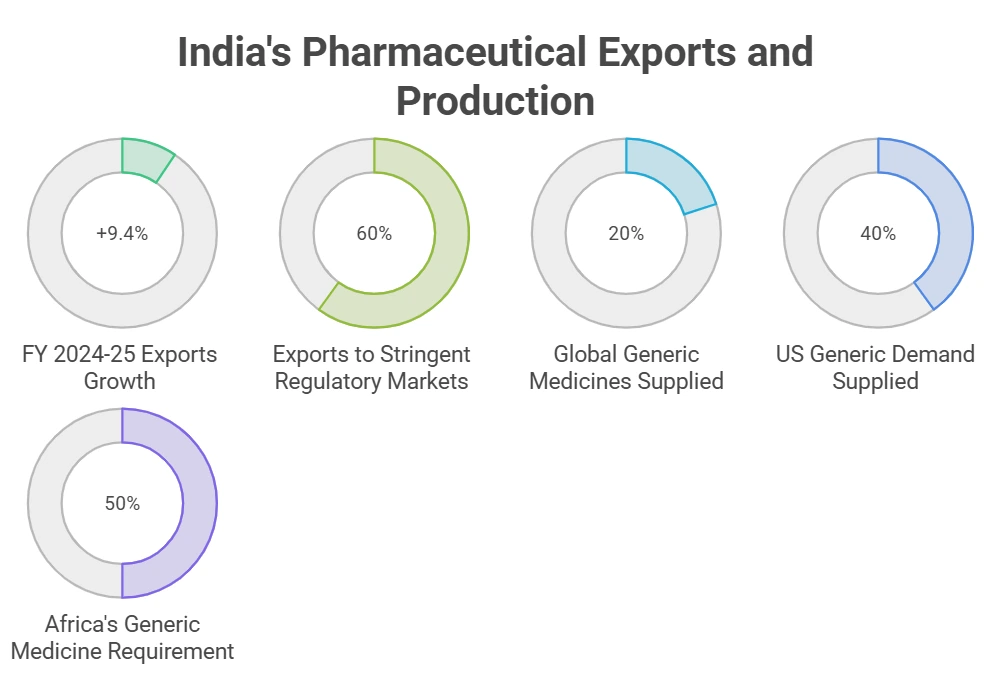
India’s pharmaceutical exports stood at USD 30.47 billion in FY 2024–25, growing 9.4% over the previous year. The sector is valued at around USD 60 billion and is projected to reach USD 130 billion by 2030. India also exports medicines to over 200 markets, and more than 60% of exports go to stringent regulatory markets.
This global reach makes supply chain reliability essential. Even a small delay in raw materials, documentation, cold storage, or export clearance can affect medicine availability.
Additionally, India is the world’s third-largest pharmaceutical producer by volume and supplies about 20% of global generic medicines. It also supplies nearly 40% of generic demand in the United States and over 50% of Africa’s generic medicine requirement.
Therefore, pharma supply chains are not only business systems. They are healthcare access systems.
Top 7 Pharma Supply Chain Challenges in 2026
1. API Import Dependency India
API import dependency india remains one of the biggest bottlenecks for Indian pharma companies. APIs, or active pharmaceutical ingredients, are the key raw materials used to manufacture medicines.
Many Indian companies still depend heavily on imported APIs and key starting materials. Reuters reported that the Indian pharma industry imports more than 60% of its raw materials and APIs from China.
This creates multiple risks:
Price volatility
Shipping delays
Currency fluctuation
Supplier concentration risk
Production disruption
Reduced negotiation power
The Government of India has been working to reduce this dependency. Under the PLI Scheme for Bulk Drugs, 38 projects had been commissioned by December 2025, creating domestic manufacturing capacity of about 56,800 MT per year for identified critical products.
However, self-reliance in APIs will take time. Until then, companies must build supplier diversification, safety stock, domestic vendor development, and better demand forecasting.
2. Geopolitical Disruption and Freight Volatility
Global geopolitical tensions are now a direct supply chain risk for Indian pharma. In March 2026, Pharmexcil asked member companies to report the impact of the West Asia situation on exports, production costs, logistics costs, key input availability, and supply chain continuity.
This matters because pharma exports depend on predictable shipping routes, port access, air cargo capacity, and stable freight costs.
Common risks include:
Delayed export shipments
Higher freight charges
Port congestion
Insurance cost increases
Route diversions
Input shortages
Delayed delivery commitments
For pharma companies, logistics delays can be more serious than in many other sectors. Some medicines are time-sensitive. Others need controlled temperature, strict documentation, or fixed delivery schedules.
Therefore, pharma companies need alternate shipping plans, multimodal logistics, export risk mapping, and closer coordination with logistics partners.
3. Cold Chain Logistics for Medicines
Cold chain logistics for medicines is becoming more important as India moves toward vaccines, biologics, biosimilars, insulin, specialty drugs, and temperature-sensitive therapies.
Cold chain logistics means maintaining required temperature conditions during storage, transport, handling, and delivery.
WHO guidance includes good storage and distribution practices for medical products and technical guidance for time- and temperature-sensitive pharmaceutical products. It also covers areas such as temperature-controlled transport, storage qualification, monitoring systems, and refrigerated vehicle qualification.
Cold chain failures can lead to:
Product quality loss
Medicine wastage
Regulatory non-compliance
Patient safety risks
Financial loss
Product recalls
In India, this challenge becomes more complex because of long distances, climate variation, power reliability issues, and last-mile distribution gaps.
Companies must invest in temperature sensors, validated packaging, refrigerated vehicles, route planning, real-time monitoring, and trained logistics teams.
4. Complex Drug Distribution Network
India’s drug distribution network is large and layered. It includes manufacturers, clearing and forwarding agents, stockists, distributors, hospitals, pharmacies, e-commerce channels, government procurement systems, and export partners.
This network creates reach. However, it also creates complexity.
Common distribution challenges include:
Multiple handovers
Limited real-time visibility
Stock mismatch
Expiry risk
Product returns
Counterfeit risk
Regional demand variation
Last-mile delivery gaps
Moreover, export markets require different documentation, packaging, serialization, and compliance standards. This increases the pressure on supply chain teams.
A stronger drug distribution network needs better digital tracking, demand planning, channel coordination, batch traceability, and inventory control.
Lead Healthcare Logistics
Prepare for pharmaceutical operations careers through practical analytics, procurement, warehousing, and global supply chain management training with expert mentorship.
Warehouse management pharma is not like ordinary warehousing. Medicines must be stored under controlled conditions, with strict attention to temperature, humidity, batch details, expiry dates, storage zones, and quality documentation.
Poor warehouse practices can damage product quality and create regulatory problems.
Key warehouse challenges include:
Temperature and humidity control
Batch-wise inventory tracking
Expiry management
FEFO implementation
Quarantine area control
Product recall readiness
Documentation accuracy
Audit preparedness
Storage space optimisation
FEFO means “First Expiry, First Out.” It ensures medicines with earlier expiry dates move first.
WHO good distribution practices highlight the importance of proper storage and distribution systems for medical products.
Therefore, pharma warehouses need trained staff, validated systems, digital inventory tools, standard operating procedures, and regular audits.
6. Global Pharmaceutical Regulations
Global pharmaceutical regulations are becoming stricter. Indian pharma companies must comply with rules in the US, Europe, Africa, Latin America, Southeast Asia, and other export markets.
The US Drug Supply Chain Security Act supports electronic information exchange across trading partners and drug supply chain security systems.
In Europe, the Falsified Medicines framework requires safety features such as a unique identifier and anti-tampering device on medicine packaging. It also includes stronger rules for API imports and record keeping by wholesale distributors.
For Indian exporters, this means compliance is no longer limited to manufacturing quality. It now includes:
Serialization
Track and trace
Data integrity
Packaging compliance
Import documentation
Market-specific labelling
Recall systems
Distributor verification
Audit readiness
Pharmexcil also noted that USFDA inspections in India increased, reflecting India’s growing role in the global pharmaceutical supply chain. Some firms faced warning letters and compliance issues that affected approval timelines and market entry.
Therefore, regulatory knowledge is now a core supply chain skill.
7. Shift from Volume to Value
Indian pharma is moving from a volume-driven model to a value-driven model. This shift includes specialty generics, biosimilars, biologics, vaccines, complex formulations, and innovation-led products.
The Government has also proposed the Biopharma SHAKTI initiative with an outlay of ₹10,000 crore over five years to strengthen India’s biologics and biosimilars ecosystem, reduce import dependence, and improve global competitiveness.
This shift creates new supply chain demands.
High-value products often require:
Stronger cold chain capability
Better quality documentation
Advanced warehousing
Regulatory traceability
Specialist logistics partners
Better forecasting
Higher service reliability
Additionally, India’s pharma export roadmap highlights supply chain resilience, China+1 opportunities, CDMO/CRO growth, and the need to move from volume to value.
As a result, pharma supply chain managers must think beyond cost. They must focus on reliability, compliance, technology, quality, and risk management.
Skills Needed to Solve Pharma Supply Chain Challenges
Students who want to build careers in pharma supply chain management should develop a mix of technical and management skills.
Important skills include:
Supply chain planning
Procurement management
Logistics coordination
Warehouse management
Data analysis
Excel and dashboarding
Demand forecasting
Regulatory awareness
Quality management
Cold chain understanding
Vendor management
Risk assessment
Documentation control
Moreover, students should understand healthcare ethics. Medicine supply chains affect patients, hospitals, and public health outcomes.
Career Opportunities in Pharma Supply Chain Management
Pharma supply chain careers are growing because companies need professionals who understand operations, logistics, compliance, and analytics.
Students can explore roles such as:
Supply Chain Executive
Logistics Coordinator
Procurement Analyst
Warehouse Operations Executive
Inventory Planner
Demand Planning Analyst
Distribution Executive
Quality Documentation Executive
Cold Chain Coordinator
Regulatory Supply Chain Associate
With experience, professionals can grow into:
Supply Chain Manager
Logistics Manager
Procurement Manager
Warehouse Manager
Distribution Head
Planning Manager
Global Supply Chain Lead
These roles are suitable for students interested in healthcare, operations, analytics, international business, and process improvement.
How Management Education Supports Pharma Supply Chain Careers
Pharma companies need professionals who can combine business thinking with operational discipline. This is where management education becomes valuable.
A strong management programme helps students understand operations, logistics, analytics, finance, strategy, and decision-making. Additionally, practical learning helps students connect classroom concepts with real supply chain problems.
At Asia Pacific Institute of Management, students gain industry-oriented learning, corporate exposure, experienced faculty guidance, and placement support. These elements help students prepare for careers in healthcare management, supply chain operations, logistics, and pharmaceutical business management.
Pharma supply chain challenges in 2026 are more complex than ever. Indian pharma companies must manage API dependency, cold chain logistics, global regulations, warehouse systems, distribution networks, freight volatility, and value-led product growth.
These challenges also create strong career opportunities for management students. The industry needs professionals who can think analytically, manage operations, understand compliance, and solve real business problems.
For students interested in healthcare, logistics, operations, and pharmaceutical management, this is a high-growth career path.
Asia Pacific Institute of Management helps students build practical management capabilities through industry-aligned education, corporate exposure, experienced faculty, and placement support.
Build Pharma Careers
Turn your interest in pharma logistics into career-ready management skills for supply planning, compliance, and distribution leadership roles.
Dr. Vikas Gupta is a distinguished academic in the education and research domain, specializing in finance and related interdisciplinary studies. He is known for his...
Pharma supply chain challenges are problems related to sourcing, manufacturing, warehousing, logistics, distribution, cold chain, compliance, and medicine delivery. These challenges affect cost, quality, availability, and patient access.
02.
Why is API import dependency India a major concern?
API import dependency is a concern because Indian pharma companies rely heavily on imported raw materials. Any disruption in supplier countries can affect medicine production, pricing, and delivery schedules.
03.
What is cold chain logistics for medicines?
Cold chain logistics for medicines means storing and transporting temperature-sensitive medicines under controlled conditions. It is important for vaccines, biologics, insulin, and many specialty drugs.
04.
Why is warehouse management pharma different?
Pharma warehousing requires strict temperature control, batch tracking, expiry management, documentation, quarantine control, and audit readiness. This makes it more regulated than normal warehousing.
05.
How do global pharmaceutical regulations affect supply chains?
Global pharmaceutical regulations affect packaging, documentation, serialization, traceability, storage, transport, product recalls, and market approvals. Non-compliance can delay exports and damage reputation.
06.
What skills are needed for pharma supply chain careers?
Students need supply chain planning, logistics, procurement, data analysis, regulatory awareness, warehouse management, communication, and problem-solving skills.
07.
Is pharma supply chain management a good career?
Yes, pharma supply chain management is a strong career option. Indian pharma exports are expanding, and companies need trained professionals to manage global supply chain risks.
















.webp) Call Us
Call Us