The Business of Medical Coding and Billing: Why US Healthcare Outsourcing Is Booming in India
Posted on 05 Aug 2026
By Dr. Vikas Gupta
Introduction
The global healthcare sector does not run on clinical care alone. Every consultation, diagnosis, investigation, procedure, and hospital stay creates administrative and financial information.
That information must be documented, coded, submitted, verified, and processed before healthcare providers receive payment.
This complex process has expanded the medical coding career scope for Indian graduates. It has also created opportunities in billing, claims management, payment posting, denial management, healthcare analytics, and revenue cycle operations.
India’s established business process management ecosystem has made the country an important delivery location for such services. The Indian BPM industry reached nearly USD 49 billion in FY24, according to NASSCOM. Moreover, healthcare revenue cycle management continues to feature within capability-building and investment activity across the sector.
However, students should understand the industry before choosing it.
Medical coding and billing are different functions. Entry-level coding is also only one part of a much larger healthcare business process.
This guide explains why US healthcare work is outsourced to India, which careers it creates, and how graduates can prepare for managerial growth.
Transform Clinical Expertise
Transform your clinical expertise into business leadership skills for rewarding careers across hospitals, rehabilitation centers, wellness, and healthcare operations.
Medical coding career scope includes coding, billing, claims processing, payment posting, denial management, auditing, compliance, quality assurance, training, analytics, and revenue cycle leadership. Indian professionals may support domestic or international healthcare operations, depending on their qualifications, certifications, experience, and employer requirements.
A medical coder converts documented diagnoses, procedures, services, and medical supplies into standardized alphanumeric codes.
The United States uses multiple coding systems for different purposes. These include ICD-10 classifications and Healthcare Common Procedure Coding System codes. Standardized codes create a common language for orderly and consistent claims processing.
Medical billing uses this coded and documented information to prepare, submit, monitor, and resolve healthcare claims.
Therefore, coding focuses mainly on interpreting clinical documentation. Billing focuses more broadly on the financial claim process.
Both activities contribute to healthcare revenue cycle management.
What Is Healthcare Revenue Cycle Management?
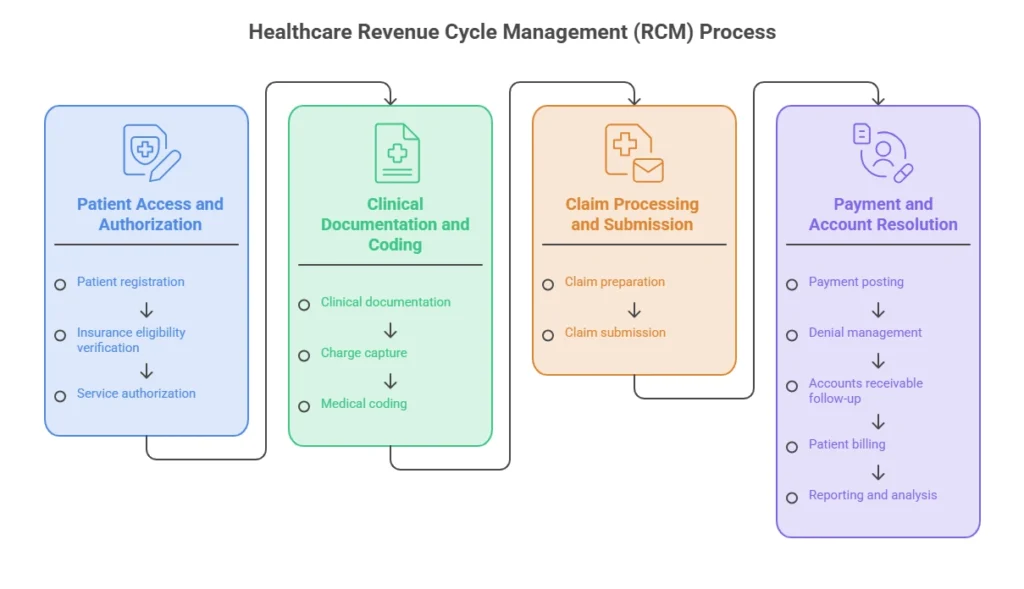
Healthcare revenue cycle management, commonly called RCM, is the process used to manage the financial journey of patient services.
It begins before or during patient registration. It continues through documentation, coding, claim submission, payment, denial resolution, and account closure.
A typical revenue cycle may include:
Patient registration
Insurance eligibility verification
Service authorization
Clinical documentation
Charge capture
Medical coding
Claim preparation
Claim submission
Payment posting
Denial management
Accounts receivable follow-up
Patient billing
Reporting and analysis
Electronic claims can be submitted to US Medicare contractors through systems that meet applicable electronic filing and HIPAA transaction requirements. Consequently, the revenue cycle depends heavily on standardized data, digital workflows, and trained professionals.
A problem at any stage can delay payment.
For example, incorrect patient information may lead to claim rejection. Incomplete clinical documentation can affect coding accuracy. Similarly, an incorrect code or missing authorization can result in denial.
RCM professionals therefore work at the intersection of healthcare, finance, technology, compliance, and operations.
Why Is US Healthcare Outsourcing to India Growing?
The phrase US healthcare outsourcing India covers a range of remotely delivered administrative, financial, analytical, and technology-enabled services.
Several factors support India’s role in this ecosystem.
1. A Mature BPM and Knowledge-Services Industry
India has decades of experience delivering international business services.
The country has developed large talent pools in process management, finance, technology, analytics, customer support, and knowledge services.
NASSCOM estimated that India’s BPM sector would reach approximately USD 54.6 billion in FY25. It also noted growing investment in analytics, artificial intelligence, and outcome-based service models.
Healthcare organizations and service providers can therefore build specialized teams within an established delivery environment.
2. Availability of Educated Talent
Medical coding and RCM roles can draw candidates from several academic backgrounds.
Depending on the job, employers may consider graduates from:
Life sciences
Pharmacy
Nursing
Physiotherapy
Allied health sciences
Biotechnology
Microbiology
Healthcare administration
Commerce
Finance
Business management
Information technology
However, educational eligibility varies by employer and role.
Clinical or life-science knowledge can help coders understand medical terminology. Meanwhile, commerce and management graduates may fit billing, finance, operations, or analytics functions.
3. Process Standardization
International healthcare services rely on defined workflows, documented rules, and measurable outcomes.
Coding standards, claim formats, payer requirements, quality targets, and productivity measures make many processes suitable for specialized delivery teams.
However, standardization does not mean the work is simple.
Professionals must interpret documentation, follow updated rules, protect sensitive information, and escalate exceptions correctly.
4. Technology-Enabled Delivery
Electronic health records, claims platforms, secure communication systems, and workflow tools allow teams to support healthcare operations from different locations.
Moreover, dashboards can monitor accuracy, productivity, pending claims, denials, turnaround time, and collections.
Technology has consequently made international delivery more practical.
It has also increased demand for professionals who understand both processes and data.
5. Cost and Operational Efficiency
Outsourcing can help healthcare organizations access specialized capabilities and manage administrative workloads.
However, cost is not the only consideration.
Healthcare providers also expect accuracy, compliance, scalability, process consistency, and measurable financial outcomes.
Indian service providers must therefore compete on capability and quality, not only labour costs.
6. Growing Complexity of Healthcare Claims
US healthcare reimbursement involves several code sets, payer rules, documentation requirements, and claim-editing processes.
For example, the US National Correct Coding Initiative promotes correct coding methodologies and seeks to reduce improper Medicare and Medicaid payments.
Such complexity creates demand for trained coding, billing, compliance, auditing, and denial-management teams.
Students often use “medical coding” and “medical billing” interchangeably. However, they involve different responsibilities.
Medical Coding
A medical coder reviews clinical records and assigns appropriate codes.
The work may involve:
Reading clinical documentation
Identifying diagnoses and procedures
Applying coding guidelines
Checking documentation completeness
Assigning relevant codes
Querying unclear information through approved processes
Maintaining accuracy and compliance
The US Bureau of Labor Statistics describes medical coders as professionals who assign diagnosis and procedure codes for patient care, health statistics, and billing purposes.
Medical Billing
A medical billing professional helps convert coded services into claims and follows those claims through the payment process.
The work may include:
Reviewing patient and insurance information
Preparing claims
Checking claim completeness
Submitting claims
Posting payments
Following outstanding accounts
Investigating denials
Coordinating corrections
Preparing account reports
Therefore, coding translates healthcare documentation into standardized information. Billing uses that information within the payment workflow.
Major Revenue Cycle Management Jobs
The rise of international healthcare services has created several functional career paths.
1. Medical Coder
Medical coders review documentation and assign relevant diagnosis or procedure codes.
Different coding roles may focus on:
Inpatient services
Outpatient services
Professional services
Emergency care
Surgical specialties
Risk adjustment
Evaluation and management
Diagnostic services
Specialization generally requires additional knowledge and experience.
2. Medical Billing Executive
Billing executives work with claims and account workflows.
They may check data, submit claims, correct errors, communicate through approved channels, and update account status.
This can be an entry point into the wider RCM industry.
3. Accounts Receivable Follow-Up Executive
Accounts receivable professionals monitor unpaid or underpaid claims.
They investigate why payment has not been received and determine the next action.
The role requires communication, payer-process knowledge, documentation, and problem-solving skills.
4. Denial Management Specialist
A denied claim has been processed but not paid as expected.
Denial specialists identify the reason, review supporting information, coordinate corrections, and help prevent recurring problems.
Moreover, experienced denial teams analyze patterns.
For example, repeated denials may reveal weaknesses in registration, authorization, documentation, coding, or claim submission.
5. Payment Posting Specialist
Payment posting professionals record payments, adjustments, and other financial information against patient accounts.
Accuracy matters because posting errors can affect balances, follow-up activity, and financial reporting.
6. Coding Auditor
Coding auditors review coded records for accuracy and compliance.
They may identify errors, provide feedback, support education, and analyze recurring quality concerns.
Auditing roles usually require substantial coding knowledge and practical experience.
7. Quality Analyst
Quality analysts review completed work against defined standards.
They calculate error rates, identify performance patterns, provide feedback, and support corrective action.
This role can create a pathway from production work toward team leadership and process management.
8. RCM Analyst
An RCM analyst examines operational and financial data.
The analyst may track:
Claim volumes
Rejection rates
Denial rates
Pending accounts
Turnaround times
Collection trends
Team productivity
Quality performance
Root causes of revenue loss
Therefore, the role requires both process knowledge and analytical ability.
9. Team Leader or Operations Manager
Experienced professionals may progress toward team leadership or operations management.
Their responsibilities can include:
Workforce planning
Performance monitoring
Quality management
Client communication
Process improvement
Risk escalation
Training coordination
Productivity management
Data reporting
However, promotion depends on performance, leadership capability, process knowledge, communication skills, and organizational opportunities.
Knowledge process outsourcing involves work that requires deeper domain understanding, analysis, judgement, or specialized expertise.
Healthcare KPO services may include:
Advanced medical coding
Coding audits
Clinical documentation review
Healthcare analytics
Revenue leakage analysis
Denial-root-cause analysis
Compliance support
Quality management
Process consulting
Reporting and forecasting
These functions can provide broader career possibilities for professionals who combine healthcare knowledge with business skills.
For example, an employee who understands only one billing task may have limited visibility.
However, a professional who understands the full revenue cycle can identify how registration, coding, billing, denial management, and collections interact.
That broader perspective becomes valuable in management roles.
International Healthcare Services Require Strong Compliance
Healthcare outsourcing involves sensitive patient and financial information.
Therefore, professionals must follow strict organizational controls.
Important areas include:
Data privacy
Access control
Password security
Approved communication channels
Confidentiality
Secure work environments
Documentation integrity
Incident reporting
Process compliance
Employees should access only the information required for their roles.
Moreover, patient information should never be copied, photographed, shared, or stored through unauthorized systems.
For managers, compliance is not simply an information technology responsibility.
It also requires employee training, supervision, audit controls, risk reporting, and disciplined operations.
Lead Beyond Practice
Combine physiotherapy knowledge with strategic management education to pursue opportunities in administration, operations, business development, and healthcare entrepreneurship.
Skills Required for a Career in Medical Coding and Billing
The right skill set depends on the role. However, several capabilities are widely useful.
Medical Terminology
Coders need to understand clinical language, anatomy, diseases, investigations, and procedures.
Billing professionals also benefit from basic healthcare terminology because claims relate to patient services.
Coding and Payer Knowledge
Coding professionals must learn the code sets and guidelines applicable to their work.
Billing and denial teams need to understand claim workflows, payer requirements, and common error categories.
Additionally, rules can change. Continuous learning is therefore essential.
Attention to Detail
Small errors can affect claims.
An incorrect digit, date, modifier, identifier, or patient detail may delay processing.
Professionals must therefore work carefully without ignoring productivity expectations.
Analytical Thinking
Strong RCM professionals investigate causes rather than only correcting symptoms.
For example, they ask why a claim was denied and whether similar claims face the same risk.
This mindset supports process improvement.
Communication Skills
International healthcare services require clear written and verbal communication.
Managers may communicate with internal teams, clients, support departments, and other stakeholders.
Therefore, professionals should learn to explain issues accurately and concisely.
Data Literacy
Dashboards and performance reports are central to RCM operations.
Professionals should become comfortable with spreadsheets, operational metrics, trends, and root-cause analysis.
Moreover, managers should know how to convert data into action.
Leadership and Business Understanding
Technical knowledge can help an employee enter the industry.
However, managerial growth also requires skills in:
Team management
Finance
Operations
Strategy
Quality
Client management
Workforce planning
Change management
Management education can help professionals understand these wider business responsibilities.
Will Artificial Intelligence Replace Medical Coding Jobs?
Automation and artificial intelligence are changing coding and billing processes.
AI tools can support documentation review, code suggestions, claim checks, work prioritization, and denial analysis.
The US Bureau of Labor Statistics has noted that AI-based tools are expected to improve medical-coding efficiency and may moderate demand for some medical records roles.
Therefore, students should not assume that every current task will remain unchanged.
However, automation can also increase demand for different capabilities.
Future-focused roles may require professionals to:
Validate automated recommendations
Handle complex cases
Investigate exceptions
Audit quality
Analyze denials
Monitor compliance
Improve workflows
Manage technology-enabled teams
The safest career strategy is not to compete with automation on repetitive tasks alone.
Instead, professionals should develop domain expertise, analytical thinking, compliance knowledge, communication, and management capability.
How to Build a Career in US Healthcare Outsourcing
Students can use the following step-by-step approach.
Step 1: Understand the Revenue Cycle
Do not study coding or billing as an isolated activity.
Learn how patient registration, documentation, coding, claims, payments, and denials connect.
Step 2: Select a Suitable Entry Path
Your academic background and interests can influence your choice.
Life-science graduates may find coding concepts familiar. Commerce graduates may prefer billing or accounts receivable. Management graduates may aim for operations and analytics roles.
However, employer criteria remain decisive.
Step 3: Build Relevant Technical Knowledge
Learn the terminology, workflows, tools, and quality expectations required for your target role.
Candidates considering certification should verify whether the credential is recognized by their intended employers.
Step 4: Develop Communication and Data Skills
Technical knowledge alone may not support long-term progression.
Build spreadsheet ability, presentation skills, analytical thinking, and professional communication.
Moreover, experience creates the context needed for quality and leadership roles.
Step 6: Prepare for Management Responsibility
Professionals seeking career growth should learn how to manage people, performance, quality, clients, and operational risk.
A broader management perspective can help them move from completing tasks toward improving entire processes.
Why Management Education Can Support RCM Career Growth
Medical coding and billing begin as specialized operational functions. However, senior roles require wider business knowledge.
An operations manager may need to understand:
Revenue-cycle performance
Workforce costs
Service-level requirements
Quality targets
Productivity
Client relationships
Technology adoption
Risk and compliance
Employee development
Therefore, professionals seeking management roles may benefit from structured education in finance, operations, strategy, analytics, marketing, and human resources.
At Asia Pacific Institute of Management, an industry-oriented curriculum, practical learning, experienced faculty, corporate exposure, and placement support can help students build broader managerial capabilities.
Such an environment can be relevant for learners who want to understand healthcare as both a service sector and a global business opportunity.
Is Medical Coding and Billing a Good Career Choice?
Medical coding and billing may suit candidates who enjoy structured processes, healthcare terminology, analytical work, accuracy, and continuous learning.
However, candidates should evaluate the realities.
Some roles involve productivity targets, detailed quality checks, international working hours, and frequent rule updates.
Additionally, career outcomes depend on the employer, role, training quality, certification, experience, and individual performance.
The growth of US healthcare outsourcing in India has expanded the business behind medical coding, billing, and revenue cycle management.
The opportunity is much broader than assigning codes.
The sector includes claims processing, denial management, payment posting, quality assurance, auditing, analytics, compliance, training, and operations leadership.
Therefore, the medical coding career scope depends on how professionals develop beyond their initial role.
Technical knowledge may support entry. However, domain expertise, data literacy, communication, process understanding, and leadership skills can support long-term progression.
Automation will continue to reshape repetitive tasks. Consequently, future-ready professionals should prepare for work that requires judgement, analysis, quality control, and process management.
For students interested in healthcare and business, international healthcare services can offer a distinctive career direction. The key is to enter with realistic expectations and a commitment to continuous learning.
Build Healthcare Leadership
Build practical business, leadership, and analytical capabilities to confidently transition from patient care into broader healthcare management roles.
Dr. Vikas Gupta is a distinguished academic in the education and research domain, specializing in finance and related interdisciplinary studies. He is known for his...
01.
What is the medical coding career scope in India?
Medical coding career scope includes entry-level coding, specialty coding, quality assurance, auditing, training, compliance, and team leadership. Opportunities may exist in healthcare service companies, hospitals, insurers, and international revenue cycle operations.
02.
Why is US healthcare outsourcing growing in India?
India offers an established BPM ecosystem, educated talent, technology capabilities, scalable operations, and experience delivering international services. Moreover, US healthcare revenue cycles require specialized support across coding, billing, claims, denials, and analytics.
03.
What are the main revenue cycle management jobs?
Common roles include medical coder, billing executive, payment posting specialist, accounts receivable executive, denial specialist, quality analyst, auditor, RCM analyst, trainer, team leader, and operations manager.
04.
Is medical coding the same as medical billing?
No. Medical coding converts clinical documentation into standardized codes. Medical billing uses coded and administrative information to prepare, submit, track, and resolve healthcare claims.
05.
Which degree is suitable for medical coding?
Employers may prefer candidates from life sciences, pharmacy, nursing, physiotherapy, biotechnology, or allied health disciplines for certain coding roles. However, eligibility varies. Candidates should check each employer’s current requirements.
06.
What determines a medical billing manager’s salary?
Salary can depend on experience, location, employer, team size, process complexity, shift, client responsibilities, certifications, leadership scope, and performance. Therefore, candidates should verify current market information before making decisions.
07.
Will AI reduce medical coding opportunities?
AI will automate or support some coding and billing activities. However, complex review, exception handling, auditing, compliance, analytics, and management will continue to require skilled professionals. Continuous upskilling will be important.
08.
How can a medical coder move into management?
A coder can build experience, learn the full revenue cycle, develop quality and analytical skills, improve communication, and take on team responsibilities. Management education can additionally strengthen knowledge of operations, finance, strategy, and leadership.


















.webp) Call Us
Call Us