How Healthcare Managers Deal with Medical Malpractice and Legal Liabilities
Posted on 27 Jun 2026
By Dr. Vikas Gupta
Introduction
Medical malpractice laws india is an important topic for healthcare managers, hospital administrators, and students planning a career in hospital management.
Hospitals face legal risks when patients or families allege negligence, poor communication, lack of consent, delayed treatment, billing disputes, incomplete records, or violation of patient rights. Therefore, healthcare managers must understand legal-sensitive hospital processes.
They do not replace doctors or lawyers. However, they help create systems that reduce mistakes, improve documentation, protect patient rights, and support ethical healthcare delivery.
This blog is for educational awareness only. Hospitals should consult qualified legal professionals for case-specific legal advice.
Manage Legal Risk
Build healthcare management skills to handle consent, records, patient rights, and hospital compliance with confidence and professionalism daily.
Medical malpractice means harm caused to a patient due to negligence, lack of reasonable care, poor documentation, failure to follow accepted standards, or improper communication.
In India, medical malpractice may involve civil liability, consumer protection law, criminal negligence, professional ethics, and hospital compliance requirements.
The Consumer Protection Act, 2019 provides a framework for consumer dispute redressal in India. It includes consumer protection councils, the Central Consumer Protection Authority, consumer dispute redressal commissions, mediation, product liability, and penalties.
For hospitals, this means patient complaints can become formal legal disputes when patients allege deficiency in service or negligence.
Why Healthcare Managers Must Understand Medical Malpractice Laws India
Healthcare managers handle the operational side of patient care. Their role becomes critical when a hospital faces legal-sensitive situations.
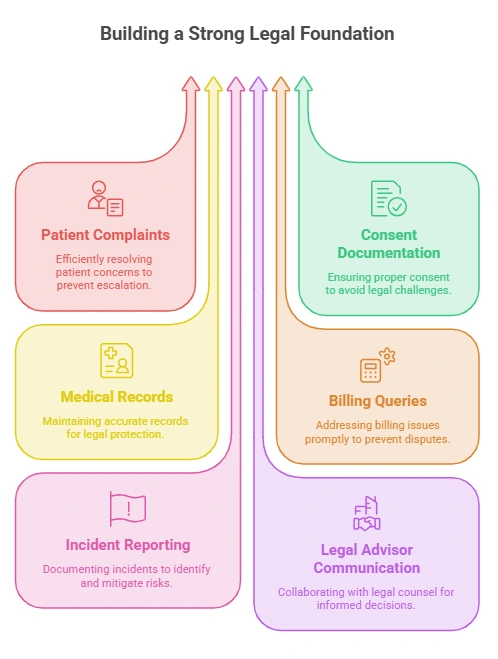
They often coordinate:
Patient complaints
Consent documentation
Medical records
Billing queries
Incident reporting
Medico-legal case handling
Internal audits
Staff training
Communication with a hospital legal advisor
Patient rights protection
A medically defensible case can still become difficult if hospital records are incomplete. Similarly, a small complaint can become serious if the patient feels ignored.
Therefore, healthcare managers must build strong systems before disputes arise.
Hospitals may face legal liabilities due to several reasons.
1. Alleged Medical Negligence
Patients may allege negligence in diagnosis, surgery, medication, post-operative care, emergency treatment, or monitoring.
However, every poor medical outcome is not malpractice. Healthcare involves clinical risks. Therefore, records must show that the medical team followed reasonable standards and communicated clearly.
2. Poor Consent Process
Consent is one of the strongest legal safeguards in healthcare.
Consent is not just a signature. Medical literature on consent in India explains that consent is a legal requirement of medical practice and not a mere procedural formality.
3. Missing or Weak Medical Records
Medical records support clinical decisions, legal defence, billing clarity, and continuity of care.
The National Medical Commission’s Code of Medical Ethics Regulations, 2002 says physicians should maintain indoor patient medical records for three years from the start of treatment. It also states that requested medical records should be issued within 72 hours to patients, authorised attendants, or legal authorities.
4. Patient Rights Violations
Patient rights protection is a major hospital management responsibility.
The Ministry of Health and Family Welfare shared the Charter of Patients’ Rights recommended by the National Human Rights Commission with States and Union Territories. It also noted that adoption, display, implementation, and grievance redressal fall under respective State and UT governments.
5. Criminal Negligence Risk
Serious cases may involve criminal negligence allegations.
Under the Bharatiya Nyaya Sanhita, 2023, causing death by negligence has specific provisions. For registered medical practitioners performing medical procedures, the law provides punishment that may extend to two years and fine in relevant cases.
Role of a Hospital Legal Advisor
A hospital legal advisor helps hospitals understand legal exposure and respond properly to disputes.
A hospital legal advisor may support:
Consent form review
Medical record policy review
Consumer complaint replies
Court case documentation
Medico-legal case process guidance
Police communication guidance
Contract review
Staff training
Internal risk review
Legal notice responses
However, legal safety does not begin in court. It begins at reception, emergency, OPD, ICU, billing, medical records, and discharge.
Therefore, healthcare managers and legal advisors must work together.
Consent Form Management in Hospitals
Consent form management is one of the most important responsibilities in hospital risk control.
A consent form should show that the patient or authorised decision-maker received clear information before treatment.
A strong consent process should include:
1. Procedure-Specific Consent
General admission consent is not enough for major procedures. Surgery, anaesthesia, blood transfusion, ICU procedures, invasive diagnostics, and high-risk treatments need specific consent.
2. Clear Explanation
Doctors should explain the diagnosis, treatment plan, risks, benefits, alternatives, and possible complications.
3. Understandable Language
Patients should understand what they are signing. Therefore, hospitals should avoid overly technical language.
4. Proper Signatures
The form should include patient signature, doctor signature, witness details, date, and time.
5. Consent Refusal Documentation
If a patient refuses treatment, the hospital should document the refusal clearly.
6. Emergency Documentation
In emergencies, treatment should not be delayed only because paperwork is incomplete. However, emergency decisions must be documented carefully.
Good consent form management protects patients and supports doctors.
Patient Rights Protection: A Managerial Responsibility
Additionally, hospital staff should receive training on how to explain patient rights politely.
Patients are less likely to escalate issues when they feel informed, respected, and heard.
Lead Hospital Compliance
Prepare for responsible hospital administration roles through practical MBA learning in legal awareness, documentation, communication, and risk control.
Consumer court cases hospitals usually arise when patients believe there was negligence, deficiency in service, unfair billing, poor communication, or denial of records.
The Consumer Protection Act, 2019 created a three-tier quasi-judicial mechanism for consumer disputes through District Commissions, State Commissions, and the National Commission.
Hospitals can reduce consumer disputes by improving:
Transparent billing
Written estimates
Consent documentation
Discharge summaries
Medical record access
Complaint handling
Patient communication
Internal incident review
The National Consumer Disputes Redressal Commission describes the Consumer Protection Act as a social legislation for protecting consumer rights and supporting redressal of grievances.
Therefore, hospital managers must treat every serious complaint with attention and documentation.
Medico Legal Cases MLC: What Healthcare Managers Should Know
Medico legal cases mlc are medical cases that may have legal investigation attached to them.
Common MLC examples include:
Road traffic accidents
Assault cases
Burns
Poisoning
Suspected homicide
Sexual assault
Workplace injuries
Unexplained injuries
Police-referred cases
Doctors usually decide whether a case should be marked as medico-legal. However, healthcare managers must ensure the hospital process is followed.
A strong MLC process should include:
Immediate clinical care
MLC register entry
Police intimation where required
Accurate injury documentation
Patient identity details
Evidence preservation
Chain-of-custody awareness
Secure record storage
Staff training in emergency areas
Managers should ensure that emergency care is never compromised by administrative confusion.
How Healthcare Managers Reduce Legal Liabilities
1. Create Clear SOPs
Hospitals need standard operating procedures for consent, MLC, discharge, billing, complaints, emergency care, records, and incident reporting.
SOPs reduce confusion and support consistent decision-making.
2. Train Frontline Staff
Front-office teams, nurses, coordinators, billing staff, and medical record teams should understand legal-sensitive processes.
For example, a front-office executive should know how to escalate a record request. A billing executive should explain estimates clearly.
3. Strengthen Documentation
Documentation is one of the strongest protections in healthcare.
Small complaints become legal disputes when patients feel ignored.
A strong grievance system should include acknowledgement, investigation, escalation, written response, and closure tracking.
5. Conduct Regular Audits
Hospital managers should audit consent forms, discharge summaries, MLC registers, billing files, and medical record requests.
Audits help identify gaps before they become serious.
6. Coordinate With Doctors and Legal Teams
During adverse events, managers should coordinate with the treating team, quality team, hospital legal advisor, and patient-relations team.
Communication should be accurate, calm, and documented.
Skills Required for Healthcare Legal Risk Management
Students interested in hospital administration should build legal-awareness skills.
Important skills include:
Healthcare operations knowledge
Medical record management
Consent process understanding
Patient communication
Complaint handling
Basic legal awareness
Quality management
Compliance coordination
Crisis communication
Ethical decision-making
Audit and documentation skills
At Asia Pacific Institute of Management, students gain industry-oriented learning, experienced faculty guidance, practical exposure, and placement support. These elements help students prepare for healthcare management and hospital administration careers.
Career Opportunities in Hospital Legal and Risk Management
Legal awareness can support several healthcare management roles.
Students can explore roles such as:
Hospital Operations Executive
Patient Relations Executive
Medical Records Manager
Quality Executive
Compliance Coordinator
Medico-Legal Coordinator
Risk Management Executive
Hospital Administrator
Patient Experience Manager
Healthcare Operations Manager
With experience, professionals can grow into senior roles in hospital administration, quality, compliance, patient safety, and risk management.
Medical malpractice laws india matter for every healthcare manager. Legal risk in hospitals often begins with weak systems, incomplete records, poor consent, unclear communication, or ignored complaints.
Healthcare managers reduce risk by building strong SOPs, training staff, maintaining records, protecting patient rights, coordinating with legal advisors, and managing medico-legal cases carefully.
For students planning careers in hospital administration, legal awareness is a valuable skill. It helps them become responsible healthcare leaders who understand both patient care and operational accountability.
Asia Pacific Institute of Management supports students with industry-aligned education, practical learning, experienced faculty, corporate exposure, and placement-focused guidance.
Build Risk Readiness
Turn healthcare legal awareness into career-ready management expertise for patient safety, grievance handling, and ethical hospital leadership today.
Dr. Vikas Gupta is a distinguished academic in the education and research domain, specializing in finance and related interdisciplinary studies. He is known for his...
Medical malpractice laws india refer to legal rules and principles related to medical negligence, consent, patient rights, consumer complaints, criminal negligence, professional ethics, and hospital liability.
02.
Can hospitals face consumer court cases?
Yes. Hospitals may face consumer complaints when patients allege negligence, deficiency in service, billing issues, or denial of records.
03.
What does a hospital legal advisor do?
A hospital legal advisor guides the hospital on consent forms, complaints, legal notices, medico-legal matters, records, contracts, and court-related documentation.
04.
Why is consent form management important?
Consent form management is important because it documents that the patient received information about treatment, risks, benefits, alternatives, and possible complications.
05.
What are medico legal cases mlc?
Medico legal cases mlc are medical cases with possible legal investigation. These may include accidents, assault, poisoning, burns, workplace injuries, and suspicious injuries.
06.
How can hospitals improve patient rights protection?
Hospitals can improve patient rights protection through clear information, informed consent, privacy, medical record access, emergency care, respectful treatment, and grievance redressal.
07.
Is legal awareness important for healthcare management students?


















.webp) Call Us
Call Us