What Is Lean Six Sigma Green Belt? Why Healthcare Students Should Do This Certification Now
Posted on 20 Aug 2026
By Dr. Vikas Gupta
Introduction
A hospital may have experienced doctors, modern equipment, and strong clinical services. Yet patients can still face long queues, delayed discharges, repeated paperwork, inventory problems, or inefficient workflows.
Many of these problems are not purely clinical.
They are process problems.
This is why Lean Six Sigma in healthcare has become relevant for hospital administrators, quality professionals, operations managers, and management students.
Lean Six Sigma combines two process-improvement approaches. Lean focuses on reducing waste and unnecessary steps. Six Sigma focuses on reducing variation, defects, and process errors.
A Green Belt certification introduces professionals to structured methods for identifying problems, analyzing data, improving processes, and sustaining better performance.
For MBA and healthcare management students, this knowledge can strengthen practical understanding of hospital operations.
It can also add substance to a CV when supported by real projects and measurable problem-solving experience.
Lead Healthcare Operations
Build practical management, analytics, and leadership skills to pursue rewarding careers across healthcare operations, quality, consulting, and management.
Lean Six Sigma in healthcare is a structured process-improvement approach used to reduce waste, delays, errors, and unnecessary variation in healthcare operations. It can be applied to patient flow, OPD waiting time, discharge processes, billing, inventory, diagnostics, pharmacy operations, and other hospital systems.
Lean and Six Sigma originally developed in industrial and process environments.
However, their underlying principles can also apply to healthcare.
Hospitals contain hundreds of processes.
For example:
Patient arrives → registers → waits → consults doctor → undergoes diagnostics → pays bill → receives medicines → leaves
Every transition can create:
Waiting
Duplication
Errors
Delays
Rework
Miscommunication
A process-improvement professional asks:
Where is time being lost?
Which steps add value?
Which steps create avoidable work?
Why does performance vary?
What data can help us understand the problem?
That thinking forms the foundation of Lean Six Sigma.
What Is a Lean Six Sigma Green Belt?
A Lean Six Sigma Green Belt is generally an intermediate-level process-improvement credential.
Green Belt training commonly introduces learners to tools used for defining problems, measuring performance, analyzing causes, developing improvements, and controlling results.
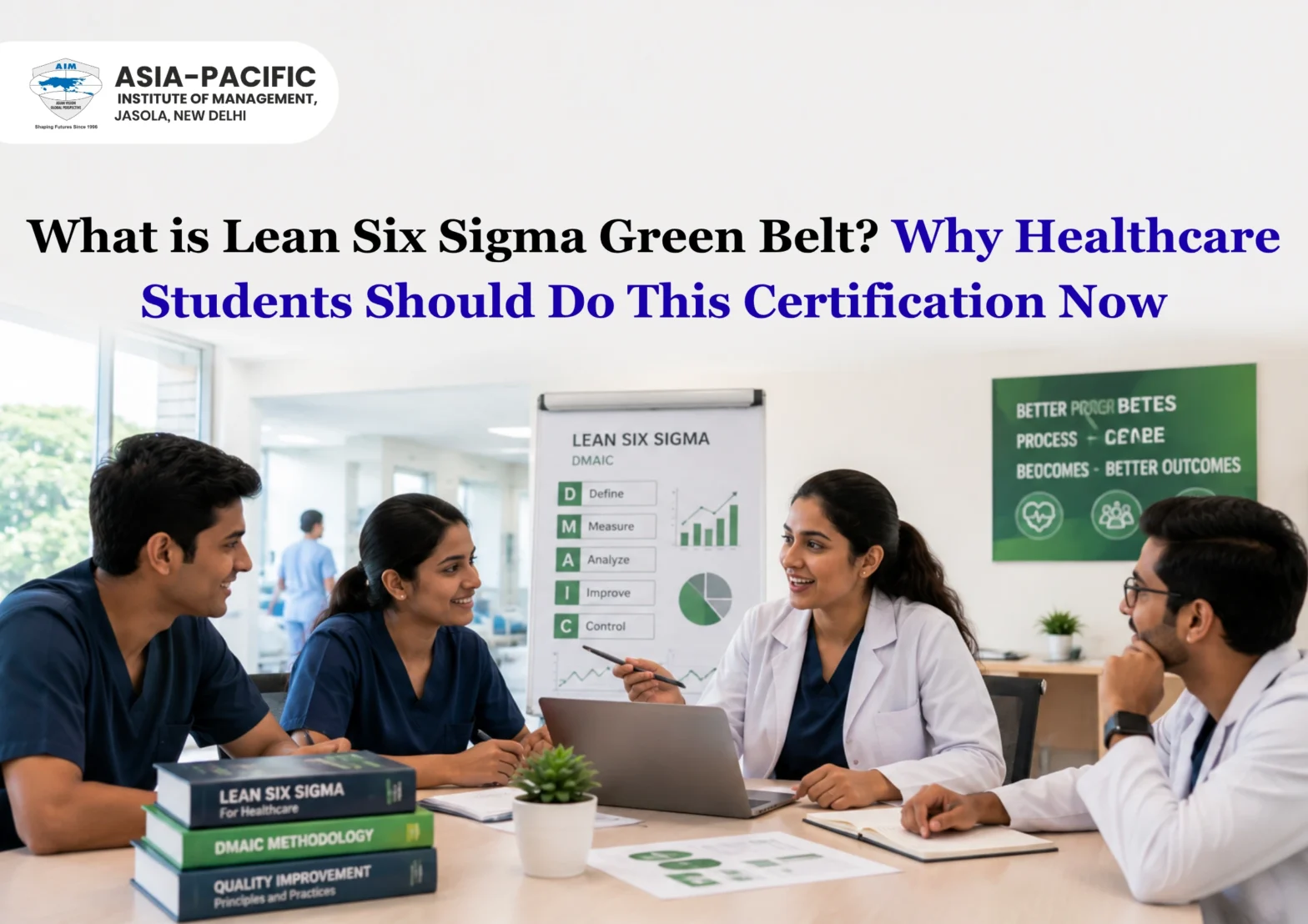
The most common framework is known as DMAIC.
DMAIC stands for:
Define
Measure
Analyze
Improve
Control
A Green Belt professional may participate in improvement projects or lead smaller projects within a department.
However, certification requirements differ between providers.
Some certifications include an examination.
Others may include training, assessments, project work, or a combination.
Therefore, students should check:
Curriculum
Assessment method
Project requirements
Trainer credentials
Recognition
Renewal requirements
Practical application
A certificate should demonstrate learning rather than simply course attendance.
Suppose a hospital has received repeated complaints about OPD waiting times.
A Green Belt approach would not immediately recommend hiring more employees.
Instead, the team would first investigate the process.
Define
Clearly describe the problem.
For example:
“Average patient waiting time between registration and consultation has increased during morning OPD hours.”
The team may then define the project objective.
Measure
Collect reliable data.
Potential measurements include:
Patient arrival time
Registration completion time
Consultation start time
Number of counters
Doctors available
Patient volume by hour
Appointment mix
Without measurement, the team may rely on assumptions.
Analyze
Identify possible root causes.
The delay may result from:
Registration bottlenecks
Uneven appointment scheduling
Doctor arrival patterns
Duplicate paperwork
Poor queue design
Diagnostic dependencies
The problem may not be a simple shortage of staff.
Improve
Test suitable interventions.
Possible improvements may include:
Staggered appointments
Separate queues
Digital pre-registration
Better counter allocation
Revised staffing schedules
Improved patient-routing systems
Control
Monitor whether the improvement lasts.
Managers may track waiting time weekly and create escalation rules when performance deteriorates.
This final stage is important.
A temporary improvement is not the same as sustainable process improvement.
Why Lean Six Sigma Matters in Hospitals
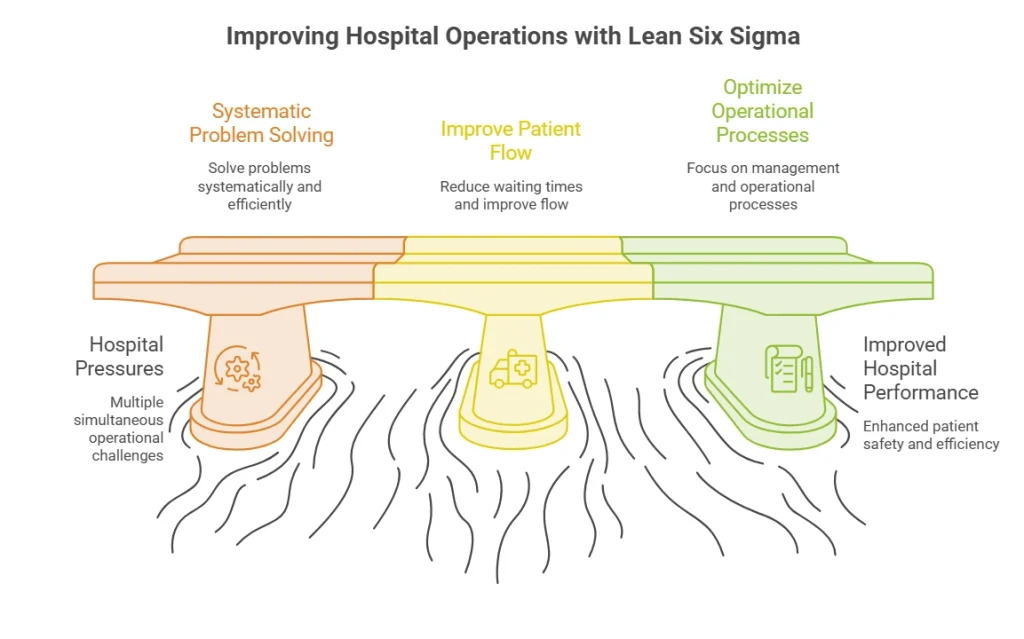
Hospitals operate under several pressures simultaneously.
They need to improve:
Patient safety
Service quality
Patient experience
Operational efficiency
Financial performance
Staff productivity
Managers therefore need methods that help them solve problems systematically.
Lean Six Sigma provides a common framework.
Research on healthcare Lean interventions has reported improvements in patient flow and waiting times. A systematic review of ambulatory-care studies found reductions in waiting time before seeing healthcare professionals in 24 of 26 included studies.
Another systematic review of Lean Six Sigma in healthcare found that many applications focused on management and operational processes, highlighting its relevance beyond purely clinical activities.
4. It Helps Students Speak the Language of Quality
Healthcare organizations pay significant attention to quality and patient safety.
Understanding concepts such as process mapping, root-cause analysis, variation, and corrective action can help students communicate with quality and operations teams.
5. It Can Strengthen CV Building
Certification alone does not guarantee a job.
However, it can support CV building when linked with practical evidence.
For example:
Weak resume line:
“Lean Six Sigma Green Belt Certified.”
Stronger resume line:
“Applied DMAIC methodology to an academic OPD-flow project and identified three process bottlenecks affecting simulated patient waiting time.”
The second statement demonstrates application.
Advance Your Healthcare Career
Strengthen your healthcare career with industry-focused MBA learning designed around business strategy, operations, analytics, leadership, and practical management skills.
Lean Six Sigma primarily teaches process improvement.
Hospital quality programmes may focus more on:
Accreditation
Patient safety
Clinical quality
Documentation
Regulatory requirements
Quality assurance systems
Therefore, Lean Six Sigma complements healthcare quality knowledge.
It does not replace hospital accreditation or clinical-quality expertise.
A student interested in hospital quality may eventually build capabilities across both areas.
For example:
Healthcare quality knowledge + Lean Six Sigma + data skills
can create a stronger process-improvement profile than any one credential alone.
Useful Green Belt Tools for Healthcare Managers
Green Belt courses may introduce several analytical tools.
SIPOC
SIPOC stands for:
Suppliers
Inputs
Process
Outputs
Customers
It gives managers a high-level view of a process.
For example, a hospital discharge process involves several suppliers of information.
These may include doctors, nurses, pharmacy, billing, and diagnostics.
The final customer includes the patient.
Process Mapping
Process maps show each step in a workflow.
Managers can use them to identify:
Duplication
Delays
Handoffs
Unclear ownership
Pareto Analysis
Pareto analysis helps prioritize frequent or significant problems.
Suppose a hospital records 500 billing complaints.
A Pareto chart may show that a small number of causes account for most complaints.
Managers can then focus improvement efforts.
Fishbone Diagram
A fishbone diagram helps teams brainstorm possible root causes.
Categories might include:
People
Process
Technology
Equipment
Environment
Policy
However, brainstorming should be followed by evidence.
A possible cause is not automatically the real cause.
Five Whys
The Five Whys technique encourages deeper investigation.
For example:
Problem: Discharge is delayed.
Why?
The final bill is late.
Why?
Pharmacy clearance is delayed.
Why?
Medication returns are entered late.
Why?
Ward communication happens only after clinical discharge.
Now the team has a process issue to investigate.
Control Charts
Control charts help monitor process performance over time.
They may help managers distinguish normal variation from unusual changes.
However, proper statistical interpretation requires training.
Healthcare Areas Where Lean Six Sigma Can Be Applied
OPD Operations
Possible objectives include:
Reducing waiting time
Improving appointment scheduling
Simplifying registration
Emergency Departments
Teams may examine:
Patient flow
Triage processes
Diagnostic turnaround
Bed coordination
Laboratory Services
Improvement projects may focus on:
Turnaround time
Sample errors
Rework
Result communication
Pharmacy
Projects may examine:
Dispensing time
Stock-outs
Inventory
Prescription-processing errors
Discharge
Teams can study:
Documentation delays
Billing clearance
Pharmacy returns
Transport coordination
Revenue Cycle Management
Lean Six Sigma can support analysis of:
Claim errors
Rejections
Denials
Billing delays
Rework
Supply Chain
Projects may examine:
Inventory levels
Procurement lead time
Stock availability
Expiry
This breadth makes the methodology relevant across multiple healthcare-management functions.
A Sample Green Belt Project for MBA Healthcare Students
A student does not necessarily need access to sensitive clinical information to demonstrate process-improvement thinking.
An academic project could examine:
“Reducing OPD registration waiting time using DMAIC.”
Define
Identify registration waiting time as the problem.
Measure
Collect de-identified or simulated information on:
Arrivals
Counters
Processing time
Queue length
Analyze
Identify bottlenecks.
Improve
Develop alternatives.
These may include:
Additional peak-hour counters
Digital pre-registration
Separate follow-up queues
Revised staffing schedules
Control
Create a dashboard for monitoring waiting time.
The project should clearly state whether data are simulated, academic, or observational.
Students should never invent real hospital outcomes.
Does Lean Six Sigma Actually Reduce Waiting Time?
Lean-style interventions have shown promising results in healthcare.
A systematic review examining ambulatory patient flow reported that waiting time before seeing a healthcare professional fell in 24 of 26 included studies.
A more recent 2025 systematic review found that outpatient waiting-time interventions can remain effective over time when implemented appropriately.
In addition, a 2026 review of Lean Six Sigma projects found improvements associated with patient satisfaction and inefficiencies such as waiting, scheduling, and discharge processes.
However, students should interpret these findings carefully.
Lean Six Sigma is not a magic formula.
Success depends on:
Leadership support
Reliable data
Employee engagement
Correct problem definition
Appropriate tools
Implementation discipline
Continuous monitoring
Poor implementation can produce little lasting benefit.
Common Mistakes Students Make With Lean Six Sigma Certification
Collecting the Certificate Without Learning the Method
A credential has limited value when the candidate cannot explain DMAIC.
Choosing a Course Only Because It Is Cheap
Compare curriculum and assessment quality.
Memorizing Tools Without Understanding Problems
Tools should support analysis.
They are not the objective.
Claiming Expert-Level Knowledge
A Green Belt does not make a fresher an experienced hospital process consultant.
Use accurate CV language.
Ignoring Healthcare Context
A technique developed for manufacturing cannot always be copied directly into patient care.
Clinical safety, ethics, patient needs, and professional judgement must remain priorities.
Using Sensitive Patient Information in Student Projects
Students should use authorized, de-identified, or simulated data.
Privacy and organizational approval matter.
How to Choose a Lean Six Sigma Green Belt Certification
Before enrolling, compare programmes using practical criteria.
Look for:
DMAIC coverage
Lean principles
Process mapping
Root-cause analysis
Data-analysis tools
Practical exercises
Examination requirements
Project opportunities
Trainer experience
Students should also ask whether the programme explains how tools apply to service industries.
A healthcare-focused case component can make learning more relevant.
However, the core methodology should remain rigorous.
Green Belt vs Yellow Belt vs Black Belt
Certification structures differ, but a typical progression may look like this.
Yellow Belt
Usually introductory.
It may suit students who want basic awareness.
Green Belt
Provides stronger process-improvement knowledge.
It can suit students or professionals who want to participate in or lead smaller improvement projects.
Black Belt
Generally involves deeper statistical analysis and more advanced project leadership.
For most MBA healthcare freshers, jumping directly toward the highest-level credential may not provide automatic career value.
Practical experience remains essential.
A Green Belt can therefore be a sensible starting point for candidates serious about hospital operations and quality improvement.
How to Add Lean Six Sigma to Your CV
Simply adding the certificate title is not enough.
A stronger CV connects certification with capability.
Certification Section
Lean Six Sigma Green Belt — [Recognized Certification Body], 2026
Skills Section
Possible skills include:
DMAIC
Process mapping
Root-cause analysis
Process improvement
Basic quality analytics
Only list tools you can explain confidently.
Project Section
Example:
OPD Process Improvement Project
“Mapped the outpatient registration process using DMAIC and identified bottlenecks affecting waiting time in an academic case exercise.”
This gives the recruiter something concrete to discuss.
How Green Belt Knowledge Helps in Interviews
Interviewers may not ask you to recite Six Sigma theory.
They may give you a management problem.
For example:
“Patients are complaining about long waiting times. What would you do?”
A candidate without process-improvement knowledge may immediately say:
“Add more staff.”
A stronger candidate may say:
“I would first map the patient journey and measure where waiting occurs. I would compare demand and capacity by time period, identify the root causes, test interventions, and monitor whether the improvement is sustained.”
That answer demonstrates managerial thinking.
Operations Value Addition for Healthcare MBA Careers
The strongest operations value addition from Lean Six Sigma is not the certificate itself.
It is a different way of solving problems.
Green Belt learning encourages students to ask:
What exactly is the problem?
How large is it?
What does the data show?
Where does the process fail?
What causes the failure?
Which intervention should we test?
Did the change actually work?
Can the improvement be sustained?
These questions are useful across healthcare management.
They can apply to hospitals, diagnostics, pharmaceuticals, health-tech, insurance operations, senior care, and other service businesses.
Combining Lean Six Sigma With Other Healthcare Skills
Certification becomes more useful when combined with complementary skills.
For hospital operations:
Lean Six Sigma + Excel + healthcare operations
For quality management:
Lean Six Sigma + hospital quality knowledge + accreditation awareness
For healthcare analytics:
Lean Six Sigma + Excel/Power BI + data interpretation
For consulting:
Lean Six Sigma + structured problem-solving + presentation skills
For supply chain:
Lean Six Sigma + inventory management + forecasting
This approach creates a coherent profile.
Random certificates rarely do.
Why Healthcare Management Students Should Build Practical Skills Now
Employers increasingly expect management graduates to understand data, technology, operations, and measurable performance.
Healthcare is no exception.
Hospitals need managers who can identify inefficiencies without compromising patient safety.
Therefore, students benefit from combining management theory with practical frameworks.
At Asia Pacific Institute of Management, an industry-oriented curriculum, experienced faculty, practical learning, corporate exposure, and placement support can help students build wider managerial capabilities.
For healthcare-focused learners, combining management education with practical skills in process improvement, analytics, quality, and operations can strengthen career readiness.
Is Lean Six Sigma Green Belt Worth Doing?
It can be worthwhile for students whose target career genuinely uses process-improvement skills.
The strongest fit may include careers in:
Hospital operations
Healthcare quality
Process excellence
Healthcare consulting
Supply chain
Revenue cycle management
Healthcare analytics
However, certification should not become a substitute for internships or practical exposure.
The best profile combines:
Knowledge + Certification + Project + Practical Exposure + Communication
This combination demonstrates both learning and application.
Lean Six Sigma in healthcare provides management students with a structured way to understand and improve hospital processes.
Its value goes beyond learning terminology.
A Green Belt introduces students to problem definition, measurement, root-cause analysis, process redesign, and performance monitoring.
These capabilities can be applied to challenges such as reducing OPD waiting time, improving discharge workflows, managing inventory, reducing billing errors, and strengthening operational consistency.
For students looking at the best certifications for MBA healthcare, Lean Six Sigma can be particularly relevant when the career goal involves operations, quality, analytics, consulting, or process excellence.
However, the certificate itself should not be the final goal.
The real advantage comes from applying the methodology.
Build a project.
Analyze a process.
Use data.
Document what you learned.
That is what turns a certificate into meaningful operations value addition and stronger CV building.
Turn Skills Into Impact
Combine process improvement knowledge with strong management capabilities and prepare for high-impact opportunities across India’s evolving healthcare industry.
Dr. Vikas Gupta is a distinguished academic in the education and research domain, specializing in finance and related interdisciplinary studies. He is known for his...
Lean Six Sigma in healthcare is a process-improvement approach that combines waste reduction with data-driven defect and variation reduction. It can support improvements in patient flow, waiting time, billing, diagnostics, supply chain, and other hospital processes.
02.
What is a Lean Six Sigma Green Belt?
A Green Belt is generally an intermediate process-improvement certification covering methods such as DMAIC, process mapping, root-cause analysis, measurement, and improvement tools.
03.
Is Lean Six Sigma useful for MBA healthcare students?
Yes, particularly for students interested in operations, quality, consulting, analytics, supply chain, or process-improvement roles. Its usefulness depends on the targeted career and practical application.
04.
Can Lean Six Sigma help reduce OPD waiting time?
Lean methods can help managers map patient flow, identify bottlenecks, align resources, remove unnecessary steps, and monitor performance. Research has reported waiting-time improvements across many healthcare Lean interventions.
05.
Is Green Belt a hospital quality control certification?
Not exactly. Green Belt focuses on process improvement. Hospital quality certifications may focus more directly on accreditation, patient safety, standards, and quality-assurance systems.
06.
Does Lean Six Sigma certification guarantee a healthcare job?
No. Certification cannot guarantee employment. Its value increases when candidates can demonstrate practical projects, healthcare knowledge, analytical skills, and communication ability.
07.
How can freshers show Lean Six Sigma on a CV?
Include the certification accurately and add relevant academic projects demonstrating DMAIC, process mapping, root-cause analysis, or measurable process-improvement work.
08.
Which healthcare processes can use Lean Six Sigma?
Possible applications include OPD flow, discharge, emergency services, diagnostics, pharmacy, billing, inventory, supply chain, revenue cycle management, and administrative workflows.
















.webp) Call Us
Call Us