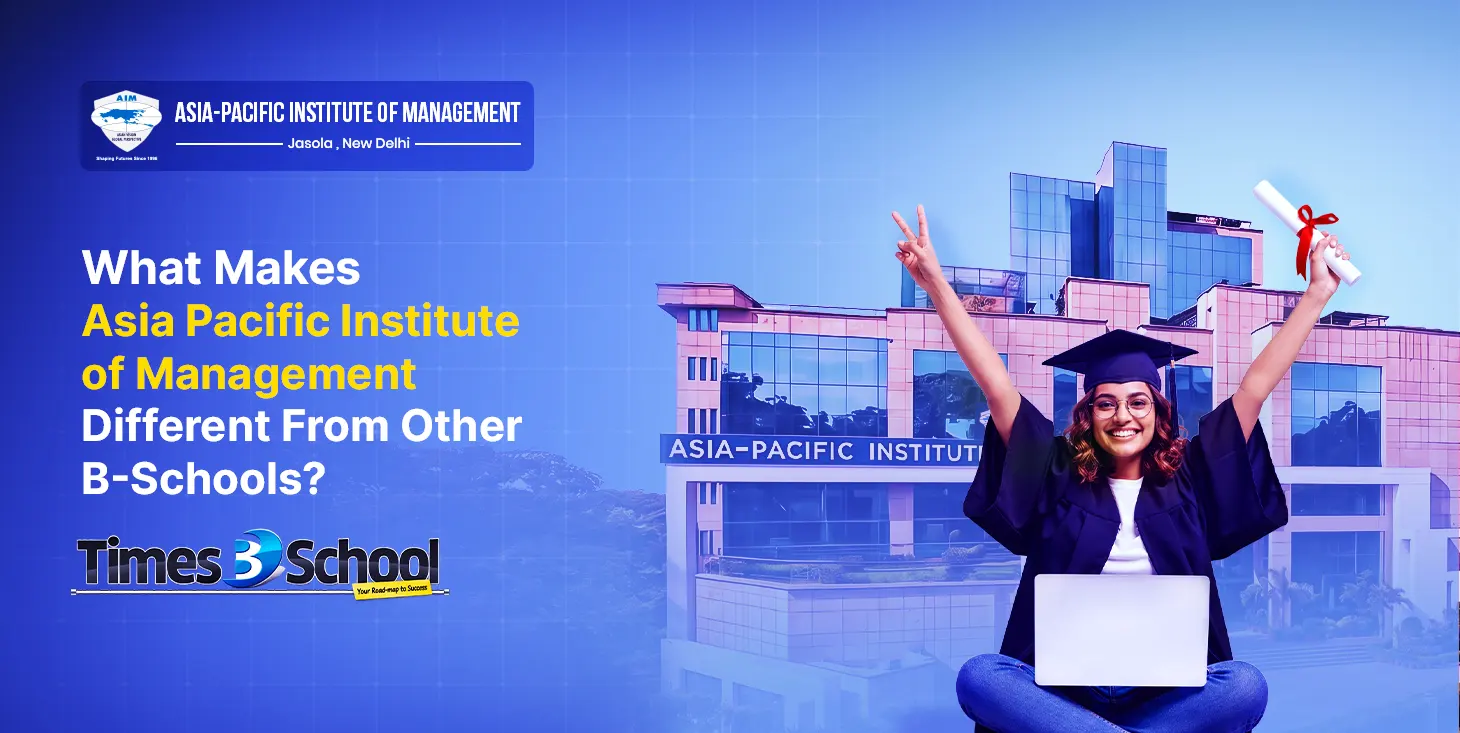
What Makes Asia Pacific Institute of Management Different From Other B-Schools?
Posted on 09 Sep 2026
By Dr. Vikas Gupta
Introduction
Choosing a business school is a major academic and financial decision, so students and parents naturally look beyond brochures before forming an opinion. Searches for asia pacificinstitute of management reviews often reflect a deeper question: what actually distinguishes Asia Pacific Institute of Management (AIM), New Delhi, from other B-schools competing for the same management aspirants?
The answer requires more than comparing rankings or isolated placement numbers. Programme credibility, curriculum relevance, industry interaction, faculty exposure, location, learning environment and career preparation all matter. This deep dive examines AIM Delhi through those practical decision-making factors. It also explains how students and parents should interpret reviews objectively, compare the institute with alternatives and determine whether its PGDM learning environment aligns with their expectations and career goals.
AIM Delhi was established in 1996 and offers AICTE-approved PGDM programmes in multiple management areas.
Its management education approach combines academic concepts with projects, industry interaction and experiential learning.
Being located in New Delhi gives students access to the wider Delhi NCR business and professional ecosystem.
AIM Delhi reviews are most useful when evaluated alongside current official programme, curriculum and career information.
Students should compare AIM with other B-schools using consistent criteria rather than relying on rankings, advertisements or reviews alone. Bonus:PGDM vs MBA comparison
What Is asia pacific institute of management reviews?
asia pacific institute of management reviews refers to student, alumni, parent and third-party opinions about Asia Pacific Institute of Management, New Delhi. Such reviews may discuss academics, faculty, PGDM programmes, campus environment, industry exposure and career support. They are useful for research but should be evaluated alongside verified institutional information and personal priorities.
What Makes Asia Pacific Institute of Management Different From Other B-Schools?
Asia Pacific Institute of Management differentiates itself through a combination of established management education, AICTE-approved PGDM programmes, industry-oriented teaching, specialised study options and its New Delhi location. Rather than judging AIM through one feature, students should examine how these elements work together and whether they match their preferred style of management education.
Established in 1996, AIM has operated in management education for three decades. Its current PGDM portfolio includes General Management, Marketing, Banking & Financial Services and Big Data Analytics, giving students options beyond a purely general management curriculum.
An important distinction when comparing B-schools is academic flexibility. PGDM programmes offered by autonomous management institutions can provide scope for curricula to respond to changing business requirements. At AIM, the institute describes its curriculum as industry aligned and increasingly connected with areas such as analytics, technology and data-driven decision-making.
That does not automatically make one institution better than another. Students comparing B school Delhi reviews should examine the actual subjects, electives, teaching methods and practical components offered by every shortlisted B-school.
How Does AIM Delhi Connect Management Learning With Industry?
AIM Delhi approaches management learning through a combination of classroom teaching and practical business exposure. Its academic environment incorporates elements such as case-based learning, projects, presentations, workshops, practitioner interaction and industry engagement. This approach can help students connect management frameworks with situations they may encounter during internships, projects and future professional roles.
For management aspirants, practical exposure matters because knowing a concept and applying it are different skills. Finance students may need analytical reasoning, marketing students must interpret consumer and market problems, while analytics-focused students increasingly need confidence working with data and technology.
AIM also emphasises what it describes as an Industry-Institute Interface. The broader objective is to introduce students to perspectives beyond textbooks through interaction with professionals and real-world business situations.
When reading asia pacific PGDM reviews, applicants should therefore look for specific descriptions of learning experiences rather than generic statements such as "good college" or "excellent faculty." A useful review explains what happened: the type of project completed, classroom interaction experienced, industry session attended or skill developed.
That level of detail gives prospective students far more information than star ratings alone.
Does AIM Offer Meaningful Choice Within Its PGDM Programmes?
AIM currently offers PGDM pathways covering General Management, Marketing, Banking & Financial Services and Big Data Analytics. This range enables applicants to compare a broader management programme with more focused areas. The meaningful difference comes from choosing a programme whose subjects, practical learning and future skill requirements correspond with the student's interests.
Specialisation should never be selected simply because a field appears popular. A student interested in financial institutions may evaluate Banking & Financial Services differently from someone interested in marketing strategy, consumer behaviour or analytics.
Big Data Analytics is particularly relevant to the changing nature of management decision-making, where managers increasingly encounter dashboards, business intelligence, data interpretation and technology-enabled processes. At the same time, General Management can appeal to students who prefer broader exposure across business functions before developing their career direction.
Parents researching asia pacific management reviews should examine the same issue from another perspective: whether the programme provides an appropriate academic foundation without forcing students into a career path based only on short-term trends. Bonus:PGDM vs MBA comparison
How Does the Delhi Location Influence the AIM Student Experience?
AIM is located in Jasola Vihar, New Delhi, placing students within the wider Delhi NCR metropolitan environment. This can be relevant for management education because Delhi NCR includes major commercial and employment centres across Delhi, Gurugram, Noida and adjoining areas. Location, however, creates opportunity only when students actively engage with the professional environment around them.
For students moving from another city, location affects far more than corporate exposure. Connectivity, accommodation, commuting, living costs, daily routines and access to professional events can influence the overall PGDM experience.
A Delhi-based B-school can also expose students to classmates from varied educational, regional and professional backgrounds. Group assignments, presentations and campus activities consequently become part of learning how to work with different personalities and viewpoints.
Infrastructure should be assessed practically as well. AIM describes facilities including classrooms, IT infrastructure, an auditorium, library resources and student spaces. A campus visit allows students and parents to judge these facilities against their own expectations instead of relying entirely on photographs or online descriptions.
How Should Students Interpret AIM Delhi Reviews Before Applying?
Students should treat AIM Delhi reviews as one input within a broader college evaluation process. Reviews can reveal recurring themes about classroom experiences, campus life or student expectations, but individual opinions remain subjective. The most reliable decision combines reviews with current programme information, regulatory verification, curriculum research, campus observation and conversations with relevant students or alumni.
Review platforms naturally contain both positive and negative experiences because students differ in expectations, academic performance, career interests and participation.
A better approach is to compare evidence consistently.
Evaluation Area
What Students and Parents Should Examine
Programme credibility
Current approval and exact programme details
Curriculum
Core subjects, electives and practical components
Faculty
Academic background, industry perspective and interaction
Industry exposure
Projects, internships, workshops and practitioner engagement
Career support
Recruitment process, roles, sectors and current disclosures
Campus
Learning facilities, accessibility and student environment
Reviews
Recent, detailed and recurring observations across sources
Overall fit
Career goals, learning preferences, costs and expectations
This framework is especially useful when investigating the question is asia pacific institute good. There is no meaningful universal answer because "good" depends on the student's alternatives and objectives.
The better question is whether AIM offers the programme structure, academic environment, exposure and career preparation that a particular applicant needs.
What Should Parents and Students Compare With Other B-Schools?
A fair B-school comparison should examine programme credibility, curriculum depth, faculty, specialisations, experiential learning, industry interaction, internships, career support, location, campus environment and total cost using the same criteria for every institution. Comparing colleges consistently produces a more dependable decision than choosing one based on a single ranking, review score or headline placement figure.
For example, one B-school may offer a preferred specialisation but require relocation to a less suitable location. Another may have strong infrastructure but a curriculum that does not match the student's career interests. AIM may be attractive to one applicant because of its Delhi setting and PGDM options while another applicant may prioritise different characteristics.
This is why B school Delhi reviews should initiate further research rather than conclude it.
Students should also distinguish between institutional reputation and personal outcome. A B-school can provide learning resources, faculty access, industry opportunities and career support, but individual development still depends substantially on academic effort, communication skills, project participation, networking and professional preparation.
Asia Pacific Institute of Management stands out not because one feature alone makes it different, but because students can evaluate a combination of programme approval, industry-oriented learning, specialised PGDM options, Delhi NCR access, faculty interaction and campus experience. For students and parents reading Asia Pacific Institute of Management reviews, the strongest approach is to compare these factors against personal career goals, budget and preferred learning style. Reviews can provide useful context, but they should support—not replace—verification of current programme details and direct campus research. A thoughtful comparison helps applicants decide whether AIM Delhi matches the management education experience they want.
Dr. Vikas Gupta is a distinguished academic in the education and research domain, specializing in finance and related interdisciplinary studies. He is known for his...
These FAQs address common student and parent questions about AIM Delhi, PGDM evaluation, reviews, learning and college selection.
01.
Is Asia Pacific Institute of Management good for PGDM?
Asia Pacific Institute of Management can be a suitable PGDM option for students seeking AICTE-approved management programmes, specialised study choices and an industry-oriented learning environment in New Delhi. Whether it is the right choice depends on the student’s career objectives, preferred specialisation, budget and expectations. Applicants should compare AIM with their other shortlisted institutes before deciding.
02.
How reliable are Asia Pacific Institute of Management reviews?
Asia Pacific Institute of Management reviews can provide useful perspective, but no individual review should determine an admission decision. Look for recent reviews containing specific details about academics, faculty, projects, campus life or career preparation. Recurring observations across multiple sources are more informative than isolated comments, especially when checked against current official programme information.
03.
What PGDM programmes does AIM Delhi offer?
AIM Delhi currently offers AICTE-approved PGDM programmes covering General Management, Marketing, Banking & Financial Services and Big Data Analytics. Each option addresses different academic and professional interests. Applicants should study the latest curriculum and specialisation structure before applying because programme content, electives and academic arrangements can evolve between admission cycles.
04.
What should parents check before choosing AIM Delhi?
Parents should evaluate programme approval, curriculum, faculty, total costs, learning environment, campus facilities, industry exposure and available career information. They should also consider whether the student’s interests match the selected PGDM programme. Visiting the campus and comparing AIM with alternative B-schools using identical criteria can make the decision more objective.
05.
Does AIM Delhi focus on practical management learning?
Yes, AIM describes its PGDM approach as combining academic learning with practical and industry-oriented exposure. Depending on the programme and academic schedule, learning can involve projects, cases, presentations, workshops and interactions with industry professionals. Students should review the latest curriculum and programme structure to understand exactly which experiential components apply to their intended batch.
06.
Does studying at a B-school in Delhi provide an advantage?
Studying in Delhi can provide access to a large metropolitan business environment and the wider Delhi NCR commercial ecosystem. However, location alone does not guarantee better education, internships or employment. Students should examine how effectively a particular B-school connects its curriculum, industry activities and career development processes with the opportunities available around it.
07.
Should students trust placement figures when comparing B-schools?
Placement information should be examined carefully rather than reduced to one highest-package figure. Students should consider the roles offered, recruiting sectors, participating organisations, batch context and the institute’s current placement disclosures. Career outcomes also vary by individual capability, specialisation, market conditions and performance, so placement statistics should form only one part of the comparison.
08.
How should I compare AIM Delhi with another management institute?
Compare AIM Delhi and another B-school using the same factors: programme approval, curriculum, specialisations, faculty, industry exposure, internships, career support, campus environment, location and overall costs. Then assess which institution better matches your academic interests and professional direction. A consistent comparison is more useful than simply counting positive asia pacific PGDM reviews or rankings.















.webp) Call Us
Call Us