PGDM vs MBA: Which Course Is Better for Your Career
Posted on 02 Sep 2026
By Dr. Vikas Gupta
Introduction
Choosing between a PGDM and an MBA can be difficult because both programmes prepare graduates for careers in business and management. For final-year students, graduates, CAT/MAT/XAT/CMAT aspirants, working professionals and parents, thepgdm vs mbadecision should go beyond the words “degree” and “diploma.” The better choice depends on the institution, curriculum, recognition, learning approach, fees, specialisations and individual career goals. Some students prioritise industry-oriented learning, while others prefer a university-based academic structure. This detailed comparison explains what PGDM and MBA mean in India, how they differ, their eligibility and career scope, and what to evaluate before investing in management education.
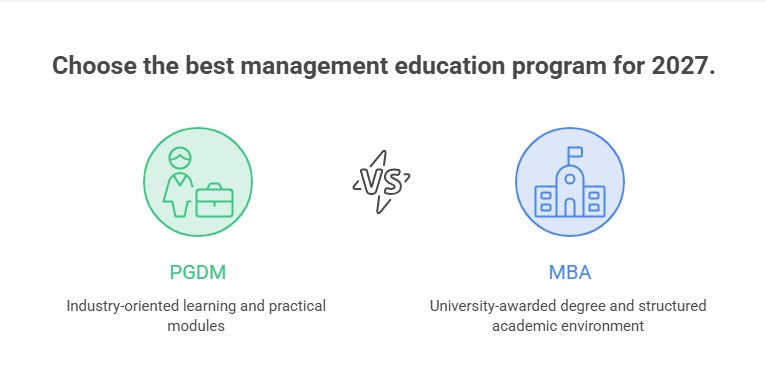
PGDM is a postgraduate management diploma, while MBA is a postgraduate management degree.
Both can support careers across finance, marketing, HR, operations, analytics, consulting and other business functions.
PGDM programmes are commonly associated with autonomous management institutions, while MBA programmes are offered through universities or affiliated institutions.
Fees and salary outcomes depend heavily on the individual institution and programme rather than the qualification title alone.
Students should compare recognition, curriculum, faculty, placements, industry exposure, specialisations and total cost before deciding. Bonus:PGDM admission in Delhi
What Is PGDM?
PGDM stands for Post Graduate Diploma in Management. It is a postgraduate management qualification generally offered by autonomous management institutions rather than as a university degree. PGDM programmes typically cover core business areas such as marketing, finance, human resources, operations, strategy and analytics while developing managerial, communication and decision-making capabilities.
The word “diploma” can sometimes cause confusion among students comparing PGDM vs MBA in India. However, the qualification title alone does not indicate programme quality or career value.
Students should verify the regulatory approval and recognition applicable to the specific institution and programme before admission. They should also examine curriculum quality, faculty, internships, industry interaction, specialisations and career support.
What Is the Difference Between PGDM and MBA?
The mainPGDM vs MBA difference concerns the type of qualification and awarding institution. An MBA is a master's degree awarded through a university framework, whereas a PGDM is a postgraduate diploma commonly offered by autonomous management institutes. Both can teach similar core management disciplines and prepare students for comparable corporate roles.
Comparison Factor
PGDM
MBA
Qualification
Postgraduate diploma
Master's degree
Common awarding institution
Autonomous management institute
University or institution authorised to award degrees
Regulatory context
AICTE is important for applicable PGDM programmes
Universities operate under the higher-education framework, including UGC requirements
Curriculum flexibility
Often comparatively flexible
Depends on university academic processes
Learning approach
Frequently emphasises cases, projects and industry applications
Can combine theoretical, analytical and practical learning
Career options
Corporate, consulting, finance, marketing, analytics, HR and operations
Similar management and business functions
Higher-study equivalence
Must be checked for the specific PGDM
MBA is itself a master's degree
Students comparing PGDM vs MBA in India should therefore avoid assuming that every PGDM is more practical or every MBA is more academic. Teaching quality and industry engagement depend on the individual institution.
Which Is Best: PGDM or MBA?
Neither PGDM nor MBA is universally better for every student. The best option depends on your career objectives, preferred learning environment, shortlisted institutions, programme quality, budget and long-term plans. A strong programme with relevant curriculum, credible recognition and good career preparation can matter more than choosing solely by qualification title.
When asking which is best PGDM or MBA, consider your priorities.
A PGDM may suit students who find a strong autonomous management institution offering relevant specialisations, practical learning and industry exposure. An MBA may suit candidates who specifically want a university-awarded master's degree or find a university programme that closely matches their academic and career requirements.
Before choosing either, compare:
Career services and skill development.
Recognition and approvals applicable to the programme
Curriculum and specialisation options
Faculty profile
Internships and practical projects
Industry interaction
Placement reports and recruiter information
Alumni outcomes
Total programme cost
Location and learning environment
Is PGDM Equivalent to MBA?
A PGDM is not automatically equivalent to an MBA simply because both teach management. UGC states that it does not determine equivalence between PGDM and master's degrees. Where academic MBA equivalence is important, students should verify whether the specific two-year full-time PGDM has current equivalence from the Association of Indian Universities and appropriate regulatory accreditation.
This distinction matters particularly for students planning higher studies or applying where eligibility specifically mentions an MBA, master's qualification or equivalent programme.
AICTE's current Approval Process Handbook specifies a two-year duration for the standard PGDM programme and sets requirements for applicable institutions. MBA, meanwhile, is listed by UGC as a specified master's degree.
Before admission, verify the status of the specific programme, not simply the institution's name. Recognition or equivalence should never be assumed from marketing terminology. Bonus:PGDM and MBA Differences
How Do PGDM vs MBA Fees Compare?
There is no universal winner in a PGDM vs MBA fees comparison because costs vary considerably between institutions. A programme's fee can depend on the college or university, location, facilities, programme structure and other institutional factors. Students should compare the complete cost rather than assuming PGDM is always more expensive than MBA.
Calculate expenses beyond the headline tuition fee, including accommodation, travel, study resources and other applicable charges.
More importantly, evaluate value rather than cost alone. Compare what the programme provides through curriculum, faculty, internships, industry exposure, career services and learning opportunities.
Always confirm current fees directly from the institution's official admission information before making financial decisions.d completing their qualifying degree within the required timeline.
What Is the PGDM vs MBA Career Scope?
Both PGDM and MBA graduates can pursue management-oriented opportunities across multiple industries and business functions. Career scope depends on specialisation, individual skills, prior experience, internships, institute quality and market conditions. Neither qualification automatically guarantees a particular role, employer, salary level or career outcome after graduation.
Depending on their programme and capabilities, graduates may explore areas such as:
Marketing and sales
Financial services and corporate finance
Human resource management
Operations and supply chain
Business analytics
Consulting
Product and project-related roles
Business development
Banking and financial services
Entrepreneurship and family businesses
For working professionals, the decision should also account for existing experience. A management qualification can complement domain knowledge, but career progression still depends on demonstrated capabilities and relevant opportunities..
How Does PGDM vs MBA Salary Compare?
There is no reliable universal PGDM vs MBA salary figure because compensation depends on the institution, employer, job role, industry, location, candidate profile and economic conditions. A PGDM graduate can earn more than an MBA graduate in one situation and less in another, making qualification title alone an unsuitable salary predictor.
When comparing colleges, examine placement information carefully instead of focusing only on the highest salary figure advertised.
Useful indicators include the types of roles offered, participating recruiters, sector distribution, internship opportunities and the methodology used for reporting placement outcomes.
Your communication skills, analytical ability, internships, specialisation knowledge, work experience and interview performance can also influence employment opportunities..
PGDM vs MBA After Graduation: How Should You Choose?
After graduation, choose between PGDM and MBA by matching programmes to your career direction rather than selecting a qualification based only on popularity. Start by identifying your preferred management field, budget and learning style, then compare recognised programmes on curriculum, specialisations, practical exposure, faculty, career support and admission requirements.
A simple decision process is:
Define the management roles or industries you want to explore.
Shortlist credible PGDM and MBA institutions rather than choosing the qualification first.
Verify programme recognition and applicable approvals.
Compare curriculum and specialisations.
Review internships, projects and industry interaction.
Examine placement information critically.
Calculate the total cost of attendance.
Compare admission requirements and accepted entrance examinations.
Speak with current students or alumni where possible.
Select the programme offering the strongest overall fit.
CAT, XAT, CMAT, MAT and other management entrance examinations may form part of admission routes depending on the institution. Applicants must verify which examination scores each shortlisted programme currently accepts.
MBA or PGDM: Which Is Better for Jobs?
Employers can consider much more than whether a candidate holds an MBA or PGDM. Institute reputation, role-specific knowledge, internships, communication, analytical ability, work experience and interview performance can all influence hiring. Therefore, students should focus on building employable management skills alongside obtaining an appropriately recognised qualification.
For jobs, evaluate what you will actually learn and demonstrate by graduation.
A marketing aspirant may need consumer understanding, communication, research and digital skills. Finance candidates may require financial analysis and quantitative capabilities. Analytics-oriented candidates benefit from data interpretation and relevant tools, while operations candidates need process and problem-solving abilities.
Choose the programme that provides credible opportunities to develop capabilities relevant to your target career. Bonus:Career Opportunities After PGDM
Conclusion
Choosing between PGDM and MBA requires more than comparing a diploma with a degree. Both routes can provide valuable management education and support careers across diverse business functions. The right decision depends on programme quality, recognition, curriculum, specialisations, faculty, industry exposure, fees, career services and your professional goals. Instead of asking whether PGDM or MBA is universally better, compare individual institutions and programmes on factors that matter to your future. Verify official information before applying, assess the total investment carefully and select a programme that develops relevant knowledge, practical skills and career readiness for the management path you genuinely want to pursue.
Dr. Vikas Gupta is a distinguished academic in the education and research domain, specializing in finance and related interdisciplinary studies. He is known for his...
These FAQs answer additional questions about recognition, admissions, career outcomes and choosing between PGDM and MBA in India.
01.
Does the word diploma make PGDM less valuable than MBA?
No, the word diploma alone does not determine career value. Employers can consider institute reputation, job-ready skills, internships, academic performance and relevant experience alongside the qualification. However, PGDM and MBA remain structurally different qualifications, so students should verify regulatory status and academic equivalence carefully when planning higher studies or applying for positions with specific eligibility requirements.
02.
Can a PGDM graduate apply for a PhD?
A PGDM graduate may be eligible for doctoral admission when the qualification satisfies the relevant university’s eligibility requirements, including applicable MBA equivalence. Students should verify whether their specific PGDM has current AIU equivalence and then check the PhD admission rules of the university concerned. Eligibility should not be assumed merely because a programme is AICTE-approved.
03.
Do companies prefer MBA graduates over PGDM graduates?
Not universally. Employer preferences differ by company, function, institution and role. Recruiters commonly evaluate management graduates through skills, academic performance, internships, work experience, communication ability and problem-solving capability. A candidate should therefore investigate which employers recruit from a particular business school and what job profiles they offer rather than selecting a programme solely by qualification title.
04.
Can students from engineering, science or arts backgrounds pursue PGDM?
Yes, management programmes commonly accept graduates from diverse academic backgrounds when they satisfy the institution’s eligibility requirements. Engineering, science, commerce, humanities and other graduates may therefore consider PGDM programmes. Applicants should verify graduation requirements, accepted entrance examinations and selection criteria directly from the institution’s current admission information because eligibility conditions are not identical across business schools.
05.
Is work experience necessary for a two-year PGDM or MBA?
Work experience is not necessarily required for many regular two-year management programmes, although individual eligibility conditions vary. Fresh graduates commonly apply to MBA and PGDM programmes, while prior professional experience can strengthen a candidate’s practical perspective. Working professionals should compare classroom profiles, programme format and career outcomes to determine whether a particular course matches their experience level.
06.
Which entrance exams should PGDM aspirants prepare for?
CAT, XAT, CMAT, MAT, ATMA and GMAT are among the examinations considered for PGDM admissions under the current AICTE framework, although individual institutions choose which scores they accept. Applicants should shortlist business schools first and create an exam-to-college map so they can prepare for examinations that provide the widest relevant application opportunities for their preferred programmes.
07.
Does PGDM offer better industry exposure than MBA?
PGDM programmes can offer substantial industry exposure, but it cannot be guaranteed from the qualification name. Autonomous institutes may have greater flexibility to introduce contemporary electives, corporate projects and industry-led learning. Many MBA programmes also provide internships and practical education. Compare the actual curriculum, projects, faculty, corporate partnerships and internship structure of each shortlisted programme before deciding.
08.
What matters most when comparing business schools for 2027?
Programme credibility, curriculum quality and career fit matter most. Applicants should also review recognition, faculty, internships, specialisations, recruiter profiles, placement transparency, alumni outcomes, location, total cost and learning environment. For PGDM programmes, verify current AICTE approval and relevant AIU equivalence rather than assuming these automatically apply to every programme offered by an institution.

















.webp) Call Us
Call Us