Introduction
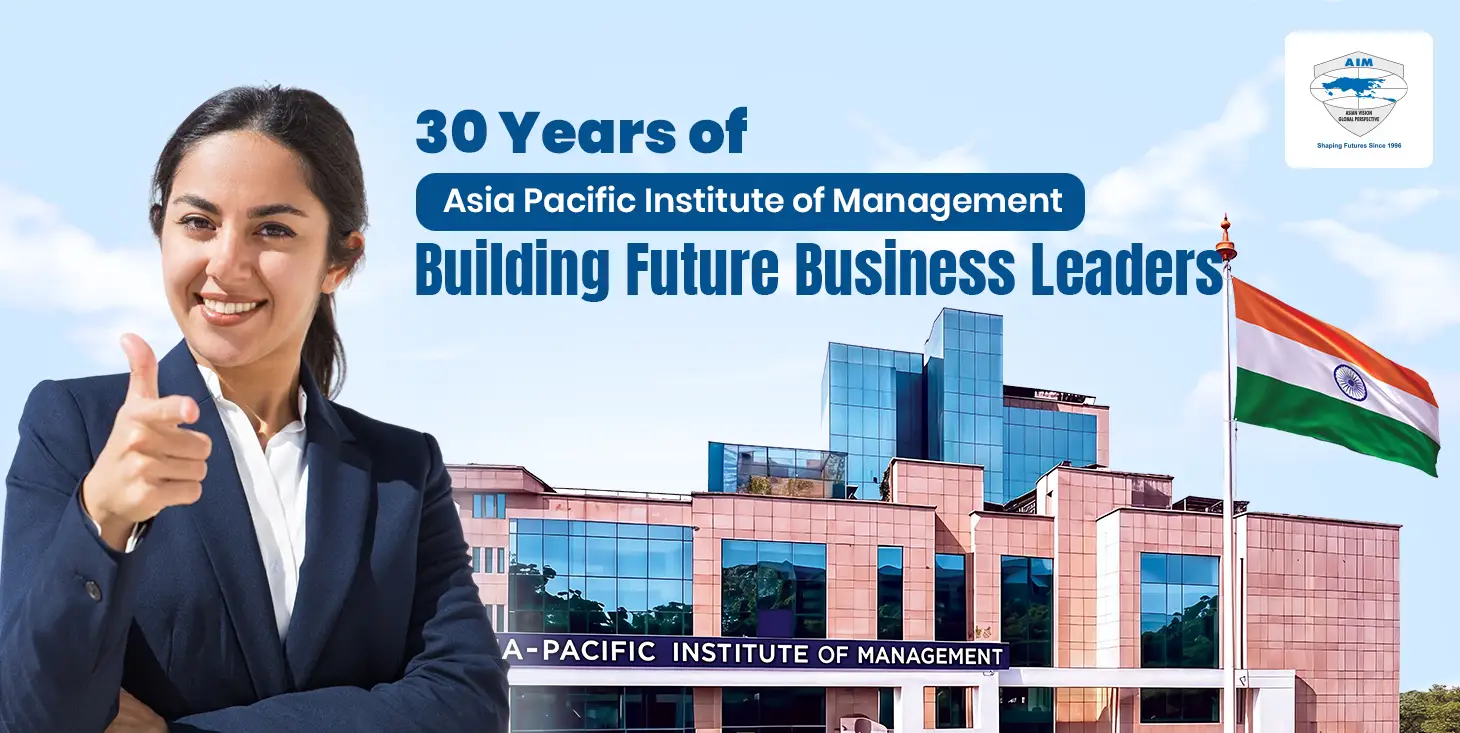
For three decades, asia pacific institute of management has been part of Delhi’s evolving management education landscape, adapting its approach as business, technology, and workplace expectations have changed. Established in 1996, the institute’s journey reflects a broader transformation in management education—from conventional classroom instruction towards experiential learning, digital tools, industry interaction, research, and leadership development.
Understanding this journey is useful not only for prospective students but also for parents, alumni, educators, and professionals interested in how a management institution develops over time. This brand story explores the Asia Pacific Institute history, important stages in its development, its approach to management education, and the continuing challenge of preparing learners for increasingly complex business environments.
Inviting Applications for PGDM
2027–29 at AIM
Apply Now
Key Takeaways
- Asia Pacific Institute of Management was established in 1996, giving it a three-decade history in management education.
- AIM’s development has included programme expansion, learning infrastructure, industry engagement, and technology-enabled education.
- The institute’s management education approach connects academic foundations with practical business learning and professional development.
- Its New Delhi location places students within a major commercial, corporate, and professional ecosystem.
- A 30-year legacy matters most when experience continues to inform relevant, responsible, and future-focused management education.
Bonus: what makes a good B-school
What Is Asia Pacific Institute of Management?
Asia Pacific Institute of Management is a management institution established in 1996 and located in Jasola Vihar, New Delhi. AIM provides management education through programmes that combine academic foundations with practical and industry-oriented learning. Over three decades, the institute has evolved alongside changes in business, technology, management practice, and professional expectations.
How Did the Asia Pacific Institute History Begin?
The Asia Pacific Institute history began in 1996, when AIM was established as a management institution offering PGDM education. Its foundation marked the beginning of a journey focused on developing management knowledge and professional capabilities while responding to the changing requirements of businesses and the wider economic environment.
The mid-1990s represented an important period for Indian business. Economic liberalisation was reshaping industries, competition was expanding, and organisations increasingly required managers capable of operating in a more dynamic marketplace.
Management education consequently needed to move beyond understanding business functions independently. Students also needed to understand how marketing, finance, operations, people management, strategy, and decision-making connected within organisations.
Against this backdrop, AIM began its journey in management education. What started in 1996 developed over subsequent decades as the institution expanded its academic approach and responded to changing expectations from students and industry.
For anyone exploring AIM Delhi history, the foundation year is therefore more than a chronological milestone. It provides the starting point for understanding how the institution has developed across different generations of management education.
How Has AIM Evolved Over 30 Years?
AIM’s evolution over 30 years has involved changes in programmes, academic resources, learning methods, industry engagement, and technology. Its institutional timeline includes programme expansion, the development of The Athenaeum library, and the adoption of digital and hybrid learning approaches as management education became increasingly technology-driven and globally connected.
An institution operating for three decades encounters several generations of change. Business models evolve, technologies emerge, industries transform, and employers reconsider the capabilities they need from management graduates.
AIM’s published institutional timeline identifies several stages in this journey:
- 1996: Foundation of the institute and beginning of its management education journey.
- 2008: Expansion through additional specialisations and executive programmes.
- 2015: Opening of The Athenaeum library to strengthen learning and research resources.
- 2020: Greater adoption of hybrid learning, digital classrooms, and technology-integrated pedagogy.
These milestones illustrate an important principle of management education: longevity alone does not create relevance. Institutions must continue adapting their academic environment as the context in which managers operate changes.
The transformation from predominantly physical learning resources to digital and hybrid environments is one example. Today, management students encounter data, analytics, artificial intelligence, digital marketing, technology-enabled operations, and rapidly changing consumer behaviour alongside established management disciplines.
Why Does a 30-Year Legacy Matter in Management Education?
A 30-year legacy can provide institutional experience, academic continuity, alumni connections, and perspective on changing business requirements. However, longevity has meaningful educational value only when an institution continues to evolve. For a management institute Delhi students may consider, history should complement current curriculum relevance, learning quality, industry exposure, and professional development.
Three decades allow an institution to observe how different economic cycles, technologies, and management practices reshape the workplace. That accumulated experience can help create continuity while academic practices continue to develop.
A legacy also extends through people. Faculty, students, alumni, visiting professionals, institutional partners, and staff collectively contribute to the knowledge and culture developed over time.
For prospective students, however, “30 years” should not function merely as a brand statement. A useful way to understand an educational legacy is to ask what the institution has learned during that period and how those lessons influence education today.
That means examining whether experience supports:
- Relevant management learning
- Practical exposure
- Academic and professional development
- Adaptation to technological change
- Industry interaction
- Leadership and decision-making capabilities
- A culture of continuous learning
Viewed this way, institutional history becomes a foundation for ongoing development rather than simply a record of the past.
How Does AIM Approach the Development of Future Business Leaders?
AIM’s approach to developing future business leaders combines management concepts with practical learning, industry interaction, professional skills, and exposure to contemporary business challenges. The objective of modern management education is not simply to transfer theoretical knowledge, but to help learners analyse problems, make decisions, communicate effectively, collaborate, and adapt to changing environments.
The meaning of business leadership has changed considerably since 1996. Managers today operate in environments influenced by digital transformation, global competition, sustainability considerations, analytics, artificial intelligence, changing workforce expectations, and new customer behaviours.
Consequently, leadership preparation requires more than memorising frameworks.
Case discussions can encourage students to examine ambiguous situations. Projects can connect concepts with practical problems. Presentations can develop structured communication. Team assignments can expose learners to different perspectives, while industry interactions can help them understand how organisations apply management principles.
This combination matters because business decisions rarely belong to one discipline. A pricing decision, for example, may involve marketing, finance, customer behaviour, competition, operations, and strategy simultaneously.
The role of a modern asia pacific management institute is therefore broader than teaching individual subjects. Management education must help learners connect disciplines and apply their understanding to situations where there may not be one obvious answer.
What Role Does Delhi Play in AIM’s Management Education Story?
Delhi is an important part of AIM’s institutional context because the institute is located in Jasola Vihar, New Delhi, within the wider Delhi NCR economic environment. For management learners, studying in a major metropolitan region can provide proximity to diverse industries, businesses, professional networks, events, and perspectives beyond the classroom.
Location does not automatically determine the quality of management education, but it can influence the environment surrounding it.
Delhi NCR encompasses corporate offices, financial and professional services, technology businesses, startups, public institutions, manufacturing centres, and other organisations across Delhi and neighbouring commercial hubs. Such diversity provides a relevant setting for observing how different sectors operate.
For a business school Delhi location also brings students into contact with a highly diverse population. That can matter because management is fundamentally about working with markets, organisations, customers, teams, and stakeholders with different needs.
AIM’s location in Jasola Vihar therefore forms part of its broader institutional identity. The educational value, however, depends on how effectively the academic experience connects learners with relevant professional and business contexts.
Bonus: role of management education
How Has Technology Changed Management Education at AIM?
Technology has changed management education by expanding access to digital resources, enabling technology-supported classrooms, and increasing the importance of data-driven business skills. AIM identifies digital transformation as part of its institutional development, including the adoption of hybrid learning, digital classrooms, and technology-integrated pedagogy around the beginning of the 2020s.
Technology is no longer a separate concern for technology companies alone. Marketing teams use analytics and automation, finance functions rely on sophisticated digital systems, operations increasingly depend on data, and managers across functions encounter artificial intelligence and digital collaboration tools.
This transformation affects what business students need to learn and how they learn it.
The management classroom must consequently connect established principles—such as strategy, finance, marketing, operations, and organisational behaviour—with emerging business realities. Students need both conceptual understanding and the ability to continue learning as technologies change.
For an institution with roots in 1996, this creates an interesting contrast. The fundamental purpose of management education remains focused on better decision-making and leadership, while the tools, data, markets, and environments surrounding those decisions continue to evolve.
Bonus: choosing Asia Pacific Institute for management education
What Can the Next Chapter of AIM’s Journey Focus On?
The next chapter of AIM’s journey can build on three decades of experience while responding to emerging requirements in management education. Future business leaders will need analytical capability, technological awareness, ethical judgement, communication skills, adaptability, and cross-functional thinking alongside strong management fundamentals to navigate increasingly complex organisations and markets.
A 30-year milestone naturally encourages reflection, but it also raises a forward-looking question: what should management education prepare students for next?
Artificial intelligence is changing workflows. Data is becoming central to decisions across business functions. Organisations are paying greater attention to sustainability, governance, resilience, cybersecurity, and rapidly shifting consumer expectations. At the same time, human capabilities such as judgement, collaboration, empathy, negotiation, and leadership remain important.
This means future-focused management education cannot choose between traditional business fundamentals and emerging skills. It must connect them.
For AIM, three decades provide institutional history from which to continue evolving. The enduring challenge is to ensure that each new generation receives an education relevant to the business environment it will actually enter.
That is how a legacy remains active rather than becoming purely historical.
Conclusion
Thirty years of Asia Pacific Institute of Management represent a journey that began in 1996 and continues through changing business and educational environments. Across this period, management education has evolved from conventional classroom models towards more experiential, technology-enabled, industry-connected learning. AIM’s story reflects that wider transformation while retaining its focus on management knowledge and professional development. For students, alumni, educators, and the broader community, the significance of a three-decade legacy lies not simply in longevity, but in continued relevance. The next chapter will depend on connecting accumulated institutional experience with the skills, judgement, adaptability, and leadership demanded by future businesses.
Inviting Applications for PGDM
2027–29 at AIM
Apply Now
About the Author
Dr. Vikas Gupta
Dr. Vikas Gupta is a distinguished academic in the education and research domain, specializing in finance and related interdisciplinary studies. He is known for his...
Read Full Bio →
















.webp) Call Us
Call Us