What Is It Like to Study at a Business School in South Delhi? Inside AIM Student Life
Posted on 01 Oct 2026
By Dr. Vikas Gupta
Introduction
What is everyday life really like at a business school in South Delhi? For management aspirants, the answer involves much more than classrooms and lectures. A business-school experience can include case discussions, presentations, group projects, peer interaction, student activities, practical learning and time spent in libraries or common spaces.
Asia-Pacific Institute of Management (AIM) is located in Jasola Vihar, New Delhi, in the Institutional Area. Its published campus information describes classrooms, a library and resource centre, IT infrastructure, an auditorium, cafeteria, student activities, clubs, committees, sports and other facilities.
For someone comparing a B school South Delhi or a management college South Delhi, understanding how these elements fit together can be more useful than judging a campus only by photographs or brochures.
Executive Health MBA
Enhance your hospital administration skills with a specialized executive management degree now.
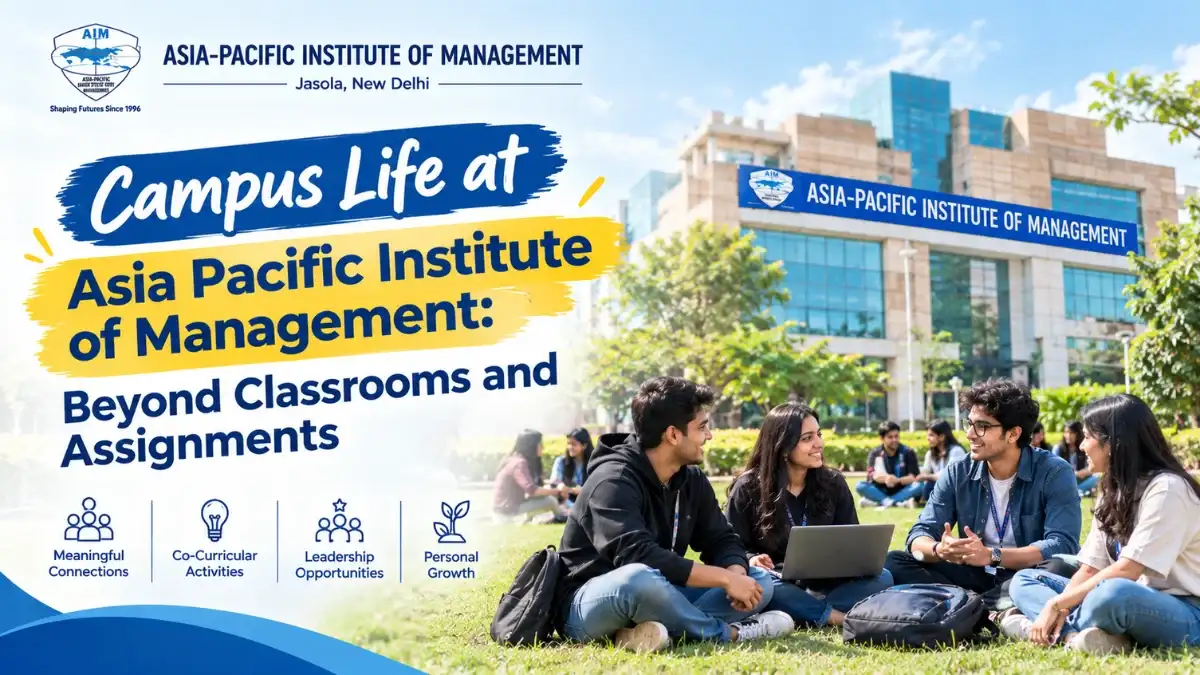
AIM student life extends beyond lectures, combining academic work with peer interaction, projects, presentations, clubs, events and professional activities.
The campus is located in Jasola Vihar, New Delhi, making location and daily commute relevant considerations for prospective students.
Learning spaces include classrooms, the Athenaeum library and resource centre, IT facilities, auditorium and cafeteria, supporting different parts of student life.
Practical learning can include case discussions, simulations, presentations, role plays, projects and team activities, depending on the programme and academic cycle.
Campus fit is personal, so aspirants should consider academics, facilities, student activities, location, accommodation and their own preferred way of learning.
What Does Student Life at a Business School in South Delhi Look Like?
Student life at a business school in South Delhi typically combines structured academic responsibilities with activities that require students to communicate, collaborate and manage their time.
At AIM, published information describes student life through academics, peer interaction, clubs, committees, events, sports, projects and professional-development activities.
This means the experience is not limited to sitting through lectures. A student may move between a classroom discussion, a group assignment, library research, presentation preparation and an activity organised by a student club.
The exact routine varies by programme, batch, academic calendar and individual participation. Therefore, an aspirant should think of “student life” as an environment rather than a fixed daily schedule.
Where Is AIM Located in South Delhi?
AIM is located at 3 & 4, G.D. Birla Marg, Institutional Area, Jasola Vihar, New Delhi, Delhi 110025. The location can be relevant to students deciding whether to commute from home or consider accommodation closer to campus.
For management aspirants, location matters for practical reasons. A daily commute can influence how much time is available for classes, assignments, group work and extracurricular activities.
Students living outside Delhi NCR should also consider accommodation and travel arrangements before selecting a PGDM college South Delhi. Those already living in Delhi can estimate their expected commute during regular class hours rather than relying only on map distance.
A campus location should not be considered in isolation. Programme structure, curriculum, fees, admission requirements and learning environment remain important parts of the overall decision.
What Are Academics Like at AIM?
AIM's published campus information describes an academic environment that can combine classroom teaching with case discussions, presentations, projects, simulations, role plays, team assignments and other experiential activities.
For management students, this approach can make the classroom more interactive. Instead of only learning a business concept, students may be asked to analyse a situation, discuss possible solutions or present their reasoning.
For example, a case discussion may require a team to examine a business problem and defend a proposed solution. A presentation can require students to organise information and communicate it clearly to classmates and faculty.
These activities can help students practise:
Analytical thinking
Communication
Teamwork
Presentation skills
Problem-solving
Decision-making
Negotiation
The specific activities, however, depend on the programme and subject. Aspirants should review the current curriculum of their intended programme rather than assuming that every course uses the same teaching methods.
What Facilities Can Students Use on Campus?
A business-school campus becomes meaningful when its facilities support the way students actually learn and work.
AIM's published campus information includes smart classrooms, the Athenaeum library and resource centre, IT infrastructure, an auditorium, cafeteria and spaces for collaboration and student activities.
Classrooms and Learning Spaces
Classrooms are central to everyday management education. Since management courses can involve presentations and discussions alongside lectures, seating, presentation facilities and the overall classroom environment can influence the learning experience.
During a campus visit, aspirants can observe whether classrooms appear suitable for discussion, presentations and student-faculty interaction.
Library and Resource Centre
The Athenaeum, AIM's library and resource centre, provides academic resources including management books, textbooks, reference materials, periodicals and journals.
For students, a library can become particularly useful during assignments, projects and independent research. When visiting a business school campus Delhi aspirants should ask about both physical and digital resources relevant to their programme.
IT Infrastructure
Digital tools are increasingly relevant to management education. Students may use technology for research, presentations, datasets, assignments and programme-specific learning.
Aspirants interested in analytics or technology-focused management programmes should therefore ask what resources are relevant to their specific course rather than judging IT infrastructure only by the presence of computer facilities.
Auditorium and Common Areas
An auditorium can support seminars, institutional programmes, guest interactions and student events, while the cafeteria and common areas provide spaces for informal interaction and breaks.
These spaces are part of the everyday environment that students experience outside scheduled classes.
How Important Are Clubs, Events and Peer Interaction?
Student activities can add another dimension to management education because they create opportunities to work with people outside regular classroom assignments.
AIM's published student-life information includes clubs, committees, events, sports, peer interaction and professional activities.
Participation can help students practise organisation, teamwork and communication in settings different from academic assessments. A student involved in organising an event, for example, may need to coordinate with peers, manage responsibilities and communicate information clearly.
However, participating in every activity is not necessarily the objective. Management students also have classes, projects, presentations and independent preparation to manage.
A more useful approach is to select activities that match personal interests and development goals.
What Could a Typical Day at AIM Feel Like?
There is no single official daily timetable that represents every AIM student. Published AIM material specifically notes that an illustrative student day can vary according to programme, batch, academic calendar and individual responsibilities.
A typical management-school routine may include:
Attending scheduled classes
Participating in classroom discussions
Working on group assignments
Preparing presentations
Conducting independent research
Meeting classmates for project work
Taking part in student activities
Using library or digital resources
Preparing for upcoming assessments
This combination can make management education different from a programme based mainly on lectures and examinations.
The experience also depends on how actively a student participates. Two students in the same classroom can have very different campus experiences depending on their academic interests, social involvement and time-management habits.
For a closer look at this routine, students can explore the day-to-day perspective before comparing it with their own expectations.
For students relocating to Delhi, accommodation can be an important part of evaluating a management college South Delhi.
AIM publishes hostel information for boys and girls, including room options and academic-year fees. For the 2026–27 and 2027–28 sessions, the published annual hostel fee is ₹1,50,000 for a non-AC double-sharing room and ₹1,70,000 for an AC room. The institute also notes that availability is limited for the boys' hostel.
These figures should be checked against the current hostel information before making financial plans because accommodation charges and availability can change.
Students should consider more than the room itself. Questions about meals, rules, room arrangements, payment schedules, availability and commuting should be clarified before admission.
How Does a South Delhi Location Add to the Student Experience?
Studying at a business school in South Delhi places the campus within the broader Delhi NCR environment, but location alone does not guarantee industry exposure or career opportunities.
The value comes from how the institution connects academic learning with practical activities, projects, internships, industry interaction and student initiative.
For an aspirant, the location can still influence everyday convenience. Students can compare expected commute time, accommodation requirements and access to the campus against the programme schedule.
The most useful question is therefore not simply, “Is South Delhi a good location?” Instead, ask whether the particular location works for your routine and whether the institution provides learning opportunities that match your management goals.
What Should You Check During an AIM Campus Visit?
A campus visit can help turn online research into a more practical comparison. AIM's published campus guide recommends looking at facilities, student activities, accommodation arrangements, commute and programme-specific information during a visit.
Use this checklist:
Area
What to Check
Classrooms
Seating, presentation facilities and learning environment
Library
Physical and digital academic resources
IT facilities
Technology relevant to your programme
Student spaces
Areas for interaction and collaborative work
Auditorium
Seminars, events and institutional activities
Clubs and committees
Activities that match your interests
Accommodation
Availability, room type and current charges
Location
Daily commute and accessibility
Programme
Current curriculum, eligibility and academic structure
This approach is more useful than simply deciding whether a campus “looks good.” It helps you assess whether the environment fits your academic and practical requirements.
How Can Management Aspirants Decide Whether AIM Student Life Fits Them?
The best way to evaluate AIM student life is to separate the experience into four areas: academic fit, infrastructure fit, student-experience fit and practical fit.
Academic fit asks whether the programme and teaching approach match your preferred way of learning.
Infrastructure fit considers whether classrooms, library resources, IT facilities and collaborative spaces support your requirements.
Student-experience fit looks at whether clubs, committees, sports, events and peer activities offer opportunities you would genuinely use.
Practical fit covers location, accommodation, commute, budget and daily routine.
This framework can also help students compare AIM with another B school South Delhi without relying on a single feature.
What Should You Look For in a PGDM College South Delhi?
When comparing a PGDM college South Delhi, look beyond the campus building. A meaningful comparison should include programme content, eligibility, fees, learning methods, faculty information, practical exposure, student activities and the institution's current facilities.
For a management aspirant, the right questions include:
Does the programme match my intended career direction?
Are the subjects relevant to current business requirements?
How much practical and collaborative learning is included?
What facilities will I actually use?
What student activities interest me?
Is the campus location convenient?
What accommodation options are available if I relocate?
Have I checked current admission and fee information?
A campus can contribute to the overall student experience, but it should be considered alongside academic and programme-related factors. Bonus:AIM campus and student experience
Conclusion
Studying at a business school in South Delhi can involve much more than attending classes. At AIM, published information describes a campus environment that combines academic spaces, library resources, IT facilities, practical learning, student activities, peer interaction and professional-development opportunities. The Jasola Vihar location also makes commute and accommodation relevant practical considerations. For management aspirants, the most useful approach is to evaluate the campus according to personal academic needs, preferred activities and daily routine. A campus visit, combined with current programme and admission information, can provide a clearer picture of whether AIM fits your expectations.
Executive Health MBA
Enhance your hospital administration skills with a specialized executive management degree now.
Dr. Vikas Gupta is a distinguished academic in the education and research domain, specializing in finance and related interdisciplinary studies. He is known for his...
These questions help management aspirants understand AIM student life, campus facilities, location, practical learning and what to check before choosing a business school.
01.
What is student life like at a business school in South Delhi?
Student life can combine classes with group projects, presentations, case discussions, peer interaction, clubs, events and independent study. At AIM, published information describes these activities alongside academic facilities and professional-development opportunities. Individual experiences vary according to programme, workload and participation.
02.
Where is AIM located?
AIM is located at 3 & 4, G.D. Birla Marg, Institutional Area, Jasola Vihar, New Delhi, Delhi 110025. Students should consider the location in relation to their daily commute, accommodation requirements and expected class routine.
03.
What facilities are available at AIM campus?
Published AIM information lists classrooms, the Athenaeum library and resource centre, IT infrastructure, auditorium, cafeteria and other learning and student spaces. The relevance of each facility depends on the student’s programme and how they use the campus.
04.
Does AIM provide practical learning?
Yes. AIM’s published campus information describes case discussions, presentations, simulations, role plays, projects, team assignments and other experiential learning activities. Specific methods can vary by programme, subject and academic cycle.
05.
Does AIM have hostel facilities?
Yes. AIM publishes hostel information for boys and girls. Current published information lists non-AC and AC double-sharing options, with fees varying by room type. Availability and charges should be confirmed using the latest institutional information before admission.
06.
What can students do outside classes at AIM?
Published student-life information includes clubs, committees, events, sports, peer interaction and professional activities. Students can choose activities according to their interests and available time, while balancing them with classes, assignments, projects and presentations.
07.
Should I visit AIM campus before applying?
A campus visit can be useful because it allows aspirants to observe classrooms, library resources, common areas and the overall environment directly. It also provides an opportunity to ask programme-specific questions and assess commute or accommodation requirements.
08.
How should I compare AIM with another management college in South Delhi?
Compare both institutions using consistent criteria: programme structure, curriculum, practical learning, facilities, student activities, current fees, admission requirements, accommodation and location. This reduces the risk of choosing based only on campus appearance or one advertised feature.


















.webp) Call Us
Call Us