BBA Course Fees in India: Affordable Govt Colleges vs Premium Private B-Schools
Posted on 11 Jul 2026
By Dr. Vikas Gupta
Understanding BBA course fees in India is one of the most important steps for parents planning their child’s undergraduate management education. A BBA is not only a degree expense. It is a four-year investment in business knowledge, communication, internships, corporate exposure, and career readiness.
However, fees can vary widely across government institutions, state university-affiliated colleges, and premium private B-schools.
For budget-conscious parents, the right question is not only “Which BBA is cheaper?” The better question is: “Which BBA gives the right balance of affordability, quality, exposure, and placement support?”
BBA Course Fees in India: Why Fees Vary So Much
BBA course fees in India vary because colleges differ in affiliation, location, infrastructure, faculty profile, internship support, placement ecosystem, hostel facilities, industry exposure, and value-added learning.
A low-cost BBA may reduce financial pressure. However, it may not always offer the same exposure, mentoring, corporate interface, or placement preparation.
On the other hand, a premium BBA may offer stronger facilities and exposure. However, parents should check whether the additional cost is justified by outcomes.
Therefore, fees should be evaluated with ROI, not emotion. Bonus:BBA admission process
Fee Comparison Matrix: BBA Options for Parents
BBA Option
Typical Fee Position
Best For
What Parents Should Check
Government institutions
Usually lower cost
Students prioritising affordability
Seats, admission cut-offs, exposure, support
State university schools
Moderate and regulated
Students wanting recognised structure
Official fee notice, degree structure, counselling rules
Parents should avoid judging a BBA only by tuition. The total cost of education is usually larger.
BBA Course Fees Plan
Explore BBA fee structures across Indian colleges. Evaluate top business program costs, return on investment, and scholarship choices for your future today!
A BBA fee may include several academic and institutional components.
Fee Component
Meaning
Tuition fee
Core academic teaching cost
University charges
Charges payable to the affiliating university
Examination fee
Exam-related charges
Development fee
Infrastructure and academic development cost
Library and lab charges
Academic resource cost
Activity fee
Student activities and events
Alumni fee
One-time alumni contribution, where applicable
Security deposit
Refundable deposit, where applicable
Internship support
May be included or separately supported
Value-added learning
Workshops, certifications, seminars, or events
Parents should ask for a written fee breakup before confirming admission.
UGC’s Public Self-Disclosure Guidelines state that higher education institutions should provide admission and fee-related information on their websites, including prospectus, fee structure, admission process, and fee refund policy.
IP University BBA Fees Structure: What Parents Should Know
Many students searching for BBA colleges in Delhi or BBA colleges in Delhi NCR also look at the IP University BBA fees structure because several BBA institutes are affiliated with Guru Gobind Singh Indraprastha University.
For the 2026–27 admission brochure, GGSIPU notes that fee structures for self-financing affiliated institutes in Delhi are determined through the State Fee Regulatory Committee framework. It also states that candidates admitted in 2026–27 must pay the notified fee.
The same GGSIPU fee chapter lists University School of Studies fee details for four-year undergraduate programmes such as BBA, B.Com(H), BA(JMC), BA(B.Ed), and BA Economics. For 2026–27, the total first-year amount shown is ₹1,56,500, followed by ₹1,66,600 for 2027–28, ₹1,79,910 for 2028–29, and ₹1,94,551 for 2029–30.
Parents must remember one important point. University School fees and affiliated institute fees may not be identical. Always check the latest official fee notice and institute-specific fee communication before payment.
Affordable Government BBA vs Premium Private BBA
A low-cost BBA government institute can be attractive because the direct academic fee may be lower. However, affordability should not be the only decision factor.
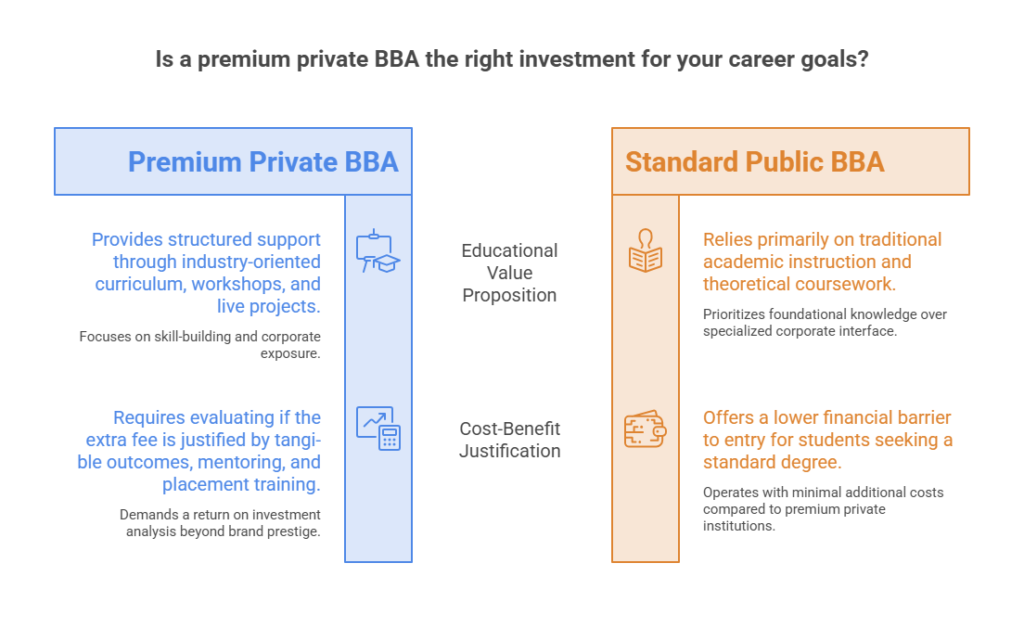
Premium private BBA programs may cost more. Yet, they may offer stronger infrastructure, corporate exposure, skill development, internships, and placement preparation.
The right choice depends on the student’s goals, budget, confidence, and career expectations.
Total Cost of BBA: Tuition Is Not the Only Expense
Parents often compare only tuition fees. However, the real cost includes several other items.
Total Cost Checklist
Expense Head
Why It Matters
Tuition fee
Main academic cost
University and exam charges
Often payable every year
Hostel management expense
Important for outstation students
Food and living cost
Monthly cost affects total budget
Travel cost
Daily commute or yearly travel
Books and learning resources
Academic support
Laptop and internet
Essential for BBA coursework
Certifications
Useful for skill-building
Internships
May involve travel or relocation
Formal wear and events
Useful for presentations and interviews
A low tuition fee may still become expensive if hostel, travel, and living costs are high.
Hostel Management Expense: What Parents Should Calculate
Hostel management expense can significantly change the total BBA budget.
Before choosing any BBA institute, parents should ask:
Is hostel available?
Is it on-campus or nearby?
What is included in the hostel fee?
Are meals included?
Are laundry and transport included?
What are electricity and maintenance rules?
What is the refund policy?
Is security available?
What is the distance from campus?
For Delhi NCR students, daily commute may be cheaper than hostel living. However, outstation students should calculate hostel, meals, transport, and personal expenses together.
BBA ROI: How Parents Should Evaluate Return on Investment
ROI does not mean only first salary after graduation. For a BBA, ROI includes career readiness, internship exposure, communication skills, practical learning, and higher education preparation.
A strong BBA ROI includes:
ROI Factor
What to Check
Degree recognition
Is the degree from a recognised university?
Curriculum
Does it include current business subjects?
Internships
Are internships supported?
Corporate exposure
Are guest lectures and live projects included?
Communication training
Does the student become interview-ready?
Placement support
Is career support available?
Skill development
Are Excel, analytics, digital, and presentation skills taught?
Alumni outcomes
Do graduates move into good roles or higher studies?
Location advantage
Does the city offer internships and exposure?
A cheaper course with weak exposure may not be the best value. Similarly, a costly course without outcomes may not be worth it.
Why Fee Comparison Should Include Curriculum Quality
Parents should check what the student will actually learn.
A strong BBA curriculum should include:
Management fundamentals
Business communication
Marketing management
Financial accounting
Business economics
Human resource management
Business law
E-commerce
Business analytics
Digital marketing
Entrepreneurship
Internships
Projects
Research or capstone work
Asia Pacific Institute of Management’s BBA program is affiliated with GGSIPU and follows a 4-year, 8-semester structure designed as per NEP guidelines. The program page highlights industry-oriented curriculum, strong corporate interface, paid internships, hands-on projects, global exposure, experienced faculty, and practical learning.
This matters because parents are not only paying for classes. They are paying for career-building exposure.
BBA Course in Delhi NCR: Why Location Affects Value
Students searching for BBA course in Delhi NCR, BBA colleges in NCR region, best colleges for BBA in Delhi NCR, or best private BBA colleges in Delhi usually want both affordability and exposure.
Delhi NCR can support BBA students through:
Corporate offices
Startups
Financial service firms
Digital agencies
Retail companies
Internship opportunities
Business events
Industry interactions
Placement preparation
However, location alone is not enough. Parents should check whether the institute actively connects students with these opportunities.
Asia Pacific Institute of Management’s BBA page states that its admission pathway includes IPU CET or CUET-UG, merit list preparation, centralized counselling through GGSIPU, seat allotment, and document verification. Bonus:BBA first year internships
Fee Comparison Matrix for Budget-Conscious Parents
Use this matrix while comparing BBA options.
Parent Question
Why It Matters
What to Ask the Institute
What is the total fee?
Avoids hidden cost confusion
“Please share complete year-wise fee.”
Is the fee approved or notified?
Builds trust
“Is the fee university-notified or regulated?”
Are exam fees included?
Prevents later surprises
“Are examination charges separate?”
What is the hostel cost?
Major outstation expense
“What is the yearly hostel and mess fee?”
Is refund policy clear?
Protects parents financially
“What happens if we withdraw?”
Are internships supported?
Improves employability
“Are internships paid or assisted?”
What placement support exists?
Helps career outcomes
“How do you prepare students for placements?”
What skills are taught?
Improves ROI
“Do students learn Excel, analytics, communication, and digital tools?”
This matrix helps parents compare value, not just price.
Best Value BBA Degree
Find affordable BBA degrees in top Indian universities. Compare total tuition costs, placement packages, and financial options to start your executive path!
Low Cost BBA Government Institute: When It Makes Sense
A low cost BBA government institute may be a smart choice when the student is self-driven and the family budget is tight.
It may make sense if:
The student can compete for limited seats.
The degree is recognised.
The location is manageable.
The student can arrange internships independently.
The student plans to pursue MBA or PGDM later.
The family wants lower financial risk.
However, parents should still check faculty, curriculum, student support, exposure, and career services.
A low fee should not mean low ambition.
Premium Private BBA: When It Can Be Worth It
A premium private BBA can be worth considering when the student needs structured support and strong exposure.
It may make sense if the institute offers:
Industry-oriented curriculum
Skill-building workshops
Regular presentations
Case studies
Live projects
Internship support
Placement training
Corporate interface
Experienced faculty
Safe and accessible location
Parents should compare the extra fee with the extra value.
Do not pay only for a brand name. Pay for outcomes, mentoring, skills, and exposure.
How to Avoid Fee-Related Mistakes
Parents should avoid these common mistakes:
Comparing only first-year fees
Ignoring hostel and living costs
Not asking about annual fee increase
Not checking refund policy
Not verifying degree recognition
Not asking about internship support
Assuming high fees guarantee placements
Choosing only the cheapest option
Ignoring commute and safety
Not checking written fee details
A good admission decision should feel financially clear.
BBA Placement ROI: What Parents Should Ask
Students often search for the best BBA placement college in India. However, parents should avoid judging placement only by one headline number.
Ask practical questions:
Placement Question
Why It Matters
Are BBA students given placement preparation?
Shows structured support
Are internships part of the program?
Builds employability
Which skills are taught before placements?
Shows readiness
Are students trained for interviews?
Improves selection chances
Are corporate interactions regular?
Builds confidence
Are alumni outcomes visible?
Shows credibility
Are placement claims program-specific?
Avoids confusion
Placement support matters, but students must also build communication, Excel, presentation, teamwork, and business awareness.
Why Asia Pacific Institute of Management Can Be Considered
Students exploring BBA in India and looking for a career-focused BBA institute in Delhi can consider Asia Pacific Institute of Management.
The BBA program is affiliated with GGSIPU and follows a 4-year, 8-semester NEP-aligned structure. It focuses on industry-oriented curriculum, practical exposure, paid internships, hands-on projects, corporate interface, global exposure, experienced faculty, and career support.
The course outline includes subjects such as Business Communication, Marketing Management, Decision Techniques for Business, E-Commerce, Financial Management, Business Analytics, Digital Marketing & Strategy, Entrepreneurship Development, dissertation, internship, and capstone components.
For parents, this means the BBA decision can be evaluated on both affordability and employability.
Parent Decision Framework: Fee vs Value
Before final admission, parents can use this simple framework.
Decision Area
Score Out of 5
Fee transparency
/5
Degree recognition
/5
Curriculum relevance
/5
Internship support
/5
Placement support
/5
Faculty and mentoring
/5
Corporate exposure
/5
Location and safety
/5
Hostel and commute cost
/5
Student confidence after campus visit
/5
A good BBA option should score well across value areas, not only fee.
Final Checklist Before Paying BBA Fees
Before paying any amount, confirm:
Complete year-wise fee structure
Refund policy
Payment schedule
Hostel and mess charges
Security deposit rules
University affiliation
Admission process
Documents required
Scholarship or fee support options
Internship and placement support
Contact details of admission office
Parents should keep payment receipts, fee letters, counselling records, and admission confirmation emails safely.
Conclusion
Choosing a BBA is a financial and career decision. Parents should compare BBA course fees in India carefully, but they should not choose only by the lowest price.
A good BBA should offer transparent fees, recognised affiliation, practical curriculum, internships, corporate exposure, communication development, and placement support.
Affordable government options can reduce cost. Premium private BBA programs can offer stronger exposure. The right decision is the one that balances family budget with the student’s long-term career needs.
Top BBA Cost Analysis
Analyze complete BBA program fees in India now. Discover transparent admission costs, campus facilities, and high-value management career opportunities today!
Dr. Vikas Gupta is a distinguished academic in the education and research domain, specializing in finance and related interdisciplinary studies. He is known for his...
BBA course fees in India vary by institution type, city, affiliation, infrastructure, hostel facility, and exposure. Government options are usually more affordable, while premium private B-schools may cost more.
02.
Why are private BBA fees higher than government BBA fees?
Private BBA fees may be higher because of infrastructure, faculty investment, corporate exposure, internships, skill training, placement support, and campus facilities.
03.
Is a low-cost government BBA better?
A low-cost government BBA can be good for affordability. However, students should also check exposure, internships, teaching quality, and career support.
04.
What should parents check in BBA fee structure?
Parents should check tuition fee, university charges, exam fee, hostel fee, refund policy, annual increase, security deposit, and hidden costs.
05.
Is hostel expense included in BBA fees?
Not always. Hostel and mess charges are usually separate. Parents should ask for a written hostel fee breakup before admission.
06.
How should parents calculate BBA ROI?
Parents should evaluate ROI through internships, placement support, communication training, practical learning, industry exposure, and career readiness.
07.
Is BBA in Delhi NCR worth the cost?
A BBA in Delhi NCR can be valuable if the institute offers practical learning, internships, corporate exposure, and placement support along with a recognised degree.
08.
Which BBA institute should budget-conscious parents choose?
Parents should choose a BBA institute that offers transparent fees, recognised degree structure, practical learning, internships, safe location, and career support.



















.webp) Call Us
Call Us