BBA Entrepreneurship Syllabus: Can a College Degree Really Teach Innovation?
Posted on 10 Jul 2026
By Dr. Vikas Gupta
Can innovation be taught in a classroom? This is one of the most common questions students ask before choosing a BBA entrepreneurship syllabus.
The honest answer is yes and no.
A college degree may not “create” ambition from nothing. However, it can train students to think like entrepreneurs. It can teach market research, business models, finance, pitching, customer validation, digital marketing, operations, and leadership.
For startup enthusiasts, a BBA in Entrepreneurship is not only about launching a company. It is about learning how to identify problems, test ideas, build teams, raise resources, and create business value.
In 2026, this mindset matters more than ever.
India’s startup ecosystem continues to grow. As of January 31, 2026, DPIIT had recognised 2,12,283 startups under the Startup India initiative. This shows how entrepreneurship has become a serious career pathway, not just a risky dream.
Start Your Venture!
Master core business subjects, modern venture capital models, and strategic launch strategies with our industry-led BBA curriculum. Enroll today to build!
A BBA in Entrepreneurship is an undergraduate management pathway that helps students understand how businesses are created, managed, funded, scaled, and sustained.
It combines management basics with startup-focused learning. Students learn how to identify opportunities, validate ideas, understand customers, manage money, build teams, and prepare business plans.
In simple terms, it teaches students how to convert ideas into structured business action. Bonus:best BBA specialisations
Can a College Degree Really Teach Innovation?
A college degree cannot guarantee that every student will become a founder. However, it can teach the process behind innovation.
Innovation is not only about having a big idea. It is also about asking better questions.
For example:
What problem are we solving?
Who faces this problem?
Is the problem urgent?
Will people pay for the solution?
How will we reach customers?
What resources do we need?
What risks can stop us?
How can we test the idea cheaply?
This is where a structured BBA helps. It trains students to think beyond excitement and focus on execution.
AIM’s BBA page describes BBA as a degree that builds a foundation in business, management, and entrepreneurship. It also highlights leadership, communication, and analytical skills for careers in corporates, startups, and higher studies.
BBA Entrepreneurship Syllabus: What Students Usually Learn
A strong BBA entrepreneurship syllabus should blend business theory with practical startup exposure.
It may include:
Subject Area
What Students Learn
Principles of Management
How organizations and teams work
Business Economics
How markets, demand, and pricing behave
Financial Accounting
How money flows through a business
Marketing Management
How customers discover and choose products
Business Communication
How founders pitch, sell, and negotiate
E-Commerce
How digital businesses operate
Business Law
How legal rules affect companies
Business Research Methods
How to study customers and markets
Financial Management
How to manage funds and budgets
Business Analytics
How data supports decisions
Digital Marketing
How startups build online visibility
Business Policy and Strategy
How companies compete and grow
Entrepreneurship Development
How startup ideas become ventures
Innovation and Startups
How new products and models are built
Internship or Capstone Project
How students apply learning in real settings
Asia Pacific Institute of Management’s BBA course outline includes subjects such as E-Commerce, Business Research Methods, Financial Management, Business Analytics, Digital Marketing & Strategy, Entrepreneurship Development, and Innovation & Startups. It also includes summer internship, major project, dissertation, and capstone components.
Why Entrepreneurship Is Not Only for Future Founders
Many students think entrepreneurship means starting a company immediately after college. That is one option, but it is not the only one.
Entrepreneurial thinking is useful in many careers.
A BBA graduate with startup skills can work in:
Business development
Marketing
Product management
Family business
Startup operations
Founder’s office roles
Sales strategy
Digital growth
E-commerce
Venture support roles
Consulting support
Corporate innovation teams
Private companies also value students who think like entrepreneurs. They want people who can take ownership, solve problems, work with limited resources, and act quickly.
Therefore, entrepreneurship education is useful even if you first choose a job.
The Founder Mindset: What BBA Students Must Develop
A BBA in Entrepreneurship should build a mindset, not only a marksheet.
Startup enthusiasts must develop:
Mindset Skill
Why It Matters
Curiosity
Helps students notice problems
Customer empathy
Helps build useful products
Risk awareness
Helps avoid careless decisions
Resilience
Helps handle failure
Financial discipline
Helps control cash flow
Experimentation
Helps test ideas quickly
Storytelling
Helps pitch ideas clearly
Team leadership
Helps convert plans into action
Data thinking
Helps measure progress
Adaptability
Helps change when the market changes
Innovation starts with curiosity. However, it grows through discipline.
Venture Capital Funding Basics for BBA Students
Students often hear words like funding, valuation, angel investor, venture capital, seed round, and equity. However, many do not understand what they mean.
Venture capital funding basics are important for students who want to launch or join startups.
Key Funding Terms
Term
Meaning
Bootstrapping
Starting a business using personal savings or business revenue
Angel Investor
An individual who invests early in a startup
Seed Funding
Early funding used to test and grow the idea
Venture Capital
Institutional investment in high-growth startups
Equity
Ownership share given to investors
Valuation
Estimated value of the startup
Term Sheet
Document explaining key investment terms
Runway
Time a startup can operate before funds run out
Burn Rate
Monthly cash spending
Exit
Investor return through sale, listing, or acquisition
Startup India’s official portal lists support areas for startups across early traction and scaling stages. These include mentorship, seed fund support, government procurement, Investor Connect, and Fund of Funds links.
This shows why students should understand both business building and funding pathways.
Family Business Management Course: Why It Matters
Not every entrepreneur starts from zero. Many students come from family business backgrounds.
A family business management course approach within BBA can help students modernize existing businesses.
For example, a student may help a family business with:
Digital payments
Online sales
Inventory tracking
Branding
Social media marketing
Customer data
Vendor management
New product launches
GST and documentation awareness
Financial reporting
Business expansion planning
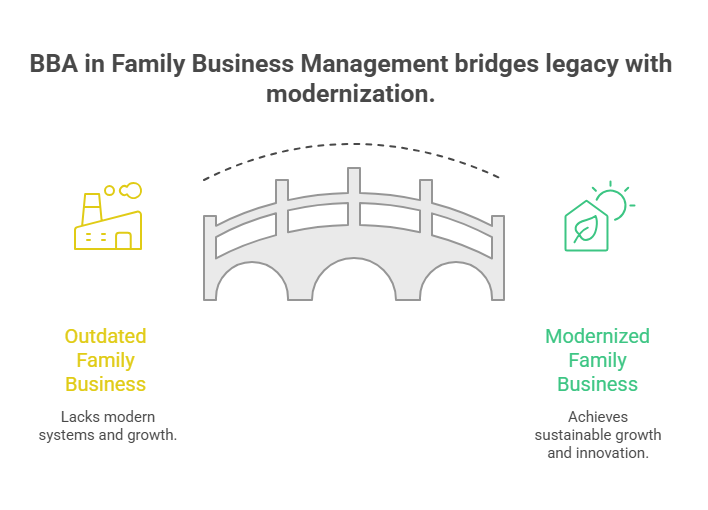
Family businesses often have trust, customer relationships, and operating experience. However, they may need modern systems and growth strategy.
A BBA can help students combine legacy knowledge with new-age business tools. Bonus:BBA in Business Analytics
Launch a Startup in College: Is It Realistic?
Yes, students can launch a startup in college, but they should start small.
A college startup does not need a large office, big team, or heavy funding. It can begin as a tested idea.
Examples include:
Campus merchandise brand
Local delivery service
Digital marketing service
Student tutoring platform
Event management service
Food ordering solution
Social media content agency
Handmade product store
Fitness community
Creator-led business
Internship matching initiative
The goal is not to become famous immediately. The goal is to learn validation, sales, feedback, and operations.
7-Step College Startup Plan
Step
Action
1
Identify a real problem around you
2
Speak to 20 potential users
3
Build a simple solution
4
Test it with a small audience
5
Track feedback and sales
6
Improve the product
7
Prepare a basic pitch deck
This process teaches more than theory alone.
Lead Next Startups
Learn product development methods, financial planning tools, and pitch deck creation through our top-rated BBA entrepreneurship specialization. Join now!
Incubation Center B-School: What Students Should Look For
An incubation center B-school environment can help students test ideas with guidance.
An incubation-focused ecosystem may provide:
Mentorship
Business model support
Pitch practice
Networking
Investor awareness
Legal and compliance basics
Market validation support
Peer founder community
Access to workshops
Prototype guidance
Students should not judge incubation only by the word “incubator.” They should check whether the college offers real mentoring, practical exposure, live projects, and industry interaction.
AIM’s BBA page highlights industry-oriented curriculum, strong corporate interface, guest lectures, live projects, corporate events, paid internships, hands-on projects, global exposure, experienced faculty, and modern infrastructure.
These elements can support entrepreneurial thinking because founders need exposure beyond classrooms.
Pitch Deck Preparation Guide for BBA Students
A pitch deck preparation guide is useful because founders must explain ideas clearly.
A pitch deck is a short presentation that explains your startup idea, problem, solution, market, business model, and growth plan.
Basic Pitch Deck Structure
Slide
What to Include
1. Title
Startup name and one-line idea
2. Problem
What customer pain point exists
3. Solution
How your product solves it
4. Target Customer
Who will use or buy it
5. Market Opportunity
Size and growth potential
6. Business Model
How you will earn revenue
7. Competition
Existing alternatives
8. Marketing Plan
How you will reach customers
9. Traction
Users, sales, pilots, feedback
10. Team
Founder skills and responsibilities
11. Financials
Costs, revenue, and funding need
12. Ask
What support or funding you need
A good pitch deck should be simple. Investors and mentors do not need decoration first. They need clarity.
What Makes a Startup Idea Worth Testing?
Not every idea is a startup opportunity. Some ideas are interesting but not practical.
Before spending money, students should check:
Question
Why It Matters
Is the problem real?
Avoids building something nobody needs
Who faces the problem?
Defines target customer
How often does it occur?
Shows urgency
Are people already paying for solutions?
Shows market demand
Can we build a simple version?
Reduces early risk
Can we reach users easily?
Supports marketing
Can this become profitable?
Tests business potential
This teaches a key startup lesson. Passion is important, but customer demand is essential.
Tools Every BBA Entrepreneurship Student Should Learn
Startup enthusiasts should learn simple business tools early.
Tool Area
Useful For
Excel or Google Sheets
Budgeting, sales tracking, inventory
Canva
Pitch decks, social media, posters
Google Forms
Customer surveys
Notion or Trello
Task tracking
Google Analytics
Website traffic insights
Meta Business Suite
Social media tracking
UPI and payment dashboards
Sales records
Basic CRM sheets
Lead management
AI tools
Research, ideation, summaries
Presentation tools
Investor and classroom pitches
Tools do not replace thinking. However, they help students execute faster.
This is why entrepreneurship education can benefit both founders and job seekers.
BBA Colleges in Delhi NCR: Why Location Matters for Entrepreneurs
Students searching for BBA colleges in Delhi, best colleges for BBA in Delhi NCR, best BBA colleges in Delhi, top BBA colleges, BBA colleges in Delhi NCR, top BBA colleges in Delhi NCR, best private BBA colleges in Delhi, or BBA colleges in NCR region often want practical exposure.
Delhi NCR can be useful for entrepreneurship-minded students because it offers access to:
Startups
Corporate offices
Digital agencies
Retail markets
Financial services firms
E-commerce teams
Mentors
Internship opportunities
Business events
Networking opportunities
A BBA course in Delhi NCR can support students better when it connects classroom learning with real business exposure.
AIM’s BBA program includes practical methods such as case studies, group discussions, presentations, live projects, and industry interactions to help students understand real-world business scenarios. Bonus:BBA institute in Delhi
How to Choose a BBA Institute in Delhi for Entrepreneurship
Students should not choose a college only because it uses startup-related words.
Use this checklist:
What to Check
Why It Matters
Entrepreneurship subjects
Builds startup foundation
Business fundamentals
Helps students manage real companies
Marketing and finance exposure
Supports customer and money decisions
Live projects
Builds practical learning
Internship support
Gives workplace exposure
Pitch practice
Builds founder communication
Faculty guidance
Helps students avoid early mistakes
Industry interaction
Connects students with real business problems
Placement support
Gives career backup
Student projects
Builds proof of work
Students looking for the best BBA placement college in India should also evaluate skill-building, internships, corporate exposure, and career support.
Career Options After BBA in Entrepreneurship
A BBA entrepreneurship graduate may choose to start a venture, join a startup, support a family business, or work in a corporate role.
Possible career paths include:
Career Path
What You May Do
Entrepreneur
Start and manage your own venture
Family Business Manager
Modernize and expand an existing business
Business Development Executive
Build partnerships and sales pipelines
Startup Operations Associate
Support daily startup execution
Founder’s Office Associate
Work directly with founders
Marketing Executive
Promote products and acquire customers
Product Associate
Support product planning and user feedback
E-Commerce Executive
Manage listings, orders, and digital sales
Sales Strategy Associate
Track leads and growth plans
Social Enterprise Founder
Build impact-focused ventures
AIM’s BBA page lists career options such as Business Development Executive, Marketing Executive, HR Executive, entry-level Financial Analyst, and Entrepreneur across industries.
Common Myths About BBA in Entrepreneurship
Myth 1: Entrepreneurs do not need degrees
Some founders succeed without degrees. However, many students benefit from structured learning, mentors, projects, and business exposure.
Myth 2: A startup idea needs funding first
Many ideas should be tested before funding. Early validation matters more than investor money.
Myth 3: Entrepreneurship is only for risk-takers
Good entrepreneurs do take risks. However, they also calculate, test, measure, and reduce risk.
Myth 4: Family business students do not need management education
Family businesses can grow faster when the next generation understands finance, digital marketing, analytics, operations, and strategy.
Myth 5: Innovation means invention
Innovation can also mean improving service, delivery, pricing, customer experience, or business models.
90-Day Startup Mindset Plan for BBA Students
Students can start building entrepreneurial ability in 90 days.
Timeline
Action
Output
Days 1–15
Observe problems around campus or locality
List of 10 problems
Days 16–30
Speak to potential users
Customer notes
Days 31–45
Pick one problem and design a simple solution
One-page business idea
Days 46–60
Test with a small audience
Feedback report
Days 61–75
Build a basic business model
Revenue and cost sheet
Days 76–90
Create pitch deck
10-slide startup pitch
This plan helps students move from imagination to execution.
Why Asia Pacific Institute of Management Can Be Considered
Students exploring BBA in India and looking for a career-focused BBA institute in Delhi can consider Asia Pacific Institute of Management.
The BBA program highlights an industry-oriented curriculum, practical learning exposure, strong corporate interface, paid internships, hands-on projects, live projects, industry interactions, and career support.
The course outline also includes Entrepreneurship Development and Innovation & Startups, which are relevant for students who want to build founder-like thinking.
For startup enthusiasts, this matters because entrepreneurship requires both mindset and method.
Conclusion
A BBA entrepreneurship syllabus can teach students how to think, test, build, pitch, and improve business ideas. It may not guarantee startup success, but it can reduce avoidable mistakes.
Innovation is not only a talent. It is also a process.
Students who want to become founders, join startups, grow family businesses, or work in dynamic companies can benefit from entrepreneurship education.
Start small. Study customers. Build proof. Learn finance. Practice pitching. Use college as your safest testing ground.
Master BBA Syllabus
Gain practical insights into market analysis, operational scaling, and innovation management. Build your entrepreneurial future with our BBA degree program!
Dr. Vikas Gupta is a distinguished academic in the education and research domain, specializing in finance and related interdisciplinary studies. He is known for his...
01.
What is included in a BBA entrepreneurship syllabus?
A BBA entrepreneurship syllabus may include management, marketing, finance, business law, e-commerce, business analytics, strategy, entrepreneurship development, innovation, internships, projects, and pitch preparation.
02.
Can a BBA degree teach innovation?
A BBA degree can teach innovation frameworks, customer research, business modelling, pitching, and execution discipline. However, students must apply these skills through projects and real experiments.
03.
Can I launch a startup in college?
Yes. Students can launch a startup in college by starting small, identifying a real problem, speaking to users, testing a simple solution, and improving through feedback.
04.
What is the role of an incubation center in a B-school?
An incubation center can support students with mentoring, business model guidance, pitch practice, networking, validation support, and investor awareness.
05.
Is BBA useful for family business management?
Yes. BBA can help family business students learn finance, marketing, operations, digital tools, customer management, and growth strategy.
06.
What should be included in a startup pitch deck?
A pitch deck should include problem, solution, customer, market, business model, competition, traction, team, financials, and funding or support ask.
07.
Is venture capital necessary to start a business?
No. Many businesses begin through bootstrapping. Venture capital is suitable for startups that can grow fast and scale significantly.
08.
Which BBA college is good for entrepreneurship?
Students should choose a BBA college that offers entrepreneurship subjects, practical learning, internships, live projects, faculty support, industry interaction, and placement readiness.



















.webp) Call Us
Call Us