MBA Healthcare vs MHA: Which Degree Is Better for Your Career?
Posted on 07 Oct 2026
By Dr. Vikas Gupta
Introduction
Choosing the right healthcare management degree can shape your career direction, job opportunities, and long-term growth. However, many students struggle with one important question: MBA healthcare vs MHA— which degree is better for your career?
Both programs can prepare students for management roles in the healthcare sector. Yet, their focus, curriculum, career orientation, and skill development can differ significantly.
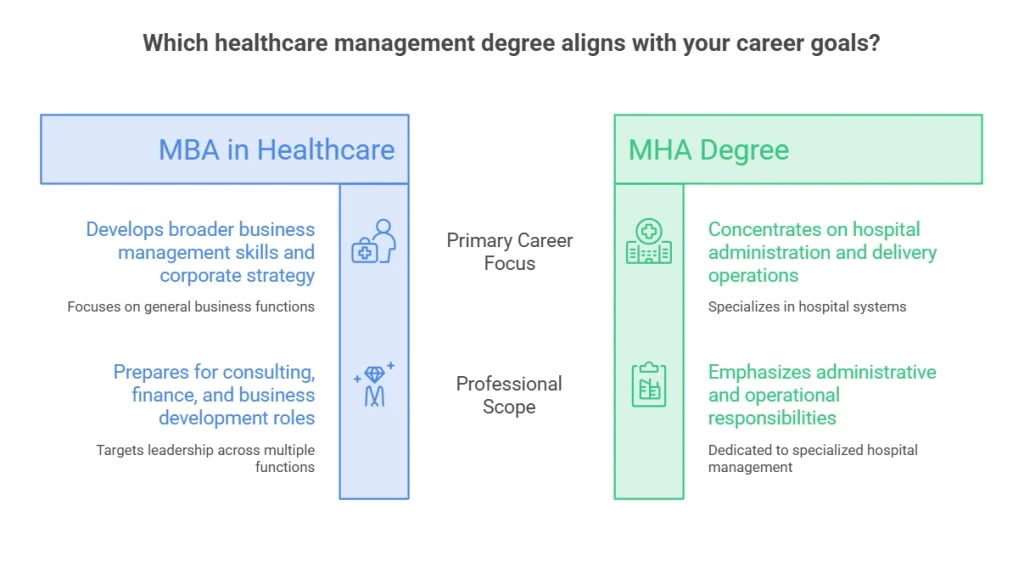
An MBA in Healthcare Management generally combines business management with healthcare industry knowledge. An MHA, or Master of Hospital Administration, focuses more closely on hospital administration and healthcare operations.
Therefore, understanding these differences is essential before making an admission decision. This guide explains MBA healthcare management vs MHA, career opportunities, skills, curriculum differences, and factors to consider before choosing a program.
Advance Your Healthcare Career
Build management expertise while working, developing skills in healthcare operations, strategy, analytics, finance, and leadership for broader career opportunities.
The primary difference lies in the breadth of management education.
An MBA in Healthcare Management typically focuses on business strategy, finance, marketing, operations, leadership, human resources, and healthcare management. It can prepare students for broader management responsibilities across healthcare organizations.
An MHA generally places greater emphasis on hospital administration, healthcare delivery systems, hospital operations, quality management, and administrative functions.
In simple terms:
MBA Healthcare Management: Broader business and management orientation.
MHA: Stronger focus on hospital and healthcare administration.
MBA: Suitable for students interested in management, strategy, business development, and leadership.
MHA: Suitable for students focused on hospital administration and healthcare operations.
However, actual subjects and career outcomes depend on the institution, curriculum, specialization, and student's previous experience.
MBA Healthcare Management vs MHA: Which Has a Broader Scope?
Healthcare is no longer limited to hospitals. The industry includes healthcare delivery, diagnostics, health insurance, pharmaceuticals, medical technology, consulting, healthcare technology, and other allied sectors.
An MBA can therefore provide a broader management foundation.
Students may develop skills in:
Business strategy
Financial management
Marketing
Operations
Human resource management
Leadership
Business analytics
Strategic decision-making
Healthcare management
An MHA, meanwhile, can provide stronger exposure to hospital administration and healthcare delivery.
Its learning areas may include:
Hospital operations
Healthcare administration
Quality management
Healthcare policies
Patient services
Hospital planning
Healthcare systems
Administrative management
Therefore, neither degree is universally better. The better choice depends on your preferred career direction.
An MBA in Healthcare Management can support careers in areas such as:
Healthcare operations
Hospital management
Healthcare consulting
Business development
Healthcare marketing
Health insurance management
Healthcare strategy
Healthcare analytics
Corporate healthcare management
Healthcare project management
The exact role depends on your skills, experience, program structure, and employer requirements.
Career Paths After MHA
MHA graduates may pursue roles related to:
Hospital administration
Healthcare administration
Hospital operations
Quality management
Patient services
Healthcare facility management
Healthcare project coordination
Administrative management
Therefore, students who already know they want to work primarily within hospital administration may find the MHA pathway more aligned with their interests.
Which Degree Offers Better Career Growth?
Career growth depends on more than the qualification itself.
Your professional development can be influenced by:
Work experience
Leadership ability
Communication skills
Analytical thinking
Industry knowledge
Digital skills
Networking
Organizational performance
Role and responsibility
Continuous learning
An MBA may provide a wider business toolkit. This can be valuable when professionals move toward strategic or cross-functional management positions.
An MHA can provide deeper administrative orientation. This can benefit professionals focused on hospital systems and healthcare delivery.
Therefore, career growth should be evaluated based on role progression rather than degree title alone.
Strengthen strategic, financial, operational, and leadership capabilities to prepare for greater responsibilities across modern healthcare organisations and management roles.
MBA Healthcare vs MHA: Which Is Better for Working Professionals?
Working professionals should consider a few additional factors.
First, look at the program format and schedule. A course must fit realistically around your professional responsibilities.
Second, examine whether the curriculum develops skills that complement your existing experience.
For example, a healthcare professional with operational experience may benefit from stronger exposure to:
Business strategy
Finance
Leadership
Marketing
Data-driven decision-making
Organizational management
Similarly, professionals focused on hospital administration may prefer deeper exposure to healthcare systems and hospital operations.
Therefore, the best program is one that fills the gaps in your existing skill set.
What Skills Should You Build Alongside Your Degree?
Whether you choose an MBA or MHA, employers value practical management capabilities.
1. Leadership Skills
Healthcare managers often coordinate multidisciplinary teams. Therefore, communication, delegation, conflict management, and decision-making are essential.
2. Financial Understanding
Healthcare professionals increasingly need to understand budgets, costs, revenue, and resource allocation.
3. Data and Analytics
Healthcare organizations generate large volumes of operational and business data. Basic analytical skills can support better decisions.
4. Communication
Managers communicate with healthcare professionals, administrators, patients, vendors, and senior leadership.
5. Problem-Solving
Healthcare operations involve complex challenges. Managers must identify problems and develop practical solutions.
6. Technology Awareness
Digital healthcare, automation, electronic records, analytics, and healthcare technology are changing management practices.
Consequently, students should look beyond classroom learning and develop practical management skills.
How Should You Choose Between MBA Healthcare and MHA?
Before applying, ask yourself these questions:
What type of organization do I want to work in?
If your target is primarily hospital administration, an MHA may align closely with your interests.
If you want broader exposure across healthcare businesses and management functions, an MBA may offer greater flexibility.
Do I want business or administration as my primary focus?
This is one of the most important questions.
MBA programs generally provide stronger exposure to business management.
MHA programs generally emphasize healthcare administration.
Where do I see myself in five years?
Think beyond your first job.
Would you like to manage a hospital department? Lead healthcare operations? Work in strategy? Move into business development? Manage healthcare projects?
Your long-term goal should influence your choice.
Does the curriculum match my goals?
Compare subjects carefully.
Look at management modules, practical projects, industry exposure, internships, analytics, leadership development, and healthcare-specific subjects.
Why Practical Learning Matters in Healthcare Management
Healthcare management is a practical discipline.
Students need more than theoretical knowledge. They need to understand how healthcare organizations operate in real-world situations.
Therefore, prospective students should look for programs that provide:
Industry-oriented curriculum
Practical projects
Case-based learning
Corporate exposure
Experienced faculty
Management simulations
Industry interaction
Career and placement support
At Asia Pacific Institute of Management, an industry-oriented approach can help students connect management concepts with practical business situations.
The focus should remain on developing skills that students can apply in professional environments.
MBA Healthcare vs MHA: Key Differences at a Glance
Factor
MBA Healthcare Management
MHA
Primary focus
Business and healthcare management
Healthcare and hospital administration
Business exposure
Generally broader
Generally more specialized
Healthcare administration
Included
Strong focus
Strategy
Strong focus
Program-dependent
Finance
Strong management orientation
Healthcare-focused
Marketing
Often included
Usually less central
Hospital operations
Included
Strong focus
Leadership
Strong focus
Strong administrative orientation
Career flexibility
Broad management roles
Administration-focused roles
Best suited for
Management and leadership careers
Hospital and healthcare administration
This table provides a general comparison. Program structures can vary considerably between institutions.
Common Mistakes Students Make When Choosing a Healthcare Degree
Choosing a degree only because it sounds popular can lead to poor career alignment.
Avoid these mistakes:
Choosing Based Only on the Degree Name
Review the curriculum, faculty, learning model, practical exposure, and career support.
Ignoring Career Goals
A degree should support your desired career direction.
Focusing Only on Starting Salary
Salary depends on experience, role, location, organization, skills, and market conditions.
Healthcare is becoming increasingly technology-driven and data-oriented. Therefore, management education should prepare students for changing workplace expectations.
Is MBA Healthcare Better Than MHA?
An MBA in Healthcare Management can be a strong choice for students seeking broader management education across the healthcare sector.
However, that does not make it universally better than an MHA.
The better option depends on your professional goals.
Choose based on:
Career direction
Curriculum
Skill development
Industry exposure
Learning format
Faculty experience
Practical projects
Career support
Long-term growth opportunities
Therefore, students should compare programs carefully before making a final decision.
Conclusion: MBA Healthcare vs MHA — Which Should You Choose?
The MBA healthcare vs MHA decision ultimately comes down to your career ambitions.
Choose an MBA in Healthcare Management if you want broader business knowledge, management skills, strategic exposure, and flexibility across healthcare-related roles.
Choose an MHA if your interests are more closely aligned with healthcare administration, hospital systems, and healthcare delivery operations.
Most importantly, do not select a degree based only on its name.
Examine the curriculum, practical exposure, faculty, industry interaction, learning approach, and career support. Also, consider where you want your career to be five or ten years from now.
For students seeking industry-aligned management education, Asia Pacific Institute of Management can provide a practical learning environment focused on management knowledge, corporate exposure, experienced faculty, and career development.
Expand Your Management Skills
Transform professional experience into management capabilities through flexible learning focused on healthcare strategy, operations, analytics, and leadership for future roles.
Dr. Vikas Gupta is a distinguished academic in the education and research domain, specializing in finance and related interdisciplinary studies. He is known for his...
Neither qualification is automatically better. An MBA may suit students seeking broader business and management careers, while an MHA may suit those focused on healthcare and hospital administration.
02.
MBA healthcare vs MHA: Which has more career options?
An MBA in Healthcare Management may provide broader management exposure across healthcare organizations. An MHA is generally more focused on healthcare administration and hospital-related functions.
03.
Can I work in hospital management after an MBA?
Yes. An MBA in Healthcare Management can prepare graduates for various hospital management and healthcare operations roles, depending on the curriculum and employer requirements.
04.
Is MHA only for hospital jobs?
No. MHA graduates can pursue different healthcare administration and management roles. However, the degree typically has a stronger connection with healthcare delivery and administrative functions.
05.
MBA or MHA which is better for working professionals?
The better choice depends on your career goals and existing experience. Working professionals should evaluate curriculum, schedule, practical learning, and how the program complements their current career.
06.
Does an MBA Healthcare degree offer corporate career opportunities?
An MBA can support broader corporate-oriented healthcare roles involving strategy, operations, business development, consulting, analytics, and management.
07.
What should I check before choosing an MBA Healthcare program?
Review eligibility, curriculum, faculty, practical learning, industry exposure, program format, career support, and the institution’s overall academic approach.
08.
Is an MBA Healthcare Management degree suitable for non-medical graduates?
Healthcare management programs can be suitable for graduates from different academic backgrounds, depending on the institution’s eligibility requirements. Always verify the latest admission criteria before applying.


















.webp) Call Us
Call Us