How Healthcare Managers Optimize Emergency Room (ER) Triage Systems
Posted on 08 Aug 2026
By Dr. Vikas Gupta
Introduction
Patients arrive with different levels of urgency. Some need immediate resuscitation. Others can safely wait. At the same time, beds, doctors, nurses, diagnostics, and support services are limited.
A strong triage system helps hospitals identify critical patients quickly, reduce dangerous delays, manage crowding, and use emergency resources more efficiently.
For healthcare managers, triage is not only a clinical process.
It is also an operational system involving patient flow, staffing, zoning, bed availability, reassessment, escalation, emergency preparedness, and data monitoring.
The Ministry of Health and Family Welfare’s current operational guidance for improving hospital patient-care services recommends a single entry point for acute patients, structured triage, colour-coded priority zones, initial assessment, reassessment, and controlled movement into treatment areas.
This guide explains how healthcare managers can strengthen ER triage systems without interfering with clinical judgement.
Lead Healthcare Operations
Build practical management skills for hospital operations, patient flow, capacity planning, quality, analytics, and high-pressure healthcare environments.
Hospital triage system protocols are structured procedures used to rapidly assess and prioritize emergency patients according to the urgency of their condition. They help direct patients to appropriate treatment areas while ensuring critically ill or injured patients receive immediate attention.
Triage is based on clinical urgency rather than arrival order.
Therefore, a patient who arrives later may receive treatment first if their condition is more serious.
The World Health Organization defines acuity-based triage as sorting and prioritizing patients according to how urgently intervention is required. Its Interagency Integrated Triage Tool uses red, yellow, and green categories for routine emergency-unit triage.
For hospital managers, an effective protocol must clearly define:
Where triage occurs
Who performs it
Which assessment tools are used
How patients are categorized
Where each category is directed
When reassessment occurs
How deterioration is escalated
How mass-casualty procedures are activated
Without these controls, the emergency department can become a first-come, first-served queue.
Managers must control entry, flow, capacity, and escalation.
Emergency departments typically face four operational pressures:
Unpredictable patient arrivals
Wide variation in clinical severity
Limited treatment capacity
Dependence on other departments
For example, an ER may function efficiently at 10:00 AM but become overcrowded two hours later after several ambulance arrivals.
The problem may not be the triage desk alone.
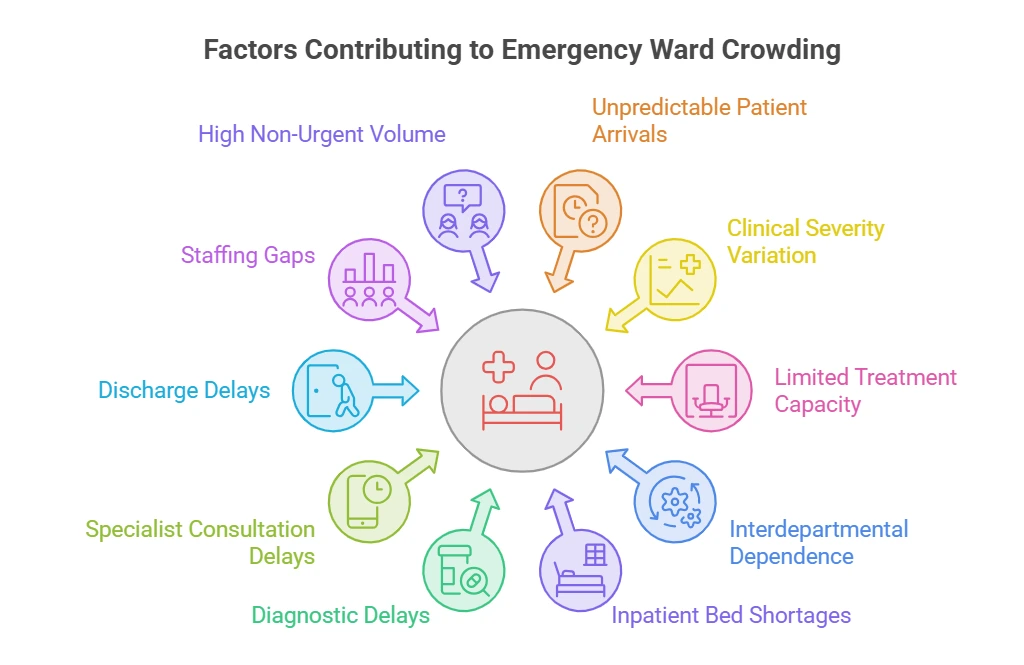
Crowding can also result from:
Inpatient bed shortages
Diagnostic delays
Specialist consultation delays
Discharge delays
Staffing gaps
High non-urgent patient volume
A 2026 systematic review found that emergency department crowding is driven by input, throughput, and output factors. These include high patient volumes, staffing limitations, diagnostic delays, inpatient boarding, and late hospital discharges.
Therefore, managers must treat triage as part of a hospital-wide flow system.
Understanding Red, Yellow and Green Triage Zones
The red yellow green triage zones provide a simple operational framework for separating patients according to urgency.
WHO's routine Interagency Integrated Triage Tool uses three main categories.
Red Zone: Immediate Care
Red-zone patients have high-acuity conditions requiring immediate evaluation and intervention.
Examples may include severe respiratory distress, shock, major trauma, altered consciousness, or other life-threatening presentations.
These patients should move rapidly toward appropriately equipped resuscitation or critical-care areas.
Management priorities include:
Immediate staff availability
Resuscitation equipment
Monitors
Emergency medicines
Airway equipment
Oxygen
Rapid diagnostics
Consultant escalation
The red zone should therefore be located close to critical services.
Yellow Zone: Urgent Care
Yellow patients require prompt assessment but do not show the same immediate life-threatening signs as red-zone patients.
These patients can deteriorate.
Therefore, they require monitoring and reassessment.
Managers need enough beds, staff, and observation capability to prevent yellow-zone patients from being overlooked during crowding.
Green Zone: Lower-Acuity Care
Green-zone patients are generally stable and can safely wait longer.
However, “green” does not mean “no care needed.”
These patients still require appropriate assessment.
A low-acuity patient may also deteriorate.
Therefore, reassessment remains important.
Is There a Black Triage Category?
Some Indian hospital protocols use a four-colour system.
Current MoHFW operational guidance describes:
Red — Immediate
Yellow — Urgent
Green — Non-urgent
Black — Dead
It also recommends different assessment and reassessment timelines according to urgency.
However, mass-casualty systems can use different category structures.
For example, WHO's mass-casualty IITT uses red, yellow, green, blue, and grey categories under MCI conditions.
Therefore, hospital managers should not assume every colour system is universal.
The organization should adopt a defined, approved system and train staff consistently.
A triage area should be easy to identify and close to the emergency entrance.
It should allow staff to quickly observe incoming patients.
The layout should support:
Ambulance arrivals
Walk-in patients
Wheelchair access
Stretcher movement
Privacy
Infection-control separation
Communication with treatment zones
Current Indian emergency-response guidance recommends positioning the triage area near the red-zone entrance so critically injured patients can move quickly into emergency treatment.
Managers should also control unnecessary crowding around the triage desk.
Family members, attendants, and media should not block patient flow during major incidents.
Step 2: Define Triage Roles Clearly
Not every employee can perform clinical triage.
The hospital should define who is qualified and authorized.
Depending on the approved model, triage may involve:
Emergency physicians
Trained emergency nurses
Other appropriately trained clinical professionals
WHO's hospital emergency-response checklist recommends assigning an experienced triage officer to oversee triage operations.
Hospital managers should support this by ensuring:
Job responsibilities are clear
Competency requirements are documented
Training is current
Backup personnel are available
Escalation authority is defined
Administrative staff may support registration and patient movement.
However, clinical prioritization should remain with qualified healthcare professionals.
Step 3: Standardize the Initial Assessment
Triage assessment must be rapid and structured.
The goal is not to complete the entire medical assessment at the entrance.
It is to identify urgency.
Depending on the protocol, initial triage may consider:
Airway
Breathing
Circulation
Consciousness
Vital signs
Major bleeding
Pain
High-risk symptoms
Mechanism of injury
Current Indian trauma guidance describes initial emergency management through preparation, triage, primary survey, resuscitation, transfer consideration, secondary survey, and continued reassessment.
Managers should ensure assessment documentation is simple enough to use during busy periods.
A complicated triage form can itself create delays.
Step 4: Establish Reassessment Protocols
Triage is not a one-time decision.
A patient's condition can change while waiting.
Therefore, managers should establish defined reassessment intervals.
Current MoHFW operational guidance includes different initial-assessment and reassessment expectations based on acuity.
The exact policy should follow the hospital's approved clinical framework.
Operationally, managers should ensure that:
Waiting patients remain visible
Reassessment responsibility is assigned
Deterioration can trigger re-triage
Changes are documented
Staff can escalate rapidly
A patient classified as yellow or green may later require red-zone care.
Therefore, waiting areas cannot become unmanaged holding zones.
Step 5: Separate Patient Streams
One queue for every patient is rarely efficient.
Hospitals can improve flow by separating patients according to need.
Possible streams include:
Resuscitation
Major emergency
Minor emergency
Trauma
Paediatric emergency
Obstetric emergency
Fast-track cases
A 2025 umbrella review found that effective triage, flow management, fast-track pathways, and expanded rapid-assessment models can help reduce emergency-department crowding.
Another recent meta-analysis found fast-track systems reduced emergency-department length of stay, although results for some other interventions varied by context.
Therefore, managers should use patient streaming based on local demand rather than copying another hospital's layout.
Step 6: Create a Fast-Track Pathway
Low-acuity patients can unintentionally compete with critically ill patients for the same resources.
A fast-track area can help manage selected lower-acuity cases separately.
Possible examples may include:
Minor wounds
Simple musculoskeletal injuries
Stable minor complaints
Clinical eligibility must be defined by qualified emergency leadership.
The operational benefit is that appropriate lower-acuity patients can move through the department without occupying high-acuity beds.
Research has repeatedly identified fast-track and patient-streaming models as among the more consistent interventions for reducing emergency length of stay.
Step 7: Improve ER Bed Turnaround Time
ER bed turnaround time refers to how quickly an emergency treatment space becomes safely available for the next patient after the previous patient leaves.
Large hospitals may benefit from centralized bed management.
A bed command function may track:
Vacant beds
Expected discharges
Beds awaiting cleaning
ICU availability
Isolation beds
Planned admissions
Emergency admissions
The system should provide real-time information.
Otherwise, emergency teams may repeatedly call wards to ask whether beds are available.
That wastes time.
Managers should also monitor discharge delays earlier in the day.
A patient who remains unnecessarily in a ward bed can indirectly contribute to ER overcrowding.
Step 9: Align Staffing With Arrival Patterns
Emergency demand varies by time and day.
Therefore, staffing should not rely only on fixed ratios.
Managers should analyze:
Hourly arrivals
Day-of-week patterns
Seasonal trends
Trauma peaks
Local events
Disease outbreaks
Suppose patient arrival increases significantly between 6 PM and 10 PM.
Increasing morning staffing will not solve the problem.
Instead, schedules should align with demand where clinically and operationally appropriate.
Managers should track staffing across:
Doctors
Nurses
Technicians
Registration
Housekeeping
Transport
Security
Support staff matter too.
An ER can become congested because patients cannot be moved, rooms cannot be cleaned, or reports cannot be completed.
Manage Healthcare Smarter
Develop leadership, analytics, and operational capabilities to manage complex hospital systems, improve patient journeys, and support efficient healthcare delivery.
WHO defines a mass casualty incident as an event producing more patients, often at higher acuity, than the facility can manage using usual resources and procedures.
Examples may include:
Major road crashes
Industrial accidents
Fires
Natural disasters
Structural collapse
Violence
During an MCI, the objective changes.
Routine emergency care focuses on achieving the best outcome for each individual patient.
During mass casualty conditions, resources may be insufficient.
Therefore, the system must prioritize patients according to clinical need, survivability, and available resources.
Preparing for Mass Casualty Events
Healthcare managers should establish a written disaster plan.
Preparation may include:
MCI activation criteria
Command structure
Expanded triage space
Additional treatment zones
Reserve staffing
Emergency supplies
Blood availability
Security
Family information areas
Media management
Ambulance coordination
Mortuary planning
WHO guidance recommends identifying alternative triage and waiting areas before an incident occurs.
Hospitals should not wait for a disaster before deciding where additional patients will go.
Mass Casualty Triage Zones
WHO's current mass-casualty triage guidance uses five categories:
Red
Yellow
Green
Blue
Grey
These categories reflect acuity and resource considerations during mass-casualty conditions.
Managers should ensure staff understand the difference between routine and MCI protocols.
Mixing different systems during an actual emergency can create dangerous confusion.
Regular drills help reinforce the process.
Conduct Emergency Drills
A protocol that exists only in a manual is not enough.
Hospitals should conduct drills.
Possible scenarios include:
Bus crash
Fire
Building collapse
Chemical exposure
Sudden epidemic surge
Drills should test:
Activation time
Triage
Patient flow
Communication
Bed capacity
Staffing
Supplies
Security
Documentation
After each drill, managers should conduct a structured review.
Ask:
What worked?
What failed?
Where were delays?
Did employees understand their roles?
Were communication channels effective?
Then corrective actions should be tracked.
Technology in Emergency Ward Management
Technology can improve ER visibility.
Useful systems may include:
Electronic triage
Bed management dashboards
Queue monitoring
Emergency department information systems
Diagnostic tracking
Ambulance pre-arrival notifications
Command-centre dashboards
A manager might view:
Current patient count
Patients by triage category
Occupied beds
Boarding patients
Waiting patients
Pending diagnostics
Average waiting time
However, managers should avoid creating dashboards that display too many metrics.
The system should help teams act.
Important Emergency Department KPIs
Managers can monitor several performance indicators.
Door-to-Triage Time
Time between patient arrival and triage.
Door-to-Provider Time
Time before clinical assessment.
ER Length of Stay
Time from arrival until discharge or transfer.
ER Bed Turnaround Time
Time required to make a treatment bed ready again.
Boarding Time
Time an admitted patient remains in the ER while waiting for an inpatient bed.
Left Without Being Seen
Patients who leave before appropriate clinical evaluation.
Re-Triage Rate
Cases requiring movement into a higher acuity category.
Diagnostic Turnaround Time
Time required for priority investigations.
These metrics should be interpreted together.
For example, reducing length of stay should never encourage premature discharge.
Audit Hospital Triage System Protocols
Managers should regularly audit triage performance.
A practical review may examine:
Was the patient triaged promptly?
Was the correct protocol used?
Was acuity documented?
Were vital signs recorded?
Was the patient placed in the correct zone?
Was reassessment completed?
Was deterioration escalated?
Were handovers documented?
Managers should also observe real practice.
Documentation may appear perfect while actual patient flow remains inefficient.
Therefore, audits should combine:
Records
Observation
Staff interviews
KPI analysis
Incident data
Common Triage Management Mistakes
Several problems repeatedly weaken emergency systems.
First-Come, First-Served Thinking
Emergency care should prioritize acuity.
Triage Becoming Registration
The triage desk should not become an administrative paperwork counter.
No Reassessment
Patients can deteriorate while waiting.
Unclear Zones
Staff and patients should understand where different categories go.
No Fast Track
Lower-acuity cases may unnecessarily occupy emergency resources.
Poor Bed Management
Admitted patients may remain in ER beds unnecessarily.
Insufficient Drills
Mass-casualty procedures may fail when teams have never practised them.
Too Many KPIs
Managers should focus on actionable measures.
The Role of the Healthcare Manager in Triage
Managers do not decide whether an individual patient is medically critical unless they are appropriately qualified and acting within that clinical role.
Their responsibility is different.
Healthcare managers create systems that allow clinical teams to make fast, safe decisions.
Their role includes:
Staffing
Layout
Capacity planning
Bed management
Equipment
Training coordination
Data systems
Quality monitoring
Disaster planning
Interdepartmental coordination
Therefore, optimized triage depends on both clinical expertise and operational management.
Skills Needed for Emergency Healthcare Management
Students interested in emergency operations should develop capabilities in:
Hospital operations
Patient-flow management
Data analysis
Capacity planning
Quality management
Emergency preparedness
Communication
Process improvement
Team coordination
They should also understand basic emergency-care terminology.
However, management students should not confuse operational knowledge with clinical authority.
At Asia Pacific Institute of Management, an industry-oriented curriculum, experienced faculty, practical learning, corporate exposure, and placement support can help students develop broader managerial capabilities.
For learners interested in hospital operations, understanding emergency workflows can strengthen preparation for high-pressure healthcare environments.
Strong hospital triage system protocols are essential for safe and efficient emergency care.
Triage allows hospitals to identify the sickest patients quickly and direct them toward appropriate treatment.
However, successful triage depends on much more than colour coding.
Managers must coordinate:
Triage layout
Qualified staff
Red, yellow and green zones
Reassessment
Fast-track pathways
Bed availability
Diagnostics
Staffing
Mass-casualty preparedness
Emergency overcrowding should also be treated as a hospital-wide issue.
A crowded ER may reflect delayed inpatient discharge, insufficient beds, diagnostic bottlenecks, or weak patient-flow systems elsewhere in the organization.
Therefore, healthcare managers should combine clinical triage protocols with operational data and hospital-wide coordination.
The goal is not simply to move patients faster.
It is to ensure that the right patient reaches the right level of care at the right time.
Build Healthcare Leadership
Prepare for impactful healthcare management roles with industry-focused learning in operations, decision-making, analytics, quality, and strategic leadership.
Dr. Vikas Gupta is a distinguished academic in the education and research domain, specializing in finance and related interdisciplinary studies. He is known for his...
Hospital triage system protocols are standardized procedures used to quickly assess emergency patients and prioritize them according to clinical urgency.
02.
What do red, yellow and green triage zones mean?
Red generally indicates high-acuity patients requiring immediate attention. Yellow represents urgent or moderate-acuity patients requiring timely care. Green represents lower-acuity patients who can safely wait longer.
03.
Why is triage important in emergency ward management?
Triage helps hospitals identify critical patients quickly, organize patient flow, use limited beds effectively, and reduce dangerous treatment delays.
04.
What is ER bed turnaround time?
ER bed turnaround time measures how quickly a treatment bed becomes ready for another patient after the previous patient leaves.
05.
How can hospitals reduce ER crowding?
Hospitals can improve triage, introduce fast-track pathways, manage beds actively, reduce diagnostic delays, improve staffing alignment, and coordinate inpatient discharge. Current evidence supports a combination of these approaches.
06.
What is a mass casualty incident?
A mass casualty incident occurs when patient numbers and acuity exceed the healthcare facility’s normal ability to respond using routine resources and procedures.
07.
Can a green-zone patient become a red-zone patient?
Yes. A patient’s condition can deteriorate. Therefore, waiting patients require reassessment and may need re-triage.
08.
What is the healthcare manager's role in emergency triage?
Healthcare managers support staffing, bed availability, patient flow, equipment, training, data monitoring, disaster preparedness, and operational coordination. Clinical prioritization remains with qualified healthcare professionals.

















.webp) Call Us
Call Us