PGDM College in Delhi With Industry Exposure: Why Location Matters
Posted on 20 Sep 2026
By Dr. Vikas Gupta
Introduction
Choosing a pgdm college in delhi involves more than comparing course names, fees, or campus facilities. For analytics students, location can influence access to corporate environments, internships, industry interactions, business problems, and professional networks. Delhi NCR brings together corporate offices, consulting firms, technology businesses, BFSI organisations, startups, digital agencies, and other employers that use data in business decisions.
For students considering analytics-oriented management education, Asia Pacific Institute of Management (AIM), New Delhi, is relevant because its published programme information combines management education with Big Data Analytics, artificial intelligence, machine learning, predictive analytics, projects, case-based learning, and internship exposure.
The important point is that location alone does not create industry exposure. The value comes when a business-rich environment is combined with an institute's curriculum, corporate interface, projects, internships, and student initiative.
Delhi NCR gives analytics students proximity to a broad corporate ecosystem spanning technology, consulting, BFSI, e-commerce, digital businesses, and startups.
Industry exposure PGDM learning is more meaningful when students apply classroom concepts through projects, internships, case studies, and corporate interactions.
AIM's PGDM in Big Data Analytics combines management foundations with areas such as AI, machine learning, cloud computing, predictive analytics, and analytics tools.
Location should be evaluated alongside programme structure, practical learning, internship opportunities, faculty, career preparation, and the relevance of the analytics curriculum.
Analytics students can make their corporate exposure PGDM experience more useful by building a portfolio of dashboards, business cases, analytical projects, and internship outcomes during the programme.
Why Location Matters for an Analytics-Focused PGDM
Location matters because management education does not happen only inside a classroom. Analytics students need opportunities to understand how organisations frame problems, collect information, measure performance, and make decisions.
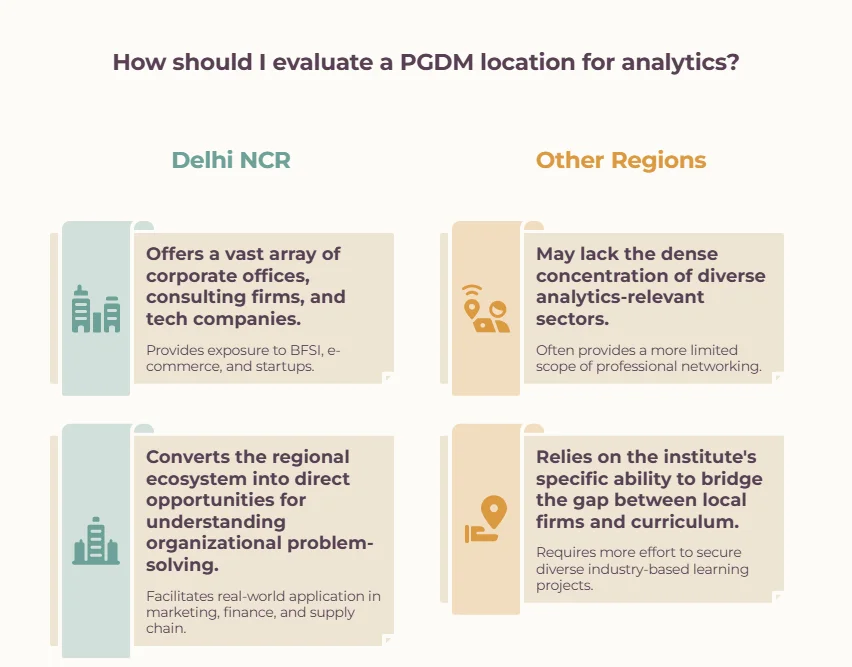
Delhi NCR provides a large business environment in which students can encounter different types of organisations. AIM's published material identifies corporate offices, consulting firms, analytics teams, technology companies, BFSI firms, digital agencies, e-commerce companies, and startups as part of the regional ecosystem relevant to analytics students.
This diversity can matter because analytics is not confined to one industry. A student may apply similar analytical thinking to customer segmentation in marketing, credit-risk assessment in financial services, demand forecasting in retail, workforce planning in HR, or operational efficiency in supply chains.
For someone comparing a pgdm college delhi option with an institute in another region, the useful question is therefore not simply, “Which city has more companies?” Instead, ask how effectively the institute converts its location into learning opportunities.
What Industry Exposure Means in a PGDM
Industry exposure refers to structured opportunities to understand and work with business situations beyond conventional classroom theory. Depending on the programme, this may include internships, live projects, case studies, corporate sessions, industry visits, consulting assignments, simulations, and interactions with working professionals.
AIM's current programme information describes experiential components such as simulations, projects, internships and industry immersion across its PGDM structure. Its Big Data Analytics programme also identifies live consulting projects, corporate immersion, CXO sessions and international exposure among its industry-oriented opportunities.
For analytics students, the difference between studying a tool and applying it is significant. Learning SQL, Python, visualisation or predictive modelling is one step. Using those capabilities to answer a business question requires problem definition, data interpretation, communication, and commercial understanding.
A useful project might therefore move through four stages:
Stage
Analytics student activity
Business outcome
Problem
Define a measurable business issue
Clear decision question
Analysis
Clean, analyse and visualise data
Evidence-based findings
Interpretation
Connect findings with business context
Practical recommendation
Communication
Present insights to stakeholders
Decision-ready output
This is where industry exposure PGDM learning can complement technical analytics education.
Why Delhi NCR Can Be Relevant to Analytics Careers
Delhi NCR is not a single industry cluster. Its broader ecosystem includes business hubs such as Gurgaon and Noida alongside Delhi, creating exposure to organisations across several sectors. AIM's published material specifically connects the region with corporate offices, technology businesses, consulting, BFSI, digital agencies, e-commerce, and startups.
For analytics students, this creates several possible contexts for learning:
Technology and digital businesses: product metrics, customer behaviour and performance dashboards.
BFSI: financial analysis, risk, fraud, credit and customer segmentation.
Consulting: structured problem-solving, data interpretation and client communication.
Marketing and e-commerce: campaign performance, customer analytics and forecasting.
Operations: inventory, logistics, demand and process analytics.
Startups: rapid experimentation, market analysis and business intelligence.
The advantage is not that every student automatically receives access to these organisations. Rather, a large business ecosystem can provide a wider context for internships, projects, events, networking and professional exploration when an institute actively connects students with it.
AIM's Industry-Oriented Approach for Analytics Students
AIM's current programme portfolio includes PGDM – General, PGDM – Marketing, PGDM – Banking & Financial Services, and PGDM – Big Data Analytics. The Big Data Analytics programme is described as a two-year, full-time programme combining management education with data science, AI, machine learning, cloud computing and predictive analytics.
For analytics-focused students, this management-plus-technology orientation is important. A business analyst or analytics professional needs more than technical execution. They also need to understand the commercial context behind the data.
AIM's published programme information identifies areas such as business analytics, data science, artificial intelligence and machine learning, predictive modelling and analytics-related business applications. It also describes practical learning through projects, case studies and internship exposure.
This positioning can be particularly relevant for students who want to connect analytics with functions such as marketing, finance, operations, consulting or strategy rather than pursue a purely technical data-science pathway.
Industry exposure becomes more useful when students can demonstrate what they learned. For an analytics student, a portfolio provides evidence of practical problem-solving rather than simply listing software tools.
A practical portfolio roadmap can look like this:
Foundation: First Trimester
Build competence in Excel, statistics, SQL and basic data visualisation. Create one small project that explains a business problem, dataset, analytical method and conclusion.
Application: Middle of the Programme
Add Python or R, dashboard development and more structured analytical projects. Build projects around customer segmentation, sales forecasting, marketing performance, financial analysis or operations.
Industry: Internship and Live Projects
Use an internship or live project to document a real business problem, your contribution, analytical approach, limitations and recommendations. Avoid publishing confidential company information.
Differentiation: Final Portfolio
Select three to five strong projects rather than collecting dozens of unfinished exercises. A balanced portfolio might contain one dashboard, one predictive or forecasting project, one functional analytics project, one business case and one internship-based project where disclosure permits.
Communication: Final Presentation
Explain every project in business language. A recruiter or manager should understand the problem, your approach, the insight and its business relevance without needing to interpret technical jargon.
This roadmap turns corporate exposure PGDM opportunities into visible evidence of capability.
What Students Should Check Before Choosing a PGDM College in Delhi
Location should be one part of a structured evaluation rather than the only criterion. Students comparing a pgdm college in delhi should examine:
Evaluation area
What to verify
Programme
Current specialisation, duration and academic structure
Analytics learning
AI, machine learning, statistics, visualisation and business analytics coverage
Practical exposure
Projects, case studies, simulations and applied assignments
Industry interface
Corporate sessions, immersion, live consulting or industry projects
Internship
Whether internships are part of the programme and how they are supported
Career preparation
Interview preparation, communication and professional development
Location
Accessibility to Delhi NCR's business ecosystem
Portfolio opportunities
Scope to turn coursework and projects into demonstrable work
This approach helps distinguish between the location advantage and the learning advantage. A college may be located near companies, but students still need structured opportunities and personal initiative to benefit from that proximity.
Why Location and Curriculum Work Together
The strongest connection between location and education is practical application. A business-rich city can provide context, but the curriculum determines whether students learn how to interpret that context.
For analytics students, this means looking for a programme where data skills are connected with management concepts. AIM's Big Data Analytics programme describes this intersection through management learning alongside AI, machine learning, predictive analytics, cloud computing and practical projects.
A student interested in marketing analytics, for example, needs both analytical capability and an understanding of customers, campaigns and commercial objectives. Similarly, a student targeting BFSI analytics needs to understand financial concepts alongside data interpretation.
That combination is particularly relevant when evaluating pgdm delhi ncr options because the surrounding business environment can provide multiple contexts in which those capabilities are applied. Bonus:Big Data Analytics at AIM
Conclusion
For analytics students, choosing a pgdm college in delhi can offer more than a convenient study location. Delhi NCR's diverse corporate ecosystem can create useful context for internships, projects, professional interactions and understanding how analytics supports real business decisions. AIM's published PGDM in Big Data Analytics combines management education with AI, machine learning, predictive analytics, practical projects and internship exposure, providing an industry-oriented framework for students interested in data-driven business careers. Ultimately, students should assess location alongside curriculum, practical learning, industry interface and their own portfolio-building effort.
Dr. Vikas Gupta is a distinguished academic in the education and research domain, specializing in finance and related interdisciplinary studies. He is known for his...
These questions clarify how location, industry exposure and analytics learning can fit together when evaluating a PGDM programme.
01.
Why does location matter when choosing a PGDM college in Delhi?
Location can provide access to a wider business ecosystem, including companies, professional events, internships and networking opportunities. For analytics students, Delhi NCR’s presence across technology, consulting, BFSI, e-commerce and other sectors can provide varied business contexts in which analytical skills are applied.
02.
What is industry exposure in a PGDM programme?
Industry exposure can include internships, live projects, corporate interactions, case studies, simulations, industry visits and consulting assignments. Its value depends on how actively students engage with these opportunities and whether the experience involves meaningful business problems rather than only observational activities.
03.
Is Delhi NCR useful for students pursuing analytics?
Delhi NCR offers exposure to organisations across technology, consulting, BFSI, digital businesses, e-commerce and startups. This variety can help analytics students explore different applications of data, although access to particular companies or roles depends on the institute, opportunity and student profile.
04.
What does AIM's PGDM in Big Data Analytics cover?
AIM’s published programme information describes a two-year, full-time PGDM in Big Data Analytics covering management alongside data science, artificial intelligence, machine learning, cloud computing and predictive analytics. The programme also includes practical learning and internship exposure.
05.
Can analytics students build a portfolio during a PGDM?
Yes. Students can develop portfolios through dashboards, business cases, forecasting projects, customer analytics, visualisations and internship-based work where confidentiality permits. A strong portfolio should explain the business problem, analytical method, findings and recommendations rather than merely listing software tools.
06.
Is corporate exposure the same as placement support?
No. Corporate exposure and placement support are different. Exposure refers to learning opportunities involving industry, while placement support concerns career preparation and recruitment processes. A programme can provide industry interactions without guaranteeing a particular job or placement outcome.
07.
Should students choose a PGDM only because it is in Delhi?
No. Location should be evaluated alongside curriculum, specialisation, practical learning, internship structure, faculty, career preparation and personal career goals. Delhi NCR’s business ecosystem can be an advantage, but students need an institute that provides meaningful ways to use that environment.
08.
How can an analytics student get more value from industry exposure?
Start building a portfolio early, participate actively in projects and internships, ask business-focused questions, document measurable learning, and practise communicating insights to non-technical audiences. Combining technical skills with business understanding can make industry exposure more useful for future analytics roles.


















.webp) Call Us
Call Us