India’s startup ecosystem is growing rapidly. Every year, thousands of young entrepreneurs launch businesses across technology, healthcare, finance, marketing, and analytics sectors. Interestingly, many of these founders begin their entrepreneurial journey during management education.
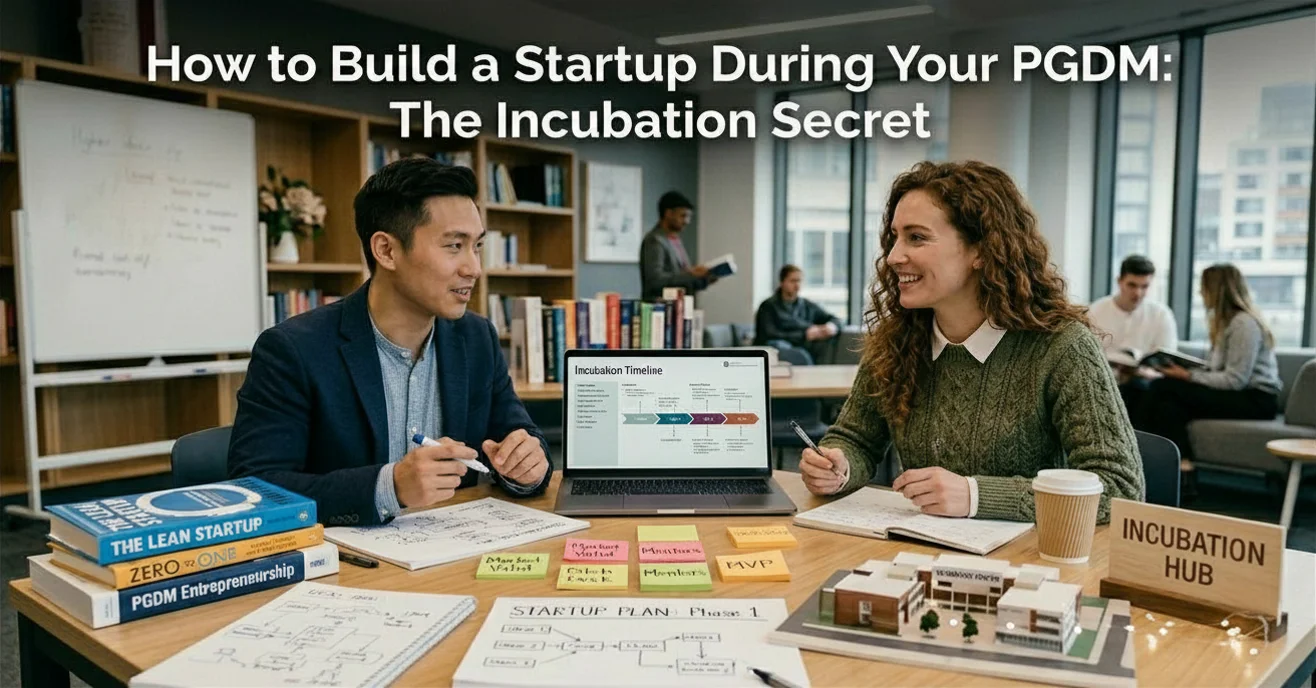
Today, a modern PGDM for entrepreneurs is no longer limited to classroom learning. Instead, it provides exposure to innovation, startup strategy, mentorship, networking, and business incubation. Consequently, students can transform ideas into real ventures while still pursuing their management education.
This guide explains how students can build a startup during their PGDM and why incubation support plays a critical role in entrepreneurial success.
Bonus: 8 Cities in India with the Best PGDM Placement Hubs
Why PGDM is Becoming Popular Among Entrepreneurs
A modern post graduate diploma in management (PGDM) focuses heavily on practical learning and industry exposure. Unlike traditional theoretical education, a contemporary PGDM program helps students understand real business challenges and market dynamics.
Entrepreneurs require skills such as:
- Leadership
- Financial planning
- Marketing strategy
- Team management
- Problem-solving
- Business communication
A well-designed PGDM course helps students develop these capabilities through projects, internships, presentations, and live industry interactions.
Additionally, students gain access to peer networks, mentors, faculty guidance, and startup ecosystems that encourage entrepreneurial thinking.
What is a Startup Incubation Ecosystem?
A startup incubation ecosystem supports students who want to transform business ideas into scalable ventures.
Incubation centers typically provide:
- Business mentorship
- Startup guidance
- Networking opportunities
- Investor interaction
- Product validation support
- Innovation workshops
These ecosystems help students avoid common startup mistakes during the early stages of business development.
Moreover, incubation support creates an environment where students can experiment, learn, and refine ideas while pursuing management education.
How Students Can Build a Startup During PGDM
Building a startup during a PGDM requires planning, execution, and consistency. However, students can significantly improve their chances of success by following a structured approach.
Identify a Real Market Problem
Successful startups solve real customer problems.
Therefore, students should:
- Observe industry challenges
- Conduct market research
- Validate customer pain points
- Analyze competitor gaps
Many innovative ideas emerge from classroom discussions, internships, and industry projects.
Students should focus on building solutions that address practical market needs rather than only theoretical ideas.
Apply Classroom Learning Practically
One major advantage of a PGDM program is exposure to multiple business disciplines.
Students can apply classroom concepts directly to startup building.
For example:
Consequently, students gain a strong operational understanding of how businesses function.
Additionally, interdisciplinary learning supports better strategic thinking for entrepreneurs.
Build a Strong Professional Network
Networking is extremely important for startup success.
Students should actively connect with:
- Faculty mentors
- Alumni entrepreneurs
- Industry professionals
- Startup founders
- Investors
- Innovation communities
These relationships often provide:
- Business insights
- Strategic advice
- Collaboration opportunities
- Funding guidance
Moreover, networking improves confidence and industry exposure.
Participate in Business Competitions
Business competitions provide practical entrepreneurial experience.
Students can:
- Present startup ideas
- Test business models
- Improve pitching skills
- Receive expert feedback
Additionally, startup competitions expose students to real investor expectations and market realities.
Many early-stage businesses also receive incubation support through entrepreneurship contests.
Role of Incubation Centers in Startup Growth
Incubation centers play a major role in helping students develop scalable businesses.
They support entrepreneurs through:
- Mentorship programs
- Business planning guidance
- Market validation
- Networking opportunities
- Funding access
- Product development support
Students pursuing a PGDM in Delhi or PGDM courses in Delhi NCR often benefit from stronger corporate and startup ecosystems because of the region’s active entrepreneurial environment.
Institutes like Asia Pacific Institute of Management encourage practical learning, innovation-driven thinking, and industry interaction that can support entrepreneurial development.
Skills Entrepreneurs Develop During PGDM
Entrepreneurship requires a combination of technical, managerial, and communication skills.
A strong PGDM course in Delhi helps students build competencies such as:
Leadership Skills
Entrepreneurs must lead teams, make decisions, and handle uncertainty effectively.
Financial Management
Students learn:
- Budgeting
- Cost analysis
- Revenue planning
- Risk assessment
Finance-focused learning becomes particularly useful for startup sustainability.
Marketing and Branding
A strong marketing program helps entrepreneurs:
- Understand consumer behavior
- Build brand positioning
- Develop growth strategies
- Improve customer engagement
Additionally, digital marketing knowledge is becoming increasingly important for startup visibility.
Analytical Decision-Making
Modern businesses rely heavily on analytics.
Therefore, many students now explore:
- Big data analytics
- Business intelligence
- Customer analytics
- Data visualization
Knowledge of big data analytics can significantly improve strategic business decisions.
Communication and Negotiation
Entrepreneurs regularly interact with:
- Investors
- Customers
- Partners
- Teams
Strong communication skills improve business relationships and investor confidence.
Best Specializations for Aspiring Entrepreneurs
Choosing the right specialization can strengthen startup capabilities.
PGDM in Marketing
This specialization supports:
- Branding
- Customer acquisition
- Sales strategy
- Market expansion
It is particularly useful for consumer-focused startups.
PGDM in Data Analytics
Analytics-driven businesses continue growing rapidly.
Students gain expertise in:
- Data interpretation
- Predictive analysis
- Performance tracking
- Strategic insights
As a result, startups can make better business decisions using data.
PGDM in Banking and Finance
Finance specialization supports:
- Investment planning
- Startup budgeting
- Financial forecasting
- Risk management
This knowledge becomes essential while managing business growth.
PGDM in Digital Marketing
Digital platforms are central to modern startups.
Students learn:
- Online branding
- Social media strategy
- Performance marketing
- Customer engagement
Consequently, startups can scale more efficiently in competitive markets.
Bonus: Dual Specialization in PGDM: Double Your Job Opportunities
Why Delhi NCR is Ideal for Entrepreneurial PGDM Students
Delhi NCR has become one of India’s major startup and business hubs.
Students pursuing a PGDM institute in Delhi benefit from:
- Corporate exposure
- Networking opportunities
- Startup communities
- Industry events
- Investor access
- Internship opportunities
Additionally, the region offers strong opportunities across:
- Marketing
- Analytics
- Finance
- Healthcare management
- Technology-driven businesses
Therefore, many students prefer PGDM colleges in Delhi NCR for entrepreneurial learning and professional growth.
Bonus: Government vs Private PGDM Colleges: Which Offers Better ROI in India?
Common Mistakes Students Make While Starting a Business
Many startups struggle because students overlook important fundamentals.
Common mistakes include:
- Launching without market validation
- Ignoring customer feedback
- Weak financial planning
- Poor team selection
- Scaling too quickly
- Lack of mentorship
Therefore, students should focus on gradual and structured business development.
How to Balance PGDM Studies and Startup Building
Managing academics and entrepreneurship simultaneously can be challenging. However, proper planning makes it achievable.
Students should:
- Create realistic schedules
- Prioritize important tasks
- Build collaborative teams
- Use academic projects for startup research
- Maintain consistency
Additionally, leveraging classroom assignments for startup development can improve productivity and learning efficiency.
Conclusion
Building a startup during management education is becoming increasingly common among ambitious students. However, entrepreneurial success requires more than just innovative ideas. Students also need business understanding, strategic thinking, mentorship, and industry exposure.
A modern PGDM for entrepreneurs provides the practical learning environment necessary for startup development. Additionally, incubation support, networking opportunities, and specialization-based learning help students transform ideas into scalable ventures.Institutes like Asia Pacific Institute of Management encourage practical business education, industry interaction, and entrepreneurial thinking to support future business leaders and innovators.
Launch Your Startup Journey
Develop entrepreneurial skills through industry-oriented PGDM learning, incubation support, mentorship, and practical business exposure.
Apply Now
→
About the Author
Dr. Vikas Gupta
Dr. Vikas Gupta is a distinguished academic in the education and research domain, specializing in finance and related interdisciplinary studies. He is known for his...
Read Full Bio →














.webp) Call Us
Call Us